



Abstract

A worm in the works
Bugbear. B,” a computer worm, attacked many of the nonclassified computers at Los Alamos National Laboratory (LANL) on June 5. The worm activated each e-mail application's “Send” command, distributing thousands of copies of old messages to random outsiders.
Many of the e-mails–like a supervisor's letter of recommendation for a former employee–appeared to contain confidential, if not highly sensitive, information. One technical message detailed an ongoing problem of toxic beryllium leaking from a workshop into an uncontrolled hallway. Other messages discussed potentially sensitive issues at the Dual-Axis Radiographic Hydrodynamic Test facility (where images are made of imploding nuclear weapons cores), the Los Alamos Neutron Science Center (where high-energy beams are fired on nuclear weapons components), the Accelerated Strategic Computing Initiative Center (where nuclear weapons detonations are simulated), and the Y-12 facility (a research and manufacturing plant for nuclear weapons in Tennessee).
These communications, which landed in our personal e-mail “in boxes,” illustrate the lab employees' tendency, except when discussing specific classified information, to avoid using their more restrictive, but secure, e-mail system that runs on computers physically isolated from the Internet. This is probably normal behavior for hard-working people focused on completing complex technical assignments, but even non-classified internal messages can be revealing.
A few days after the worm attack, reporters from USA Today and the Associated Press began asking the lab's public-relations department how this could be happening. The spin doctors told them that it was true a computer attack had occurred on June 5, but that “no sensitive information was compromised,” and that “the leak was sealed within 90 minutes” of its discovery. They also denied any problems with beryllium leaks.

Nonetheless, during the next three weeks, LANL computers sent out three more swarms of worm-captured e-mails.
Bugbear. B is an improved variant of the original Bugbear worm that first appeared in the wild on September 30, 2002, and shortly thereafter took down the police department in Albuquerque, New Mexico. Bugbear. B itself first showed up in Malaysia on June 4, 2003, and rapidly infected computers in India, Poland, Italy, Finland, Britain, the United States, and elsewhere.
By the following day, many tens of thousands of copies of the worm had been detected, and almost one of every 200 e-mails was infected. Computer security firms ranked it as a fast-spreading, high-risk threat. Brad Meehan, director of product management at eThreat Management Solutions, said, “We can stop looking for worms of mass disruption–Bugbear. B is it.”
A versatile invader, Bugbear. B develops and sends its own e-mails and changes appearance to evade detection. In addition to disabling dozens of antivirus programs and personal firewalls, it scarfs up the text of old messages that it finds in an infected computer and re-sends them to other email addresses that it finds in the victim's in box. It also employs a key logger to store all the keystrokes that the unsuspecting victim types on his infected machine–passwords and all. Then, either when it acquires 25,000 bytes of data, or once every two hours, it secretly sends the information to several hard-coded encrypted e-mail addresses of its own.
To add insult to injury, it also has a “Trojan Horse” application that opens a listening port (or back door) allowing the attacker to access the infected computer (or an entire network) directly through a Web-based interface.
With surreal incongruity, on July 8 Linton Brooks, head of the National Nuclear Security Administration, announced an initiative aimed at strengthening the nuclear weapons complex's safeguards and long-term security operations. He ordered his security experts to focus on the changes they thought were most important–increasing the frequency of visual surveillance, improving physical security barriers and controls, and reviewing the staffing and training of security forces.
Might Brooks believe the stories his PR people have been telling? Or perhaps he just assumes that the labs' computer systems are safe and secure. Meanwhile, we–along with other recipients of randomly redirected e-mail–have learned that LANL's system lacks effective firewalls and virus scanners.
James M. Maroncelli and Timothy L. Karpin are industrial historians and the authors of The Traveler's Guide to Nuclear Weapons: A Journey Through America's Cold War Battlefields (2002).
In Brief
As the Scottish Daily Record pointed out on July 3, Britain's Food Standards Agency was already busy analyzing rabbit meat from around the Dounreay nuclear plant in northern Scotland, a result of someone having discovered that the local bunnies were at least mildly radioactive. But what concerned the Daily Record even more on that day was the belief that cats who rove the Dounreay area are likely to eat the atomic bunnies–becoming themselves radioactive in the process. A Dounreay spokesman, of course, said there was no evidence that rabbits were spreading radioactivity from Dounreay's low-level waste storage. But he admitted that the facility had “arranged for a cull of rabbits on the site.”
The School of the Americas Watch is an organization devoted to protesting the military training for Latin American officers offered by the U.S. government at the Western Hemisphere Institute for Security Cooperation (formerly the School of the Americas) at Fort Benning, Georgia. Protesters often engage in nonviolent trespass, are arrested, and are sentenced to fines and jail terms. According to the organization, one convicted protester, William Combs, who was serving a three-month sentence, was placed in solitary confinement for eight days. The Bureau of Prisons' official reason for throwing Combs in solitary was that he was being investigated by the FBI, but one official said informally that Combs was actually being punished for sharing his copy of Reader's Digest–or for “receiving and distributing political literature,” as the official explained.
A New Zealand Web developer has a somewhat unusual hobby: He's building a cruise missile in his garage (Associated Press, June 3). Bruce Simpson says he has had no difficulty purchasing the necessary high-tech parts over the Internet, and that when completed, his 22-pound missile will be able to fly 60 miles in 15 minutes. Progress on the missile, which is expected to cost Simpson $2,850 to complete, can be viewed at aardvark.co.nz/pjet, where he also solicits contributions for his “X-jet pulse engine.”

The Department of Health & Human Services (HHS) proudly announced at a public meeting in early June that it had studied uranium emissions at the Y-12 plant at the Oak Ridge nuclear facility in Tennessee and found they posed no threat to the health of those living in surrounding communities (KnoxNews.com, June 3). What HHS didn't share with the local community was the Environmental Protection Agency's (EPA) assessment of its study. In an April 24 letter evaluating the study, Lowell Ralston, a radiobiologist for the EPA's Agency for Toxic Substances and Disease Registry, pointed out that HHS had “miscalculated the total radiation dose for all pathways by nearly a factor of 10,” used overly conservative assumptions and values, did not sample undisturbed soil in nearby areas, and chose not to examine any areas that were actually downwind from the plant. Ralston concluded his remarks by pointing out that HHS also used health evaluation criteria that “exceed the limits of national and international radiation protection advisory organizations, the U.S. Nuclear Regulatory Commission, and the EPA.”
Oakland police may or may not have felt justified firing so-called nonlethal projectiles (beanbags, wooden dowels, and “sting balls” that spray BB-sized rubber pellets) at a crowd of some 500 anti-war protesters at the Port of Oakland (Associated Press, April 7). But the police managed to hit as many working longshoremen as protesters. After the incident, Trent Willis, business agent for the International Longshore and Warehouse Union, explained why dock workers left the area and refused to return to work that day. “They shot my guys,” he said. “The cops had no reason to open up on them.”
Nuclear power plants need cooling systems, and unexpected events can cause unusual problems. For instance, one hot, dry summer several years ago, several nuclear plants in France had to be shut down because the levels of the rivers into which they discharged still-heated water had dropped too low to safely add more heat. This year, both units of the Cook Nuclear Plant in Michigan had to be shut down when a massive school of migrating alewives, 3- to 6-inch fish, suddenly clogged the cooling system's water intake. It took about two hours to clear the intake screens of the fish, which, said the plant's environmental manager John Carlson, were seeking shallow, warmer water in which to spawn (American Electric Power; aep.com, April 25).
Nuclear-powered cars?
President George W. Bush got a lot of credit when he announced a long-term plan to convert the U.S. auto industry from producing gas-guzzling, environmentally damaging cars to manufacturing clean-burning, environmentally friendly cars that use hydrogen fuel cells.
But that was before anyone knew much about plans for how the hydrogen would be produced. Although most hydrogen is produced today using fossil fuel, one of the biggest supporters of hydrogen-powered cars turns out to be the nuclear industry, which believes that new power reactors are just the thing to produce the massive amounts of hydrogen that will be required to fuel the U.S. auto fleet. In fact, Paul Grant, a science fellow at the Electric Power Research Institute (EPRI), a global energy consulting firm based in Palo Alto, California, says nuclear energy is the only thing that makes sense.
The United States would need about 230,000 metric tons of hydrogen gas daily if all U.S. autos converted from gasoline. Extracting that much hydrogen requires about 400 gigawatts of continuously available electricity, Grant says in a commentary in the July 10 issue of Nature. He estimates that much power would require the construction of hundreds of natural gas- or coal-fired power plants at a total cost of at least $400 billion. The carbon emissions from all those extra plants would offset any benefit gained from eliminating 9 million barrels of petroleum per day. Other potential solutions for hydrogen generation, such as solar- or wind-powered facilities, simply take up too much room to be practical, he adds.

The hydrogen-car effort comes at a perfect time for Washington's nuclear backers, providing fuel for the brewing nuclear resurgence. This year, New Mexico Republican Sen. Pete Domenici has inserted an extra $1 billion in the Senate version of the Energy bill for a demonstration project–the building of a new “advanced” nuclear reactor in Idaho (no new reactor has been ordered in the United States since 1973), rationalized as the best source for producing hydrogen batteries. The House has also approved a plan for “research into high-temperature reactor designs for large-scale hydrogen production.”
John Kane, a senior vice president of the Nuclear Energy Institute, an industry group, is excited about everything the nuclear industry is getting in the Energy Department's new bill–continued government guarantees of limited liability, as well as generous loan guarantees for new plants–arguing that nuclear power will triumph because “we're safe, we're cheap, we're clean.”
EPRI's Grant even pinpoints the perfect plant to emulate for the nuclear hydrogen effort: Tokyo Electric Power Co.'s (Tepco) Kashiwazaki nuclear facility, which took 20 years to build and generates 8 gigawatts of power, available 90 percent of the time.
Others are less than pleased with the notion. Keith Ashdown of Taxpayers for Common Sense points out that nuclear power is still much more expensive than coal- or gas-fired power. The seven reactors at Kashiwazaki cost more than $21 billion, according to Tepco records. Using that number, meeting the 230,000-metric-ton estimate of daily U.S. hydrogen needs would require more than 50 such plants, at a cost of more than $1 trillion.
Oregon Sen. Ron Wyden, a Democrat, believes that the loan guarantees proposed to the nuclear industry in the new Energy bill could risk as much as $30 billion of public money. He reminded his colleagues that when the Washington Public Power Supply System pulled the plug on its ambitious, over-budget nuclear program in 1983, it mothballed several unfinished nuclear plants and defaulted on $2.25 billion in bonds–at the time, the worst bond default in history, but positively Yugo-sized compared to the potential fallout from a subsidized nuclear renaissance built around hydrogen-powered cars.
Paul Rogers is a Chicago-based freelance writer.
High-tech tailoring
They Won't exactly be leaping tall buildings in a single bound, but U.S. soldiers may someday be able to beat the world pole vault record–without using a pole. Researchers at the new Institute for Soldier Nanotechnologies (ISN) at the Massachusetts Institute of Technology (MIT) are using materials engineered with nanotechnology to create a new battle uniform that they hope will give U.S. troops superhuman capabilities: the ability to hurdle 20-foot-tall obstacles, deflect bullets, change colors like a chameleon, and a host of other fantastic feats.
Nanotechnology involves manipulating matter on a microscopic scale to design and produce new materials and devices. At the ISN ribbon-cutting in May, researchers showed how certain “hinge” molecules change properties–opening and closing like a door hinge–when exposed to electricity. Scientists believe they can create a material with the molecules that could be woven into a uniform and function as “exo-muscle,” stiffening to provide a splint for broken arms or legs, tightening to form a tourniquet, or providing extra strength for lifting or jumping.
Other demonstrations at the ISN opening showed how a fluid containing certain nanoparticles could be used to engineer dynamic armor that automatically hardens when a ballistic threat is detected.
“When a bullet is fired there is a flash of light that travels a lot faster than the bullet or its sound. It won't be so good if the shooter is next to you, but [at a distance] it could make for great protection,” Edwin Thomas, director of the ISN, told a British trade publication, The Engineer, in June. “It might sound impossible, but the concept of airbags must have also seemed like that when it was first set out for passenger protection.”
The smartly dressed soldier of the future?

The U.S. Army Soldier Systems Center in Natick, Massachusetts, hopes to build the suit (Associated Press, June 1). Their mock-up outfit–called the “Scorpion Ensemble”–looks suspiciously like the gear Darth Vader's Imperial Stormtroopers wore in Star Wars, from the eerie helmet to the white body armor and blaster rifle.
The army wants uniforms stuffed with sensors that monitor vital signs, transmit them to remote medics, and automatically administer treatment–medication, tourniquets, and splints–in times of physical distress. Soldiers will also have chemical and biological protection built right into the new uniforms, courtesy of nanoscale materials that close pores between fibers when an attack is detected.
Cameras and sensors on the uniform would be able to detect the enemy and display maps, global positioning data, and images taken by unmanned aerial vehicles on a semitransparent screen in the helmet. Everyone on the battlefield could then be linked to central command via nanoscale communication materials woven directly into the fabric.
“We already have the smartest soldiers. Now we're going to give them the smartest uniforms,” Claude Bolton, assistant secretary of the army for acquisition, logistics, and technology, told the Army News Service.
MIT has a five-year, $50 million army contract to spearhead the research, which is also being backed by industrial partners, including Raytheon, DuPont, and Dow Corning. The research, Thomas said, not only needs the financial backing and concept-to-reality thinking of commercial companies, but also has the potential for endless civilian safety applications, from home health-monitoring systems and emergency protective gear to Armani suits for conducting business in less stable nations.
The primary short-term goal of the project is to waterproof military battle uniforms and cut in half a soldier's pack weight (now more than 100 pounds).
The Associated Press reports the first battalion could receive the preliminary Scorpion Ensemble by late 2010. The superhero features of the suit are expected 15-20 years down the road.
Goodness gracious, great balls of power
Novel energy sources include solar power, wind power, even wave power. But all those non-fossil fuels–and gas and nuclear, too–may no longer be of much interest to the Japanese, if they can only figure out a way to take advantage of the vast deposits of methane hydrate that can be found on the seabeds off the Japanese coast.
A solid hydrate cap, or “pingo,” about the size of a Volkswagen Beetle.
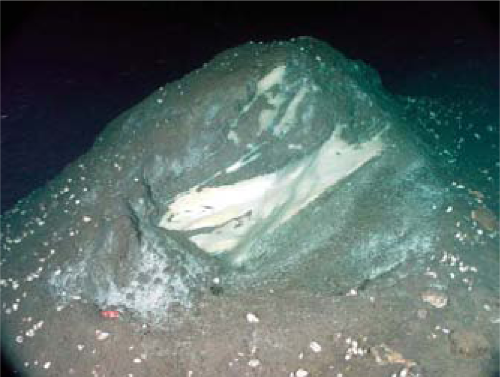
According to a July 3 report by Hans Greimel of the Associated Press, the ocean near Japan has so much methane hydrate–between 140 and 700 trillion cubic feet of cold, white, frozen gas–that if it could be harvested, it could power the entire world for centuries.
Of course there's a little technical problem to solve–as the frozen stuff is brought nearer the surface, it begins to melt and bubble up, eventually dissolving into the ocean. So the trick will be to figure out a way to harvest the energy under water.
Next January a Japanese research effort will begin in earnest, with the government sending a drilling ship to dig 10 to 20 wells more than half a mile below water along the Nankai Trough. That will inaugurate a 10-year study of the commercial viability of methane hydrate exploitation. A lot is at stake: The worldwide supply of methane hydrate is estimated at 875,000 trillion cubic feet.