




Abstract

A mid suspicions that it was developing secret nuclear weapons facilities, Iran revealed earlier this year that its nuclear capabilities were more advanced than thought–that it was nearly ready to start up a gas centrifuge uranium enrichment pilot plant at Natanz, near Kashan in central Iran. Iran also confirmed that it was building a much larger centrifuge facility at the same site, but insisted that both plants were for peaceful purposes only.
Iran lives in a dangerous neighborhood. And with U.S. troops in Iraq and possibly taking up positions along the Iran-Iraq border, Tehran may feel even more threatened than usual, and thus may be more motivated to seek a nuclear weapons capability.
Iran says, however, that it is a member in good standing of the Nuclear Non-Proliferation Treaty (NPT), and that the facilities at Natanz will be used to produce reactor fuel. The U.S. government disagrees, adding that Iran may have a secret nuclear weapons program that includes other secret uranium enrichment facilities. The United States also accuses Iran of intending eventually to withdraw from the NPT, which would permit it to build nuclear weapons without violating treaty obligations–the step North Korea took last year.
After some delays, Mohamad El Baradei, the head of the International Atomic Energy Agency (IAEA), visited Iran in late February. That visit confirmed that Iran has joined an exclusive club of some 10 nations that can build gas centrifuges. Its centrifuge technology is considerably further along than Iraq's was at the time of the 1991 Persian Gulf war.
During his visit to Iran, El Baradei met with both hardliners and reformers, including President Mohammad Khatami, Majlis Speaker Mehdi Karroubi, and Chairman of the Expediency Council Akbar Hashemi Rafsanjani. All of these officials expressed their commitment to developing the entire range of nuclear fuel-cycle facilities. They stressed that Iran's nuclear program was for civil purposes only, and they insisted that Iran had the right under the NPT to develop them. The IAEA, they said, had an obligation to help Iran obtain civil nuclear assistance. The officials also expressed the hope that being “transparent” about the enrichment facility would result in concrete rewards.
Due to a generic loophole in the original IAEA safeguards agreement, Iran did not have to declare that it was building a pilot plant until 180 days before it expected to introduce nuclear material into the plant. It was this loophole that allowed Iran to legally construct the plant in secret. In the early 1990s, the IAEA had asked NPT members to close the loophole–to accept a new requirement to provide the agency with design information when construction was first authorized. Iran is the last country to accept this new requirement, and its commitment to do so was the most concrete accomplishment of El Baradei's visit. The IAEA should receive design information on the Natanz facilities in early spring.
Only partially transparent
Although Iran's revelations and offers to the IAEA are significant, its transparency remains partial. Tehran told the IAEA it is still unwilling to sign and ratify the advanced safeguards protocol, or “additional protocol,” an international agreement negotiated by IAEA member states in the mid-1990s granting the agency more authority to search for undeclared nuclear activities. Iranian officials will only sign under certain conditions, including an arrangement for Western nuclear assistance.
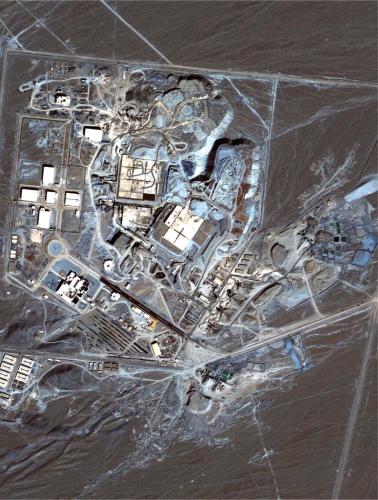
The Iranian gas centrifuge uranium enrichment plant at Natanz in February 2003, first seen publicly in satellite imagery in December 2002. The group of five white buildings (left) comprise the pilot plant. The large rectangular construction sites (center) are where underground buildings will house thousands of centrifuges. Late last year, the Institute for Science and International Security discovered a September 2002 image by using crude geographical information provided by an Iranian opposition group.
Without the advanced protocol in effect, the IAEA does not have adequate inspection tools to find undeclared nuclear activities or to establish with any confidence that they do not exist. These tools are critical to determining whether Iran has secret parallel uranium enrichment facilities, as has been charged.
The Iranian gas centrifuge uranium enrichment plant at Natanz in February 2003, first seen publicly in satellite imagery in December 2002. The group of five white buildings (left) comprise the pilot plant. The large rectangular construction sites (center) are where underground buildings will house thousands of centrifuges. Late last year, the Institute for Science and International Security discovered a September 2002 image by using crude geographical information provided by an Iranian opposition group.
Iran increased IAEA officials' suspicions by claiming that it had never enriched any uranium. This claim is difficult to believe; it is standard practice to test how well a single centrifuge will work using small quantities of uranium hexafluoride. Only after conducting such tests and developing an optimized centrifuge design would a country build a pilot plant, which involves cascades of hundreds of centrifuges connected by pipes.
A facility near Tehran known by its front name of Kala Electric is suspected of enriching uranium. This site is reported to be the headquarters of the centrifuge program and the location of many of the program's research and development activities, which include running single centrifuges and possibly small cascades.
If Iran sticks to its claim that it has not enriched any uranium, it will have a hard time convincing the IAEA it is telling the truth. On the other hand, if it admits it has enriched uranium, even in small quantities, it will also be admitting it violated the NPT, reflecting badly on its claim to be demonstrating transparency. This is a serious issue, and IAEA officials have asked Iran to provide a written answer to their questions. As of mid-March, the agency had not received a reply.
Adding to concerns is the fact that China has provided Iran with uranium hexafluoride. Although the known Chinese-supplied uranium hexafluoride is under safeguards, it is possible that Iran may have obtained additional amounts outside of safeguards.
To help address these issues, the IAEA also asked Iran to provide detailed written information about its nuclear program–past, current, and future. The agency also wants more access to a range of research, development, and production sites, and permission to take environmental samples at various sites.
Reactions
The Iranian revelations caught the Bush administration off guard. Through its transparency to the IAEA, Iran is sending the signal that it is close to being able to make nuclear weapons while denying it has any such intention.
The United States is only now starting to deal with this emerging crisis. But it is finding it difficult to mount an effective campaign to pressure Iran to accept more transparency and to stop it from making progress on its sensitive fuel-cycle facilities.
Under the NPT, Iran can legally build any nuclear facility, including an enrichment plant, as long as the facility is committed to peaceful uses and subject to IAEA safeguards. However, the NPT also allows states to withdraw from the treaty with 90 days notice if their security is fundamentally threatened. Thus, a fully inspected Iran with a uranium enrichment plant is tantamount to Iran having the ability to break out of the treaty at any time and rapidly produce weapon-grade material.
The Russian government, the supplier of the Bushehr power reactor–caught unaware and embarrassed by Iran's revelation of the secret plant–must now decide whether it wants to fulfill, let alone increase, its nuclear contracts with Iran. Those contracts have been important to Russia, helping to prop up its sagging nuclear industry. The roughly $1 billion Bushehr reactor is nearly completed, and Russia is scheduled to ship low-enriched uranium fuel to it soon. In a March 18 article in The Guardian, Russia's minister of atomic energy said that Iran had not told its Russian partners about its other nuclear projects, including the gas centrifuge facility at Natanz. Compounding their embarrassment, Russian officials had long defended their nuclear dealings with Iran by insisting that Iran would never be able to build gas centrifuges–that the required expertise was simply outside Iran's reach. Russia could face further embarrassment if it turns out that its enterprises have provided significant assistance to sensitive Iranian fuel-cycle facilities.
Then there's Pakistan. Despite persistent media reports and statements by U.S. officials about significant and perhaps multi-year Pakistani nuclear assistance to Iran, Pakistan denies that it or any of its nuclear scientists were Iran's source of centrifuge design or equipment. However, such assistance is widely believed to have been provided in the early 1990s, a time when Iran is believed to have accelerated its centrifuge program (see David Albright's “An Iranian Bomb,” July/August 1995 Bulletin). Pakistan's assistance may have been crucial to Iran's early efforts, although the centrifuges Iran is now building appear to be several generations beyond the first-generation machine whose design could have been provided by a Pakistani. According to one official, the origin of the centrifuges in the pilot plant could not be determined from a cursory visual inspection. However, he added, they did not appear to be of Russian centrifuge design.
An ambitious program
In a February 9 television appearance, two weeks before the El Baradei visit, President Khatami revealed that Iran was operating or constructing a number of facilities to produce fuel for nuclear reactors. While acknowledging the existence of the enrichment plant at Natanz, he also said that Iran was operating or building uranium mines, uranium concentration and conversion facilities, and fuel fabrication plants. He also said that Iran wants the capability to reuse fuel from power reactors, implying that Iran wants to be able to separate plutonium.
The next day, the head of the Iranian Atomic Energy Organization, Gholamreza Aghazadeh, said that the uranium conversion facility that is slated to open soon at Isfahan will transform yellowcake into uranium oxide, uranium hexafluoride, and uranium metal. He added that natural uranium oxide could be used directly as fuel in reactors that do not require enriched uranium. This statement may explain the purpose of another secret site, the Arak heavy-water plant. The Bushehr reactor, which uses normal or “light” water, does not need heavy water, but Iran may originally have planned to operate a heavy-water reactor that uses natural uranium fuel. Heavy-water reactors raise additional concern because they are easier to use to make weapon-grade plutonium than light-water reactors.
Aghazadeh did not explain why Iran would want to produce uranium metal. His statement raises suspicions because uranium metal has few civil uses, but is a key ingredient in nuclear weapons and a widely accepted indicator of a nuclear weapon program.
He also told the media that he started the uranium enrichment and heavy-water plants at the same time. When he ordered their construction, he did not know which would succeed, but in the end both projects have succeeded, he said. He implied that he did not need the heavy water for a reactor, but intended to finish the plant in any case. If Iran has no domestic use for heavy water, he added, Iran could sell it overseas.
The main concern
The most sensitive aspect of the Iranian nuclear program is its uranium enrichment program, which El Baradei characterized as sophisticated. The Natanz site houses a centrifuge pilot plant that reportedly has 160 operating centrifuges ready for the introduction of uranium hexafluoride gas.
The buildings at Natanz also house centrifuge testing and assembly facilities. A network of companies located elsewhere makes centrifuge components and sends them to Natanz for final testing and assembly. El Baradei and his team also saw enough components at Natanz for another 1,000 machines.
Nearby are huge underground buildings, built to a depth of 75 feet and able to withstand aerial attack. When finished, they will hold tens of thousands of centrifuges. When completed (many years from now) these two underground buildings will have a capacity to produce about an estimated 100,000-150,000 separative work units (SWU) per year. This capacity is just barely consistent with a program to produce low-enriched uranium for fuel for nuclear power reactors like Bushehr. At this capacity, Natanz could provide about enough low-enriched uranium for one 1,000 megawatt-electric reactor.
Nonetheless, such a facility could also use a relatively small fraction of its capacity, say 10,000 SWU per year, to make enough highly enriched uranium for three nuclear weapons a year. This capacity could be installed at Natanz within a few years. In addition, if a country can make an enrichment plant of this size, it could make enough machines to outfit another secret enrichment plant with a capacity of 10,000 SWU per year involving several thousand machines. The IAEA would have a tough time detecting such clandestine activities without far more extensive inspection rights than Iran has been willing to provide so far.
Iran argues it wants the Natanz facility to establish self-sufficiency in producing nuclear fuel for power reactors, expressing fears of a cutoff of low-enriched uranium by Russia, its only supplier. As a result, Iran is proceeding with Natanz, although it must recognize that overseas purchase of low-enriched uranium for fuel is more cost effective than domestic production. Indigenous production is made even costlier by the perceived need to produce enriched uranium in heavily fortified underground facilities, which are significantly more expensive to build and operate than aboveground facilities.
What's next?
Despite its goal of self-sufficiency in fuel manufacture, Iran has often expressed its desire for foreign nuclear assistance. In his February television speech, Khatami also stressed that Iran needs science and technology assistance, particularly in “high tech.” But it is unlikely to receive such assistance while questions about its nuclear intentions remain.
Inspections are not going to remove suspicions that Iran will one day renounce the NPT and produce highly enriched uranium or separated plutonium for nuclear weapons in Natanz or other sensitive fuel cycle facilities. This unfortunate situation is already provoking deep concern and suspicion among Iran's neighbors and in the international community. If Iran truly wants international assistance, it may have to halt construction of any uranium enrichment or plutonium separation plants.
But Iran will not accept far greater transparency, or abandon its sensitive fuel cycle facilities, in response to economic or military threats. The United States, Russia, and other concerned states need to develop a strategy of incentives and disincentives aimed at bringing Iran into the international community while simultaneously reducing the risk that Iran will build nuclear weapons. The current melange of policies being pursued by the United States, Russia, and others seems certain to increase the risk that Iran will emerge in a few years with a nuclear arsenal.