




Abstract
With weapon delivery measured in minutes, an India-Pakistan agreement on missile controls is essential.
India test-launched a nuclear-capable Agni I missile on January 9–yet another in increasingly frequent South Asian missile tests. Last year, India conducted a total of nine missile tests while Pakistan tested five times. These tests are extremely worrisome, given the missiles potential use as delivery vehicles for nuclear weapons.
It is imperative to reduce the danger that ballistic missile development represents on the subcontinent, where missiles need very short flight times. Indias Agni II can cover a range of more than 2,000 kilometers in just 11 minutes, and Pakistans Ghauri II can reach a distance of 1,165 kilometers in 12. The use of even short-range missiles like Indias Prithvis and Pakistans shorter-range Hatfs would make it possible to carry out nuclear attacks on national capitals in less than five minutes. It is highly unlikely that any warning could be given in the event of an accidental or unauthorized launch, and the time available to judge the genuineness of an alarm is also extremely short, increasing the danger of retaliatory action.
Without reliable, redundant early warning systems, both countries are substantially in the dark regarding the others capabilities. They are particularly vulnerable to misinformation from third party sources.
Pakistan, with its small land area, has limited strategic depth compared with much larger India. Moreover, Islamabad believes that its nuclear weapons are essential for deterring Indias much larger, conventional military force. Pakistan may feel compelled to enlarge and disperse its nuclear arsenal so as to increase its nuclear options and make the threat of nuclear retaliation more credible. But that would only increase the danger of accidental, unauthorized, or inadvertent nuclear use.
First steps
Although missile control measures are imperative, the suspicion, mistrust, and animosity between India and Pakistan mean that some of the most important measures would be certain to prove nonstarters. It would be best to concentrate first on measures that can be implemented without requiring any significant change in current Indo-Pakistan security policies. If these measures were implemented, they could lay the foundation for more significant measures at a later stage.
India and Pakistan should pledge that whatever the circumstances, they will use this link in a crisis. Moreover, they should extend the hotline to their air forces and nuclear establishments.
Because of the overlap in the technology and physical characteristics between ballistic missiles and space launch vehicles, the two countries should also notify each other in the case of a space launch, with the same objective–to reduce the risk of nuclear war as a consequence of misinterpretation, miscalculation, or accident.
In the longer term …
The implementation of other measures would require significant changes in the security behavior of India and Pakistan, and those changes may not be possible unless core issues that affect the bilateral relationship are addressed.
India's ballistic missiles
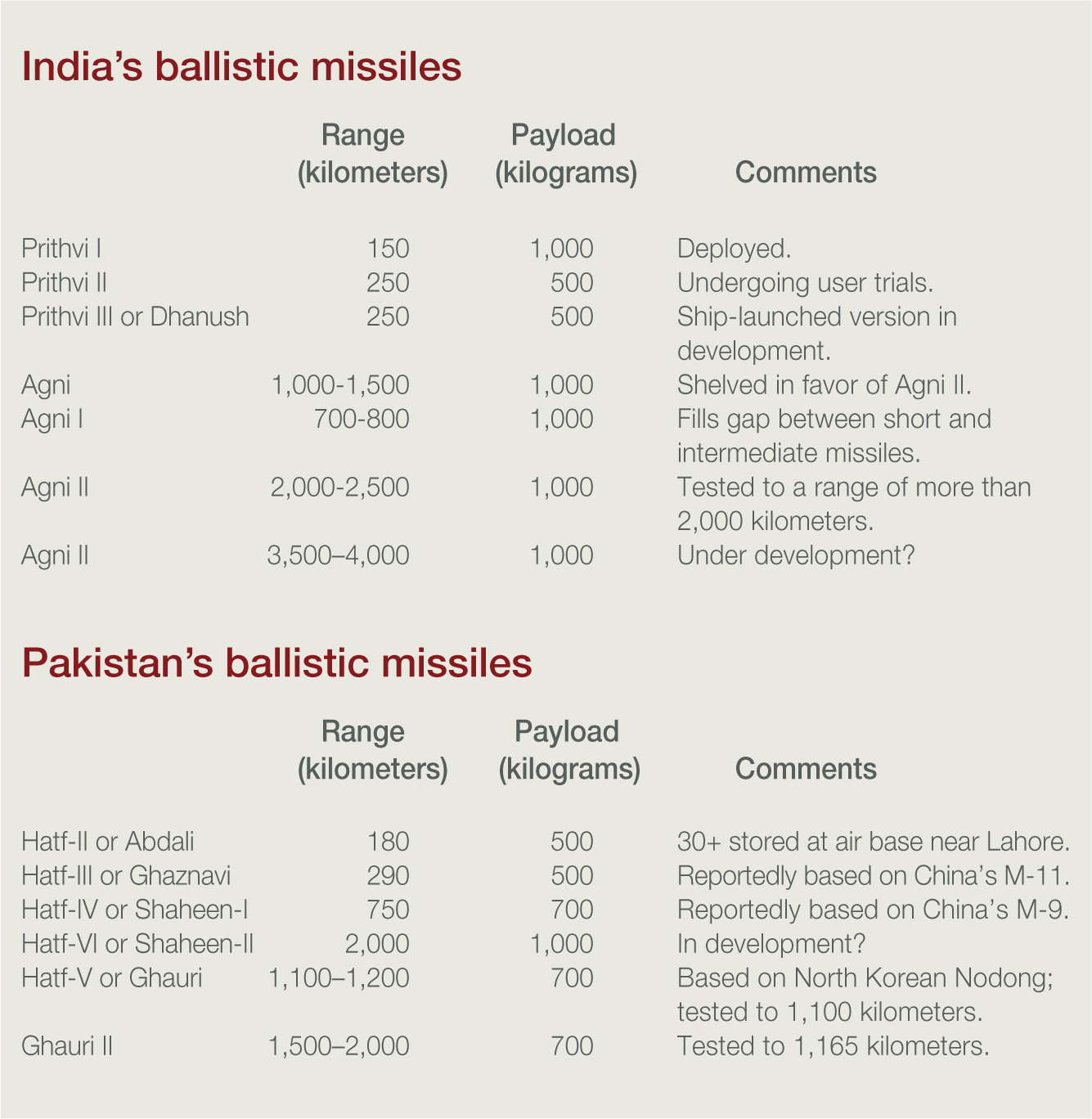
The first measure could be a peacetime ban on deployment of any delivery system with greater than battlefield range. The ban would have to apply to all missiles of a longer range, as it could be difficult to distinguish between conventionally armed and strategic delivery systems.
Second, India and Pakistan could agree to notify each other of their missile-alert status during times of crises.
Third, they could seriously consider the non-weaponization option–storing nuclear weapons physically separated from nuclear-capable ballistic missiles and aircraft, by a distance of at least 50 kilometers. Besides preventing a hair-trigger situation, such a move would also reduce the financial and logistical burden of ensuring the safety and security of assembled nuclear weapons. And it would greatly reduce the risk of accident–as well as lighten the burden on command-and-control systems.
Fourth, India and Pakistan need to formulate modest nuclear doctrines. India needs to reinforce its no-first-use pledge with restraint in development, and Pakistan should minimize its reliance on nuclear deterrence to the greatest extent possible.
Finally, both countries need to accept the reality of nuclear asymmetry in South Asia. Pakistan should accept the fact that Indias nuclear calculation takes into account both Pakistan and China. Similarly, India should accept that Chinas nuclear capability takes into account both U.S. and Russian arsenals. Any expectation of parity is unrealistic.
Three major problems stand in the way of reducing missile dangers in South Asia. They are: the unresolved nature of the Jammu and Kashmir dispute, Pakistans increasing cross-border intrusions, and the status of China.
Over the years, militant opposition to Indian rule of Kashmir has undergone a transformation. Conflict was initiated, and at first waged, by local Kashmiri militants, although Pakistan had always considered Kashmir an unfinished agenda of partition as well.
“I'm tired of money being taken out of my paycheck to help others who are more fortunate.”

Since the late 1980s, when Pakistan acquired a nuclear capability, however, it has pursued a proxy war in Kashmir without fear of Indian retaliation. In the mid-1990s, the struggle was taken over by foreign mercenaries recruited from as many as 14 Islamic nations, believed to be under the guidance of Pakistan. Throughout this period, the Pakistani army was not directly involved in operations against India.
But the Kargil war in 1999 demonstrated that Pakistan was not averse to raising the stakes through direct intervention. Similarly, Pakistan once supported terrorism and arson only in Jammu and Kashmir, but more recently it has supported terror activities in other parts of India, including New Delhi. Indias tolerance was breached when allegedly Pakistan-based terrorist outfits attacked the Indian parliament on December 13, 2001. Deciding it could no longer live with the proxy war, India massed troops on the Indo-Pakistani border.
A final problem is the status of China, which is the key to the success of any substantive missile control regime in South Asia. If Beijing will not participate, even at the margins, it will be difficult for India to participate in any discussion of missile control with Pakistan.
China is Indias largest neighbor and is central to Indian strategic thinking. India suffered a major military defeat in the 1962 border war with China and it fears Chinese intransigence on other territorial claims. China still occupies 38,000 square kilometers of Kashmir, and it claims another 90,000 square kilometers in the Indian state of Arunanchal Pradesh. After the dissolution of the Soviet Union, China quickly resolved its territorial disputes with Russia and the newly independent Central Asian states, but Beijing has shown little or no interest in resolving Sino-Indian territorial disputes, ostensibly to keep India under pressure.
Chinese participation in any South Asian missile control discussion is also required because China has been the principal provider of nuclear and missile technologies to Pakistan. It has actively helped Pakistan by providing Islamabad with a tested design of a nuclear warhead, M-9 and M-11 ballistic missiles and missile components, fissile material, nuclear plants, and ring magnets for enriching uranium. These transfers led the United States to impose sanctions against China twice, in 1991 and 1993. Beijing appears to have been building up Pakistan as a military counterweight to India, as well as using it as a bargaining chip in an attempt to curb U.S. arms transfers to Taiwan. Because Chinese actions directly threaten Indias security, New Delhi will not participate in any credible missile control discussion unless China participates.
What are the prospects for missile control in South Asia? The answer to this question actually depends on the manner in which the areas most pressing problems are addressed. India should shed its unrealistic hope that the problem of Kashmir will disappear if it is ignored. Similarly, Pakistan should realize that India will no longer tolerate cross-border terrorism. The present crisis provides an opportunity for both India and Pakistan to rethink the premises that have governed their relationship for the last 55 years.
Almost any settled resolution of Kashmir would be better for both countries than continuing the security risk and massive cost of the present situation. But no resolution is possible unless both countries reassess their positions, which they have regarded as non-negotiable.
The addition of the China factor in the South Asian security matrix makes it extremely difficult to come up with simple proposals. As an established nuclear weapon state, China is no doubt most reluctant to accept any condition that would constrain its options in any way. China also refuses to acknowledge India as a de facto nuclear weapon state, and still insists that India abandon its nuclear and missile programs and sign the Nuclear Non-Proliferation Treaty and Comprehensive Test Ban Treaty unconditionally and immediately.
It might be worthwhile for other nuclear weapon states to engage China in a discussion to seek its agreement to formalize the practice of storing warheads separately from ground-based missiles. And perhaps China could be persuaded to cease supplying advanced missile and nuclear technology to Pakistan, which would address Indias security concerns to some extent. But it remains to be seen whether other nuclear powers, especially the United States, would be willing to enter into such an undertaking.
The United States could play other important roles as well. It could press Pakistan to dismantle the infrastructure of terrorism that it has used against India, and encourage both India and Pakistan to accept a fair and reasonable solution to the Kashmir dispute.