




Abstract
The United States may have rejected the bioweapons protocol because it is committed to continuing and expanding its secret programs.
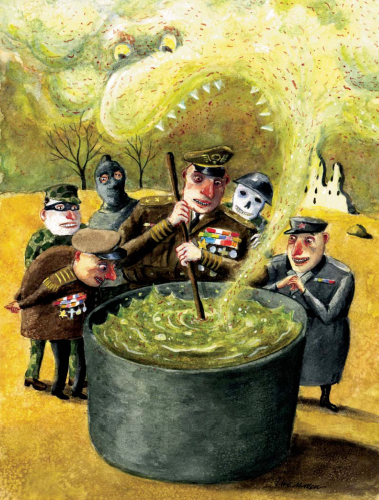
In the summer of 2001, the United States shocked its peers when it rejected the protocol to the bioweapons treaty. Intended to strengthen compliance with the vital but weak Biological Weapons Convention (BWC), the protocol was dead in the water without U.S. support, and the world was left wondering what prompted the surprise move.
Some suggest the rejection was due to changing U.S. perceptions of sovereignty and self-reliance. Others thought that perhaps its own recently revealed covert biological programs were too sensitive for the United States to willingly reveal more. But this explanation falls short because, had it wished, the United States could have both supported the protocol and avoided disclosing its secret operations simply by terminating them before the protocol entered into force.
A more ominous explanation is that perhaps the United States rejected the protocol not just because it is conducting secret, offensively oriented “biodefense” programs, but because it is committed to continuing and expanding them.
The treaty and its protocol
The BWC, signed in 1972 and entered into force in 1975, was the first treaty to ban the possession of an entire class of weapons of mass destruction. It prohibits the development, production, and stockpiling of microorganisms or toxins for other than peaceful purposes, and it categorically prohibits development, production, and stockpiling of devices designed to disseminate such agents for hostile purposes. It is a landmark in weapons control.
But the bioweapons treaty lacks teeth. It has essentially no verification provisions, and there have been notable violations. The Soviet Union (and later Russia) maintained a massive stockpile of biological agents and delivery devices into the 1990s. Iraq's modest stockpile of agents and munitions was discovered by a U.N. inspection team in 1995. And classified intelligence suggests that several other nations either have or are pursuing offensive biowarfare capabilities. Among them are Israel, North Korea, Iran, Syria, Libya, and China.
In 2001, at the Fifth Review Conference, the United States tried to terminate the protocol negotiations completely, throwing the meeting into disorder.
The treaty's failure to prevent proliferation led to the start of negotiations in 1995 for an addendum to the treaty–a protocol that would establish legally binding measures to promote compliance. Major elements included:
Annual declarations that would require participating nations to identify and describe their biodefense facilities and programs, as well as industrial facilities that could be used to produce microbial cultures in quantity.
Random visits to declared facilities. A consultation process would be provided if one country questioned the completeness or accuracy of another's declarations.
A provision for a multilateral team to conduct short-notice investigations into facilities suspected of illegally producing bioweapons agents; allegations of bioweapons use; or disease outbreaks suspected to be the result of an accidental release of microbes from an illegal facility.
By mid-2001 a consensus text was emerging, and on July 23, 2001, the twenty-fourth negotiating session convened. Delegates expected their efforts would soon result in a final text. During the first three days, more than 50 nations spoke in favor of promptly completing the negotiations. Then U.S. Amb. Donald Mahley brought the entire process to an end: “The United States has concluded that the current approach to a protocol to the Biological Weapons Convention … is not, in our view, capable of … strengthening confidence in compliance with the Biological Weapons Convention…. We will therefore be unable to support the current text, even with changes.”
Killer “non-lethals”
On October 26, 2002, Russian special forces pumped a Moscow theater full of knockout gas to incapacitate Chechen rebels who had taken hostage more than 700 audience members. Afterwards, Russian President Vladimir Putin said, “We managed to do the near-impossible: Save the lives of hundreds, hundreds of people.” But as many as 130 hostages died, and it was four days before Russia identified the gas as a fentanyl derivative, a calmative that in large doses can lead to a total shutdown of the respiratory system.
It's not surprising that Russia was tight-lipped over naming the gas; many experts see its use as a violation of the 1993 Chemical Weapons Convention (CWC). But in the court of Bush administration opinion, Russia had little to worry about–Putin's decision to use the gas was not criticized.
The United States is also attracted to all manner of antipersonnel and anti-materiel non-lethal weapons, including acoustics (infrasound and “acoustic impact”), opticals (flashes), directed energy (heat beams), as well as chemical agents for smokescreens, stink bombs, pepper sprays, tear gas, slippery foams–and agents like the gas used in Moscow. Non-lethal weapons, promoted as an alternative to violence and a way to resolve situations casualty-free, are a temptation that's hard to resist.
In early November, the National Research Council of the National Academy of Sciences (NAS) released a long-awaited assessment of non-lethal weapons. The report recommended the adoption of non-lethals in naval warfighting and operations, as well as renewed research and development of the weapons in the other branches of service. The report says that a “calmative agent sponge projectile,” which would use fentanyl to incapacitate people, is being studied at the Edgewood Chemical and Biological Center “after a lull in R&D for 10 years.” That lull was because of the CWC, which banned the development, stockpiling, and possession of chemical weapons. And although stronger than its bioweapons brother, the treaty has weaknesses–namely, allowing the use of chemical weapons like tear gas in law enforcement and riot control, a loophole that some read as permitting the use of other, more dangerous, chemical agents. According to the NAS, though, “perceived treaty constraints” are an obstacle to chemical non-lethal weapons development “in spite of legal interpretations of the treaty indicating that it does not preclude such work or the employment of such agents in specified and increasingly important military situations.”
October 26, 2002: An unconscious hostage is carried from a Moscow theater. More than 700 people were held by Chechen rebels.
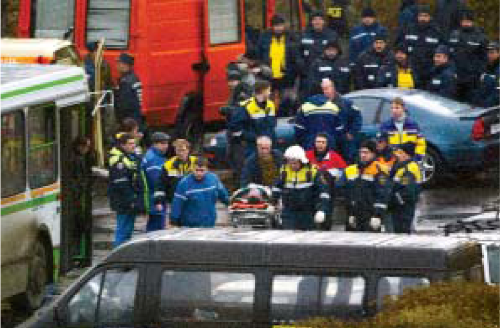
The situation in the Moscow theater tragically illustrates why some decry calmatives and other chemical non-lethals as violating the CWC: The gas makes no distinction between combatants and civilians. It successfully knocked out both hostages and captors, but overdoses killed or hospitalized hundreds of innocent people. (Although the gas could be to blame for some deaths among the hostage-takers, most were shot to death while unconscious.) The incident shows the difficulty of guessing the appropriate dose level for a non-lethal weapon, and how deadly an incorrect guess can be.
What happened in Moscow is a reminder that if it sounds too good to be true, it probably is. But the big picture is more frightening–if NAS is willing to sidestep treaties, arms control could suffer greatly.
Without U.S. participation, few other countries could be expected to sign on. Its surprise announcement cost the United States a great deal of goodwill. This ill-will was compounded later in 2001 when, at the Fifth Review Conference, the United States tried at the last minute to terminate protocol negotiations completely, throwing the meeting into disorder and leaving no option but to suspend the conference until November 2002.
Questioning U.S. motives
Why did the United States take such dramatic and unpopular action so late in the game? Why did the United States, unlike any of its principal allies, supposedly decide that the protocol would not enhance its security? What about the protocol was so threatening that it justified tearing a serious rift between the United States and its closest allies?
The United States gave three reasons. First, it said, the protocol couldn't adequately detect secret bio-weapons proliferation. It is true that a single inspection may not be enough to discriminate between a covert program and a legitimate biotech operation. But this limitation was understood from the start. The true value of the protocol was expected to be the increased transparency it would bring to worldwide biodefense and biotech activities. Frequent routine visits, coupled with the possibility of an intrusive investigation to resolve specific suspicions, were thought to be a significant deterrent to all but the most determined proliferator. No verification measure could ever absolutely guarantee the detection of all covert biowarfare activity, but the protocol was seen by all close U.S. allies as a modest improvement in short-term security whose value would increase substantially with time.
Another reason the United States gave for rejecting the protocol was that it would unacceptably jeopardize commercial proprietary secrets. Yet the protocol had been drafted to specifically protect such industrial information: All visits and investigations would be conducted under rules of managed access, meaning that the visited facility could shroud equipment, block access to certain areas, turn off computer monitors, and take other measures necessary to protect its proprietary secrets. Unlike its allies, the United States made little effort to work with its industries to test whether the visits and inspections envisaged under the protocol would work. Several other countries, individually and in collaboration, made numerous trial visits to different industrial sites. The results were clear–visits could effectively verify declarations and increase confidence in treaty compliance without putting industrial secrets at risk.
The U.S. pharmaceutical industry organization, Pharmaceutical Research and Manufacturers of America (PhRMA), released a position paper early in protocol negotiations that opposed routine visits and called for strict limits on investigations. But the industry position might well have changed if the government had worked to satisfy industry concerns. A joint paper authored by representatives from PhRMA and the Federation of American Scientists outlined elements of domestic legislation that could have protected industry secrets, but the paper's suggestions were ignored. Washington appears to have had no interest in developing a protocol that was acceptable to the pharmaceutical industry.
The third reason the United States gave for rejecting the protocol was that it would endanger its biodefense program. This too is puzzling. Most of the principal allies of the United States have biodefense programs–some of them quite substantial–and they all concluded that their programs would not be compromised. Furthermore, the U.S. biodefense program has traditionally been largely unclassified. It is hard to see how such a program could be seriously compromised by visits and investigations–unless the historical openness of the program has recently changed.
The investigation into the anthrax letters revealed a secret U.S. program to produce dried, weaponized anthrax spores.
None of the explanations the United States gave sufficiently justifies such a diplomatically costly step, nor are they consistent with the broad support the protocol had from countries with proliferation concerns, biotech and pharmaceutical industries, and biodefense programs similar to the United States. The only area in which it is plausible that the United States differs significantly from its allies is its recent classified biodefense activities.
Questionable activities
After Nixon renounced offensive bio-weapons programs, the biodefense program was essentially unclassified. Housed mainly in the U.S. Army Medical Research Institute for Infectious Diseases, its only classified portion was a small, analytical (not experimental) threat analysis component. Now the Energy Department, Defense Department, and even the CIA conduct classified biodefense programs. When this change began–and why–is unclear. It appears to have begun early in the Clinton administration, at a time when government concerns about bioweapons in the hands of terrorists were growing and agencies' roles in the post-Cold War world were changing. Presumably most of the new programs are legitimate defensive work, but in fall 2001 several programs that may have violated the bioweapons treaty were revealed–and it is likely that others remain closeted.
One of the uncovered projects, run by the CIA, involved building and testing a cluster munition, modeled on a Soviet bioweapon, to spread biological agents. Another secret project, under the Pentagon's Defense Threat Reduction Agency, tested whether terrorists could construct a sophisticated bioweapon plant from commercially available materials without raising suspicions. Project personnel bought the supplies, built the facility, and used it to produce nonpathogenic bacterial spores that were then dried and weaponized. A third project was to be administered by the Defense Intelligence Agency, another Pentagon unit, but it may not have gone beyond the planning stage. It was to have genetically engineered Bacillus anthracis (the causative agent of anthrax) to recreate a Soviet strain thought to be resistant to the U.S. vaccine.
In addition, the investigation into the anthrax letter attacks revealed that the United States had an ongoing program to produce dried, weaponized anthrax spores for defensive testing. How much was made is unclear, but multiple production runs were apparently conducted over many years, and total production must have been in the 10s or 100s of grams of dried anthrax spores. Since a single gram of anthrax spores contains millions of lethal doses, the quantities produced seem unjustifiable for peaceful purposes under the bioweapons treaty. Whether excess spores were stockpiled or destroyed–or whether they can even be adequately accounted for–is unknown. Under the treaty's confidence-building measures, agreed to in 1986, the United States made a commitment to annually declare all its biodefense projects and facilities. None of the above programs was mentioned in U.S. declarations.
On dangerous ground
It seems the U.S. government has concluded that the global proliferation of bioweapons is inevitable. Having made this decision, the United States may have concluded that an offensive biological research program was necessary to evaluate the threat, devise countermeasures, and possibly even to eventually develop sophisticated bioweapons. Perhaps this decision follows from secret policy responding to known instances of bioweapons proliferation, or perhaps from a convergent belief in the biothreat among those with policy responsibility in different agencies. September 11 and the anthrax letter attacks lent urgency and credibility to this position, and also sparked greatly expanded funding for biodefense work.
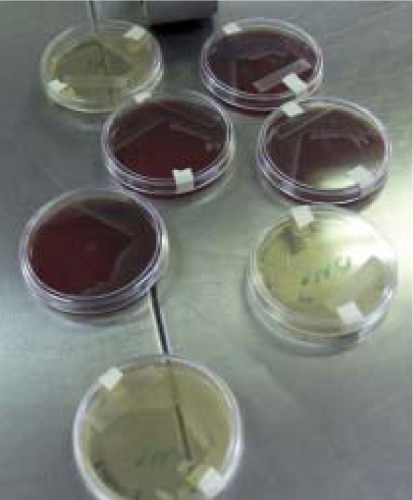
Petri dishes containing anthrax.
The U.S belief that bioweapons proliferation is unstoppable, paired with its long-standing belief that its security is based on technological superiority, may very well lead to the exploration of biotech applied to bioweapons development, with serious implications for arms control. The consequences threaten to fatally undermine both the bioweapons and chemical weapons treaties, leading to a new arms race.
What might such a world look like? All major military powers could be armed with bombs, missiles, shells, and spray tanks on unmanned aerial drones, loaded with chemical agents that cause stupor, convulsions, panic attacks, hallucinations, or violent sensory experiences; or with genetically engineered biological agents that degrade paint, plastic, rubber, fuel, and lubricants. Some regional powers would have stockpiles of lethal agents like third-generation nerve gases and genetically engineered pathogens. Non-lethal chemical weapons, anti-materiel weapons, and possibly also lethal chemical and biological weapons would likely be used repeatedly in regional conflicts. The proliferation of these technologies would dramatically increase the chances that terrorists would become capable of mass-casualty attacks using chemical or bioweapons. Police forces would be armed with new riot control agents, based on military non-lethal weapons that are much more effective than tear gas. This would greatly increase government power to control civil unrest–a dangerous tool in totalitarian hands, and one for which democracies have little use.
Something rather than nothing, but is it enough?
When the Fifth Review Conference of the bioweapons treaty resumed in November 2002, Chairman Tibor Toth said he had consulted widely on ways to secure a successful outcome to the conference. All possible options had been explored, said Toth, who presented a draft proposal–the only one that he believed could be realistically achieved.
In it, Toth proposed that all state parties agree to meet each year for the next three years. Each one-week meeting of the parties would follow a two-week meeting of experts. The topics to be discussed, to “promote common understanding and effective action,” would be agreed in advance.
In 2003 the topics would be:
The adoption of necessary national measures to implement the prohibitions set forth in the convention, including the enactment of penal legislation; and
National mechanisms to establish and maintain the security and oversight of pathogenic microorganisms and toxins.
In 2004:
Enhancing international capabilities for responding to, investigating, and mitigating the effects of cases of alleged use of bioweapons or suspicious outbreaks of disease; and
Strengthening and broadening national and international institutional efforts and existing mechanisms for surveillance, detection, diagnosis, and combating of infectious diseases affecting humans, animals, and plants.
Finally, in 2005:
The content, promulgation, and adoption of codes of conduct for scientists.
Ambassador Toth's proposal was discussed and adopted before the midpoint of the scheduled two-week meeting. What does that mean?
Obviously, the United States must have softened its position to some extent. As Toth pointed out in presenting the proposal, this plan ensures a continued multilateral approach to the implementation and strengthening of the treaty rather than just an agreement to meet again in 2006. And there is clearly some room for treaty members to have wide-ranging discussions on these topics, even if they do reflect the agenda the United States put forward before the review began in 2001.
The problem is that these discussions are no substitute for the protocol that had been hammered out over the last decade. The United States has complained strongly about the lack of treaty compliance, but it has proposed no measures that actually address the problem. If the discussions go well and progress is made, the atmosphere will be better for the 2006 review conference. But the gap in organizing for verification and actual verification will remain.
Given the scope and pace of global advances in biotechnology and the relentless spread of advanced weapons-related capabilities, is it really enough to have agreed to an agenda of work on issues that are marginal to the real problem?
For decades, the United States has based its military strategy on maintaining technological superiority. A program that includes exploring new ways to make weapons using biotech would be an appealing response to the threat of bioweapons. But besides helping the military understand that threat, such a program would also constitute a first step toward an offensive capability.
Of great concern are the calls from the U.S. military to alter or eliminate the bioweapons treaty. Doing so would allow it to develop genetically engineered bioweapons that target military materiel like camouflage paint, tires, stealth coatings, electronic insulation, runway tarmac, lubricants, and fuel.
For more than a decade the military has been exploiting a loophole in the Chemical Weapons Convention that permits chemical agents for law enforcement purposes. It has actively pursued development of non-lethal chemical weapons with the expectation of someday using them in military operations other than war (counterterrorism, hostage rescue, embassy protection, peacekeeping operations, etc.).
The United States is also developing munitions to deliver its non-lethal chemical agents. More and more, biotechnology is being used for this program. Reproducing this approach in its biodefense program would be a natural step for the military. Indeed, the same agency that administers the non-lethal chemical weapons program has serious interest in–and apparently projects on–genetically engineered non-lethal bioweapons. This is pioneering very dangerous ground.
No good secrets
The United States appears to have embarked on a largely classified study, across several agencies, of biotech applications for the development of new bioweapons. The clandestine U.S. programs indicate a willingness to ignore treaty law in favor of maintaining technological superiority in response to the emerging bioweapons threat. And U.S. behavior suggests that its biodefense program is even larger than those portions that have been revealed. This U.S. exploration of the utility of biotech for bioweapons development is unwise, for the rest of the world will be obliged to follow suit. In its rush to stay ahead technologically, the United States runs the risk of leading the world down a path toward much-reduced security. More than 30 years ago, the United States ended its offensive bioweapons program in part because it feared that the program's very existence invited other nations to imitate it. That wisdom seems to have been forgotten.
U.S. behavior suggests that its biodefense program is even larger than those portions that have been revealed.
Furthermore, the secrecy required by such a program is antithetical to the transparency on which long-term bioweapons control must be founded. It could also spark a global bio-weapons arms race. A world in which many nations are secretly exploring the offensive military applications of biotech would be ripe for proliferation. If a country doesn't know its enemy's offensive capabilities, military strategists must assume the worst–that the enemy possesses or is developing bioweapons. This will provoke the development of bioweapons for a retaliatory or deterrent capability. And once bio-weapons are established in military arsenals and in planning, they will be considered legitimate.
The United States is one of the most open societies in the world, with one of the most democratic governments, but as the world's preeminent power, the military has great influence–especially when projects are secret and have little oversight. Review and oversight of secret biodefense programs need to be strengthened considerably. It is critically important that Congress, U.S. citizens, and U.S. allies understand and debate the use of biotechnology for military purposes, keeping an eye toward the implications for arms control and proliferation. Perhaps the greatest danger is that the United States will embark on this path without public debate.
Congress must determine the full scope of all classified U.S. biodefense programs. It must develop, with maximum public input, a clear philosophy by which to guide these programs; establish effective ongoing oversight mechanisms; and promote as much transparency in biodefense as possible.
U.S. allies need to press the United States to explicitly disavow offensive bioweapons, to renounce non-lethal chemical weapons, and to commit to transparency so as not to provoke destabilizing suspicions. Cooperation with U.S. initiatives against suspected proliferators might also be conditioned on full U.S. compliance with the letter and spirit of the bioweapons treaty, its confidence-building measures, and the chemical weapons treaty. Arms control organizations and the media must also aggressively investigate biodefense issues.
The United States cannot continue to shroud its biodefense program in secrecy. The only way to ensure that bioproliferation is not a serious global problem is worldwide biodefense transparency–and the United States must lead by example, or no one will follow.