



Abstract

The United States continues to be the world's largest weapons supplier, capturing a 45.8 percent share of the $12.1 billion global arms market in 2001.
Since September 11, the Bush administration has relied heavily on a quiet campaign of defense deals as a way to win friends for its war on terror. The unsurprising result: a significant increase in U.S. arms transfers and military aid. Although the purported goal is to improve U.S. security, too often military aid has gone to repressive regimes that use the assistance to violate the human rights of their own populations. Sometimes, these weapons and technologies fall into hostile hands and they end up being used against the United States.
The gears that drive the deals that ratchet up military aid for U.S. allies have been greased in the post-September 11 world by the steady erosion of restrictions on military transfers. Some of the more significant changes and proposals so far include:
Congress broadened the U.S. role in Colombia from counternarcotics support to a “unified campaign” against insurgents and narco-traffickers.
The Bush administration wants to lift a ban on training Indonesia's military (placed because of its failure to comply with human rights-related rules).
Congress wants to give $403 million in military aid and assistance to Central Asian war-on-terror allies–despite these regimes' failure to democratize or to respect human rights.
The United States gave the republic of Georgia $64 million to train and equip its military to hunt Al Qaeda members living among Chechen rebels on its Russian border.
The Philippines received about $100 million in U.S. security assistance, including transport planes, utility helicopters, a naval patrol boat, and 30,000 M-16 rifles. The U.S. military also deployed 1,200 soldiers to train and help Philippine troops pursue the Abu Sayyaf group, an organization allegedly linked to Al Qaeda.
Who's winning in the war on terror? Nepal, for starters
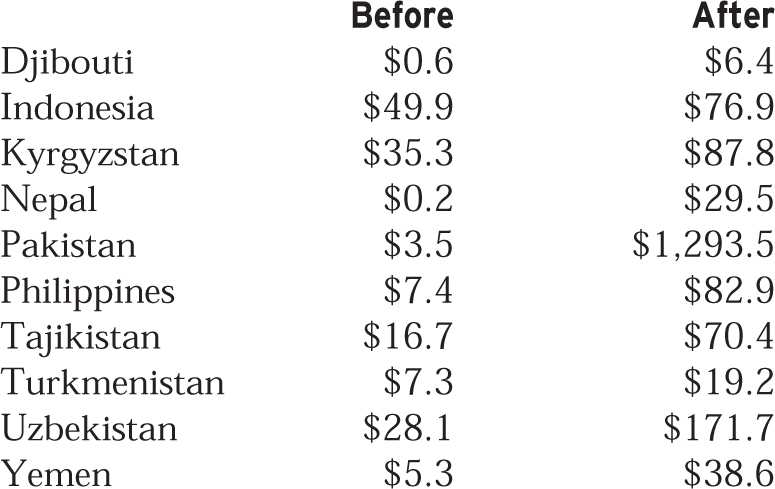
There have been some interesting surprises in the “war,” including its major beneficiaries. The table shows U.S. war on terror-related aid to certain lucky countries before and after September 11, 2001. The “before” totals include aid appropriated under the 2001 Foreign Operations Appropriations Act; “after” totals include aid in two supplemental appropriations acts passed after September 11, 2001 and aid requested as part of the 2003 Foreign Operations Appropriations Act.
What goes around…

During the 1980s, the Reagan administration secretly gave hundreds of man-portable surface-to-air Stinger missiles to the mujahideen in Afghanistan and to UNITA rebels in Angola. These 1.5-meter “fire-and-forget” missiles shot down dozens of Soviet attack helicopters. But the qualities that made the Stinger an effective weapon against the Soviets (portability, lethality, and ease of use) also make them a grave threat to U.S. military and commercial aircraft–and an ideal black market commodity. Hundreds of Stingers originally transferred to the mujahideen quickly vanished into the illegal global arms pipeline and ended up in the hands of terrorists, rebels, and states hostile to U.S. interests. In 2001, U.S. war planners worried that Afghanistan's Taliban would try to “return” its Stinger supply in a decidedly unfriendly fashion.
China, Iran, Qatar, Pakistan, the former Soviet Union, and even North Korea are all believed to have ill-gotten Stingers. And many non-state actors suspected of illicitly acquiring Stinger missiles are now recognized as terrorist organizations by the State Department. These include the Armed Islamic Group (in Algeria), Islamic Jihad/Hezbollah, the Kurdistan Workers Party (in Turkey), the Tamil Tigers (Sri Lanka), and last–but definitely not least–Al Qaeda.
Arms exporter to the world
The United States approved arms exports and military aid to 170 countries in 2001, delivering $13.1 billion in commercial and government-to-government arms sales to 154 of those countries.
In 2001, 60 countries were the lucky recipients of $3.5 billion in U.S. foreign military financing, allowing the United States to dole out money for purchasing U.S. weapons, military service, and training. All but 5.4 percent of 2001 financing went to Israel, Egypt, and Jordan, as a reward for making peace with one another.
In 2001, the United States gave 113 nations $57.7 million for “international military education and training” (IMET)–aid to foreign governments to teach their military personnel (think of it as “Military 101”). The U.S. military offers more than 2,000 courses, including classes in combat skills, military management, civilian-military relations, and the use of U.S. weapons systems.
The United States isn't too choosy about who gets these goodies. Many of the 2001 recipients weren't exactly good guys. A number of them, in fact, were characterized by the State Department as having “poor” or “extremely poor” human rights records.
Who gets U.S. military weapons and aid? Not just the good guys.

Some for him, some for you

In anticipation of Pakistan's crucial role in the war on terror, the U.S. government lifted sanctions on Pakistan and India that had been in place since the two saber-rattlers decided to test their nukes in 1998. In 2002, political tensions on the subcontinent threatened to erupt into conflict that many feared would “go nuclear.” Despite this, the United States moved forward with its arms deals. At the same time it was publicly pressuring Pakistan and India to restrain themselves, the U.S. government was quietly approving weapons transfers to both. The transfers at left have already been approved.
By Tamar Gabelnick and Matt Schroeder of the Federation of American Scientists Arms Sales Monitoring Project. More information on U.S. and global arms sales is available online at fas.org/asmp.