




Abstract
Richard Nixon thought a secret, worldwide nuclear alert would remain unknown to the American public, and he was right. But his strategy–to threaten the Soviets into helping bring an end to the Vietnam war–was unsuccessful. They may not even have noticed.
In 1969 President Richard Nixon ordered a worldwide nuclear alert–one of the largest secret military operations in U.S. history. Only Nixon, his special adviser for national security affairs Henry Kissinger, Kissinger's National Security Council aide Col. Alexander Haig, and White House chief of staff H. R. “Bob” Haldeman, knew that the underlying purpose of the alert, known as the “Joint Chiefs of Staff Readiness Test,” was to convince the Soviets that helping to end the war in Vietnam was in their best interests.
The alert began on October 13, 1969, when U.S. tactical and strategic air forces in the United States, Europe, and East Asia began a stand-down of training flights to raise operational readiness; Strategic Air Command (SAC) increased the numbers of bombers and tankers on ground alert; and the readiness posture of selected overseas units was heightened. On October 25, SAC took the additional step of increasing the readiness of nuclear bombers, and two days later SAC B-52s undertook a nuclear-armed “Show of Force” alert over Alaska, code-named “Giant Lance.” Three days later, U.S. intelligence detected Soviet awareness of the heightened nuclear alert and Defense Secretary Melvin Laird ordered commanders to terminate the test at the end of the month.
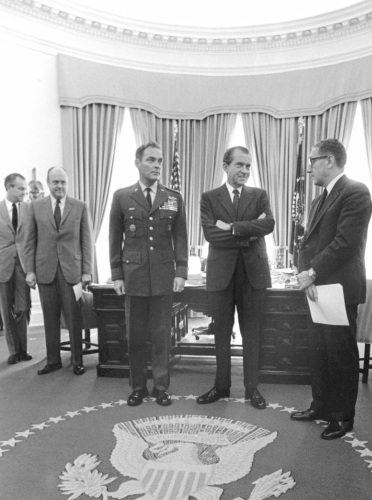
Five days after the readiness test ended, Alexander Haig received a general's star from President Nixon. To the left, CIA Director Richard Helms and Defense Secretary Melvin Laird. Henry Kissinger is to the right.
The alert, along with Nixon's orders to launch it, remained secret from much of the government as well as the public until 1983, when journalist Seymour Hersh reported on one of its phases and speculated about the reason behind it. Hersh suggested that it was a manifestation of Nixon's strategy in Vietnam, related in some way to “Duck Hook”–a massive mining and bombing operation Nixon had threatened to unleash against North Vietnam if Hanoi did not yield to Washington's terms at the Paris peace negotiations.
Five days after the readiness test ended, Alexander Haig received a general's star from President Nixon. To the left, CIA Director Richard Helms and Defense Secretary Melvin Laird. Henry Kissinger is to the right.
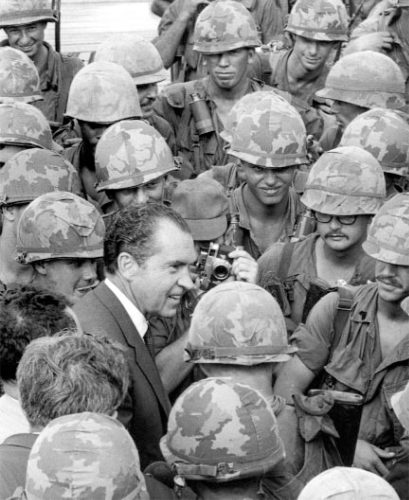
Nixon meeting the troops in Vietnam, July 1969.
Hersh's report was an investigative coup, but his version of events was brief, fragmentary, and partially incorrect. Inexplicably, it was little noted, even at the time.
The declassification of documents in the 1990s, however, confirmed that the readiness test had in fact occurred. At least one analyst speculated that the test was “an apparent effort to add credibility to the U.S. threat to intervene in a Sino-Soviet conflict.” But documents that have been released more recently, and statements by former senior Nixon-era officials who have become more willing to talk about Nixon-Kissinger policies, show convincingly that Nixon invoked the alert as part of an unsuccessful strategy for ending the Vietnam War. No direct evidence has turned up to support the theory of a connection between the alert and the Sino-Soviet border crisis.
Nixon hoped that the nuclear alert would cause the Soviets and North Vietnamese to think it was a lead-up to Duck Hook, thus jarring them into making the diplomatic compromises demanded by the United States. Although a bluff, the alert also had a compensatory purpose. Because Moscow and Hanoi would discover after November 1 that he had not carried through with Duck Hook, the nuclear readiness measures, he thought, would at least serve to salvage his reputation for toughness and irrationality, and thus his credibility, by reminding the North Vietnamese, and especially the Soviets, that he was capable of taking dangerous and unpredictable escalatory steps.
The war in Vietnam
Nixon had campaigned on a secret plan to end the war in Vietnam, and he believed at his inauguration that he was well on the way to fashioning the outlines of a strategic plan that would enable him to extricate American troops from Vietnam, win a release of American prisoners of war, and preserve the non-communist government of South Vietnam's President Nguyen Van Thieu.
In contrast to skeptical anti-war critics, Nixon, Kissinger, and other policy-makers believed that achieving their goals in Indochina would have a critical bearing on the global influence of the United States. If they were perceived to have abandoned a client and ally, they felt, American credibility would be undermined on issues ranging from nuclear arms to Mideast politics.
The plan included Vietnamization, de-Americanization, international diplomacy, and negotiations with the Vietnamese communists in Paris–all coupled with what Nixon referred to in one of his memoirs as “irresistible military pressure.”
Nixon and Kissinger believed that by offering détente, they could persuade the Soviet Union to lever the North Vietnamese into being “reasonable” at the negotiating table. And by détente they meant more than a simple matter of relaxing tensions. As Raymond Garthoff put it, détente was a “strategy to contain and harness Soviet use of its increasing power” by enmeshing it in “a web of relationships with … the United States, a web that he [Nixon] would weave.”
But the benefits of détente would not become available unless Moscow used its influence to help Washington reach a Vietnam settlement. “We should be hard and pragmatic in dealing with the Soviets,” Nixon told French President Charles de Gaulle in February 1969. He believed Soviet influence would be pivotal because “85 percent of [North Vietnam's] weapons came from the Soviet Union.”
Attempting to lever Hanoi by offering favors to or putting pressure on Moscow–and later on Beijing–was also known as “triangular diplomacy.” It was a game that Hanoi and Beijing engaged in as well, with Hanoi playing China and the Soviet Union against each other, and Beijing playing the American card against the Soviet Union.
On the military front, Nixon continued to carry out the ground operations in South Vietnam begun by the last administration, including “pacification” and big-unit sweeps–and he envisioned adding more ground and air options.
At the core of Nixon's notions was a diplomacy-supporting stratagem he called the Madman Theory, or, as he and Bob Haldeman described it, “the principle of the threat of excessive force.” Nixon was convinced that his power would be enhanced if his opponents thought he might use excessive force, even nuclear force. That, coupled with his reputation for ruth-lessness, he believed, would suggest that he was dangerously unpredictable. The Madman Theory undergirded not only his policy toward North Vietnam but also toward other adversaries, including the Soviet Union.
Although Nixon favored this theory more than most, threatening excessive force was nothing new. In the 1950s President Dwight D. Eisenhower, his Secretary of State John Foster Dulles, and then-Vice President Nixon, had overtly practiced a version of the Madman Theory by means of the “uncertainty principle” and coercive nuclear “brinkmanship.”
The Nixon Vietnam plan
Nixon viewed the different elements of his evolving Vietnam plan as an interrelated whole. Expanded conventional military operations would not only have military consequences on the ground and bolster the morale and staying power of the Thieu regime, they would lend credibility to the Madman stratagem by signaling his willingness and ability to escalate the war. In turn, threats to use even greater force would bolster linkage and triangular diplomacy, and vice versa–or so he hoped. He decided on and implemented these elements in stages, however, as his hopes and fortunes waxed and waned in relation to the vicissitudes of the war in Vietnam and public opinion in the United States.
Just seven days after his inauguration, Nixon met with Kissinger, Laird, and Gen. Earle Wheeler, chairman of the Joint Chiefs, to discuss “the possibility of working out a program of potential military actions which might jar the North Vietnamese into being more forthcoming at the Paris talks” and thereby “preclude prolonged stalling tactics.”
Nixon described the link between a Vietnam settlement and other issues to Soviet Amb. Anatoly Dobrynin at a February 17 meeting. As Haldeman noted, the “President made clear that progress on political issues [is] bound to have real bearing on progress on arms control…. President hoped that Soviets would show constructive attitude in Middle East talks and do what they could to get Paris Vietnam talks off dead-center, since progress in these two areas bound to be helpful in reaching agreement on other issues.”
On March 17 Nixon showed his inclination to send tough signals to adversaries when he launched “Operation Breakfast”–a massive B-52 bombing campaign against communist base areas in Cambodia. Kept secret from the public and most government officials, it was intended as a dramatic signal to “demonstrate to Hanoi that the Nixon administration is different and ‘tougher’ than the previous administration,” as one “well-placed” official put it.
Meanwhile, Vietnamization, the publicly visible element in Nixon's plan, was only slowly taking shape. On April 10 he ordered the preparation of timetables for incremental American troop withdrawals, and at Midway on June 8 he told President Thieu that 25,000 American troops would be withdrawn between July 1 and August 31.
July 7, 1969: Henry Kissinger, South Vietnam Vice President Cao Ky, and U.S. Amb. Ellsworth Bunker listen to Nixon's speech in Saigon.
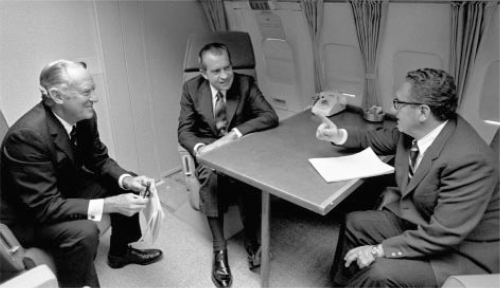
From left, Secretary of State William Rogers, Nixon, and Kissinger on Air Force One.
By the time the withdrawals actually began, however, Vietnam policy was at a critical juncture. North Vietnam had not been intimidated, and Kissinger's efforts to persuade Moscow to help with Hanoi had not succeeded. The talks in Paris were deadlocked, and the anti-war opposition at home was becoming restive. Laird and Rogers wanted to accelerate troop withdrawals; Kissinger did not.
“Going for broke”
Nixon wrote in his post-war memoirs that he emerged from a July 7 meeting with Kissinger on the presidential yacht Sequoia intending to “‘go for broke’ in the sense that I would attempt to end the war one way or the other–either by negotiated agreement or by an increased use of force.” He could either escalate the war to force a favorable negotiated agreement or he could accelerate the withdrawal and do what was necessary to protect American forces while they were leaving. In either case, he said, “We'll bomb the bastards.”
In July and into August, Nixon was disappointed by the lack of success on the diplomatic front. With public patience waning, he decided to appease everyone with simultaneous Vietnamization and military escalation.
Nixon and Kissinger set in motion the enhanced-threat phase in July and August. Kissinger met with Dobrynin on July 11, just four days after the Sequoia meeting, to warn him that Nixon might use “other alternatives” against North Vietnam unless Hanoi made concessions. Should this happen, Kissinger hinted, it would likely cause Soviet-American relations to fall to a “dangerous minimum.”
Four days later Nixon continued his arm-twisting campaign by sending a letter to Ho Chi Minh via the North Vietnamese representatives in Paris. Nixon called on Ho “to move forward at the conference table toward an early resolution of this tragic war.” Nixon told Thieu in Saigon on July 30 that he would send “a warning to Hanoi … in an unorthodox way.”
Kissinger flew to Paris, where he held his first secret meeting with the North Vietnamese, during which he reminded Xuan Thuy of the letter to Ho. At another meeting on the same day, he told French Foreign Ministry officials that “it was important that [the United States] not be confounded by a fifth-rate agricultural power.”
By mid-August Nixon, Kissinger, and presidential advisers Haldeman, John Mitchell, and John Ehrlichman believed that for political reasons the administration had to bring the war to a favorable end “in six to nine months,” but that the “process will be difficult.” Soon after returning to Washington from an around-the-world trip, Nixon began to prepare himself for the heat he believed he would get should he resume the bombing of North Vietnam. Reviewing alternatives on August 18, Nixon felt the need to make a “total mental commitment.”
Although they were unaware of contingency planning for the bombing of North Vietnam, Laird and Rogers opposed military escalation and continued to press for accelerated Vietnamization. Concerned about Nixon's resolve, but supported by Haldeman, Mitchell, and Ehrlich-man, Kissinger lobbied vigorously against Vietnamization while advocating the second phase of escalation.
According to Haldeman's notes, Nixon reviewed Kissinger's “contingency plan for Vietnam” at the western White House on August 28. That plan was probably the emerging blueprint or “study” for a contemplated military operation against North Vietnam–code-named “Pruning Knife” by the military but known as Duck Hook at the White House and National Security Council.
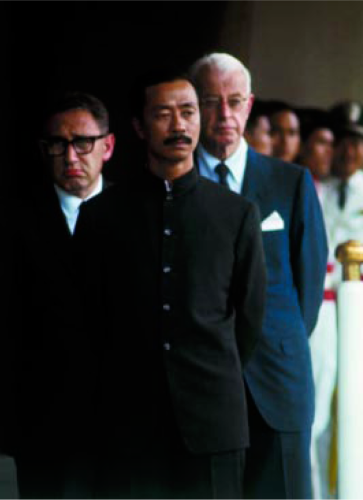
Xuan Thuy, North Vietnam's chief negotiator, arriving at the site of the peace talks in Paris.
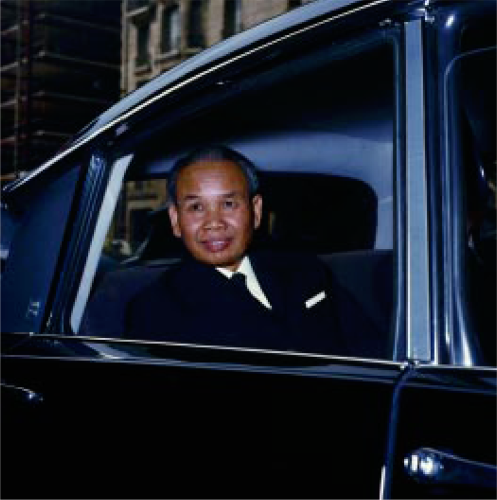
On August 30, Nixon received Ho Chi Minh's reply to his July 15 letter. Ho rejected Nixon's negotiating terms, put forward his own plan for a negotiated solution to the war, and brushed aside Nixon's threats.
His warnings having failed to intimidate either Hanoi or Moscow, Nixon knew that he would soon have to make a decision about which alternative to pursue–military escalation or accelerated Vietnamization.
In late August or early September Kissinger formed a group of NSC staffers–sometimes called the “September Group”–which was charged with designing a scenario for what they hoped would be final negotiations, and drafting a presidential speech scheduled for November 3 in which Nixon would announce and defend renewed bombing.
On September 9, Kissinger met with General Wheeler to “discuss military planning for the Duck Hook operation … and to convey to him the president's personal mandate that planning be held strictly in military channels,” thereby precluding “discussion of the plan and the ongoing detailed planning with even the secretary of defense.”
By September 16, if not before, the “concept of operations,” was complete. It called for the bombing of military and economic targets in and around Hanoi, the mining of Haiphong and other ports, air strikes against North Vietnam's northeast line of communications as well as passes and bridges at the Chinese border, and air and ground attacks on other targets throughout Vietnam. The September Group continued to debate which parts of the operation to include or exclude.
Threat-making accompanied operational planning. In a meeting with Republican senators on September 27, Nixon staged simultaneous ploys with the senators and Ambassador Dobrynin. With the senators he “planted a story,” as he put it, that he hoped would be leaked to the press and “attract some attention in Hanoi.” He told them he was considering a plan to blockade Haiphong harbor and invade North Vietnam. By prearrangement, Nixon phoned Kissinger, who was meeting with Dobrynin, and instructed him to tell the Soviet ambassador that Soviet cooperation on Vietnam was essential before a dangerously uncontrollable process unfolded.
After he canceled the “Duck Hook” bombing campaign, Nixon believed “the Soviets would need a special reminder.” That reminder was the nuclear alert.
Having temporarily mollified Laird and public opinion by announcing the withdrawal of 40,000 troops and holding open the accelerated Vietnamization option, several days later Nixon concluded that “the long route can't possibly work,” because “the doves and the public are making it impossible to happen.” He needed to go through with “the tough move”–Duck Hook.
A change of plans
But even as the Duck Hook plan moved forward, Nixon's resolve melted. At home, Laird and Rogers opposed military escalation; there were reservations about Duck Hook's potential effectiveness; public support for the war continued to decline; and there were signs of political slippage. Meanwhile, North Vietnamese negotiators remained steadfast; there was lowered enemy-initiated fighting in South Vietnam; and the Soviets were still not cooperating.
Two major anti-war actions were scheduled for October and November: the Moratorium on October 15, and the Mobilization Against the War on November 13-15. Nixon was concerned that they would erode confidence in his leadership and blunt Duck Hook's impact.
In an October 3 Nixon-Kissinger-Haldeman meeting, Kissinger presented stark choices, arguing that the only two courses were a “bug out” (accelerated Vietnamization) or escalation (Duck Hook), without which, he said, the president would be lost. Nixon believed that he was “lost anyway if that fails, which it well may.”
Kissinger countered that the only question is “whether P can hold the government and the people together for the six months it will take.” But that was precisely the rub for Nixon, since “it's obvious from the press and dove buildup,” Haldeman noted, “that trouble is there whatever we do.”
Nixon continued to “talk through alternatives” until October 11, but it was probably on October 6 that he decided against Duck Hook. His televised speech to the nation, scheduled for November 3 to announce the resumption of bombing, would have to be rewritten as an attack on his domestic and foreign opponents and as an appeal for the American public to support his Vietnam strategy.
Even after canceling Duck Hook, Nixon could continue to show resolve to the North Vietnamese on the battlefield. But “the Soviets would need a special reminder,” he said in his memoir. That special reminder was the nuclear alert.
On October 6, Nixon initiated the alert by telephoning Defense Secretary Melvin Laird. As Haig wrote to Kissinger, the president asked Laird to order U.S. military forces to take a “series of increased alert measures designed to convey to the Soviets an increasing readiness by U.S. strategic forces.”
In recent interviews Laird has confirmed that when Nixon ordered the alert measures, he was recalling Eisenhower's 1953 strategy for dealing with Korea by threatening China: “Nixon did it because of Soviet aid to North Vietnam–to alert them that he might do something. This was one of several examples of the Madman Theory…. He never used the term ‘madman,’ but he wanted adversaries to have the feeling that you could never put your finger on what he might do next. Nixon got this from Ike, who always felt that way.”
Later in October, Kissinger reminded Nixon that in a forthcoming meeting with Dobrynin, “your basic purpose will be to keep the Soviets concerned about what we might do around November 1” and also to “make clear that … unless there is real progress in Vietnam, U.S. Soviet relations will continue to be adversely affected.”
If the Soviet ambassador raised the subject of “our current military measures,” Kissinger suggested that Nixon should, in oblique diplomatic language, coolly reply that they were “normal exercises relating to our military readiness.” In sum, Nixon and Kissinger were hoping that the “unusual” readiness test, or nuclear alert, would frighten the Soviets into helping force concessions out of the North Vietnamese.
The alert
The morning after Nixon's phone call, Laird's military aide, Col. Robert E. Pursley, called Kissinger aide Haig. Pursley told Haig he was sending a “plan for increased SAC alert.” But this first paper disappointed Haig, who told Kissinger it was “merely a résumé of an already approved East Coast air defense exercise, which was not responsive to the president's instructions.”
Haig asked Pursley for more impressive measures, telling him that the White House wanted military measures that the Soviets would consider “unusual and significant” but not “threatening.” The White House also wanted actions that were not expensive, did not require allied approval, would “not degrade essential missions,” and would have a “minimal chance of public exposure.”
Nixon believed that anti-war rallies, like this one in Washington, D.C., were likely to turn violent.
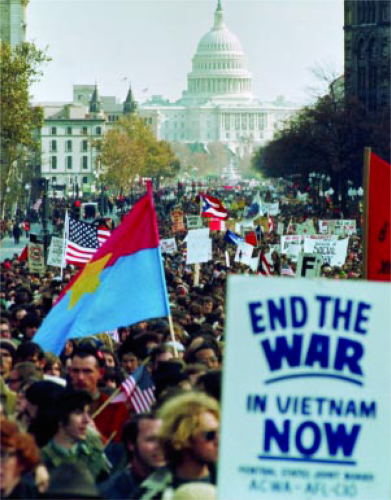
The next day, October 8, Pursley responded with a list of actions that were closer to Haig's criteria. The new plan called for communications silence; a stand-down of combat aircraft (cessation of training flights); increased reconnaissance operations around the Soviet periphery; increased ground alert rates for SAC bombers and tankers; the dispersal of
SAC aircraft with nuclear weapons to designated military bases around the country; and the alerting/sending to sea of ballistic-missile submarines.
While the Joint Staff went to work on the details, Nixon took action. Kissinger passed Pursley's first list to Nixon and recommended radio silence, aircraft stand-down, increased surveillance of Soviet shipping, higher alert rates for SAC aircraft, and dispersal of SAC bombers “phased appropriately through the week.” Kissinger did not approve increasing aerial reconnaissance operations near Soviet territory or raising alert levels of nuclear-armed submarines, thinking them too provocative or too hard to conceal (although measures involving submarines would come into play later). After Nixon signed off on these steps, Haig called Pursley and asked for a detailed plan and implementing instructions.
Deep secrecy was needed to avoid public exposure. Haig may also have seen secrecy as useful for protecting Soviet prestige–if the measures became known, Soviet leaders might have found it necessary to take countermeasures.
Given the emphasis on secrecy, only a small number of individuals in the U.S. government knew about the alert or why Nixon had ordered it. At the White House only Nixon, Kissinger, Haig, and Haldeman knew. Apparently, even NSC staff experts on Vietnam and Soviet affairs were not told about the decision. At the Pentagon, only Laird, Pursley, and General Wheeler may have had the full picture. Secretary of State Rogers and Undersecretary Richardson may not have learned about the readiness measures until October 13–if then–and by then the alert was already beginning.
Although NSC-State Department relations were steadily deteriorating, Haig believed that Rogers and Richardson had to be told, although they “will most probably strongly object.” Unless they were informed, “feedback will most certainly come immediately through State channels.” In other words, some government, perhaps a NATO ally, was likely to notice heightened military activities and lodge a question with a U.S. ambassador. Haig further observed that “I do not believe Rogers or Richardson will forgive our failure to keep them informed,” and that the White House would face criticism if the press learned that State had been shut out. Whether Rogers or Richardson learned about the readiness test remains unknown.
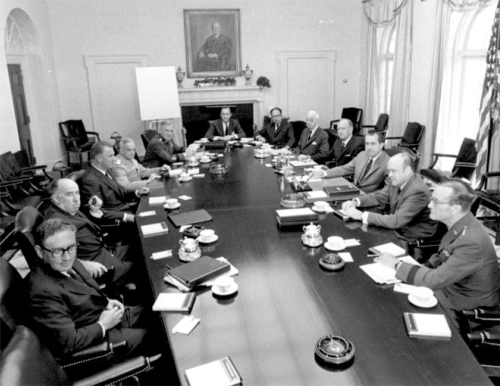
September 12, 1969: Nixon meets with the National Security Council. Counterclockwise from right: Gen. Earle Wheeler, chairman of the Joint Chiefs; Defense Secretary Melvin Laird; President Nixon; Secretary of State William Rogers; Ellsworth Bunker, ambassador to South Vietnam; Philip Habib, U.S. delegate to the Paris peace talks; Richard Helms, CIA director; Gen. Creighton Abrams; Adm. John McCain; Vice President Spiro Agnew; Attorney General John Mitchell; and Henry Kissinger, national security adviser.
Laird quickly brought Wheeler into the planning, and on October 10, Wheeler notified the CINCs (the Commanders-in-Chief of the Strategic Air Command, European Command, Pacific Command, Atlantic Command, Southern Command, Strike Command, Alaska Command, and North American Air Defense Command) that “higher authority”–President Nixon–had directed the Pentagon to “institute a series of actions” from October 13 to 25 to “test our military readiness in selected areas world-wide to respond to possible confrontation by the Soviet Union.” According to Wheeler, “these actions should be discernible to the Soviets but not threatening in themselves.”
Laird briefed Nixon and Kissinger on October 11. In the meantime, SAC began to prepare. At 8 a.m. on Monday, October 13, SAC canceled tactical training flights and put as many nuclear bombers and tankers on ground alert as possible, although forces assigned to Vietnam were excluded. Wheeler did not need to include intercontinental ballistic missile (ICBM) forces in the directive, because these were routinely on a high state of alert, ready for launch on warning. If Nixon wanted a “show of force” that Moscow would notice, SAC bombers were the best instruments for that purpose because their alert status could be visibly heightened.
Standing orders called for SAC to maintain 40 percent of each squadron–six aircraft for each 15–on ground alert ready to strike Single Integrated Operational Plan (SIOP) targets if early warning sensors detected a missile or bomber attack. But shortages of bomber crews–due mainly to Vietnam War commitments–had forced SAC to reduce the number of bomber and tanker “sorties” on alert. Actual ground alert bomber and tanker forces were substantially below SIOP requirements. Had it been a real emergency, SAC would have needed four to six hours to staff the degraded alert sorties. Given the personnel shortage, canceling flight training was essential to any effort to increase the numbers of aircraft on ground alert.
SAC increased forces on ground alert to 144 B-52s, 32 B-58s, and 189 KC-135s–still below the 40 percent SIOP requirement, but close enough. Haig believed that an increase in the ground alert rate could be reached “without undo costs and risks,” but General Wheeler deflected White House pressure on SAC. To ensure that Moscow noticed the readiness test, though, SAC tried to bring more nuclear-armed aircraft into it.
Other U.S.-based commands with nuclear-capable air forces expanded the scope of the test. On October 15, Strike Command ordered Tactical Air Command (TAC) to begin a stand-down. Pilots at TAC bases around the country stopped flying nuclear-capable aircraft–F-105 Thunderchiefs and F-4 Phantoms–as well as C-130s used for tactical airlift operations. During the stand-down, TAC cancelled 4,216 scheduled sorties, using the spare time to raise the combat-ready status of aircraft. The nuclear-capable air defense forces of the Alaskan and Continental Air Defense Commands also joined in the stand-down.
By October 15, the U.S. European Command was participating in the readiness test. On order from Commander-in-Chief Gen. Andrew J. Goodpaster, U.S. air forces tightened security around European bases and stood down training flights. United States Air Forces in Europe (USAFE) alone had a formidable force of nuclear-armed and nuclear-capable tactical aircraft, including F-4 Phantoms. By October 19, those forces had obtained an average operational readiness rate of 94 percent. In addition, Goodpaster ordered the Sixth Fleet to enact controls over communications, but otherwise keep ship movements on schedule. Pacific Command received orders to instruct component forces to join the test. For example, on October 15, activities by South Korea-based units of the Pacific Air Forces (PACAF) were standing down training flights and increasing numbers of aircraft slated for “SIOP alert.”
But why?
The commanders who presided over the readiness test could only puzzle why the White House had requested the exercise. When SAC Commanderin-Chief Bruce Holloway called the Pentagon for more information, for example, he learned nothing. Correctly believing that Henry Kissinger was involved in the operation, senior officers at SAC headquarters speculated over a possible connection to the Vietnam negotiations in Paris and noted the return of U.S. negotiators to Washington for consultation as well as Nixon's announcement that he would make a major address on Vietnam on November 3.
Lack of knowledge about the alert's purpose made it difficult for operational planners at SAC, among other commands, to respond to a Joint Chiefs Staff's request for additional suggestions for action; they could only wonder whether their proposals were even relevant.
To ensure the operational secrecy the White House wanted, the Pentagon imposed strict requirements on the services. Initially, and on the assumption that something would leak to the public, the guidance authorized public affairs specialists to respond to media queries with the flat statement that “we are merely testing current readiness posture.” But the assistant secretary of defense for public affairs weighed in with more rigorous guidance prohibiting any public announcement of the exercise and forbidding any response to questions unless specifically permitted. The Pentagon's public affairs officers soon relaxed the latter restriction by allowing officials to answer queries with the statement: “We do not comment on readiness tests.” But no questions arose.
Ordinarily, higher alert postures would be accompanied by messages indicating a change in Defense Readiness Condition or DEFCON status. But, consistent with secrecy, no increase was ordered.
High Heels
General Goodpaster, wearing two hats as Commander in Chief of European Command and Supreme Allied Commander Europe, believed he should inform NATO about the USAFE stand-down in progress, not least because under NATO procedures, ordering a stand-down unilaterally would raise questions from allies and pose “serious problems.” Haig believed the contrary–that telling NATO anything would risk leaks and jeopardize operational secrecy.
Haig told Kissinger on October 14 that Laird was “reluctant” to proceed further. In addition to general concerns about the risks, Laird had another objection: The readiness test would interfere with an already scheduled secret nuclear command post exercise, “High Heels.” An annual exercise begun in the early 1960s, High Heels involved the Defense Department, the Joint Chiefs of Staff, the CINCs, and the State Department, among other agencies, around the world. The “High Heels 69” scenario posited a series of aggressive Soviet moves leading to a preemptive nuclear strike against the United States and the “exercise” of U.S. nuclear war plans in retaliation.
The Joint Staff and some of the CINCs believed that carrying out and supervising such a complex nuclear exercise while implementing readiness measures would overload communications and decision-making systems. Another concern was that the intelligence agencies would have difficulty differentiating between Soviet reactions to the alert measures and to High Heels.
The proposal for increased surveillance of Soviet ships en route to North Vietnam was another area of contention. Wheeler wanted to hold that measure in abeyance because of its expense and its ramifications–the dangers of an incident and the likelihood of Soviet charges of interference with shipping. The U.S. Navy, among other military and intelligence agencies, routinely monitored Soviet shipping to Vietnam; Wheeler may have felt that was enough. Haig, however, suggested that Kissinger should “encourage” Laird to take action on surveillance.
On High Heels and NATO consultations, among other areas of divergence, Haig told Kissinger that Laird's objections were “not overriding.” Nevertheless, Laird was a powerful figure in the government, which made it necessary for Kissinger to get the president's support.
Kissinger met with Laird and Chairman Wheeler to adjust High Heels and the alert measures so as to ensure their implementation. Haig believed that “it was necessary to have the measures completed sufficiently before 3 November for the president to ascertain beyond a doubt whether or not the signals have been effective.” In other words, before Nixon finished work on his speech, he had to know whether the alert measures had had an impact on Moscow's Vietnam policy.
No record of the discussion with Laird and Wheeler is available, but Laird agreed to modify High Heels so that it would not complicate the readiness test. For the first time, the Pentagon limited High Heels to the “Washington area alone,” leaving the CINCs free to concentrate on the readiness test. As for the problem of NATO consultations, Haig recommended that Goodpaster tell any inquisitive allies that the stand-down was an “additional aspect of the High Heels operation.” Whether Goodpaster received such instructions or whether NATO officials asked about the USAFE stand-down remains unknown.
At the meeting with Kissinger, Wheeler received instructions about the alert's duration: On October 14 he notified the CINCs that the nuclear alert would last until the first minute of October 30. SAC forces would be on heightened ground alert for more than three weeks. Exactly how long the alert would last would depend on the timing of Soviet reactions. At some point on or after October 10, it had been decided–who made the decision is unknown–that the activities would “continue until our intelligence indicates that the Soviets have become aware of the increased readiness.” To make such a decision possible, Wheeler established a special intelligence watch to look for information suggesting that Moscow was aware of the U.S. alert.
Searching for the Soviet reaction
The Pentagon and the White House approved new air, ground, and sea-based readiness measures for implementation in Europe, the Near East, East Asia and the Pacific, and North America. Wheeler also allowed a temporary relaxation of the stand-down to meet air force concerns about flight training. Meanwhile, Kissinger hoped that Dobrynin's request for a meeting meant that the alert was having an effect on Moscow, but the Soviets remained unresponsive to Nixon's pressure.
Since October 10, when the CINCs received the first message on the readiness posture, they had been sending Wheeler suggestions for additional military actions. Within a few days, the Joint Staff had sifted through and digested the advice, and on October 17 Wheeler forwarded new instructions to the CINCs designed to signal, with mounting intensity, increased U.S. readiness.
Significant details of Wheeler's instructions, especially those concerning nuclear weapons, remain classified. Nevertheless, their clear purpose was to intensify the readiness test, making it even more apparent to Soviet intelligence. Strike Command received orders for Middle East Force to deploy destroyers and destroyer escorts to the Gulf of Aden to conduct multiple ship exercises, while the Continental Air Defense Command was to keep its forces on alert and join the Alaskan Command in increasing air interceptor deployments. Wheeler instructed Atlantic Command to order the heavy cruiser U.S.S. Newport News, and a hunter-killer anti-submarine warfare group led by the carrier Yorktown, to rendezvous in the North Atlantic.
Two other aircraft carriers, the Forrestal and the Franklin D. Roosevelt, were to leave ports in Virginia and Florida respectively and steam at high speed to points in the Western Atlantic. The Commander in Chief of the Atlantic Command would also stand down air patrol activities in the North Atlantic as well as flight training between October 25 and 30. U.S. Army Europe increased surveillance and intelligence gathering at the East-West German border. U.S. Army Europe also increased surveillance of the Soviet Military Liaison Mission, which monitored U.S. forces in West Germany.
Adm. John McCain, the Commander in Chief, Pacific Command, revived the proposal for the surveillance of Soviet ships en route to North Vietnam. Following McCain's suggestion, Wheeler directed that as of October 21 Pacific Command was to monitor those Soviet ships as well as any en route to the Bering Sea. In addition, Wheeler approved another McCain suggestion: to increase the number of Polaris missile submarines on patrol in the Pacific.
On October 17, Wheeler gave SAC new instructions drawing on suggestions from General Holloway, and relaxed the stand-down to ease the burden it had imposed on flight training. When SAC resumed the stand-down on October 25, it was to place additional aircraft in the “highest state of maintenance readiness.” They would be “EWO [Emergency War Order] Configured”–that is, equipped with nuclear weapons but not on ground-alert status or assigned with crews with combat mission folders (target lists) on board. Maintenance readiness was a less demanding alternative to ground alert; it raised SAC's readiness posture without further straining the crew-shortage problem, thus tacitly meeting White House interest in a larger-scale nuclear alert.
Wheeler also approved Holloway's recommendation for a “Show of Force” by SAC nuclear bombers, which involved an airborne-alert exercise of the Selective Employment of Air and Ground Alert (SEAGA) system. Wheeler ordered “Giant Lance,” a SEAGA “Show of Force” operation, to begin late in the day on October 26. SAC bombers and tankers would fly the “Eielson East orbit,” referring to Eielson air base in east-central Alaska (south of Fairbanks). The Pentagon rejected Kissinger's proposal to send a carrier task force farther north into the Tonkin Gulf.
On October 17, Dobyrnin requested a meeting with Nixon, which Kissinger interpreted as meaning that the test was already having an impact on Moscow. Yet the Nixon-Dobrynin meeting on October 20 was inconclusive. Ignoring Nixon's threatening language, the Soviet ambassador offered nothing on Vietnam, but sought to defuse tensions through “reverse linkage”–by making a positive response to an earlier U.S. proposal to begin Strategic Arms Limitation or SALT Talks.
The Pentagon eagerly scoured reports for Soviet reactions to the alert. Moscow noticed the stepped-up naval activities in the Gulf of Aden; Soviet ships in the area reversed course and headed toward the Gulf. The Pentagon decided to continue the Gulf activities but kept assessing Soviet naval actions.
No doubt the Chinese and the North Koreans noticed U.S. naval operations in the Sea of Japan, but only the Soviets reacted to them. On October 21, several Soviet Badger medium bombers flew in the vicinity of the U.S.S. Constellation task group, which was monitoring Soviet shipping in the Sea of Japan. Probably on a reconnaissance mission, the Badgers flew within a mile of the Connie's port bow right after U.S. fighter aircraft intercepted them. Overflights of U.S. naval activity were routine, so this was not necessarily a reaction to the readiness test as such, but Moscow may have wondered why the task force was lingering in the Sea of Japan. U.S. military intelligence could not tell, however, whether the Soviets saw the naval operations in the Sea of Japan and the Gulf of Aden, much less any of the readiness test, as part of a larger pattern.
Giant Lance
In keeping with his orders from General Wheeler, the Commander in Chief of Strategic Air Command ordered his commanders to generate additional bomber and tanker aircraft, over and above those on ground alert, to the “highest state of maintenance readiness.” The nuclear-armed aircraft would have “adequate supervision” and undergo daily inspection, with tires rotated and engines and other systems checked at regular intervals. This action was to begin no later than 8:00 a.m. local time on October 25 and would last “through the first week of November and possibly longer.”
Also to increase the intensity of the readiness test, the SAC commander instructed the commanders of the 22nd and 92nd Strategic Wings to implement the “Show of Force” to begin on October 26. The bomber wing commanders were told that the airborne alert would not be accompanied by a declaration of DEFCON 3, which was the usual procedure, and that it could continue into early November.
The “maintenance generation” that began on October 25 assured that a large portion of SAC's nonalert bomber and tanker force–about 65 percent–was loaded with four or more bombs and missiles. At about 8 a.m., on October 27, the 22nd and 92nd Wings began flying six nuclear-armed bomber aircraft continuously “over the frozen terrain of the Arctic.” It wouldn't take long for Soviet early warning systems to detect this activity.
While SAC was implementing Giant Lance and the other alert activities continued, U.S. military intelligence searched for signs of Soviet reactions. The Pentagon kept monitoring specific actions, such as stepped-up activities at the East-West German border or a stand-down of air patrol operations in the North Atlantic, but it found no evidence that Moscow had noticed. On October 28, Acting Joint Chiefs Chairman William Westmoreland told Laird there had been no specific Soviet reactions to measures in the European and Atlantic areas. He also reminded Laird that the test would end on October 30 as previously scheduled. The next day, Westmoreland instructed the CINCs to end test activities at the first minute of October 30 GMT. Thus, after 17 days of ground alert, stand-downs, surveillance, heightened naval activity, and airborne alert, the test ended on schedule.
Years later, Defense Secretary Laird recalled that the readiness test ended when U.S. intelligence picked up Soviet communications expressing “concern” about the alert measures. That would have been consistent with White House instructions to end the test when the Soviets had reacted, but so far no documents confirm Laird's account. Perhaps new intelligence became available after Westmoreland wrote to Laird. In any event, it appears that when Westmoreland decided to end the test, the elaborate alert measures had not elicited any discernible Soviet reaction.
Post-mortems
While military officers pondered the experience of the readiness test and the CINCs responded to requests for evaluation, Nixon and Kissinger may have puzzled over its impact. They had hoped that military pressures would jar the Soviets enough to facilitate a Vietnam “breakthrough,” but that proved illusory. Conversations that Dobrynin held with Ambassador-at-Large Llewellyn Thompson a few days after the test ended showed that Moscow was not about to take the kind of steps on Vietnam that Washington would regard as helpful.
To Thompson, Dobrynin frankly emphasized Soviet antipathy toward such U.S. pressures as Nixon's earlier visit to Romania, linkage on Vietnam, and statements of neutrality in the Sino-Soviet conflict. He did not bring up U.S. military moves: Either he did not know of them, was not free to mention them, or did not consider them significant compared to other pressures. In any event, Dobrynin insisted that pressure would not elicit Soviet assistance on Vietnam: “The reaction in the Kremlin to tactics of this kind would always be the opposite of what [Washington] desired.”
Whether the nuclear alert even had an impact on Moscow's Vietnam calculations is worth some speculation. As historian Roger Dingman has put it, “Nuclear weapons are slippery tools of statecraft.” Nixon and Kissinger could not be certain that the Soviets had read their message as intended–that is, if they had even seen the readiness test's larger pattern, although they presumably did. The simultaneity of the readiness measures and Nixon's October 20 “bad cop” message to Dobrynin might have appeared to Moscow as just a coincidence.
If the Soviet leadership saw a connection, however, it very likely saw the readiness test as a bluff. As one Soviet official said many years later about an October 1973 alert, “Mr. Nixon used to exaggerate his intentions regularly. He used alerts and leaks to do this.”
To the Soviets, Nixon's October 1969 alert must have paled in comparison to the nuclear alert staged during the Cuban Missile Crisis, when SAC raised readiness levels to DEFCON 2–with 145 missiles and 1,436 bombers on high alert, all ready to strike targets in the Soviet bloc. Kennedy's coercive nuclear diplomacy combined with a blockade of Cuba helped force a change in Soviet conduct. Although Nixon may have gotten Moscow's attention in October 1969, his avoidance of strongly threatening measures possibly reduced the readiness test's impact.
How the Soviet high command interpreted the October 1969 alert may be unknowable until Russian documentation becomes available. That the alert was pitched at a level that Moscow would not regard as threatening reduced the possibility of an overreaction. And the alert was at a somewhat lower level of intensity than the White House may have preferred, owing to Wheeler's opposition to bomber dispersal. Whether Nixon and Kissinger even saw that as a problem, however, is also imponderable.
Nixon had no diplomatic coup to announce on November 3. All he could do was explain his past efforts for peace, attack anti-war opponents, criticize Hanoi's obstructions, threaten “strong and effective measures,” and summon the “Silent Majority” to rally behind him. Two days after Nixon delivered his speech, Dobrynin expressed Moscow's derision to Llewellyn Thompson, remarking that he did “not understand why there had been such a big build-up beforehand.”
The failure to jar Moscow did not dampen Nixon's interest in the Madman Theory. Nixon and his advisers continued to believe that threats of force, military signaling, and alerts intimating nuclear threats were valid and necessary tools of diplomacy. The deployment of naval strike forces in the eastern Mediterranean during the September 1970 crisis over Jordan, and into the Indian Ocean during the 1971 South Asian war, and the raising of alert levels of military forces during the October War in 1973, demonstrated Kissinger's willingness to use threats of force to deter Soviet military intervention in regional conflicts (even if the Soviets had no plans to intervene).
Despite the scale and scope of the readiness test, Nixon, Kissinger, and Haig made only indirect and cryptic references to it in their memoirs. Perhaps they thought it was too sensitive or wondered whether their hastily improvised effort would withstand public scrutiny. Perhaps Nixon and Kissinger did not care to revisit the desperate and wishful thinking that encouraged them to think that the pressure of nuclear alerts would induce Moscow to give greater assistance on the Vietnam problem. Nevertheless, the readiness test demonstrated their conviction that a show of force was essential to salvage U.S. Vietnam policy and the credibility of American power.