




Abstract
When women are persecuted, it's often described as a cultural norm rather than a reason to grant asylum.
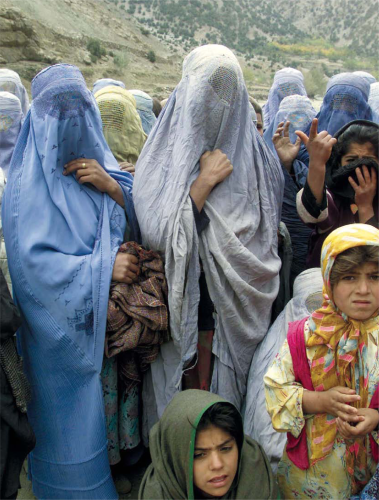
October 1, 2001: Afghan women who fled Taliban persecution await the distribution of blankets in Jabel al Sardj, Afghanistan.
On December 17, 1994, Fauziya Kas-sindja arrived at Newark International Airport and immediately requested asylum. The 17-year-old Togo native had fled her country to escape an arranged marriage for which she would have been forced to undergo her tribe's tradition of genital mutilation. Her father had opposed the practice, and Kassindja had not been subjected to it as a girl. But when her father died, an uncle assumed legal authority over her and insisted on both the marriage and the mutilation.
Kassindja escaped to the United States, where she was detained by the Immigration and Naturalization Service (INS) for 16 months. Her request for asylum was denied on August 25, 1995, by an immigration judge who maintained that genital mutilation was a cultural norm, not persecution, and that Kassindja therefore did not qualify for asylum.
The ruling was highly publicized, and refugee and human rights advocates rallied around the case, recognizing it as a compelling example of a serious international problem: Many women fleeing persecution are blocked from asylum because of a blind spot in the 1951 Refugee Convention.
A June 13, 1996 Board of Immigration Appeals ruling should have lessened that problem in the United States. Reversing the previous decision, the board granted Kassindja asylum, stating that a woman who flees genital mutilation is entitled to refugee protection. The ruling provided the first clear legal precedent in the United States for granting asylum in gender-based cases and is applicable to a wide range of asylum claims in which women suffer because of their gender, including threatened honor killings, sexual slavery and trafficking, extremely repressive social norms, and domestic violence.
Despite the establishment of this precedent, grants of asylum involving similar claims have been unpredictable, and the direction of such cases in the United States is uncertain.
In the last decade, advocates have made tremendous progress toward the recognition of women's rights in the international human rights arena. This has encouraged and supported efforts toward advances in the area of asylum law and the protection of refugee women. But progress has been slow, and the United States in particular has displayed deep ambivalence and resistance. Nevertheless, international momentum for the protection of women refugees is growing. The United States may soon stand alone among industrialized nations in its refusal to fully acknowledge that women who suffer serious gender-based violations of their fundamental human rights are entitled to protection as refugees.
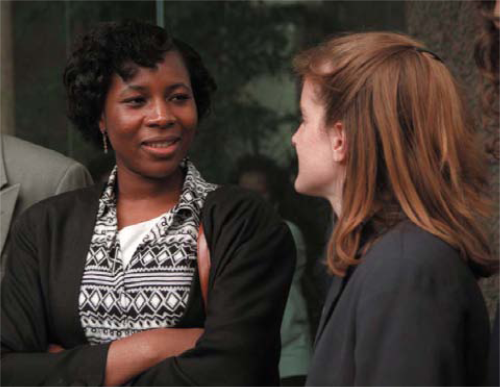
May 2, 1996: Fauziya Kassindja (left) speaks with Sidney Lebowitz, a law student working on her case, following a hearing.
Extreme persecution
Despite years of relentless struggle, no society has managed to achieve gender equality. Yet the simple fact is that respecting women's rights benefits development. According to the World Bank, countries that “promote women's rights and increase their access to resources and schooling enjoy lower poverty rates, faster economic growth, and less corruption than countries that do not.”
But in many countries the inequalities are extreme. Young girls are sold into marriage, killed for “shaming” their families, denied equal rights before the law. We are all now familiar with the Taliban's repression of women in Afghanistan, including the elimination of education for girls, head-to-toe veiling, and acid attacks as punishment.
Stories of extreme violations of women's rights frequently appear in the news. In Pakistan, a tribal council ordered a woman gang-raped as punishment for a perceived violation by her younger brother. In Nigeria, under Shariah law a woman faces death by stoning for bearing a child outside of marriage. In Saudi Arabia, schoolgirls trying to escape a fire were driven back into the burning building by guards because they were not wearing head scarves.
Women's rights in international law
Several international treaties over the last half-century have included issues of women's rights. Building on the U.N. Charter's affirmation of “equal rights of men and women,” gender discrimination is barred under the Universal Declaration of Human Rights and the International Covenant on Civil and Political Rights. In 1979, the U.N. General Assembly adopted the Convention on the Elimination of All Forms of Discrimination against Women, often described as an international bill of women's rights. The convention has been approved by 170 countries–a number that does not include the United States. President Jimmy Carter signed it in July 1980, and in July 2002 the Senate Foreign Relations Committee voted to ratify; the treaty awaits action by the full Senate.
Yet the reality of protection has been very limited because of the so-called public-private sphere distinction. The protections of the international human rights system were seen to apply to governments only, which operate in public, and not to violations committed by private individuals. This limits the reach of human rights protections to women in particular, whose rights are more frequently violated within the family or community, where religion and culture are deferred to as justification.
In the last decade, women began organizing to overcome this inequity. With the rallying cry of “women's rights are human rights,” they engaged in sustained advocacy until their concerns were recognized. Thanks to their efforts, many international human rights documents now specifically address those concerns. The 1993 Vienna Declaration and Programme of Action urged that women's rights should “form an integral part of the United Nations human rights activities, including the promotion of all human rights instruments relating to women.” In the same year, the U.N. General Assembly adopted the Declaration on the Elimination of Violence against Women. The declaration recognized gender-based violence as an imperative human rights issue and stated that whether violations are committed by state or private actors, governments are responsible for remedying violence against women, and that those violations cannot be justified under “custom, tradition, or religious consideration.” The 1995 Beijing Declaration and Platform for Action fortified this position: “Any harmful aspect of certain traditional, customary, or modern practices that violates the rights of women should be prohibited and eliminated.”
Recognizing the refugee woman
The international definition of a refugee originated in the period immediately following World War II and was in great measure a belated response to the world community's failure to protect Jews fleeing the Holocaust. The 1951 Refugee Convention defines a refugee as an individual with a “well-founded fear” of persecution due to race, religion, nationality, membership in a particular social group, or political opinion.
This definition came of age during the Cold War and has been interpreted within an overwhelmingly male paradigm. The quintessential refugee was a political dissident in the Soviet Union or one of its allies. “Persecution” was understood to encompass beatings, torture, and political imprisonment, but not the multitude of violations that are inflicted mainly on women. The absence of the word “gender” from the list of five types of persecution for which refugee status could be based underscores the blind spot the convention drafters had regarding the protection of women.
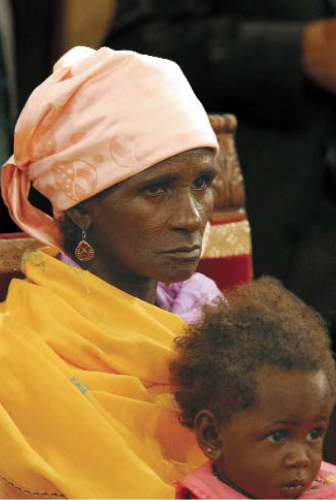
September 2002: Safiya Hussaini is granted honorary citizenship in Rome. Hussaini had been sentenced to death for adultery in her native Nigeria.
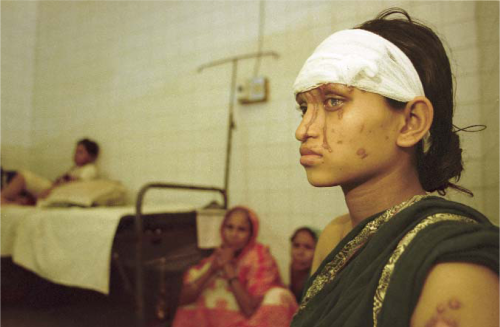
July 2000: Asma, whose ex-boyfriend attacked her with battery acid, waits for treatment with other burn victims in Dhaka, Bangladesh.
In the mid-1980s, the UN. High Commissioner for Refugees (UNHCR), the supervisory body for international refugee issues, began to address the issue of women asylum seekers. Bolstered by parallel developments in international human rights, UNHCR began to recommend that gender-based persecution could be considered grounds for refugee status because women who suffer it could be members of a “particular social group.” 1 In addition, UNHCR encouraged state parties to develop their own guidelines on women asylum seekers. In response, several countries developed immigration policy guidelines that recognized gender-based asylum claims. Canada was the first, followed by the United States, Australia, Britain, and Sweden. Other countries, such as Ireland and South Africa, adopted legislation stating that gender is an appropriate characteristic defining a “particular social group” for asylum purposes. 2 Most recently, in May 2002, UNHCR issued new guidelines on gender-related persecution. The most critical element of the guidelines is their central affirmation that a gender-sensitive interpretation be applied to the refugee convention as a whole.
Gender asylum in the United States
On the basis of the Kasinga decision (her name is misspelled in the legal case), some adjudicators in the United States started to grant asylum to women with gender claims. One such case, granted within months of the Kasinga ruling, was that of Rodi Alvarado, a Guatemalan woman. Alvarado's husband was a former military man who bragged to her about his brutality in killing old people and children, describing in some instances how he burned them alive. For virtually the entire course of their marriage, he subjected her to a level of physical abuse that amounted to torture.
Alvarado's attempts to escape her husband within Guatemala failed because of his ability to track her down. She decided to flee the country after local police and courts rebuffed her requests for protection because they considered it a domestic matter.
The judge who heard Alvarado's case granted her asylum in 1996, but the INS chose to appeal the decision to the same board that had granted asylum in the Kasinga case. When the court finally issued its decision in June 1999, it was a clear repudiation of the Kasinga finding. The persecution that Alvarado had endured had not been of the sort that is covered by the refugee convention, the court ruled, expressly declining to state that she was persecuted because of her membership in a social group defined by gender.
The decision evoked a wave of criticism. Five members of the board wrote a scathing dissent, observing that the ruling was inconsistent with the court's own precedent in Kasinga. Scholars faulted it for being result-oriented and out of step with international developments in the protection of women's and refugee rights. Advocates organized a nationwide campaign to request that Janet Reno use her authority as attorney general to reverse the decision. On January 19, 2001, the last day of the Clinton administration, Reno vacated the decision, erasing the appeal court's “Matter of R-A-” ruling from the books. She ordered the court to reconsider the case after proposed regulations on gender cases, made in December 2000 by the Justice Department, were finalized. Nearly two years later, it is still unclear when, if ever, the Bush administration will take action on those proposals.
An Afghan refugee woman cares for her children in a makeshift camp near the city of Peshawar, Pakistan.
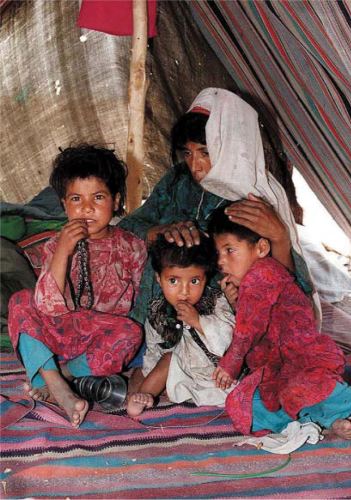
Decisions in the United States on gender asylum remain erratic. Some judges continue to apply the negative precedent of Matter of R-A-, ignoring the fact that it has been overturned, as justification to deny women asylum. In contrast, others see the mooting of the Alvarado case as a go-ahead to grant asylum in gender cases. Many cases sit in limbo, including Rodi Alvarado's, awaiting some signal of the administration's opinion.
Muktar Mai (center) was gang-raped in June on the orders of a Pakistani tribal council as punishment for an alleged transgression by her brother.
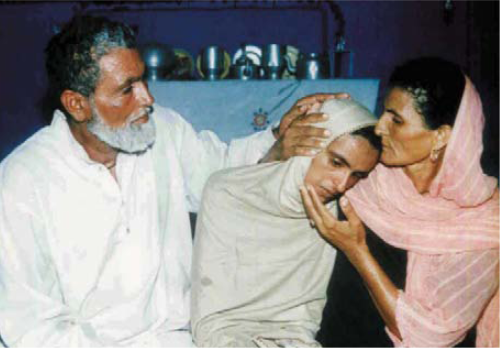
Internationally, the momentum for protection is mounting. In 1999, Britain's highest court overturned previous denials of asylum to two married Pakistani women with similar claims. Forced by their husbands to leave their homes, each faced false accusations of adultery. The women claimed that authorities in Pakistan would not protect them, and instead would subject them to criminal proceedings for sexual immorality–punishable by flogging or stoning to death. The high court ruled for the women to be given asylum because they belonged to the persecuted social group of “women in Pakistan.” 3
That same year, the New Zealand Refugee Status Appeals Authority granted asylum to an Iranian woman whose husband had violently abused her and used subterfuge as well as the legal system to prevent her from access to their child. 4 The New Zealand court remarked that gender discrimination was evident in Iranian laws on divorce and custody, as well as in its penal code, and that “the attitude to domestic violence by the Iranian state is one of condonation if not complicity.” Following that decision, the High Court of Australia ruled favorably in the case of a woman from Pakistan who had escaped from a husband and relatives who beat her and tried to burn her alive. 5
These three cases involved domestic violence and spousal abuse, but the legal principles behind the decisions are applicable across a much broader range of refugee claims brought by asylum-seeking women.
Fear of floodgates
There remains deep resistance to the full inclusion of women within the protection of the Refugee Convention. Some belittle the types of violations women flee from (“You get a punch in the mouth, and you're home free,” scorned one commentator); others criticize granting asylum to these women as improperly meddling in other cultures or societies. Still others characterize the inclusion of women as “special treatment,” rather than equality in terms of protection.
The real reasons for the hostility to gender-based asylum claims are multiple and complex, and include a fear of “opening the floodgates.”
The number of potential beneficiaries of a fair refugee policy is not a principled basis for denying an individual case, and in reality, the majority of women who might benefit live in countries where they are of such subordinate status that they lack the means or resources to escape persecution and claim asylum. The relatively low number of women asylum seekers is born out by statistics from Canada and the United States.
The refugee convention was created to provide surrogate protection to individuals when their own government is unable or unwilling to protect them. It was drafted at a time when the international community had not yet begun to fully recognize women's rights. This fact should not be allowed to hinder its progressive development. The convention is committed to protecting human rights; as the international understanding of human rights advances to fully include women's rights, so too should the convention. There is simply no good reason to deny protection to women refugees who have suffered persecution. •
Footnotes
1.
In 1985, UNHCR's Executive Committee advised that women refugees who face harsh treatment for having “transgressed the social mores of the society in which they live” may be considered to be members of a particular social group, and could therefore be granted asylum. Conclusion on Refugee Women and International Protection, UNHCR Programme Executive Committee, 36th Session, No. 39(k) (1985).
2.

3.
Islam & Shah, [1999] 2 WLR 1015.
4.
Refugee Appeal No. 71427/99.
5.
Minister for Immigration and Multicultural Affairs v. Khawar, [2002] HCA 14.