




Abstract
A worldwide survey of refugees shows that when crises emerge, the international community takes too little action, too late. Things have only gotten worse since last September.
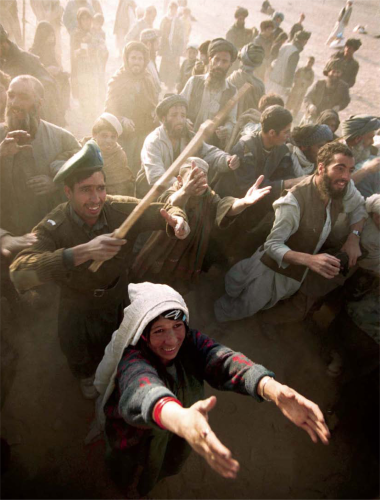
December 4, 2001: Afghan refugees in a temporary camp at Chaman, Pakistan, jockey for position to receive food aid.
The terrorist attacks of september 11, 2001, and the subsequent “war on terrorism” launched by the United States and its allies have had a spillover effect on the lives of refugees worldwide.
Afghan refugees, internally displaced persons, and asylum seekers were most obviously affected–directly or indirectly. Hundreds of thousands of Afghans were forced to flee and others were plunged into further destitution and uncertainty. Neighboring governments, some of which had hosted millions of Afghans for nearly two decades, closed their doors to new arrivals and accelerated measures of inhospitality to encourage long-term Afghan refugees to go home soon.
But the ripple effect carried far beyond southwestern and south central Asia; not only did asylum seekers worldwide find their paths blocked by new security measures and tightened immigration controls, but recognized refugees found that offers of resettlement through organized and legal channels were put on hold. And although the crisis succeeded in focusing the world's attention on the humanitarian needs of hungry and desperate Afghan refugees, resources urgently needed to provide for refugees and displaced people in many other places, particularly Africa, became ever scarcer.
The case of Afghan refugees is an important object lesson for the future: Neglect is never benign. Failed states producing hopeless and dependent uprooted people are not simply a blight on the world stage, but a dangerous breeding ground for political and religious fanaticism and a vacuum of lawlessness where warlords, gangsters, and terrorists can operate with impunity. Too often, the world community takes notice only after terrorists strike. Too often, the international response is to blame the refugees, even when they themselves are the victims, not the perpetrators, of terrorism.
The displacement of Afghan refugees engendered little international interest or response for nearly a quarter-century. What little interest there was waned during the past decade, particularly as the conflict in Afghanistan ceased being a proxy battle in the Cold War and degenerated into a chronic, ethnically based conflict of little or no political interest outside the confines of Afghanistan and its immediate neighbors.
Afghans joined the ranks of other long-term refugee and internally displaced populations, left to years of stagnant, forgotten limbo by seemingly intractable conflict. The chronic uprooted were victims not only of the failed leadership of their own societies, but also, in turn, of the unwillingness of the international community to devote necessary resources to help resolve those conflicts, or at least to attend to the social and humanitarian dimensions of the political stalemates that prevented them from returning home.
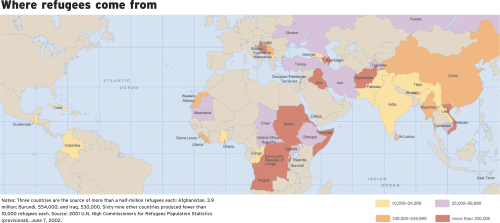
Living on the margins of unwilling host communities, often in overcrowded and fetid refugee camps, the long-term uprooted–including Afghans, Palestinians, Sudanese, Soma-lis, Iraqis, Angolans, Colombians, Er-itreans, Azerbaijanis, Sahrawis, and Burmese–were victims not only of the war and persecution that forced them from their homes, but of the neglect that kept them in misery and denied them hope of political settlements to resolve the underlying causes of their misfortune.
Refugees and internally displaced people are not simply a humanitarian burden of the sort created by earthquakes, floods, or even generalized poverty. As victims of conflict and persecution, they serve as a clear warning that the social compact has gone awry. Attending to the needs of refugees will not only benefit the refugees themselves, it will enhance the peace and security of the world.
At the close of 2001, U.S. policymakers, in particular, were reexam-ining one of the campaign issues in the previous year's presidential election: whether the United States ought to be engaged in so-called nation building. In 2000, presidential candidate George Bush had scorned the idea that the United States had a role in promoting or facilitating nation building of failed states. In late 2001, however, Bush came to a different conclusion. He no longer saw nation building as the dreamy province of overly idealistic do-gooders, but as smart national security-oriented foreign policy.
Attending to the needs of refugees and internally displaced people is often the first step in restoring order to a disordered world. But bringing order out of chaos is not achieved quickly, easily, or on the cheap. It requires resources, patience, and, most important, commitment. It is a process, one that has distinct stages.
A smart refugee policy is a humane policy that should:
seek to resolve or attenuate the causes of forced migration in unstable nations by promoting human rights, conflict resolution, democratization, and sustainable development;
insist on the right of displaced persons to seek asylum from persecution across borders;
ensure that asylum seekers are provided at least temporary protection and physical security by countries of first asylum through equitable international burden sharing;
afford asylum seekers the opportunity for fair consideration of their refugee claims;
provide refugees and internally displaced persons adequate assistance to meet their basic needs for food, medicine, clothing, shelter, education, and their longer-term needs for employment, free movement, and self-sufficiency; and
facilitate safe repatriation or other durable solutions that allow refugees to enjoy a future anchored in human dignity.
Safe and dignified return is not possible unless the country of origin is stable, capable of reintegrating returnees, and respectful of human rights. Returning refugees can be a tremendous asset to a recovering society, as we were beginning to see with the return of Afghans at the close of 2001. But they cannot be thrown back in helter-skelter and be expected to succeed without outside support.
The following summary of the situation of refugees, asylum seekers, and internally displaced people at the end of 2001 demonstrates how badly needed is a more proactive response from the international community.
South and Central Asia
Afghan refugees and displaced persons became the focus of world attention in late 2001 when the United States embarked on a military campaign to root out terrorists operating out of Afghanistan and to topple the Taliban regime that harbored them.
Earlier in the year, conflict between the Taliban and Northern Alliance opposition forces, coupled with the second year of a devastating drought, had forced tens of thousands of Afghans to flee to Pakistan and many others to be internally displaced. U.S. air strikes and intensified ground conflict between Taliban and Northern Alliance fighters displaced hundreds of thousands more civilians and disrupted the efforts of U.N. agencies and international nongovernmental organizations (NGOs) to assist an estimated 5 million Afghans in need of food aid. With U.S. help, the Northern Alliance captured most of northern and western Afghanistan by mid-November, but the lawlessness and banditry that followed continued to disrupt aid efforts.
Although the Pakistani border was officially closed to all but a few thousand vulnerable refugees, more than 160,000 Afghans managed to enter the country through the still-porous border between September and December. Most stayed with friends and relatives, but as their numbers grew, the U.N. High Commissioner for Refugees (UNHCR) began transferring some of them to new camps that Pakistan situated in harsh, unsafe locations near the Afghan border.
Already host to more refugees than any other country in the world, Iran also closed its border to thousands of Afghans attempting to enter the country. Although Iran set up camps for would-be refugees across the border in Afghanistan, the camps were overcrowded and lacked adequate resources. In December, the Iranian Red Crescent refused to admit some 2,000 Afghans, mainly women and children, saying that the camps were full. Afghanistan's central Asian neighbors also kept Afghan refugees out.
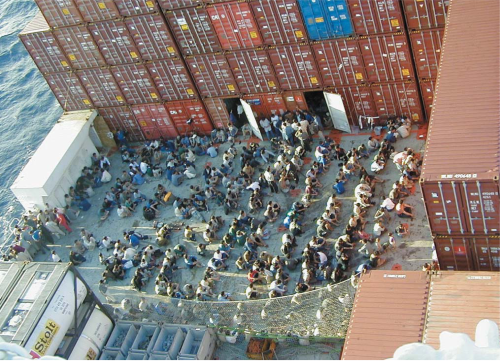
August 2001: A Norwegian cargo ship with more than 400 refugees rescued from a boat stranded at sea. When Australia turned the refugees away, they were taken to camps on Nauru.
Elsewhere in the region, Islamic extremist violence caused as many as 40,000 Bangladeshi Hindus to flee to India. In October, after mobs killed several Hindu men and raped dozens of Hindu women and children, Indian border guards arrested hundreds of Bangladeshi Hindus trying to flee across the border. The Indian authorities did not assist the refugees who managed to enter. In Arunachal Pradesh and Mizoram states in northeast India, xenophobic local groups sought to push out refugees who had been living in those states for years. Fighting in Sri Lanka continued to displace civilians, with little hope in sight for an end to the 18-year conflict between that country's majority Sinhalese Buddhist majority and Tamil Hindu minority. Burmese Rohingya refugees and ethnic Nepal-ese and Bhutanese refugees also continued to languish, with little hope for an end to their plight, in camps in Bangladesh and Nepal, respectively.
Middle East
In the Middle East, the cycle of bloodletting between Israelis and Palestinians intensified significantly in 2001, resulting in hundreds of Palestinian and Israeli deaths and new Palestinian displacements. Although during 2000 the violence was confined mostly to clashes between Israeli soldiers and Palestinian youth armed with stones and Molotov cocktails, the fighting in 2001 escalated into near-open warfare, pitting Palestinian gunmen against Israeli tanks, helicopters, and fighter aircraft.
Civilians on both sides paid the price. Palestinian suicide bombers and gunmen targeted Israeli civilians in Israel and Israeli settlers in the Occupied Territories, resulting in scores of deaths during the year, often in ghastly attacks on clearly civilian concentrations. Israel employed missiles, tanks, and aircraft to target Palestinians suspected of masterminding terrorist attacks in Israel, killing not only their intended targets, but also innocent bystanders. By year's end, the Palestinian death toll had climbed to more than 860 since the Palestinian uprising began in September 2000. Israeli forces also responded to Palestinian fire on Jewish settlements and Israeli soldiers in the Occupied Territories by demolishing some 280 Palestinian homes, rendering more than 3,000 Palestinians homeless, most of them refugees from 1948 and their descendants who lived in camps in the Gaza Strip.
Israeli curfews and closures further exacerbated the predicament of Palestinians in the West Bank and Gaza Strip. Closures crippled the Palestinian economy, disrupted daily activities such as schooling for children, and at times prevented Palestinians from reaching hospitals for life-saving medical treatment.
With daily bloodshed continuing, the prospects for breaking the cycle of violence and returning to the negotiating table appeared remote. Palestinian-Israeli violence also appeared to add to the ranks of Palestinians displaced from the Gaza Strip and West Bank in 2001; more than 26,000 Palestinians reportedly left and did not return to the Occupied Territories between June 2000 and July 2001.
In Iran and Iraq, the persecution of minorities and political opponents continued to displace significant numbers of people. In Iraq, crippling economic sanctions continued to render destitute thousands of Iraqis, leading many to leave the country. For those who managed to escape persecution, asylum in the region remained precarious.
In addition to imposing new restrictions on Palestinian refugees, Lebanon cracked down on asylum seekers from other countries, reportedly detaining hundreds of Iraqis and Sudanese in poor conditions. Lebanon committed refoule-ment, forcibly returning some refugees and asylum seekers to their countries of origin during the year, a violation of international refugee law.
Although the UNHCR is responsible for conducting status determinations in these and most other countries in the region, it recognizes only a small fraction of refugee claimants. Without possibilities for either obtaining legal status in the region or resettling to other countries, many attempted the journey to Europe, Australia, and other Western industrialized countries, often putting themselves into the hands of smugglers and traffickers.
East Asia and the Pacific
The year's major refugee story in the East Asia/Pacific region began in late summer, when one of the region's “Western” nations initiated a dramatic policy aimed primarily at asylum seekers from Afghanistan and Iraq. Australia's harsh policy seemed eerily prophetic just weeks later when, in the aftermath of September 11, Afghanistan was once again at the center of a refugee and humanitarian crisis.
On August 26, a Norwegian freighter in the Indian Ocean answered a distress call from a boat carrying more than 430 Afghans and Iraqis. The passengers had traveled to Indonesia with the help of smugglers, who then put them on a leaky ferry bound for Australia.
After the rescue, the captain of the Norwegian ship responded to the asylum seekers' request to be taken to Christmas Island, an Australian territory about 900 miles from the mainland. Australia refused to let the freighter dock and insisted that Norway or Indonesia take responsibility. Neither country did. Eventually, the tiny Pacific nation of Nauru agreed to accept the asylum seekers for the purpose of having their refugee claims processed. In exchange, Australia gave Nauru an aid package worth $10 million. Soon after, Australia legislatively removed its outlying territories from its “migration zone” and struck a deal with Papua New Guinea for it to become a second regional processing site.
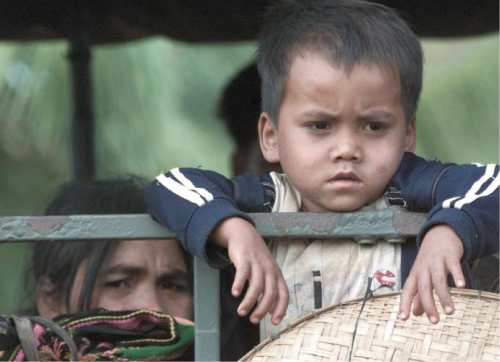
April 2002: Vietnamese Montagnards who fled first to Cambodia, on the second leg of their journey to resettlement in the United States.
Elsewhere in the region, the situation of refugees and displaced persons remained largely unchanged from the previous year. Indonesia appears to have surpassed Burma as the region's largest producer of internally displaced persons–the Indonesian figure grew to more than 1.3 million by year's end.
By contrast, the number of East Timorese refugees in the Indonesian territory of West Timor fell to an estimated 50,000-80,000, as repatriations to East Timor increased despite continued militia intimidation and the lack of a UNHCR presence in West Timor. It is unclear to what extent returns were coerced by Indonesia's threat to withdraw refugee status and discontinue aid.
In Burma, fighting between ethnic Shan insurgents and Burmese troops, as well as the Burmese regime's relocation of tens of thousands of ethnic Wa into traditional Shan areas, forced thousands to flee to Thailand. Thai authorities continued to deny most Shan access to refugee camps, forcing them to remain in Thailand without legal status. Thailand also maintained its restrictive admissions standard for other Burmese minorities and forcibly returned some refugees to Burma.
As violence and new displacement continued in the southern Philippines, Malaysia once again beefed up air and sea patrols for a possible influx of Filipino refugees. However, it sent mixed messages about its willingness to receive them.
Vietnam and Cambodia once again became immersed in a refugee dilemma, as hundreds from Vietnam's central highlands, mostly Montagnards, fled to Cambodia following a government crackdown. Cambodia took a harsh public line against the asylum seekers, but permitted UNHCR to screen and assist them, and to arrange U.S. resettlement for some approved refugees, angering Vietnam. In late September, the two countries signed an agreement to prevent future “illegal border crossings.”
Africa
In Africa, the prevailing sense of 2001 was of an entire continent holding its collective breath to see if true peace really was about to break out in several war-torn countries. The continent ended the year approximately as it began: with some 13 million people uprooted by war and persecution, including about 3 million refugees and about 10 million internally displaced persons.
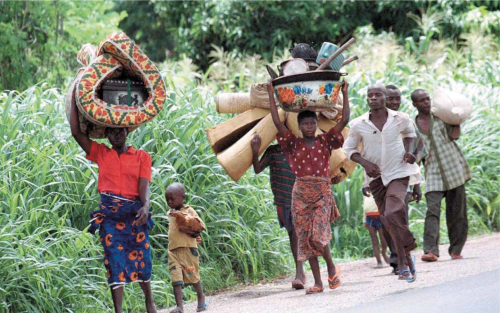
An estimated 1.7 million Africans fled their homes during the course of 2001–testament to the continent's continued volatility. New flows of refugees and displacement were particularly large in Congo-Kinshasa, Sudan, Burundi, Liberia, Angola, Zimbabwe, Nigeria, the Central African Republic, and Senegal.
Behind the grim facts about refugees, however, a tantalizing question lingered unanswered throughout the year: Was peace nearly at hand, or were ongoing peace negotiations merely a cruel deception by antagonists wedded to war?
Negotiations to end civil wars in Congo-Kinshasa, Sierra Leone, and Burundi seemed to make progress during 2001, yet warfare continued to rage in two of those three countries. Genuine peace in all three countries would allow nearly a third of Africa's uprooted people to go home.
Sierra Leone appeared to make the greatest inroads toward peace during 2001, after 10 years of war. Tens of thousands of Sierra Leonean refugees and displaced persons returned to their homes as rebel forces and civilian militia gradually disarmed under the watchful eyes of U.N. peacekeepers and British troops. Sierra Leone's increasingly hopeful population dared to plan for democratic elections in mid-2002.
Peace agreements in Burundi and Congo-Kinshasa were more tenuous–if credible at all. Military offensives in violation of cease-fire agreements persisted in Congo-Kinshasa, preventing most of the country's 2 million uprooted people from returning home to restart productive lives. Congo-Kinshasa's war entered its fourth year.
A new transitional government in Burundi, cobbled together through sheer force of will by mediator and former South African president Nelson Mandela, encouraged a dozen exiled Burundian political leaders to repatriate, but failed to curb continued attacks by two rebel armies or secure a cease-fire. Burundi's war entered its ninth year, stranding nearly a million uprooted people.
Bolstered by U.N. peacekeeping troops, Ethiopia and Eritrea maintained a grudging peace during 2001 after several years of massive bloodshed over a disputed border between the two countries. International arbitration over the border was scheduled to reach a final judgment in early 2002.
No such doubts existed about the wars in Sudan and Angola, where prospects for imminent peace simply did not exist. Sudan's civil war entered its nineteenth year and continued to produce one of the world's largest uprooted populations–nearly 4.5 million people.
Angola's civil war remained mired in a vicious cycle of government military offensives and rebel counterof-fensives, forcing more than a quarter-million additional Angolans from their homes during 2001. Three decades of violence have left at least 1.5 million Angolans uprooted.
Nigeria, June 2001: A clash between ethnic groups, the Hausa and the Tiv, sent these Tiv refugees, and thousands of others, in flight.
Much of Somalia remained rife with violence and relative anarchy during 2001. However, positive developments occurred in much-ignored northwest Somalia, where tens of thousands of refugees returned home to the self-declared country of Soma-liland after surviving for years in squalid refugee camps in neighboring Ethiopia.
Poor funding by donor nations for refugee assistance was, sadly, a common occurrence throughout Africa during the year and often resulted in harsh living conditions for the continent's refugees.
Relief programs for a million refugees in East Africa and the Horn of Africa received $8 million less than needed in 2001, according to UNHCR. Assistance for nearly a million refugees in Central Africa suffered a $7 million shortfall. More than a half-million refugees in West Africa lacked nearly $5 million in much-needed aid.
Inadequate funding led to food cutbacks, unreliable drinking water, bare medical clinics, overcrowded schools, and other cuts in basic services to refugee populations throughout Africa.
At the end of 2001, the five largest sources of uprooted people in Africa were Sudan, Congo-Kinshasa, Angola, Burundi, and Sierra Leone. Those five countries accounted for some three-quarters of all uprooted people on the continent.
The five African countries hosting the largest numbers of refugees were Tanzania, Sudan, Congo-Kinshasa, Zambia, and Kenya.
These grim national rankings will remain unchanged for the foreseeable future unless peace negotiations and post-conflict humanitarian assistance prove to be genuine efforts, rather than half-hearted gestures.
Europe
As in much of Africa, the lack of progress in negotiating a peace left more than 450,000 Chechens displaced in Chechnya and neighboring republics with little prospect of safe return. Despite dismal conditions for most of the displaced living in neighboring Ingushetia, few returned to Chechnya during the year, both because they still feared for their lives there and because, in many cases, their homes were destroyed. Poor security and the threat of kidnapping of aid workers impeded relief efforts inside Chechnya, where about 160,000 displaced persons lived.
The post-September 11 climate of anxiety about terrorism, combined with Russia's pledge of support for U.S. anti-terrorism efforts, led the United States to soften its already muted criticism of Russia's human rights record in the region. At year's end, there was no movement toward a negotiated settlement, and the low-intensity conflict sputtered on.
In the Balkans, where nearly 2 million people remained displaced from their homes by the ethnic conflicts that consumed the region during the 1990s, the year was marked by mixed developments. The arrest and subsequent extradition to the Hague in June of former Yugoslav president Slobodan Milosevic raised hopes for national reconciliation and new international aid for the economically ravaged Serbia, while a new law allowed some of the estimated 400,000 refugees in Serbia to adjust to citizenship and integrate locally. In Croatia, the moderate government elected in 2000 enabled the return of about 53,000 refugees and displaced people in 2000 and 2001, although a number of issues affecting refugee return, including returnees' repossession of property, remained unresolved.
At the same time, continued ethnic tension in the Kosovo region meant that few of the 230,000 uprooted Serbs, Roma, and other ethnic minorities attempted to return to the homes they fled in 1999-2000. In Bosnia-Hercegovina, about 18,400 refugees were able to repatriate during 2001, although 635,000 people remained internally displaced at the end of the year, with some 380,000 living abroad without durable solutions.
In Macedonia, ethnic tensions were inflamed during the first eight months of the year by fighting between ethnic Albanian rebels and Macedonian government forces, resulting in the displacement of some 170,000 people. By year's end, following a peace accord signed in August, about half had returned home.
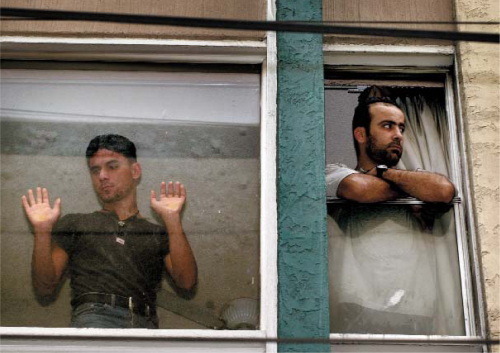
September 2000: Iraqi Chaldean Christians wait in a Tijuana hotel while their requests for asylum in the United States are considered.
Reverberations from the September 11 terrorist attacks in the United States were felt throughout Europe in the last few months of 2001. In a climate of increased wariness toward asylum seekers, governments stepped up border controls to combat smuggling of immigrants and asylum seekers and proposed tightened asylum screening processes. Several governments passed anti-terrorism laws that curtailed the rights of immigrants and refugees inside their borders. In December, the European Commission issued a working paper that examined mechanisms for excluding terrorists or suspected terrorists from protection under the U.N. Refugee Convention. Several countries, including Sweden and Austria, allowed asylum seekers accused of terrorism to be extradited to countries where they could face torture or execution. Although discussions continued in 2001, European Union member states made little significant progress toward adopting a common European asylum policy.
The Americas
In North America, the September 11 attacks had far-reaching implications for asylum seekers and refugees. Following the attacks, the United States, Canada, and Mexico intensified efforts to harmonize their immigration and asylum procedures, and discussions of a “North American Security Perimeter” were revitalized. [See “¿Dónde Está La Frontera?” in the July/August 2002 Bulletin.] In December, the United States and Canada formally agreed to review security-screening procedures for refugees and asylum seekers, share information on asylum seekers, and negotiate a safe third-country agreement.
The September 11 attacks also had immediate repercussions for refugees destined for resettlement in the United States. The United States immediately halted all refugee processing and admissions after the attacks and did not resume until December. The three-month moratorium meant that fewer refugees were admitted to the United States in 2001 than in any year since 1987, continuing a trend in declining admissions that began in the early 1990s. Canada's refugee processing was not suspended after September 11, and Canada's resettlement program continued to operate throughout the year.
The number of asylum applications filed in the United States rose substantially in fiscal year 2001 (ending on September 30). The most dramatic increases were in the numbers of Colombians, Albanians, Burmese, Indonesians, Mexicans, and Armenians filing for asylum, all of which more than doubled. While the number of Afghans applying for asylum in the United States remained low, most who applied were granted asylum. Most Colombians who sought refuge in the United States did not apply for asylum, fearing rejection.
Before September 11, the newly elected presidents of the United States and Mexico engaged in a series of talks toward legalizing the status of millions of undocumented Mexicans living in the United States. After the September terrorist attacks, U.S.-Mexico discussions shifted focus to security concerns. Mexico detained a number of immigrants from the Middle East after September 11, including a group of Iraqi Chaldeans who had asylum applications pending in the United States.
In the first eight months of the year, Central America continued to be an increasingly popular route for migrants from Africa, the Middle East, and other areas outside the region who intended to reach the United States. At the same time, Central American political leaders and law enforcement pledged to intensify efforts to tighten border security and combat human trafficking.
Although the conflict in Colombia continued to escalate during 2001, generating record numbers of displaced people, news of the country's violence and displacement nearly disappeared from international public attention after September 11. Right-wing paramilitary groups and left-wing guerrillas increasingly targeted civilians, committing dozens of brutal massacres, in some cases hacking their victims to death with machetes. The violence uprooted some 342,000 Colombians during the year.
The United States provided more than $860 million in aid to Colombia under “Plan Colombia” during 2000 and 2001. Most was military aid aimed at combating narcotraf-ficking, but some of the aid went to projects that benefited internally displaced persons. U.S.-funded aerial spraying of coca crops did not displace as many people as advocates for the displaced initially feared it would, but the fumigation program disrupted the lives of many peasants in the southern Putumayo region, and reportedly caused health problems, particularly among children. •