




Abstract
On May 24, President George W. Bush signed a spanking new arms control agreement in Russia. The treaty, which he claimed would “liquidate the legacy of the Cold War,” mandates the reduction of deployed strategic nuclear weapons to between 1,700 and 2,200 over the next decade, a reduction of about 4,000 weapons for each country. Yet even as the administration touts these would-be reductions and basks in its victory in Afghanistan, it has been elevating the development and possible use of nuclear weapons to what looks like the centerpiece of its new national security agenda. This has engendered something of a backlash in Congress.
The agreement signed in Russia reflects the options outlined in the administration's Nuclear Posture Review, a periodic reappraisal of U.S. nuclear policy. Some of the review's conclusions were provided to the media in January; much of the rest leaked out in March.
The review's recommendations are alarming. It lists three broad contingencies in which the United States would consider using nuclear weapons: to attack targets that cannot be destroyed by conventional explosives, such as bunkers buried deeply underground; to respond to an attacker who used nuclear, chemical, or biological weapons; or to respond to “surprising military developments.” (emphasis added)
The first option is controversial, but the third option should raise seri ous alarm: When is a military conflict not a surprise? Saddam Hussein's invasion of Kuwait was a surprise. Slobodan Milosevic's march into Kosovo was a surprise. The attacks on the World Trade Center and the Pentagon were surprises. Do these unexpected military actions warrant use of nuclear weapons?
The report also lists specific scenarios for using nuclear weapons— an Arab-Israeli conflict, a conflict with China over Taiwan, a North Korean attack on South Korea, and an attack by Iraq on Israel or another neighbor. The new policy means that for the first time the United States will threaten the use of nuclear weapons against countries that do not themselves possess nuclear weapons, a radical shift in long-held U.S. policies that have been consistent with the Nuclear Non-Proliferation Treaty.
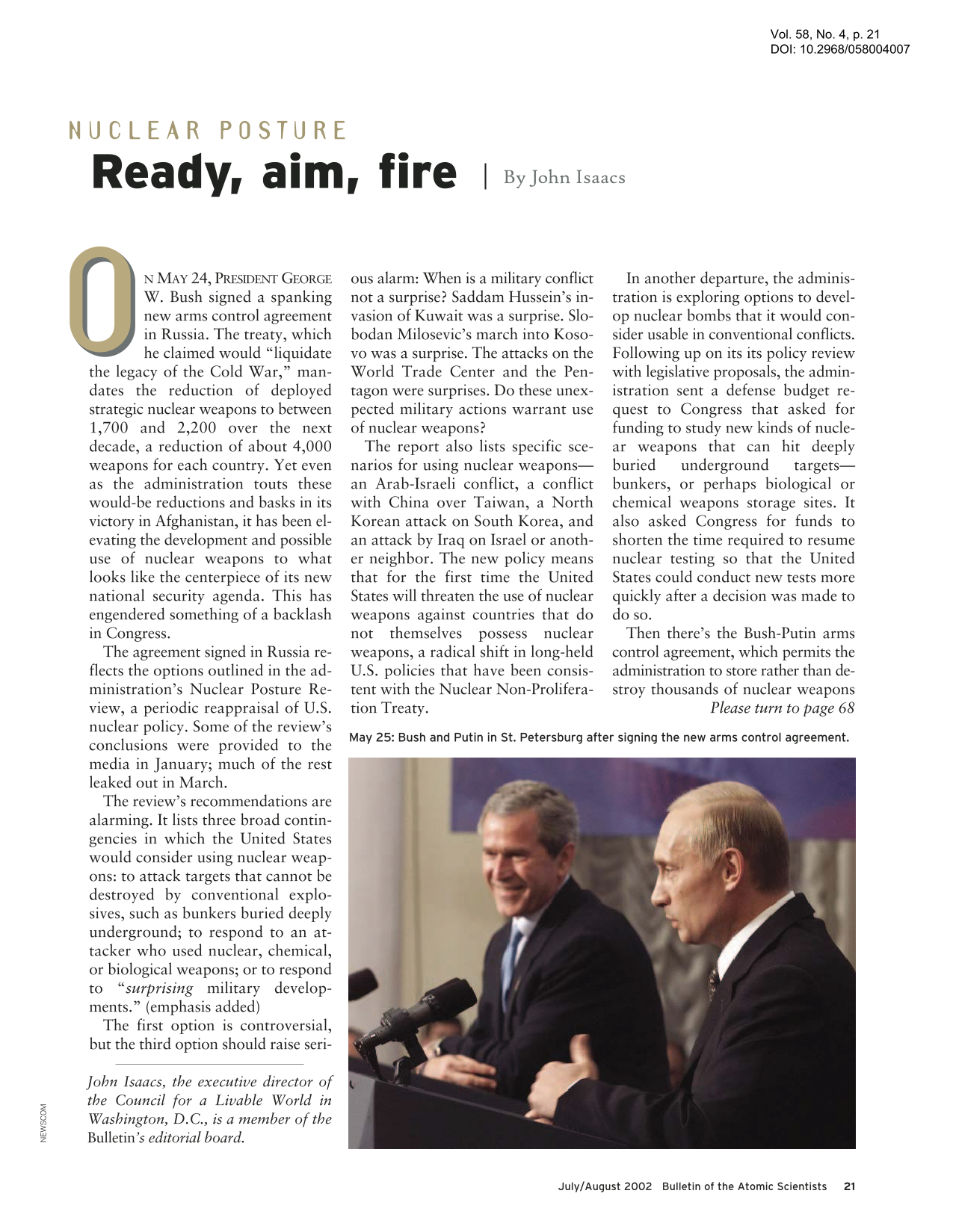
May 25: Bush and Putin in St. Petersburg after signing the new arms control agreement.
In another departure, the administration is exploring options to develop nuclear bombs that it would consider usable in conventional conflicts. Following up on its its policy review with legislative proposals, the administration sent a defense budget request to Congress that asked for funding to study new kinds of nuclear weapons that can hit deeply buried underground targets— bunkers, or perhaps biological or chemical weapons storage sites. It also asked Congress for funds to shorten the time required to resume nuclear testing so that the United States could conduct new tests more quickly after a decision was made to do so.
Then there's the Bush-Putin arms control agreement, which permits the administration to store rather than destroy thousands of nuclear weapons taken off-line, meaning they will remain available to be redeployed in the future.
In addition, a key Pentagon adviser suggested exploring the use of nuclear-armed interceptors in the budding U.S. missile defense system.
No nuclear bombs have been dropped since the United States destroyed Hiroshima and Nagasaki in 1945. In the intervening 57 years, the United States and Russia constructed tens of thousands of nuclear weapons and engaged in numerous military and diplomatic confrontations. Even when presented with the nuclear option in past crises, American political leaders have concluded that it is unthinkable for the United States to employ nuclear weapons for any purpose except to deter the use of nuclear weapons against the United States and U.S. forces. But now the Bush administration seems intent on erasing the bright and long-established line between the use of conventional and nuclear weapons.
Newspaper editorials and a number of Democratic members of Congress jumped on the president's new policy direction. On March 12, the New York Times editorialized against the new policy with the headline: “America As Nuclear Rogue.”
The same day, the Los Angeles Times wrote: “Merging nuclear and non-nuclear systems as part of planning could encourage other nations to step up development of their own nuclear weapons. In 1945, J. Robert Oppenheimer watched the detonation of America's first atomic weapon, which he helped build, and recalled the lines from the Hindu epic Bhagavad Gita: ‘Now I have become Death, destroyer of worlds.’ His horror is worth remembering.”
In a letter to President Bush on April 11, 2002, Democratic Cong. Edward Markey of Massachusetts and 33 cosigners wrote: “Threaten-ghoulish scientific interest in the offensive possibilities of bacteria.” But these types of assessments were rare, and readers will be struck by the modest, measured nature of most of the advisers' recommendations.
British scientists worked on a range of lethal biological agents, including plague and anthrax, as well as on incapacitating germs like brucellosis and tularemia, which produce a persistent fever but are rarely fatal to humans. They also studied the military application of various biotox-ins, like botulinum— now the basis of the popular beauty treatment, botox. Balmer hints at, but does not directly discuss, additional work on anti-livestock and anti-crop warfare.

The book provides a great deal of new information, including descriptions of wartime efforts to design an anthrax bomb, which reached the prototype stage; “Project Red Admiral,” the Royal Air Force's post-war program to develop an offensive biological bomb “comparable in strategic effect with the atomic bomb”; proposals for an experimental plant in the heart of southern England to mass-produce pathogenic organisms; and a series of trials carried out in the Caribbean and off the Scottish coast. He describes how scientists exposed animals to anthrax, brucellosis, and tu-laremia in choppy seas off Antigua in 1948; the use of plague—possibly an “avirulent” strain—in prototype bombs tested off the Isle of Lewis in 1952-1953; and tests using aerosol sprays to disseminate Venezuelan equine encephalitis in the Bahamas in 1954-1955.
By the mid-1950s, writes Balmer, the requirement to produce a biological bomb had been dropped and the bioweapons program was “drifting.” In 1956, the Chiefs of Staff decided
to abandon all work on offensive chemical weapons and perhaps—the documentary record is unclear—to abandon biological weapons as well. Despite these developments, tests of sprays and “non-pathogenic” organisms continued into the 1960s. Many of these tests took place over British cities, including Salisbury and Norwich, in government buildings, and in the London Underground. Biological warfare research was still alive and well, although it had been re-focused on defensive measures and threat assessment. But the trail of declassified documents begins to run cold at this point.
A central question of Britain and Biological Warfare is whether germs can truly be used as weapons of mass destruction. British officials and scientists began asking themselves this question as far back as 1946. Military planners thought biological warfare had considerable potential, and for a short time it received high priority in British defense research, on par with nuclear weapons. Ten years later, however, planners concluded that “the strategic value of biological warfare in its present known forms is insignificant.”
Delivering bacteria to a target was a difficult undertaking, but problems related to engineering an epidemic and using it to undermine an enemy's ability or willingness to fight were never truly addressed. In strategic terms, biological warfare had no real place, either in an East-West global nuclear war or in British “imperial policing” operations. International legal prohibitions against the first use of chemical and biological weapons, established by the 1925 Geneva Protocol, were also powerful constraints on the British government and its research establishments.
Britain also considered the possibility of sabotage—of using bacteria as a terror weapon. The Special Operations Executive contemplated clandestine germ attacks on Germany during World War II, and the security services seem to have investigated defensive measures against germ sabotage. But these organizations lacked the political weight and funding of the armed forces, and so sabotage remained a minority interest.
The book's weakness is its lack of context. Packed with detail, it is sometimes hard to follow and interpret, especially if the reader lacks a broader knowledge of British politics and defense policy. The book also pays little attention to biological warfare research outside Britain. Although Balmer describes discussions between British, Canadian, and U.S. scientists, and underscores the value these countries placed on international collaboration, we find out little about what resulted from their interactions.
The lay reader may find much of the book to be somewhat demanding, but this shouldn't discourage those interested in the history of weapons of mass destruction programs and proliferation. The book will be of particular interest to students of British defense history and policymakers, who must confront a biological warfare threat that now seems as frightening and real as ever. •
Richard Moore is the author of The Royal Navy and Nuclear Weapons. He lives in Gloucestershire, England.