




Abstract
The Tragedy of Great Power Politics
John J. Mearsheimer
W. W. Norton & Company, 2001
555 pages; $26.95
If you thought the twentieth century was cruel, with upwards of 100 million people killed in warfare, wait until the twenty-first: “This cycle of violence will continue far into the new millennium,” writes John J. Mearsheimer, the R. Wendell Harrison Distinguished Service Professor of Political Science at the University of Chicago. “Hopes for peace will probably not be realized” because great power competition is the natural state of affairs–making for a world of sharp conflict that is nasty, brutish, and eternal.
Mearsheimer offers his theory of “offensive realism” in “a handful of simple propositions” that come at the reader like staccato machine-gun fire. Great powers are those that can field a conventional army capable of conducting all-out war, and that have a survivable nuclear deterrent; they perpetually seek to maximize their share of world power in a zero-sum struggle with other powers doing the same thing; and their ultimate aim is to be the hegemon–“the only great power in the system.” This state of affairs is tragic, according to Mearsheimer, precisely because it is unavoidable and ineluctable; it is neither designed nor intended by human beings, yet we are all caught up in it, inescapably and forever.
This book does not have a tragic tone, however, because Mearsheimer is having too much fun explaining why we're all going to hell in a hand basket of our own (unconscious) design. This treatise is a milestone in the literature of realpolitik for its simplicity and directness, its unswerving commitment to a single handful of pithy, tried-and-true realist propositions, and its unalloyed, straightforward shoot'em-up style.
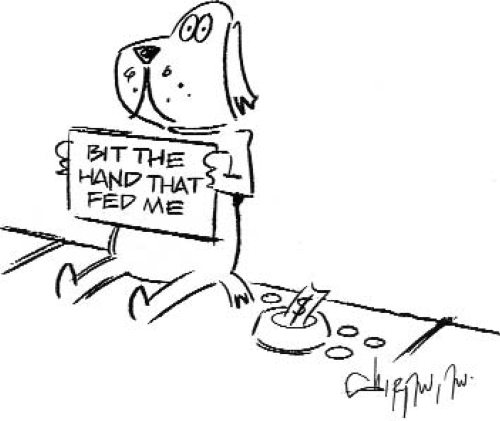
Bullets seem to whiz by as Mearsheimer tells us that anarchy reigns in the international system; that the guy with the biggest gun wins (“the strongest power is the state with the strongest army”); it's a dog-eat-dog world and when you get into trouble there's no 911 to call; going democratic won't help either because regime type makes no difference (democracies fight each other, too); and a cruel fate awaits us all because for every human neck, “there are two hands to choke it.” If this sounds like the Clint Eastwood theory of international affairs, Mearsheimer would only take that as a compliment. His fervid and often funny style will make the book standard reading in the classroom; indeed, generations of students will enjoy throwing brickbats at his arguments.
The big powers, being big powers, are always on the march. If they aren't, well, they're just biding their time and building up their armies, looking for a chance to strike. The French will delight in Mearsheimer's account of modern German history, with Germans on the aggressive onslaught every day of the week from Bismarck through Hitler, just as Koreans will love his depiction of Japan's single-minded expansionist bent from 1868 to 1945. History is the place where Mearsheimer “tests” his propositions, and it's hard to fail the test: Even pasta and wine-loving modern Italy was constantly seeking “opportunities to expand”; its “hostile aims were ever-present.” If Italy nonetheless wasn't going anywhere, it was because “its army was ill-equipped for expansion.”
You would think that the spectacle of the world's second-ranking superpower closing up shop and turning itself into 15 squabbling nations in 1991 would be a bit of a stretch for the tenets of “offensive realism,” but no–the Soviet Union's self-liquidation was another instance of realism in action.
Now the theory tells us that the great clash of the new century will be between the United States and China. But we don't need to worry about Japan and Germany: They may be the second and third largest economies in the world, but they haven't been great powers since 1945. Why? Because the United States keeps its troops on their soil. And if the troops should leave? Then they're great powers after all and all bets are off. It's nice to have a parsimonious theory that explains everything.
The book is a bit too simple, however, in its confrontation with a narrow literature of international relations unique to the American experience and the American academic scene. There are only two theories, realism and liberalism (or idealism), as Mearsheimer tells us today, and as George Kennan told us half a century ago in his classic little book, American Diplomacy. The liberals are irremediably deluded, of course, but the only realists that capture Mearsheimer's attentions are his contemporaries in American political science like Kenneth Waltz, Stephen Krasner, and Stephen Walt, or renowned predecessors like E. H. Carr and Hans Morgenthau.
Completely absent is the important literature in international relations that goes far beyond the simple dichotomies of realism and idealism, like the world economy theories of Karl Polanyi or Immanuel Waller-stein, important work on hegemony by Robert Cox and Stephen Gill, the realist political economy done by Susan Strange, or the application of critical theory to international relations by James Der Derian, Robert Latham, and others. The growing body of feminist work on international relations would be even more remote from Mearsheimer's concerns, but perhaps by now there is something refreshing in an author who never seems to have heard of the race-class-gender triptych.
Meanwhile, on a Pacific beach north of Santa Cruz, 2-ton elephant seals wallow about in the sand while waiting for the winter weather to clear. A mammoth “alpha male” maintains a harem as against all the other males, who spend their waking hours trying to slither in for a dalliance with one of the females, only to be beaten back by the ever-vigilant (and indeed sleepless and exhausted) alpha male.
Mearsheimer perfectly captures this world with his theories, just as the current Bush administration seems to mimic the alpha male's indefatigable unilateralism.
But E. H. Carr, a more subtle realist, once taught us that shrewd leaders act like realists while talking like idealists–they are “masters in the art of concealing their selfish national interests in the guise of the general good.” Now there's a definition of what effective human power actually sounds like–with no bullets whizzing by.