




Abstract
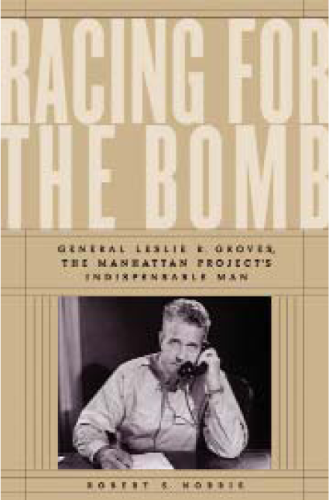
Racing for the Bomb: General Leslie R. Groves, The Manhattan Project's Indispensable Man
By Robert S. Norris
Steerforth Press, 2002
700 pages; $40.00
When historian of science Stan Goldberg died after a precipitous illness in 1996, it seemed to many of us who knew him that a double death had occurred. Not only had the field prematurely lost an irascible, iconoclastic, informed, and energetic scholar, but also lost was the life he was meticulously reconstructing, that of Manhattan Project commander Gen. Leslie R. Groves, on whose biography Goldberg had been laboring for nearly a decade.
Then another Stan came to the rescue. Robert S. “Stan” Norris, a veteran analyst of nuclear affairs for the Natural Resources Defense Council, decided to pick up the challenge of assessing this crucial figure in the creation and early history of the atomic bomb. Although he used some of Goldberg's articles and papers on Groves, and (with the family's cooperation) his voluminous but disorganized research materials, Norris did not set out to replicate or approximate Goldberg's idiosyncratic style or interpretations. Instead, he applied his own considerable research abilities and expertise in both the technical and political dimensions of atomic matters to the task of mastering the life of a man who, despite his generally recognized importance to the bomb story, had never before received a rigorous or balanced biographical treatment.
The resulting study, Racing for the Bomb: General Leslie R. Groves, The Manhattan Project's Indispensable Man, admirably fills the gap in the historiographical record and fleshes out Groves as both a human being and managerial juggernaut. More importantly, the book clarifies the role of the military in the birth of the nuclear age.
With lucid prose, clear organization, and a sympathetic yet critical eye, Norris distills and disentangles a complex and in some respects secrecy-enshrouded story. He delivers a readable, solid account that helps put the Manhattan Project's “indispensable man” into context and explains how he was so successful in amassing and wielding power to achieve his principal goal of completing a workable atomic bomb in time for use during World War II.
Groves has been a familiar figure to even cursory students of the atomic story, but in a curiously circumscribed fashion. Identified as a husky, ambitious colonel best known for overseeing the construction of the Pentagon, he enters the narrative in September 1942, as the secret atom bomb project passes from the research phase to military control and industrial development. The anecdote of his initial encounter with the atomic effort's political managers (Secretary of War Henry L. Stimson; Vannevar Bush, the White House's scientific director; and Harvard University President James B. Conant) helps establish Groves's character. Brash, brusque, and blunt, after confirming his authority to run the project with virtually unfettered control (and a fresh promotion to brigadier-general), he excuses himself to catch a train to Tennessee to inspect a site for what would later become the secret Oak Ridge facility.
Next comes the story of his troubled relationship with the atomic scientists. Many accounts tilt toward the scientists' view of Groves as myopic and obsessed by secrecy, hierarchy, and discipline. They complain that he tried to impose a military mindset and culture (including uniforms and ranks) on an incorrigible bunch of “long-hairs” devoted to the free exchange of ideas and information characteristic of the pre-war international scientific world. According to their accounts, Groves felt the project included an alarming proportion of physicists with foreign accents, left-wing politics, or both.
Yet somehow, amidst this military-scientific kulturkampf, Groves was able to forge a mutually fruitful relationship with J. Robert Oppen-heimer. He hired the Berkeley physicist to run the secret Los Alamos weapons laboratory over the recommendations of security officers who were appalled by Oppen-heimer's communist associations, and then worked with him to get the job done. Groves got high marks, even from the scientists, for transcending his own prejudices in selecting Oppenheimer and sticking with him. The appointment, I. I. Rabi acknowledges in the documentary The Day After Trinity, was “a stroke of genius on the part of General Groves, who is not generally considered to be a genius.”
Then Groves tends to recede from the conventional narrative, except for occasional run-ins with uppity characters like Leo Szilard or periodic exhortations to Oppie, before resurfacing in the summer of 1945, when he pressed unsuccessfully (he was overruled by Stimson) for the inclusion of Kyoto on the target list. Groves went on to oversee the military side of dropping the weapons on Hiroshima and Nagasaki. For the most part, however, the vicissitudes of his management of the vast military-industrial-technical enterprise take place off stage, lacking the drama of the scientific goings-on at Los Alamos and Chicago, or of the political intrigues in Washington and Potsdam.
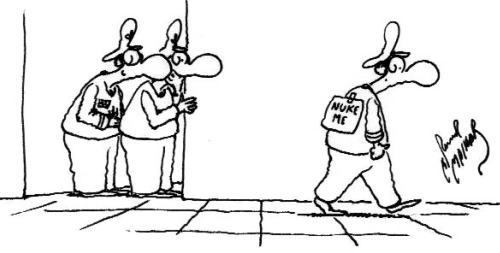
Pentagon pranks.
From the early writings of the post-war atomic scientists' movement, through full-length narratives ranging from Alice Kimball Smith's A Peril and a Hope (1965) to Martin J. Sherwin's A World Destroyed (1975) to Richard Rhodes's The Making of the Atomic Bomb (1986), not to mention popular versions like the cheesy 1989 movie Fat Man and Little Boy (where Groves was portrayed by a comparatively svelte Paul Newman), Groves has often appeared as little more than a bumptious foil to the scientists in their bids first to build, and then to control the bomb, and to maintain their intellectual and political independence.
A rapid post-war fall from power and glory further shrank Groves's historical reputation. From “hero for a day” after Hiroshima, as Norris calls him, he sank rapidly, both in public image–due to withering attacks by atomic scientists and their allies who charged him with seeking to retain personal and military control over the atomic energy field–and in the murky world of Washington bureaucratic politics, where, suddenly bereft of the two weapons that had served him so well during the war, unstinting presidential support and pervasive secrecy, he was rapidly and unceremoniously eased from power.
Groves's own memoir, Now It Can Be Told (1962), was criticized as self-serving. An earlier biography, William Lawren's The General and the Bomb (1988), was sparsely documented, with only brief treatments of Groves's pre- and post-Manhattan years. Neither did much to forestall Groves's historiographical marginalization.
But Racing for the Bomb should help restore Groves's dimmed luster. It is not that Norris has discovered some shocking secret general, a closet liberal, pacifist, or broad-minded aesthete. Nor does he reach particularly startling conclusions on the most enigmatic or controversial issues in which Groves was involved. On his mysterious bond with Oppen-heimer, for example, Norris, like others, concludes that there really wasn't much of a mystery.
“Part of Groves' genius,” Norris writes, “was to entwine other people's ambitions with his own. Groves and Oppenheimer got on so well because each saw in the other the skills and intelligence necessary to fulfill their common goal, the successful use of the bomb in World “War II. The bomb in fact would be the route to immortality for the both of them.”
And to explain Groves's strong and unwavering support for using the bomb on Japan, Norris delineates “at least half a dozen reasons,” none surprising: to end the war as soon as possible with minimal cost in American lives (the “dominant” motive); the Manhattan Project's “sheer momentum”; domestic politics, the public criticism that would surely have arisen had the bomb been available and not been used; ambition and career interest, both personal and institutional; “retribution and revenge” against the Japanese; and finally (though Norris failed to turn up any explicit new evidence), sympathy for the argument that the weapon could be helpful in the mounting political-diplomatic confrontation with the Soviet Union.
“What comes through most strikingly is the scale and extent of Groves's achievement in amassing and wielding power and resources for the purpose of building from scratch not only the bomb but the foundations of the U.S. nuclear weapons complex. Despite Groves's occasional lapses, both in judgment and personal interaction, Norris shows that he acted decisively and daringly, with protean energies, little oversight, and a hard-earned presidentially endorsed triple-A authorization (higher than all other war projects).
In doing so, Norris argues, Groves was neither merely a military blunderbuss nor a replaceable cog in a bureaucratic machine. Despite his faults, he was a brilliant organizer and manager, without whom the bomb would not have been completed as quickly, or possibly at all, during World War II. Such qualities, Norris writes, belied the impression of many atomic scientists of “an uneducated military martinet…. Many never understood that behind the bluff and bluster was a man capable of quickly grasping the essentials of most technical problems and whose experience and performance in the administration of grand engineering proposals had few equals.”
Thriving in conditions of wartime urgency and secrecy, and possibly keeping, as Norris suggests in a footnote, “the entire Manhattan Project in his head,” Groves was able to construct a virtual state-within-a-state. He ran “his own” construction industry, science and intelligence services, air force, state and treasury departments, and exerted such tight control over the final arrangements for Hiroshima and Nagasaki that even military historians have been unable to reconstruct the precise chain of command.
Chapters on Groves's early life, informed by family archives, help explain the source of his ambitions and convictions. Hs father, Leslie Richard Groves, was an army chaplain who literally sanctified the American imperialist surge of the late 1890s, accompanying troops to Cuba and the Philippines, and even to China to suppress the Boxer Rebellion. By the end of a childhood spent in a succession of military bases with his father often absent, young “Dick” Groves had already been inculcated with patriotism, perseverance, hard work, and a desire for a military career that sent him on a quest, finally fulfilled, to enter West Point. Norris also notes the emergence of his less appealing qualities, which would later land him in trouble, including brusqueness, brashness, intolerance, egotism, Anglophobia, and “some anti-Semitic and racist attitudes, quite typical of the time”–although the author notes Groves's ability to transcend prejudices in individual cases. Accounts of his work on various pre-Manhattan military engineering and construction projects foreshadow the strategies and skills he would employ when the atomic assignment dropped in his lap.
Despite Groves's fast exit from the atomic inner sanctum after World “War II and his anticlimactic subsequent career in business and retirement before his death in 1970, Norris shows how his legacies of secrecy and a far-flung military nuclear establishment have persisted even beyond the Cold War.
Above all, Groves will be identified with his central role in creating the bomb, and Norris has written what will likely stand as the defining, if not definitive, narrative of that tale, contributing an essential volume to the growing collection of major studies of key actors in the birth of the nuclear age.