Abstract

In the May/June 2001 issue of the Bulletin of the Atomic Scientists, Editor Linda Rothstein complained that experts' plans for the burial of excess weapons plutonium were “so twentieth century.” The material would be hidden away “in the deepest, most inaccessible underground caverns tunneled out of the most remote corners” of both the United States and Russia. There, this very dangerous manmade material and the billions of dollars it had cost–first to produce and then to bury it–could be forgotten.
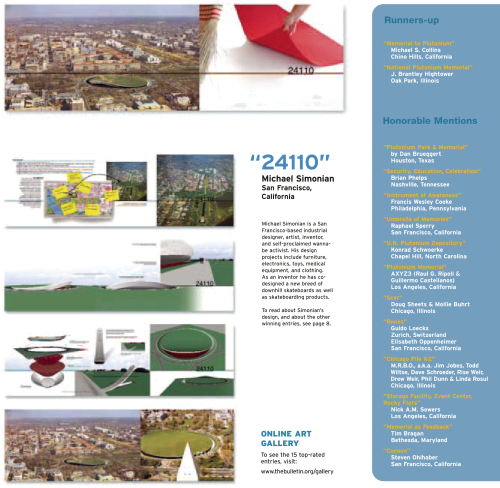
Why not store the plutonium in plain sight instead, she asked. Perhaps in a giant mausoleum, that would “draw visiting families eager to take their children on tours … as a demonstration of one of the true object lessons of the nuclear age.” The world's politicians and scientists had failed to solve the plutonium storage problem–it was time to ask artists, architects, and other visionaries to plan a “Plutonium Memorial.” And so the Plutonium Memorial Design Contest was born.
The contest, which ran from May 2001 through January 31, 2002, garnered 150 entries from 20 countries.
First Place