




Abstract

John Bolton, undersecretary of state for arms control, waited until the final hours of the review conference of the Biological Weapons Convention last December to deliver his attack:
“The Conference takes note of the work of the Ad Hoc Group and decides that the Ad Hoc Group and its mandate are hereby terminated.”
By proposing this language for the conference's final declaration, Bolton struck another blow to multilateral arms control on behalf of the Bush administration. This time, it was the Ad Hoc Group's six-year effort to develop a verification protocol to the bioweapons treaty that took the hit.
The surprise move united representatives of all other states in shock, anger, and disbelief. The normally sedate conference proceedings were reported to be tense; one Western ambassador was overheard denouncing “these American cowboys.” Only an astute move by the conference chair, Hungarian diplomat Tibor Tóth, to suspend talks for a year–an unprecedented action under the bio-weapons treaty framework–saved the proceedings from collapse.
Fueling the Bush offensive is a geopolitical mindset that originated in the last years of the Cold War and that casts states as either “responsible” adherents to arms control agreements or “irresponsible rogues” that are assumed to flaunt these agreements. Consequently, so the Bush argument goes, arms control does not work because responsible states don't need it and irresponsible states cheat. This line of argument supports the “Bush doctrine” promoted by National Security Adviser Con-doleezza Rice: Reject multilateralism pursued for its own sake and hold nations responsible for all who violate international law.
The September 11 attacks have been used to reinforce this world-view. As Bolton asked in his opening address to the review conference on November 19, 2001: “Do we really believe that a protocol that would allow violators to conduct an offensive biological weapons program while publicly announcing their compliance with the agreement is ‘better than nothing’?” Answering his own question, Bolton continued: “The United States will simply not enter into agreements that allow rogue states or others to develop and deploy biological weapons.” No matter that, with the exception of Iraq, the United States has never produced clear evidence to support its accusations. Nor has it explained why, given the fuzzy boundary between offensive and defensive activities defined by the bioweapons treaty, it is convinced that some states have sinister intentions.
In his opening address, Bolton insisted on naming names of the accused violators–Iraq, North Korea, Libya, Iran, Syria, Sudan. The finger-pointing ensured a fractious start for the conference and paved the way for Bolton's later rejection of the entire multilateral process.
Conveniently ignored in the world according to Bush are recent revelations that the United States itself is playing fast and loose with the bioweapons treaty, exploiting the vaguely defined boundary between permitted and prohibited development and production.
Projects uncovered by New York Times journalists include the Pentagon's construction of a mock germ warfare factory at the Nevada Test Site, the CIA's testing of a bio-weapons bomb to study dispersal capability, and a project sponsored by the Defense Intelligence Agency at the Battelle Memorial Institute based in Columbus, Ohio, to genetically engineer a strain of vaccine-resistant anthrax. [For more on this, see “On The Wrong Side of The Line?” by Oliver Meier, November/December 2001 Bulletin.] The non-governmental organizations the Sunshine Project and the Federation of American Scientists have uncovered evidence of further proposals for developing and testing non-lethal biological weapons, such as anti-personnel biochemical weapons and microbes engineered to attack oil and lubricants. [For details on the latter, see “The Soft-Kill Fallacy,” by Steven Aftergood, September/October 1994 Bulletin.]
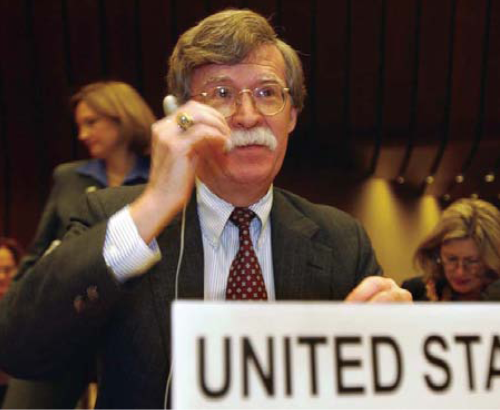
John Bolton, U.S. delegate to the conference, pulled the plug on verification.
Development of a strain of anthrax able to resist the protection of vaccines is one of the most dangerous genetic engineering projects ever contemplated. Not too long ago, taking a pathogen and making it worse was the nightmare scenario of genetic engineering–a procedure so dangerous that it was generally agreed it should be banned. Nor can it be justified for defense. Richard Novick, New York University microbiology professor and head of a committee to study research for biological defense, told me, “I cannot envision any imaginable justification for changing the antigenicity of anthrax as a biodefensive measure.” Had one of the “rogues” been caught in a similar effort, one can imagine the Bush administration's response.
These projects raise serious questions about U.S. compliance with the bioweapons treaty. In the corridors of the Palais des Nations in Geneva, where the review conference was held, several diplomats viewed testing delivery devices as an outright violation and saw the other projects as casting doubt on the U.S. commitment to the treaty.
The purpose of the protocol, which has been under negotiation since 1995, is to require procedures (declarations, inspections, and investigations of suspicious behavior) that build trust that states are complying with the convention and that deter prohibited behavior. The barriers to achieving this goal have proved formidable. Conceptually, negotiators faced the challenge of designing a process that would select from a huge range of biologically based activities those most likely to support non-compliant behavior. They also had to design methods to appraise compliance and non-compliance with a treaty that draws the line between permitted and prohibited activities largely in terms of intentions–a criterion that is notoriously difficult to apply in practice. But the political barriers were perhaps more difficult to surmount: persuading secretive military establishments and industries to part with information they normally hold close and to submit their facilities to inspections.
Progress would have been difficult under the most favorable conditions. And the conditions were hardly favorable. The smaller Western states and nearly all the states of South and Central America had little difficulty accepting declarations and inspections. But larger states with more influential military and industrial sectors tended to resist proposals for a high level of intrusion into their biological activities. The Clinton administration led the resistance, stubbornly insisting on loopholes favorable to the large U.S. biological defense program and on a light inspection regime largely controlled by the inspected party and serving the interests of the U.S. biotechnology industry. Rumors circulated that other major states were glad to see the United States doing so much to create a weak inspection regime.
Skepticism set in to the Geneva negotiations. Progress was sluggish from the late 1990s onwards, with stories of major differences emerging within the normally united Western Group. Negotiators succumbed to zombie-like reads of draft texts riddled with the brackets that signify contested issues. Last April, Ambassador Tóth, hoping to press toward a speedy conclusion before the review conference, introduced his own text with compromise language on the outstanding contested issues.
But in July 2001, hopes for completing a verification protocol were crushed when the Bush administration rejected the draft agreement following a policy review. The division of the world into responsible and irresponsible states again provided the backdrop for the reasoning of U.S. chief negotiator Donald Mahley. Mahley argued that while the draft agreement would be incapable of deterring “rogue” states from pursuing illegal biological weapons programs, it would jeopardize national security and the confidential business information of the biotech industry. The U.S. position must have been supremely frustrating to negotiators who had been pushed into conceding major loopholes in the text by the stubborn diplomacy of the Clinton administration.
While Mahley seemed to reassure delegates that the United States rejected only the specific form of the draft agreement, not the multilateral framework of the negotiations, some voiced skepticism. China's ambassador, Hu Xiaodi, observed that China would “wait and see” whether U.S. “rhetoric [would] be translated into concrete actions.” The Chinese reservations proved insightful. Instead of proposing alternative measures to achieve more effective, streamlined declarations and inspections, the Bush administration's opposition to any protocol hardened in the fall of 2001. Adhering to a protocol would have required revealing precisely the types of projects that the Pentagon, the CIA, and the Defense Intelligence Agency wanted to pursue in secret. When the review conference opened last November, Undersecretary Bolton pronounced the protocol “dead, and not … to be resurrected.”
The position of the Bush administration seems contradictory. While rejecting the mandate for negotiating the protocol, in his opening statement Bolton proposed several actions–a voluntary cooperation mechanism for clarifying and resolving compliance concerns, enactment of national criminal legislation with enhanced extradition requirements by each country, provision of assistance to victims of bioweapon attacks, and technical and scientific cooperation in biological safety and global disease surveillance–that would be impossible to achieve without cooperation from all the treaty parties.
Are these proposals merely a façade? Does the United States intend to pursue a unilateralist agenda, dealing with any bioweapons problem primarily through deterrence and expansion of its large and provocative–“robust” in Bush-speak–biological defense program, and through the use of the Security Council (whose decisions can be controlled by U.S. veto-power) to address violations?
The immediate prospects for strengthening the bioweapons treaty seem bleak. At a moment of pressing need to address the bioweapons problem, the Bush administration faces a critical choice before talks resume in November. Will it continue to pursue its unilateralist offensive and opt for a dangerous biological defense program that might stimulate development of new, more lethal forms of biological weapons? Or will it recognize that going it alone could make the world an even more dangerous place?