




Abstract
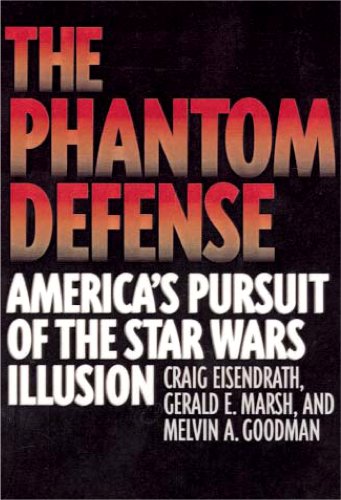
The Phantom Defense: America's Pursuit of the Star Wars Illusion
By Craig Eisendrath, Melvin A. Goodman, and Gerald E. Marsh
Praeger, 2001
208 pages; $24.95
September's terrorist attacks against the United States seem to have put national missile defense, until then Priority Number One for the Bush administration, on a back burner.
Phantom Defense is a concise résumé of the many reasons why national missile defense is a defenseless priority and should remain at a low simmer. The United States does not need to rush into a limited missile defense system because there is no real threat and because the technology is not yet ripe. Indeed, the technology may not ripen at all because of the sometimes uncongenial laws of physics.
Although the details of Bush's missile defense plan are not yet fully known, the president is intent on beginning deployment of a limited national system as soon as possible, which seems to mean that deployment will take place before anyone is really sure that it works.
The Bush administration says it will eventually build a “multi-layered system,” including “boost-phase” and “terminal” intercepts, all of which the authors of Phantom Defense explore. But the currently planned “mid-course” system is the focus of the book. That's because getting that system–the “hit a bullet with a bullet” plan envisioned by the Clinton administration–up and running is the president's first priority. A mid-course system is conceptually simple, but nearly impossible to pull off under real-world conditions.
Space-based warning satellites would detect missile launches in their “hot” or boost phase. Updated ground-based radars, including an X-band radar system, would track the warheads in their “cool” mid-course phase as they arc silently through space. (Eventually, the “Space-Based Infrared System-Low Earth Orbit, or SBIRS-Low, itself a trouble-plagued and behind-schedule effort, would take over major tracking duties.)
The ground- and space-based network would guide ground-based interceptors, tipped with kill vehicles, to projected intercept points. Near the intercept points, sensors in the kill vehicle would take over and guide it to an annihilating collision in space. No explosives, just kinetic energy, which at closing speeds of up to 16,000 miles an hour, would be sufficient to pulverize and vaporize the warhead.
That's theory. The problems are many, beginning with the fact that the warheads would have company. Odd bits of the booster rocket as well as cunningly designed counter-measures–“chaff” and decoys–would accompany the warhead in a “threat cloud.”
The decoys could be of many kinds, including those designed to “look” like warheads and have roughly the same thermal characteristics, or warheads disguised to look like decoys.
“The X-band radar, visible, and infrared sensors used by the National Missile Defense system cannot distinguish between real warheads and decoys, nor will an increase in their performance allow them to do so,” write the authors of Phantom Defense.
While the ground-based radars almost surely could do a credible job in steering the interceptor and its kill vehicle toward the oncoming threat cloud, at some point the kill vehicle must take over and steer itself.
Unhappily, though, the kill vehicle's telescope, a sophisticated instrument operating in the visible spectrum as well as at least two infrared wavelengths, does not have enough resolving power to see the individual objects in the threat cloud as anything but points of light.
Nevertheless, the onboard computer has to pick out the warhead by analyzing how “each point of light, corresponding to a warhead or decoy, fluctuates in time.” In other words, the points of light seem to pulse, and the characteristics of a particular pulse are determined by the size of the object and its temperature, surface materials, and how it rotates, tumbles, and wobbles in space.
In theory, the kill vehicle would have a chance to hit the right object, the warhead, if its onboard computer could read the pulses, compare them to known databases, and thus determine which point of light is the warhead. In more familiar terms, the kill vehicle must find a pattern, make sense of it, and act–all in a matter of minutes and seconds.
That system could work, but only if the different objects have different characteristics and those characteristics are known and in the databank.
The authors cite the work of Theodore A. Postol, a physicist at the Massachusetts Institute of Technology and a missile expert, whose analyses of missile defense tests have been a festering thorn in the side of the Ballistic Missile Defense Organization (BMDO). His conclusions are often at variance with official BMDO interpretations.
Integrated Flight Test IA was particularly illuminating. The exercise was designed to test kill-vehicle sensor technology. A mock warhead and 10 balloon decoys were used in a “fly-by” over the Pacific. According to Postol's analysis, the sensor data did not “uniquely” identify the warhead.
“This is the bottom line,” write the authors of Phantom Defense. “The problem isn't technology, it's physics. Decoys and warheads can always be made to emit almost identical signals in the visible, infrared, and radar bands.”
Given that, the probability of an actual intercept, even if everything else works with near perfection, is a matter of chance.
In one mathematical mind game, the authors suggest that if an adversary deploys 24 decoys and one warhead, the probability of picking out the warhead in the threat cloud would be 4 percent. But to give the system the benefit of a willing suspension of disbelief, the authors up that probability to 20 percent.
They then assume an 80 percent probability that the interceptor rockets would work as advertised and an 80 percent probability that the kill vehicles would actually hit the objects they focused on.
“Then the number of interceptors required for a 90 percent chance of stopping the attacking missile is 17; for a 98 percent chance, the number is 29. In reality, under real-world operational conditions, the probability of a successful intercept could well be far smaller than these estimates.”
The political consequences of deploying a national missile defense system, the authors point out, could be huge. Deployment means scrapping the 1972 Anti-Ballistic Missile Treaty, the foundation for subsequent nuclear arms reduction treaties. Russia has given little indication that it will go along with the Bush administration in killing the treaty. If the administration proceeds, Russia may halt the nuclear arms reduction process. Meanwhile China, which has always seen “limited” missile defense as a de-fang-China ploy, will almost surely build more missiles.
But the case against national missile defense is more than just a matter of unripe technology and uncooperative physics and political consequences. It isn't even, in my opinion, a matter of cost, which the authors rail at. How much is it “worth” to save a city–a Los Angeles, or a Chicago, or a Manhattan? Or an Atlanta, a Dallas, a Seattle? You can't put a price on that.
The problem is, there is not yet a real threat out there, nor is there enough of a potential threat to justify an expensive system that has little likelihood of working. If a state wants to hit the United States with missiles, cruise missiles hidden aboard freighters could do the job at much less cost, and probably with greater accuracy.
The authors–Eisendrath and Goodman are senior fellows at the Center for International Policy in Washington, and Marsh is a retired physicist at Argonne National Laboratory–go into threat assessment thoroughly, far more than one can discuss in a short review. But one observation leaps out:
“Compared to nationally delivered ICBMs, the threat to the United States is probably much greater from non-state actors, and from non-nuclear weapons with short-range, non-missile delivery systems.”
They follow that comment with a quote from recent Senate testimony by a CIA analyst who noted that “non-missile delivery means are less costly and more reliable and accurate. They can also be used without attribution.”
The world saw a demonstration of that on September 11. High levels of death and destruction were accomplished cheaply and easily, and with great precision. There was no direct “attribution,” making U.S. retaliation a slow and globally controversial process.
The threat-assessment community, a cottage industry that stretches from California to Massachusetts, has suggested for years that in the face of America's high-tech prowess, adversaries were likely to turn to “asymmetric” means to counter American power.
That's basic. When fighting an enemy, do it your way, not his. Be unpredictable. Keep the other side guessing, off balance. “The enemy must not know where I intend to give battle,” Sun Tzu wrote 2,000 years ago in the Art of War. “For if he does not know where I intend to give battle he must prepare in a great many places. And when he prepares in a great many places, those I have to fight in any one place will be few.”
Quoting Sun Tzu in the context of the September 11 attack is unfair. Sun Tzu wrote of how warriors could defeat warriors; he was no killer of civilians. But unhappily, the advantages offered by unpredictability are real, whether the targets are military or civil. That forces the other side to prepare on all fronts, which in turn saps national resources.
The Bush administration will have to get its priorities straight. It will have to devote tremendous financial and human resources to the war on terrorism, fighting it–as the president has repeatedly pointed out–on many fronts.
As for national missile defense, it is time to turn down the heat, even if the system is now on a back burner. Research should continue, of course, as well as some development work. But it makes little sense to rush a half-baked system to deployment. There are many other dangers to contend with, and they are both clear and present.