




Abstract
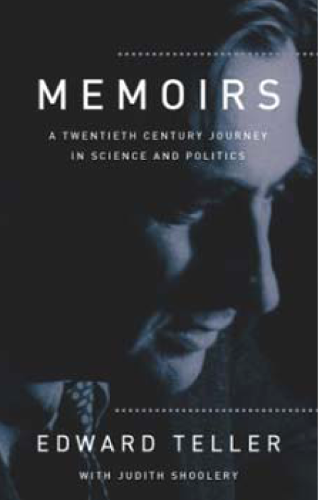
Memoirs: A Twentieth-Century Journey in Science and Politics
By Edward Teller with Judith
Shoolery
Perseus Books, 2001
602 pages; $35.00
Edward Teller is perhaps the most powerful American scientist of the past half century. Born in Budapest in 1908, he studied physics in Leipzig under Werner Heisenberg in the 1920s and worked with Niels Bohr in Copenhagen in the 1930s. Together with fellow refugees from Nazism–including Hans Bethe, Enrico Fermi, and Leo Szilard–he aided the effort to develop the first atomic bomb, or fission bomb, as part of the Manhattan Project.
In 1942, Teller proposed the hydrogen bomb, or fusion bomb, and is widely known as its “father.” A passionate techno-scientist and anti-communist, he exerted great political influence during the Cold War.
In 1990, he returned to Hungary for the first time in 54 years and was given a hero's welcome.
Now, at the dawn of the twenty-first century, the United States is poised to embrace Teller's last big cause, strategic missile defense.
Countless pages have been written about Teller's controversial roles in many key events of nuclear history, including his dedication to hydrogen bomb research and development during and after World War II; the techno-scientific dead ends that he pursued before coming up with a successful H-bomb design; his fight with mathematician Stanislaw Ulam over credit for the discovery of the H-bomb's secret; his angry departure from Los Alamos in 1951, claiming the laboratory's leaders would not support H-bomb research; his role in the creation of a second weapons laboratory at Livermore; and his testimony against Robert Oppenheimer during an Atomic Energy Commission (AEC) security hearing in 1954.
Teller, who was aided by Judith Shoolery, opens his memoirs with early recollections. As a child he was a musical, as well as a scientific, prodigy. His mother, a fine musician in her own right, hoped he would become a concert pianist. He writes that at age four he began consistently thinking about numbers.
In 1919, when Teller was 11, the communists came to power in Hungary. Their short-lived takeover had a more direct and traumatic effect on the Teller household than did World War I. His father, a prominent attorney, was forbidden by the communists to practice his “capitalist” profession, and the family became–in Teller's words–social outcasts.
Teller provides a thoughtful account of life in Europe between the world wars, including discussions of significant developments in physics. In the first third of the book he proves to be an erudite and charming storyteller. Throughout, he is generous in his remembrances of friends and pro-tégés–his portraits of physicists Maria Mayer and John Wheeler and mathematician John von Neumann are notable for their warmth. Teller's explanations of science are clear, logical, and accessible.
But while the first third of the 600-page opus is coherent and engaging, the latter part–particularly Teller's discussions about politics and social relations–is often deeply problematic, confusing, and contradictory.
Teller provides plenty of fodder for debate, reworking arguments he has made over the past 50 years and settling scores with his scientific and political enemies, many long dead. General readers trudging through the morass of plots and characters would be wise to avail themselves of some of the relevant literature, both academic and popular.
In some respects, Edward Teller is a romantic figure, a man whose lifelong quest has been the pursuit of new scientific knowledge. Although it is clear that he cherishes the friendships he made along the way, his unrelenting technical enthusiasm ultimately helped isolate him from many of his peers.
In 1942, Oppenheimer invited Teller and other elite scientists to a conference in Berkeley to discuss atomic bomb theory. Among them was Teller's friend, Hans Bethe, who would later head the theory division at Los Alamos. For Teller it was a golden time, reminiscent of the deep and inspiring collegiality of his youth in Europe.
At the meeting, the physicists also explored the possibility of producing a hydrogen bomb, and Teller recalls Oppenheimer being very engaged by the idea. He fondly remembers these conversations as being the only time that he felt intellectually close to Oppenheimer.
The successful explosion of the first atomic bomb at Trinity, together with the bombings of Hiroshima and Nagasaki, revealed the unimaginable power of nuclear energy. Many atomic scientists paused to consider the moral and political ramifications of bringing an even more powerful weapon–the H-bomb–into being. Fermi and I. I. Rabi wrote that such a weapon was an “evil thing considered in any light.” And Bethe asked, “Can we who have always insisted on morality and human decency between nations … introduce this weapon of total annihilation into the world?” Teller, however, remained undeterred, viewing his fellow physicists' reluctance to pursue the next scientific grail as heresy. In Teller's mind, a scientist's first responsibility was to science.
In a 1995 interview, Teller told me, “I did not want the hydrogen bomb because it would kill more people, I wanted it because it was new.” He rejected the notion of a scientist choosing ignorance intentionally.
In contrast, when I asked Bethe in 1997 to comment on Teller's charge that the H-bomb controversy was the first time that a large group of scientists “argued for remaining ignorant of technical possibilities,” he told me: “Correct statement. And I would would have been very happy if we had remained ignorant.”
Teller and Bethe's dispute over the H-bomb goes beyond issues of moral responsibility. In 1954, Bethe wrote an overview of the H-bomb's history that was immediately classified. In 1982, when the history was declassified and published in Los Alamos Science, a contentious public debate ensued over Bethe's technical analysis, including his assertion that the weapon was not ready for a crash program when Teller first advocated it in 1949. In his memoirs, Teller dismisses Bethe's history, although he declines to address various points of dispute, arguing that his critics are more interested in attacking him than in considering the facts.
Later, Teller confesses that his own 1955 overview, published in Science, was intentionally inaccurate. To strengthen his claim that he was primarily responsible for the breakthrough that led to the “Superbomb,” he states, “I even went so far as to give Stan Ulam credit for suggesting compression, although I had come to that realization weeks before Stan discussed it with me…. Still, I had no objection to the white lie in the article if it soothed ruffled feelings.”
Encounters with Edward Teller
“They [Slate, a reform-minded Berkeley student political party] took me to see the Livermore Laboratories, where most of America's nuclear weapons development still takes place under the auspices of the University of California. There I secured an interview with Dr. Edward Teller, a prototype for the Dr. Strangelove movie character. Teller patiently described how nuclear war could be survived and, in any event, why it was ‘better to be dead than red.’ After hearing his arguments, I signed a statement supporting an August 6 [1960] pro-disarmament rally commemorating the atomic bombing of Hiroshima and Nagasaki.” From Reunion: A Memoir, by Tom Hayden (1988)
“Another really tough guest was physicist Edward Teller, the ‘father of the H-bomb.’ Teller was a visiting professor at the University of Miami, and another professor who was a listener persuaded Teller to appear on my TV show–by then [the mid-1960s] I had a late-night television show on the weekend. While he was getting his makeup put on I went in and introduced myself. Teller is a very imposing man; he has a heavy German accent, and enormous bushy eyebrows which he uses to dramatic effect…. [He] looked at me and said, ‘By de vay, don't ask me about de H-bomb.’
“Don't ask about the H-bomb. Great. I figured he'd walk, and we'd have to dig up another guest. Then the red light on the camera went on and I said to Teller, ‘Why is it that in high school everyone hated to take physics?’
“Teller's face lit up. He said it was taught terribly because most high school teachers don't understand physics. ‘Pheeseecs is life. Dat's vat dey should call it–life, not pheeseecs,’ he said.” From Larry King, by Larry King with Emily Yaffe (1982)
“I met him on his birthday [in 1988], and we spoke for 30 minutes in relative privacy just before a formal banquet was held in his honor in the ballroom of a Washington hotel. I said a few words about the parallels in our lives, about the respect I had for the principled and determined manner in which he defended his views, regardless of whether I agreed with them or not. (I repeated these thoughts publicly in my speech at the banquet.) Teller spoke about nuclear energy; we had no disagreements on that subject, and we quickly found a common tongue.
“I turned the conversation to SDI [Strategic Defense Initiative], since my main reason for coming to see him was to discover the basis of his support for this concept. As I understood it, the moving force behind his promotion of SDI is a profound and uncompromising distrust of the Soviet Union. [He told me that] technical difficulties can always be overcome if need be–they can and will be solved now that a system of defense from Soviet missiles has been put on the agenda. A shield is better than a sword.
“Behind all this there was the unspoken thought: We have to develop this defense first. You're trying to scare us off, to sidetrack us, while you've been working in secret on the same idea for years. We were summoned to the banquet before I had a chance to reply.”
From Moscow and Beyond: 1986 to 1989, by Andrei Sakharov (1991)
The quotes were compiled by Dana Cook, a collector of first-person accounts of famous persons meeting famous persons. His compilations have appeared in the Globe and Mail, the Chicago Sun-Times, The Hemingway Review, the James Joyce Literary Supplement, and New Scientist.
In April 2001, the New York Times reported that during a recently uncovered 1979 interview, Teller revised his initial accounts of the H-bomb's genesis, crediting physicist Richard Garwin with having come up with the first workable design. Critics interpreted this as a further attempt by Teller to discredit Ulam and other scientific adversaries. Although his original accounts did not mention Garwin, as early as 1981 Teller publicly credited the younger scientist with the H-bomb's first blueprint. The memoirs devote three paragraphs to Garwin's contributions. In contrast, during a 1996 interview with me, Garwin expressed no particular pride in having played a role in the H-bomb's development.
The emotional core of the memoirs is Teller's discussion of Oppen-heimer's 1954 hearing before the AEC's Personnel Security Board–an event which marked a tragic turning point in both men's lives. Teller's apologia takes up more pages than any other subject in the book.
After the war, Oppenheimer, who had led the Manhattan Project's Los Alamos laboratory to its spectacular success, became the nation's most influential scientist. In 1949, he headed the AEC's General Advisory Committee (GAC), which recommended against a crash program to develop the H-bomb.
By 1954, however, some important officials suspected that Oppenheimer was a communist agent who had furthered Soviet interests by opposing the H-bomb. Although he remained a government consultant, he resigned from the GAC and lost his political influence. The hearing, which resulted in Oppenheimer's losing his security clearance, was the coup de grace.
Despite the outrage expressed by many in the scientific community over the hearing, even Oppen-heimer's staunchest supporters were (and are) troubled by the testimony that he gave, which revealed that he had lied to security officers during the war. He testified that he had invented a “cock and bull” story about how a Soviet agent had tried to approach three project scientists through an intermediary. He also revealed that he had falsely identified his friend, Haakon Chevalier, as the intermediary. Oppenheimer's defense: “I was an idiot.”
In his memoirs, Teller claims he opposed McCarthy-style “smear campaigns” and considered the hearing a “dirty business.” His agreement to testify was the result of his “stupidity,” and he describes agonizing over what to say. Teller insists that he fully intended to affirm Oppen-heimer's loyalty and that, unlike McCarthy and his ilk, saw nothing sinister in Oppenheimer's communist leanings. However, long before his discussion of the hearing, he cleverly begins weaving a narrative thread insinuating something very different. One of their earliest encounters, in 1942, set the stage for what Teller believes was a moral showdown between the two men.
Teller writes that during a train journey to Washington, D.C., before the establishment of Los Alamos, Oppenheimer confided in him, “We have a real job ahead. No matter what [Manhattan Project Commander Gen. Leslie] Groves demands now, we have to cooperate. But the time is coming when we will have to do things differently and resist the military.” Teller reports being so shocked by the notion of resisting the military that he hurriedly changed the subject. Consequently, “Oppie continued to be friendly, and he continued to encourage me to come to Los Alamos, but the warmth of our conversations vanished and never returned.”
Teller later picks up the thread: “My friendships are deeply important to me…. When I came to Los Alamos, I did not expect that Oppenheimer and I would become good friends. Months before I had become aware that Oppenheimer and I had values that were too different to allow us to be close.” He articulates neither the values nor the differences. These passages exemplify Teller's method of intentional imprecision. He intentionally sets up a logic that points the reader in a specific direction. At the same time, however, he is imprecise enough to free himself of responsibility for any particular conclusion the reader might draw–he retains “deniability.”
In an even later reflection on the train ride, Teller writes, “I had the strong impression that Oppenheimer was talking about some form of civil disobedience; but I could not imagine that anyone of good will and intelligence would find it necessary in this country.” Is Teller saying that Oppenheimer was suggesting some sort of subversive activity? Or that because he did not take the bait, Oppenheimer knew Teller was not sympathetic to his shadowy cause, and therefore rejected him? If so, what is the evidence? What exactly does Teller mean by “civil disobedience” and why does he think Oppenheimer was planning to act against the government? For all his assertions to the contrary, Teller is clearly implying something sinister. Absent is the careful precision of his scientific reasoning. Left with so many unasked questions, readers are forced either to accept Teller's argument as is, or take it upon themselves to do further research.
According to Teller, just before entering the hearing room, he learned of Oppenheimer's revelation regarding Chevalier. Confused and profoundly concerned about Oppen-heimer's trustworthiness, Teller testified, “I feel that I would like to see the vital interests of this country in hands which I understand better and therefore trust more.” And under further questioning, “If it is a question of wisdom and judgment, as demonstrated by actions since 1945, then I would say one would be wiser not to grant clearance.”
He admits that his testimony was confusing, and he takes great pains to explain and justify his words. In fact, the testimony's ambiguity serves as Teller's defense against what he insists are two erroneous interpretations of his statements: that he opposed Oppenheimer because of his stance regarding the H-bomb, or because of his left-leaning politics. Although Teller expresses deep regret for his lack of clarity at the hearing, and insists throughout the book that he is a political naïf, he never backs down from his stand against Oppenheimer.
Teller's final word on the matter: “The wartime relationship between the United States and the Soviet Union was ambiguous. Oppen-heimer's relationship with his friend Chevalier was just as ambiguous. My own strong distaste for ambiguity in friendship may be excessive. Unfortunately, those feelings exist, and they deeply affected my testimony.”
Herbert F. York, the first director of Lawrence Livermore National Laboratory, recently told me that he clearly remembers Teller and Ernest O. Lawrence discussing the hearing well in advance of Teller's testimony. Both men were unwavering in their opposition to Oppenheimer, agreeing that he had too much influence in Washington and “had to go.”
Missing from Teller's memoirs is any serious discussion of the grave legacies of the Cold War, including the obscene number of nuclear weapons in Russia and the United States, the proliferation of weapons of mass destruction, and the staggering quantities of weapons-grade uranium and plutonium around the world.
It will require a biographer of patience and forbearance to explore what these memoirs most strikingly reveal–the vast dark matter of Edward Teller's universe, his insatiable appetite for power.