




Abstract

“Open Skies”–a treaty allowing suspicious nations to fly over and scrutinize their potential enemies–was first proposed in 1955. It remained largely just an idea until last November 2, when Russia and Belarus became the final required countries to deposit their instruments of ratification to the Open Skies Treaty, an agreement between 27 NATO and former Warsaw Pact nations allowing pre-arranged but unrestricted aerial reconnaissance flights over member territories. The treaty entered into force on January 1, 2002.
Although Open Skies is a welcome and long-overdue addition to the global security regime, it may not turn out to be the critical confidence-building measure it was originally conceived to be. For one thing, the increasing availability of high-resolution satellite imagery threatens to make it obsolete. Also, political squabbles and mutual distrust could hamper its successful implementation.
President Dwight D. Eisenhower first proposed Open Skies at the 1955 Geneva Summit. In the years immediately preceding the summit, the United States and Soviet Union had successfully tested hydrogen bombs, pushing Cold War tensions to a new high. Eisenhower thought that overflights would help reduce tensions and build trust. He also hoped the treaty would play a role in monitoring and verifying arms control agreements. The Soviets, however, rejected the proposal as a U.S. attempt to spy on their territory.
In 1989, the Bush administration revived the idea of aerial inspections. It saw Open Skies as a test of President Mikhail Gorbachev's commitment to glasnost. Although Gorbachev responded favorably to the idea, treaty negotiations had to weather a number of political crises, including a failed coup attempt against Gorbachev, the break up of the Soviet Union, and the dissolution of the Warsaw Pact.
The treaty was signed in March 1992. By 1995, 22 states had ratified the treaty. The only holdouts were the former Soviet republics of Russia, Ukraine, Kyrgyzstan, Belarus, and Georgia. The others argued that they would ratify the treaty only after its ratification by Russia, where power struggles and political turmoil kept the treaty in limbo for most of the 1990s.
Plans to put Open Skies into operation began in the early 1990s. The Open Skies Consultative Commission (OSCC), a body created by the treaty to handle compliance issues and aid in the interpretation of treaty provisions, met regularly between 1992 and 1997. There have also been numerous trial flights since 1992 involving several treaty members. By fall 2001, the United States had conducted 72 joint trial flights, mostly over the territories of NATO countries. Russia has participated in more than 60 trial flights.
A major hurdle to Russian ratification was the continued distrust among Russian officials, particularly communists and hardline nationalists, of the United States and Western Europe. Many viewed the overflights, together with the eastern expansion of NATO, as part and parcel of a revived containment strategy.
Open Skies Treaty members
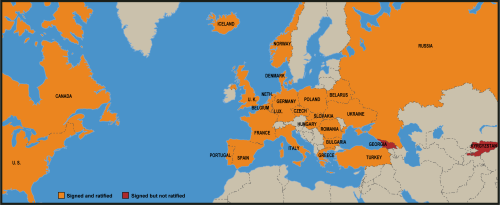
Fueling Russian concerns were the divergent approaches taken by Russia and the United States. Russia wanted to group Open Skies with a larger “negotiation basket” that tied it and similar confidence-building measures to progress on various arms control agreements–in particular, the Comprehensive Test Ban Treaty and the Chemical Weapons Convention. But the United States argued that they should be treated separately. The United States also aroused Russian suspicions by vigorously arguing its case at the Organization for Security and Cooperation in Europe. When Vladimir Putin came to power, though, he delinked Open Skies from other negotiations.
Another problem was the Russian military, which continues to be skeptical about openness. As one State Department official told me, “Russia is still not as forthcoming as it should be about its military matters.”
Russia has also expressed concern over the costs of implementing the treaty. According to U.S. and European negotiators, much of this problem stems from Russia's insistence on exercising the treaty's “taxi option.” In early treaty negotiations, the Soviet Union argued that other countries might hide illegal sensors from inspectors and collect intelligence damaging to its national security if they were allowed to use their own aircraft. To allay these concerns, negotiators agreed to give members the right to force an observing country to use host aircraft. Russia–like all member states–must pay for the flights it conducts. It will also have to cover part of the costs for hosting observation flights. These added costs are likely to increase in the years to come because so many countries want to take a look at areas in Russia.
Each state party is required to accept a certain number of observation flights, called its “passive quota.” That number is used to determine its “active quota,” or the number of flights it can conduct. No country is required to accept more flights than it is allowed to undertake.
The larger the country, the greater the number of observation flights it must accept (and, as a result, the more it can conduct). But strict proportionality need not be followed. For instance, in order to have a more influential role in the treaty process, Britain, France, Germany, Italy, and Turkey have agreed to quotas greater than the maximum specified by their geographic size.
The treaty also establishes “initial passive quotas.” Both the Belarus/Russia group (these two countries have formed a treaty coalition) and the United States must accept as many as 42 flights per year. Seven countries have quotas of 12, and the remaining smaller countries, from two to seven. However, in the first “treaty year,” which will actually cover a two-year period–from January 1, 2002 to December 31, 2003–member states need not accept more than two-thirds of their quotas. This means that Belarus/Russia and the United States can cap the number of overflights of their territories at 28.
A country planning an overflight must notify all treaty members 72 hours before the flight. After the observers arrive at a designated point of entry, the host state can ask for a one-day waiting period before the flight begins. During this time, the host may inspect the observer's aircraft. Both parties also meet to discuss the proposed flight plan.
Four types of sensors can be used to gather data: standard framing and panoramic black-and-white cameras with 30-centimeter resolution; 30-centimeter resolution video cameras that use magnetic tape; infrared scanning systems with 50-centimeter resolution; and 3-meter resolution synthetic aperture radars. The treaty explicitly bars the collection of signals intelligence.
Representatives from the observing state must place each unit of film or tape in a container and seal it in the presence of host representatives. The data is then shared with all treaty members. Data cannot be transmitted during flights.
Now that the treaty has entered into force, additional states are likely to join. (A few days after Russia and Belarus submitted their ratification instruments, Finland and Sweden announced that they intended to join the treaty at the earliest possible date.) All former Soviet states are eligible for admission at any time, and during the treaty's first six months states belonging to the Organization for Security and Cooperation in Europe can apply for membership. All other countries can apply at the end of the first six months.
The treaty may also be modified. Several states, including the United States, have expressed an interest in lowering the 30-centimeter resolution limit on imagery, a move that would bring the treaty into the modern world, where higher quality imagery has been available on the open market for some time. Digital imaging may also be allowed at some point. Further, the treaty could eventually cover activities not originally envisioned by negotiators, including Russian surveillance of U.S. missile defense installations and monitoring of the earth's environment.
Open Skies faces several lingering political concerns. Many countries are worried about potential security threats from a resurgent Russia. As a result, Belarus/Russia's initial passive quota of 28 overflights is being divvied up among 11 states. (By comparison, the U.S. initial quota is minuscule–only Russia wants to fly American skies, which it will do only four times over the next two years.) Competition for access to Russian skies will become more intense as membership expands.
Russia, which is slated to accept the most flights (about one-third of all flights in the first year), has already raised the idea of decreasing its yearly quota to less than 42 flights. Although a State Department official told me that the United States “is willing to consider this option,” the United States will probably insist on having its own quota reduced.
The costs of implementing the treaty also remain a point of contention, in particular the extra costs that will result from Russia's insistence on exercising the taxi option. The United States and Europe, which have subsidized Russia's participation in test flights and will likely continue to assist Russia for some time, view these costs as an unnecessary burden.
Finally, there is the question of the treaty's relevance in the post-Cold War world. The idea of using aerial reconnaissance to enhance international security made sense in the 1950s, when planes were the best observation tool available. In the late 1980s, Open Skies continued to be a suitable method of building trust between Cold War adversaries. And when the treaty was finally signed in 1992, it was widely believed that flights would quickly follow and prove helpful in thawing latent Cold War tensions.
Now, nearly 50 years after it was first proposed, Open Skies seems antiquated. In a sense, it is a fair-weather friend, the product of a favorable international climate–just as its past failures were the result of mutual distrust and suspicion. Still, whether Open Skies will have a positive impact on security remains uncertain, especially in light of the squabbles over quotas. The State Department official I spoke with said that the United States would reconsider its commitment to the treaty if it caused an increase in tensions.
While the treaty will give many states access to quality intelligence for the first time, better intelligence is already available from high-resolution satellite imagery operated by commercial remote sensing providers and as a result of national technical means. In contrast, Open Skies seems quaint. Until the treaty allows modern sensing capabilities, its promise cannot be truly fulfilled.