




Abstract
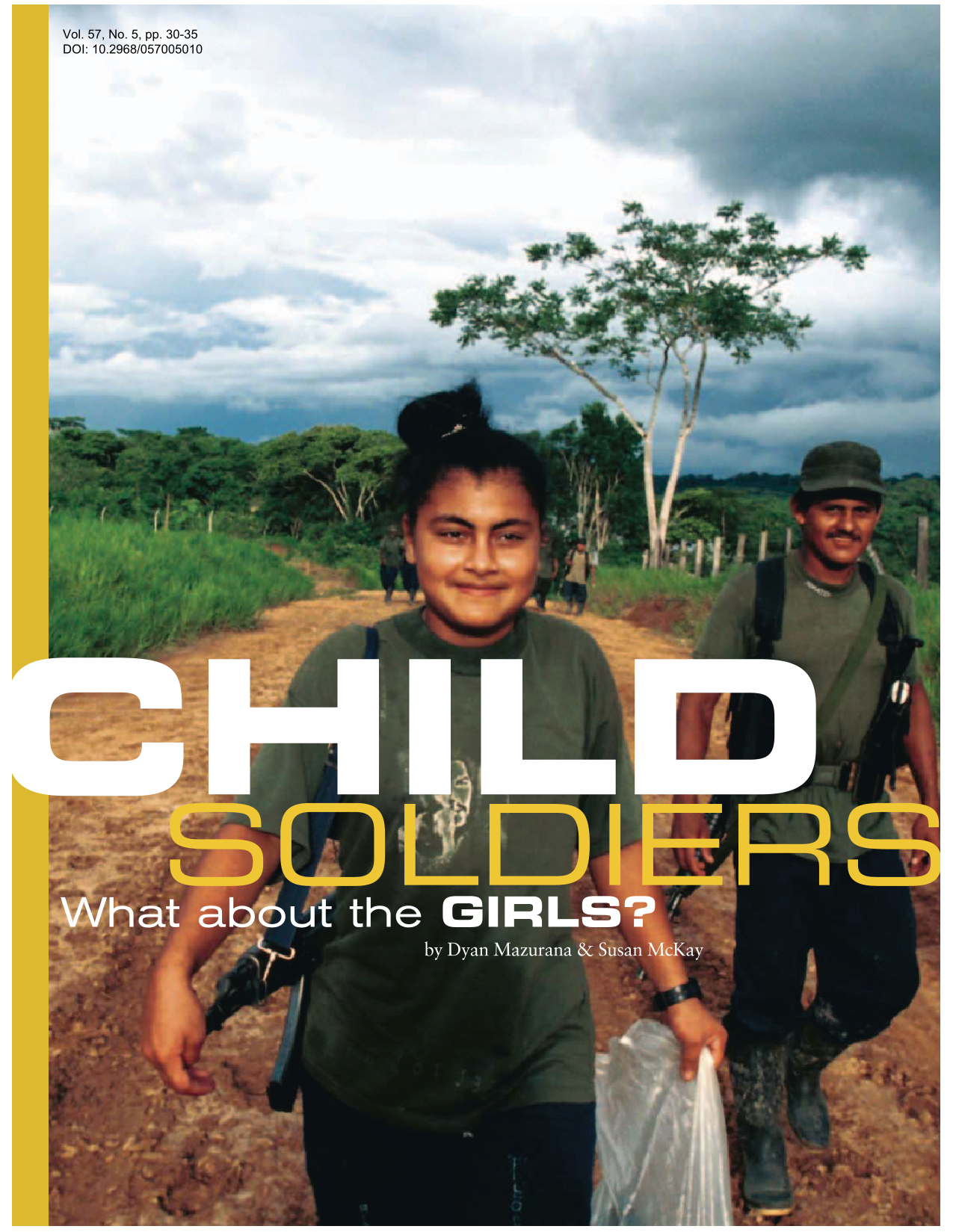
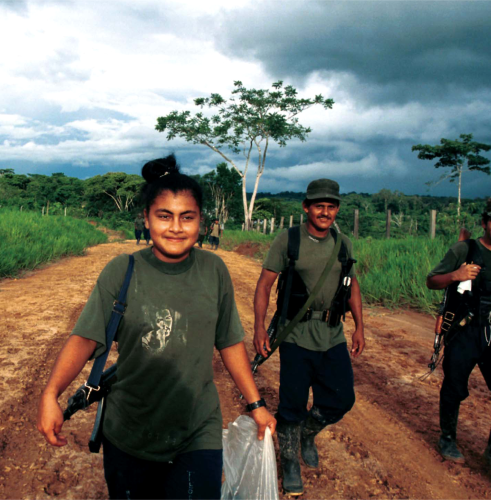
The 1992 peace accords ending the bloody 16-year civil war in Mozambique called for the demobilizing of soldiers from both the government force, Frelimo (Front for the Liberation of Mozambique), and the rebel force, Renamo (Mozambique National Resistance). Throughout the war, children had been systematically kidnapped to fill out the ranks of each side. When the first soldier to be demobilized turned in his gun, the 16-year-old said he had been abducted by Renamo at age 9.
But it wasn't just boys who were kidnapped. Young girls, too, were captured and forced into wartime service. The girls were treated as sexual property, allocated to soldiers as “wives,” distributed as rewards for good soldiering, or given to local chiefs. 1 When the fighting finally stopped, men and boys entered demobilization camps for rehabilitation and reintegration into society. The girls were often forgotten.
Outside the system
The situation of girls involved in the Mozambican war is hardly unique. According to data we have compiled, from 1990 to 2000 underage girls were active in armed conflicts in at least 32 countries. The United Nations estimates that worldwide some 300,000 children (individuals under 18) are serving as soldiers in areas of conflict.
Although young girls carry out vital duties in conflicts, they have received scant attention. Any use of children in combat was largely unacknowledged internationally until a 3-year-old consortium of international humanitarian groups, the Coalition to Stop the Use of Child Soldiers, began systematically identifying girls and boys associated with fighting forces in every country. But too often in international reports and initiatives the generic terms “child soldiers” or “children” refer only to boys. For the most part they ignore the fate of girls. And international programs addressing the needs of girls—when such programs exist—are poorly informed.
Invisible
No one knows how many girls were kidnapped during the Mozambican civil war, or how many never returned to their homes. The international humanitarian community failed to recover the majority of girls given by Renamo forces to regional leaders, in part because they failed to recognize girls' unique post-conflict predicaments. One U.N. Development Program report epitomizes the problem: When demobilized Renamo soldiers boarded vans to return to their home districts, girls and women were simply left standing by the roadside. Other girls, not lucky enough to be abandoned, were forced to accompany soldiers back to homes that were not their own. 2
As one study reported, “It is quite astonishing that Mozambican girls and women still accompanying soldiers at the time of demobilization in 1994 were not counted, addressed, nor cared for. It appears that no one among either the international or national agencies knows exactly what happened to them. They and their scars remain invisible.” 3
In today's conflicts, we repeatedly find that girls are rarely included in disarmament, demobilization, and reintegration programs. For example, the rebel Revolutionary United Front/Armed Forces Revolutionary Council forces (ruf/afrc) in Sierra Leone recently released some of its child soldiers as an indication that it was ready for peace talks. Although girls constitute 30 percent of ruf's total forces, of the 1,213 children released in May, only 15 were girls. 4
The short- and long-term impact on girls' lives, both during and after conflict, has barely begun to be assessed by the international humanitarian and defense community. “Where are the girls?” is rarely asked in discussions about planning for children who have been used by armed forces.
A way to survive
From Colombia to Sri Lanka to Uganda to Kosovo, girls are involved in armed conflict; the paths that lead to their participation are many. Some girls are actively recruited, many are abducted or “gang pressed” into serving, and a few join voluntarily.
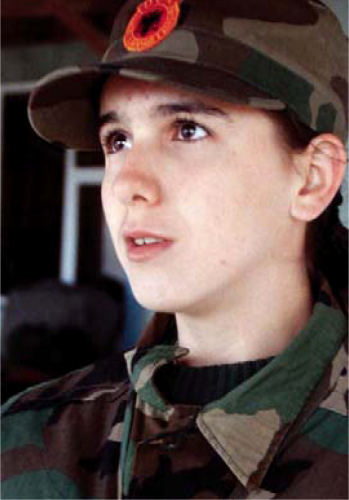
In the spring of 1999, when other girls at her Bronx high school were picking out gowns for the prom, 16-year-old Elinda Muriqi was preparing to put on the camouflage fatigues of the Kosovo Liberation Army (kla). The kla, like other armed opposition groups such as the Kurdistan Workers Party, carried out aggressive international recruitment campaigns, netting many soldiers—including boys and girls. As Elinda and other Albanian-American volunteers waited in a hotel parking lot to depart for the war in Kosovo, speakers praised the soldiers-to-be for their bravery and dedication while relatives wished them well. Elinda's first stop would be Albania, where she and hundreds of other volunteers from around the world received 15 days of training before being sent to the front lines to fight the vastly more experienced forces of the Federal Republic of Yugoslavia. “I'll die happy if the first bullet kills me—I will die for the freedom of Kosova,” Elinda said. 5
Few girls who participate in today's wars do so as willingly as Elinda. In conflicts in Africa, girls are among the primary targets of armed forces and armed opposition groups that abduct them and force them to become warriors and sexual and domestic slaves.
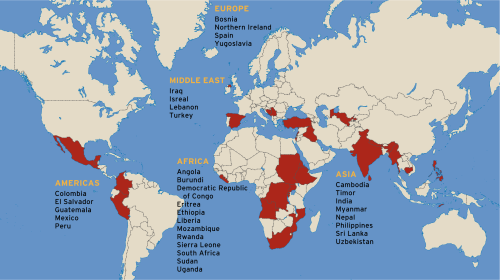
No numbers exist to indicate the extent of the practice, but abduction into the ranks of armed forces or groups is geographically widespread. Over the past decade, girls have been kidnapped and forced into wartime service in at least 20 countries— Angola, Burundi, Liberia, Mozambique, Rwanda, Sierra Leone, and Uganda in Africa; Columbia, El Salvador, Guatemala, and Peru in Latin America; Cambodia, East Timor, Myanmar (Burma), Philippines, and Sri Lanka in Asia; the Federal Republic of Yugoslavia in Europe; and Turkey in the Middle East. 6
When girls are gang pressed, they are physically coerced into serving. Schools, discotheques, and markets are typical sites for gang pressing girls. In Sri Lanka, Tamil girls orphaned by the war are recruited and gang pressed by the rebel Liberation Tigers of Tamil Eelam (ltte). The LTTE also runs its own orphanages and takes children from those orphanages to fill its ranks. Its elite fighting force, the Leopard Brigade, for example, is reportedly made up of girls and boys drawn from LTTE orphanages. While such children are more likely to join willingly, it is doubtful whether refusing to join is permitted.
There are countless other avenues into conflict for girls. Girls are sometimes given by their parents into armed service as a form of “tax payment,” as in Colombia or Cambodia; sometimes for other reasons. After the rape of his 13-year-old daughter, a Kosovo Albanian refugee father gave her to the kla. “She can do to the Serbs what they have done to us,” he said. “She will probably be killed, but that would be for the best. She would have no future anyway after what they did to her.” 7
Although some girls become involved in war of their own free will, it is often a matter of survival. The infrastructure of warring groups may be the only source of food, shelter, and security available to children in war-affected areas. To call their enlistments voluntary is misleading. The Khmer Rouge in Cambodia deprived villages of food supplies in order to force starving children into their ranks. “I joined because my parents lacked food and I had no school,” one child told the Coalition to Stop the Use of Child Soldiers. “I was worried about mines but what can we do—[going to the front line is] an order…. I saw young children in every unit.”
No story is typical
It is impossible to list “typical” duties and activities that girls carry out as participants in conflict. Gender is not always a given in terms of predicting roles: In Liberia and Uganda, some girls fought on the front lines while some boys were forced to provide sexual services. 8 In the 1990s, girls operated as combat soldiers, often with front-line duties, in countries from every region of the world. They also cooked and cleaned, spied, looted, and acted as porters. Girls conducted suicide missions and mine sweeps, helped recruit and abduct other children, and at times carried out punishment against others, such as killing those who attempted escape, as reported in Uganda and Sierra Leone. Perhaps the ugliest reality of all: Girls were nearly everywhere subject to rape and were at times systematically forced to provide sexual services for armed forces and/or groups, as confirmed in Angola, Bosnia, Burundi, Cambodia, Colombia, Democratic Republic of Congo, East Timor, Honduras, Indonesia, Kosovo, Liberia, Myanmar, Mozambique, Peru, Rwanda, Sierra Leone, Sudan, and Uganda.
Countries where girls were involved in armed conflict, 19902000, are shown in red.
During some of the fiercest fighting in Sierra Leone over the past decade, the majority of RUF camp members were captive girls. In most cases, the girls were treated as commodities to be traded. In both Sierra Leone and Uganda, the higher the status of a male commander, the more abducted girls he is given as “wives.” According to a 22-year-old male ex-rebel commander with Uganda's rebel Lord's Resistance Army (LRA), “I was abducted at the age of 9.1 was a ‘good’ soldier and by the age of 14,1 was ‘given’ my first wife (she was 17 years old at the time). When I turned 18, I was rewarded with a second wife (then 14 years old).” 9
One 14-year-old girl who was abducted by the lra and forced to be a soldier's “wife” recalls: “We were distributed to men and I was given to a man who had just killed his woman. I was not given a gun but helped in the abductions and grabbing of food from villages. Girls who refused to become LRA wives were killed in front of us to serve as a warning.”
Not all girls perform every duty (for instance, there is no evidence that Sri Lankan girl soldiers have ever been systematically required to provide sexual services). Because girls typically perform multiple duties, to categorize them as acting within a single role (as either soldiers or sexual servants, for example) is inaccurate and has numerous policy implications. Constrained notions of girls' roles may contribute to girls being overlooked for post-conflict demobilization and rehabilitation programs. Male fighters are the nearly exclusive priority for most disarmament, demobilization, and reintegration programs—significantly marginalizing girls. In Liberia, fewer than 1 percent of all demobilized child soldiers were girls, although girls constituted a large portion of the rebel National Patriotic Front of Liberia. In Angola, 8,500 boys were demobilized, no girls—despite the fact that the Angolan armed forces forcibly recruited girls and the rebel forces extensively used child soldiers, 30-40 percent of whom were girls. 10
An uneven battlefield
When wars cut off food supplies or interrupt vaccination programs, malnutrition and illness endanger children of both sexes. And all children are subject to the psychological scars that accompany the wartime loss of family, home, and community. But because of their gender and reproductive status, many young girls' experiences are distinct from those of boys.
In war-torn countries, large numbers of girls, women, and their babies are thought to die during pregnancy and childbirth. Most reports about these events are by nature anecdotal because accurate and sex-disaggregated data are rare. When girls become pregnant, whether they are encouraged to abort or keep their pregnancies can depend on the priorities of the group they are affiliated with. In Colombia, the rebel Armed Revolutionary Forces of Colombia (farc) is said to fit its young girls with intra-uterine devices or give them contraceptive injections because pregnancy is considered a liability. The Coalition reports that in Cambodia and El Salvador, pregnant girls in armed opposition groups were given the choice to abort or give their babies to peasants, who would raise them until they reach fighting age, when the forces reclaim them.
In the late 1990s in Uganda, some abducted girls who became pregnant were taken to special camps in the Sudan and looked after by older lra female commanders until they gave birth. The children then became the next generation of LRA fighters. 11
Normal female health problems associated with pregnancy, childbirth, and child-rearing are exacerbated by war. Babies often die because their mothers are unable to obtain adequate health care during and after pregnancy. The babies of abducted girls in Sierra Leone's Kenema hospital were so sick and malnourished that 20-50 percent of them were dying. 12 Little is known about breastfeeding and infant care in conflict situations, but malnourished, tired, or untrained new mothers undoubtably find it difficult to nourish and sustain their babies while at the same time being associated with fighting forces. In Sierra Leone, babies were drugged so they would sleep while their mothers went about their duties. According to a Coalition report, babies were even carried into battle.
The girls themselves appear lucky to survive the birthing process in some countries. According to one veteran humanitarian aid worker, the ruf's birthing practices in Sierra Leone included jumping on the abdomens of expectant girls and inserting objects into their vaginas to force the girls into labor well before they were properly dilated, or tying their legs together to delay birth if the forces need to move quickly. 13 Because the RUF is made up primarily of children, these practices may occur because there are no adult women or midwives around who understand proper birthing methods. 14
Girls' overall lower status makes them more vulnerable to assault than boys. Rape is damaging, physically as well as psychologically. Studies in Uganda conducted by the African Psycare Research Organization found that abducted women and girls who became pregnant after rape often experienced serious complications and infections after giving birth, developing gynecologic problems that sometimes caused permanent disability.
One 15-year-old Mandin-go girl in Sierra Leone who was abducted and later escaped told this story: “I was a virgin before. They ruined me…. I was at home when they came and kidnapped me…. They undressed five of us, laid us down, used us in front of my family and took us away with them. I couldn't walk—the pain.” 15 Rape is especially damaging to the smaller, developing bodies of younger girls. Serious reproductive health problems can occur in girls who have been sexually assaulted. Infection, uterine deformation, vaginal sores, menstrual complications, premature births, stillbirths, sterility, and death were suffered at the Kiowko hospital in Uganda by girls involved in conflict who had been subject to repeated rape, according to the African Psycare Research Organization. Rape victims often contract syphilis, gonorrhea, or hiv. In Sierra Leone, health workers estimate that 70-90 percent of rape survivors tested positive for sexually transmitted diseases; abductees were especially at risk because of repeated incidents of sexual violence. 16
Even for girls not subjected to forced sex, devastating health effects still occurred. In Cambodia, young girls were stationed at the front line of military actions and reportedly received no medical treatment when wounded; similar patterns are reported in the Democratic Republic of Congo, Myanmar, and Sri Lanka. In Sri Lanka and several other countries, girls under the age of 10 are often chosen as suicide bombers because of their small stature and gender—who would suspect a little girl of carrying a bomb under her dress? Explosives are also fitted around the waists of older girls, giving the appearance of pregnancy and supposedly averting suspicion en route to bombing missions. And in other countries, girls may be chosen for smuggling missions because they are more likely to be able to avoid body searches at checkpoints where male soldiers are not allowed to search females.
Elinda Muriqi volunteered to fight for the Kosovo Liberation Army at age 16.
Psychologically, girls may be affected in different ways than boys by the trauma of the loss of family, home, friends, community, virginity, a future, a present. In the aftermath of repeated sexual assault, girls often experience shock, loss of dignity, shame, low self-esteem, poor concentration and memory, persistent nightmares, depression, and other post-traumatic stress effects.
The psychological scars do not heal easily. After the war in Uganda ended, one Kikamulo woman who had been forced into sexual slavery said, “I have decided not to get married because of the suffering I experienced. … I cannot repeat associating with men and sex.” 17
The many problems rape victims must cope with are compounded in some countries by the stigma of lost virginity. Girls may be ostracized or rejected because they have experienced pre-marital sex—even via rape— as in Sierra Leone, Mozambique, and throughout the Balkans. The children born as a result of rape may not be accepted; the girls' problems are magnified when families reject them, their babies, or both.
Rehabilitation projects typically overlook girls' needs for physical and psychosocial assistance. Girls have the right to develop, mentally and physically, to their fullest potential. Because girls are the mothers and caregivers for future generations, their health has a critical impact on the overall health of a nation and its population.
Time for change
The policies and programs developed by the majority of organizations that respond to armed conflicts have not addressed the needs of girls who have been drawn into those conflicts. Acknowledgement of and support for the rehabilitation and reintegration of girls is needed. So far, girls seem to be lost in the shuffle, continually marginalized by disarmament, demobilization, and reintegration programs at all levels.
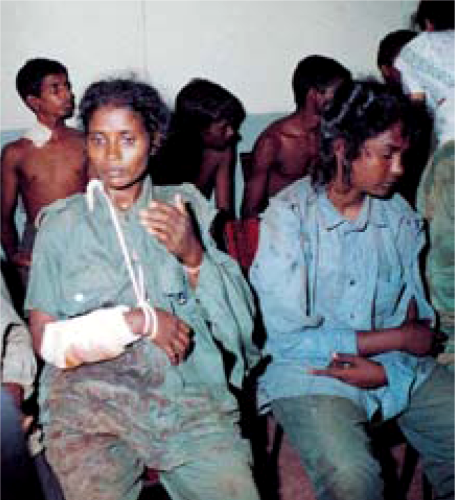
1998: Injured soldiers of the Liberation Tigers of Tamil Eelam in Sri Lanka.
The Convention on the Rights of the Child and the Optional Protocol on the Involvement of Children in Armed Conflict are among the foremost legal standards forming the international framework to stop the recruitment and abduction of girls and boys into armed conflict. To date, 166 countries have ratified the Convention. Seventy-six countries have signed the Optional Protocol, but only four have ratified it. The United States has ratified neither. To foster successful reintegration of girls, and to identify treaty violators, it is necessary to learn more about girls' participation in conflict. More needs to be learned about girls' roles and the gender-specific problems they face in order to develop international policies and programs that attempt to recognize and address their needs.
Footnotes
1.
Carol Thompson, “Beyond Civil Society: Child Soldiers as Citizens in Mozambique,” Review of African Political Economy (80), pp. 191-206; Jean Claude Legrand, United Nations Children's Fund (UNICEF), personal communication, June 18, 2001.
2.
Ruth Jacobson, as cited in Thompson.
3.
Thompson, “Beyond Civil Society.”
4.
Associated Press, May 17,2001, May 26, 2001; unicef, May 20,2001, May 29, 2001.
5.

6.
Coalition to Stop the Use of Child Soldiers, “Africa Report,” March 1999, “Americas Report,” July 1999, “Asia Report,” May 2000; Susan McKay and Dyan Mazurana, “Girls in Militaries, Paramilitaries, and Armed Opposition Groups,” Selected Proceedings from the International Conference on War-Affected Children, (Ottawa: Department of Foreign Affairs and International Trade and UNICEF, 2000).
7.
Carol Williams, “In Kosovo, Rape Seen as Awful as Death,” Los Angeles Times, May 27, 1999, Al.
8.
Thompson, “Beyond Civil Society.”
9.
Aki Stavros Stavrou, Robert Stewart, and Amanda Stavrou, “The Reintegration of Child Soldiers and Abductees: A Case Study of Palaro and Pabbo, Gulu District, Northern Uganda.” Background papers for the International Conference on War-Affected Children, September 2000, (Ottawa: Canadian International Development Agency and UNICEF, 2000).
10.
Coalition to Stop the Use of Child Soldiers, Child Soldiers Global Report, (London: Coalition, 2001).
11.
Leila Pakkala, UNICEF, personal communication, June 19,2001.
12.
Physicians for Human Rights, Preliminary Findings and Recommendations on the Health Consequences of Human Rights Violations During the Civil War, unpublished report, March 2000.
13.
Marie de la Soudiere, International Rescue Committee, personal communication, June 15,2001.
14.
Legrand, personal communication, June 18,2001.
15.
Physicians for Human Rights, Preliminary Findings, p. 3.
16.
Ibid.
17.
African Psycare Research Organization, The Psychological Consequences of War Traumatization on the Women of Luweero District: An Intervention Report, (Kampala: Isis-WICCE, June 1999), p. 52.