




Abstract
Strange things are happening in pakistan. take, for example, this April 22 headline from The News International (Rawalpindi): “PAEC [Pakistan Atomic Energy Commission] classified budget slashed by 10 percent.”
PAKISTAN: Khan forced out
Although the commission issued a vague clarification the next day, it was the first time that the nuclear program's budget was the subject of a newspaper story. The public learned there was also something called the “open budget,” making it nearly impossible to calculate the real cost of the nuclear program.
The story of the budget cut came in the wake of even stranger and, for most Pakistanis, more shocking news—the ouster of A. Q. (Abdul Qadeer) Khan, the “father of Pakistan's nuclear program,” and founder and head of the laboratories that bear his name. Simultaneously, another prominent scientist, Ishfaq Ahmed, was removed from the paec chairmanship.
Both were sent off to “retirement” in March, but neither went willingly. Both were offered the compensatory post of “adviser to the chief executive” Gen. Pervez Musharraf. Khan turned down the offer, then accepted it, and eventually refused it again. He is now officially described as “Special Adviser to the Chief Executive on Strategic and krl [Khan Research Laboratories] Affairs,” but neither he nor the press use this title.
Most political observers in Pakistan expected a strong backlash from right-wing political parties and the religious fringe over the unceremonious and sudden dumping of the two scientists, and the treatment of Khan in particular. “Their retirement…has not been taken as a routine government measure. Islamabad and the rest of the country is abuzz with rumors, insinuations, and stories behind what the media has called ‘the story of the year,’” wrote Wajid Shamsul Hasan, a former ambassador to Britain.
Why the public didn't react
But the “story of the year” did not create the uproar analysts like Hasan expected. Some political parties— notable among them the Muslim League of exiled prime minister Nawaz Sharif—accused the government of “making a compromise on the national nuclear program under foreign pressure.” But the public, by and large, remained quiet. And few newspapers deemed the event important enough for editorial comment.
“This hush-hush atmosphere has been forced by the military government because it has bowed completely to the demands of the United States,” concluded a spokesman of a religious party, the Jamiat-e-Ulema Islam. “Signing the [test ban treaty] will be the next step.”
But the public response was lukewarm to complaints that the forced retirements demonstrated the “triumph of the American agenda” or that the nuclear program has been sold out.
In fact, there had been long-running internal bickering in Pakistan's nuclear establishment. A war of words between two groups of nuclear scientists, led by Khan and Ahmed, erupted soon after the nuclear explosions of May 28,1998.
This year, on the third anniversary of the tests, the government released handouts declaring that the day was “celebrated throughout the country.” In fact, there were few if any public gatherings or rallies. And among the general public, there was a visible lack of enthusiasm.
A. Q. Khan at the inauguration of the Ghauri II missile in Islamabad, May 28, 1999—one year after Pakistan's nuclear tests.
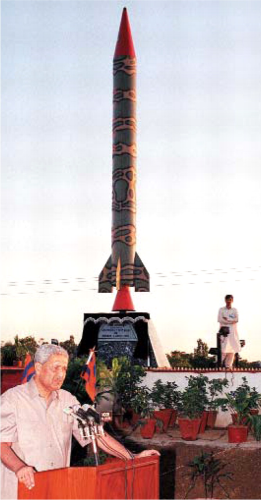
There was also no official boasting about how Pakistan's nuclear weapons could annihilate any target in the enemy country—something A. Q. Khan would use as a refrain in his speeches at every opportunity. He, too, remained silent.
An arms race within?
Compared to Ahmed and other Pakistani scientists, Khan is a legendary figure. Myths, mysteries, and an aura of stardom have surrounded his life. Since 1976, when the laboratories at Kahuta were established, Khan has always been considered the most authentic voice on the status and capability of Pakistan's nuclear projects. Although Khan and krl started out as an affiliate of the Pakistan Atomic Energy Commission and seemed subordinate for a short while, he soon took center stage and, in many ways, became the face and voice of Pakistani nuclear policy.
Khan's work may have been shrouded in secrecy, but he himself became one of the most popular public figures in Pakistan. Controversial for his extraordinarily lavish lifestyle and off-the-cuff nuclear bravado, he cultivated a larger-than-life image of himself in the media. Generally, the public adored him. Krl was his brainchild, and he and his lab seemed inseparable—until March, when the Musharraf government sacked him and his counterpart at paec.
The commission and the Khan laboratories worked in tandem—and, at times, in a bitter and unseemly competition—to make Pakistan capable of manufacturing atomic weapons and their delivery vehicles.
Until the nuclear explosions in 1998, Khan had sole claim over the making of the bomb, and to the Pakistani public, the name of Khan and krl stood for Pakistan's nuclear program. After the explosions, however, the media reported an ugly battle, as both groups of scientists made their bid to appear as the real bomb makers. This bizarre situation went to such an extreme that the government of Nawaz Sharif had to intervene to silence the scientists and clarify the contributions of the two organizations: Uranium had been enriched by KRL; other processes, up to the explosions, were handled by paec.
Bureaucratic circles in Islamabad had long been aware of the rivalry between the two nuclear groups. But the dust-up after the nuclear tests made it public. The effect of public wrangling has hung over their heads ever since.
Paec was established more than a decade before krl. The commission gave the country KANNUP, its first nuclear power plant, at Karachi, which operates under International Atomic Energy Agency safeguards. The country's other nuclear power plant, at Chashma, inaugurated earlier this year, is also the handiwork of Ahmed's paec.
Paec and krl have been even more competitive in the field of missile development. Each makes its own “brands” of missiles: Krl produces the Ghauri and Hataf, paec the Sha-heen and Hyder.
“Pakistan has got two missile programs,” George Perkovich, director of the W. Alton Jones Foundation's “Secure World Program” told News-week recently, and, he explained, when it comes to lobbying for funds for missile technology, the two organizations are in effect engaged in an arms race of their own.
Sources in Pakistan's Ministry of Science and Technology say that weapons and missiles are not the only areas of competition. “The two organizations also run extensive research training programs for young graduates and technicians.”
“Much of the myth disappeared from the nuclear folklores with both India and Pakistan conducting simultaneous tests. The ensuing verbal scuffling made the people more skeptical of their heroes' real mettle. The Musharraf government's decision was timely in the sense that neither was it expected nor could it be challenged as, after all, the military has been the real source of strength for the nuclear establishment,” said one paec scientist, who asked not to be identified.
Both Khan and Ahmed—as well as other scientists like Munir Ahmed Khan, Ahmed's predecessor at paec— have basically been the civilian faces of an essentially military-sponsored nuclear program. If the decision to sack them had been taken by a civilian prime minister, he would have found it difficult to survive the backlash. But, in the present situation, the military rules unchallenged.
Often forgotten is the fact that the work of these scientists would have amounted to little had there not been outside support. Financing from Libya and other Arab countries set the ball rolling in the 1970s. Expertise and materials from China, whose engineers were officially praised on the occasion of the Chashma plant's opening earlier this year, were absolutely vital in developing Pakistan's “indigenous” nuclear technology. Pakistan owes its nuclear-capable missiles to help from North Korea.
“The core of the two teams is formed by unknown and unsung scientists, technicians, and engineers, and it will remain unaffected by top-level changes,” the anonymous PAEC scientist told me. Weapons and weapon-related technologies, he said, are only one part of these organizations' work. “We are into education, research, and development on many other fronts as well, such as medicine, computer sciences, etc. So, in the bigger picture, PAEC and krl remain as significant as ever,” he said. But both will have to push for funding without their famous trademark faces.
On January 1, a third organization, the National Engineering and Science Commission, was established. This is an independent offshoot of paec, headed by Samar Mubarakmand, a senior paec official who has emerged as the main character in the test operations in 1998. It is expected to focus on missile development.
Changes part of a bigger plan?
Are these top-level changes and the reported cut in the nuclear budget, however small, part of a major change in policy? The government's stance on the test ban treaty and nuclear weapons remains unchanged. Although Pakistan's foreign minister, Abdul Sattar, did hint that Pakistan could sign the treaty, he hurriedly added that it would require a “national consensus” on the subject, and “adequate assurances” on security.
Analysts here believe that Khan represented the far-right, Islamic-nationalist lobby and that his removal is an indication the government might opt for a more rational course on the nuclear issue.
Others contend that Khan's charisma and overarching personality put a considerable hurdle in the way of a credible and smoothly functioning command and control mechanism. One scientist associated with krl remarked: “It is more due to the requirements of command and control over nuclear weapons and warheads that the government has eased out the two big scientists.”
As long as Pakistan and India are locked in a stalemate over Kashmir, however, and as long as the two countries see each other as eternal enemies, the race for more and better nuclear weapons and missiles will go on—both between India and Pakistan and between the paec and krl scientists, whom Musharraf called “dedicated warriors” whose work complements one another's progress for the defense of Pakistan.
“In a sea of disappointments, the development of Pakistan's nuclear capability is a unique national success story. The nation salutes you,” Musharraf said, pointing to Khan and Ahmed at the farewell dinner in their honor.