



Abstract

SS-18s. On September 26, 2000, an SS-18 was launched from Baikonur carrying commercial satellites. The launch provided the srf with significant performance information, allowing it to extend the service life of its remaining SS-18s to 24 years.
SS-19s. On November 1, 2000, one SS-19 was fired to test its ability to carry a single warhead, as called for in the start II Treaty.
SS-25s. On October 11, 2000, a 16-year-old SS-25 was launched, suggesting that the service life of SS-25 missiles might be extended by a year.
SS-27s. On February 9, 2000, the tenth and supposedly final test-launch of the SS-27 (Topol-M) was conducted. The first training launch of a silo-based SS-27 occurred on September 26, 2000, in Plesetsk; the following day, a mobile SS-27 was launched for the first time. The srf wants to deploy mobile SS-27s by end of 2002 or the beginning of 2003.
Non-strategic forces

Two silo-based SS-27s were put on “trial service” in December 1997 at the Tatishchevo missile base in southwestern Russia. One regiment of 10 missiles was declared operational in December 1998, and a second regiment in December 1999. A third regiment became partially operational late last December, but because of budget cuts it had only four missiles, one of which may have not been fully operational. All 24 SS-27s are housed in former SS-19 and SS-24 silos at Tatishchevo. In 1998, the srf hoped to deploy 20-30 SS-27s per year over the next three years and 30-40 per year for the three years following that. Deployments have fallen far short of this schedule, and tighter budgets—coupled with a shift in spending from nuclear to conventional forces—suggest that there will be further delays. By the end of 2005, it is possible that 60-80 missiles will be deployed.
Operational ssbns in the Northern Fleet are based on the Kola Peninsula at Nerpichnya and Yagelnaya, and in the Pacific Fleet at Rybachiy, 15 kilometers southwest of Petropav-lovsk, on the Kamchatka peninsula.
In 1999 the production line of SS-N-23 submarine-launched ballistic missiles (slbms) was restarted to keep the Delta IVs in service. Because of slow production, steps are being taken to extend the service life of deployed SS-N-23 missiles.
On March 27, 2000, the Delta IV submarine Karelia test launched two SS-N-23s, and on December 27 the Delta IV submarine Novomoskovsk fired a single SS-N-23.
The operational tempo of submarine patrols has been reduced dramatically since the end of the Cold War. In 1991 there were 37 ssbn patrols— by 1999 there were only seven.
The keel of the first new Borey-class ssbn was laid in November 1996. However, construction was suspended altogether in 1998. Chief of the Navy Adm. Vladimir Kuroye-dov announced that the submarine was being redesigned to accommodate a new missile. It is unlikely that any Borey-class subs will join the fleet for at least four years. Despite the Russian Navy's interest in maintaining an ssbn fleet, the future of the Russian ssbn force remains much in doubt.
In late April 2000, Tu-160 Blackjack and Bear bombers flew from En-gels Air Base to test launch cruise missiles at the northern Kanin Nos test range. In mid-August, Tu-95s from Ukrainka flew to northwest Russia to fire cruise missiles as part of Northern Fleet exercises (the same in which the Kursk submarine sank). The bombers landed in Belarus before returning to Ukrainka. Early last December, seven Tu-95MS bombers (two from Engels and five from Ukrainka) deployed to three Arctic staging bases to conduct exercises. In mid-February 2001, Blackjacks, Bears, and Backfires (Tu-22s) participated in a major exercise supported by 11-78 Midas tankers along the coasts of Norway and Japan.
As partial payment of its debt to Russia for natural gas, Ukraine sent eight Tu-160s, three Tu-95MSs, and 575 cruise missiles to Russia in late 1999 and early 2000. The Kazan Gorbunov production plant also delivered one new-construction Tu-160 to the Russian Air Force in May. These additions raised the number of Tu-160s deployed in the Russian Air Force from six to 15 in 2000. The Gorbunov plant might produce at least two more Tu-160s. The larger force led to the creation of a new Tu-160 unit, the 22nd Donbass Guard Heavy Bomber Aviation Division (Tu-160s had operated as part of the 121st Heavy Bomber Regiment). There are plans to modernize these Blackjacks and to equip them with conventionally armed long-range cruise missiles.
Strategic forces
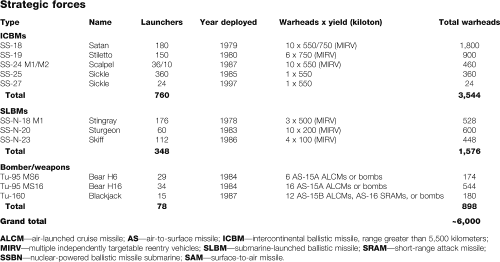
The Gorbachev and Yeltsin dismantlement initiatives were to be completed in 2000, but whether the schedules were met is unknown. Several thousand tactical nuclear weapons may be retained as spares or reserves. They also could have been retired but await dismantlement.
Some in the government and military have called for a renewed emphasis on tactical nuclear weapons to combat NATO's eastward expansion and to offset the West's superior conventional forces. The reverse argument was proposed almost 50 years ago, when the inferiority of NATO's conventional forces against the perceived Soviet threat was said to be equalized by the introduction of U.S. nuclear weapons in Western Europe.