




Abstract
If all the “excess” plutonium from dismantled weapons were measured in units of 8 kilograms—the amount the International Atomic Energy Agency considers sufficient to make a Nagasaki-type bomb—then there is enough excess weapons plutonium to build about 9,000 bombs, and enough plutonium separated from spent reactor fuel to build another 25,000.
As worrisome as it is to have so much material stored in weapons-usable form, even more is on the way. To date, the United States and Russia have each declared 34 metric tons of weapons plutonium as excess, but they will have another 100 tons to dispose of if they are serious about reducing their arsenals from tens of thousands to thousands of warheads each.
The U.S. government plans to process its declared excess at the Energy Department's Savannah River Site, where much of its weapons plutonium was produced. In Russia, the plan is to store the material in a high-security facility being built at the Mayak plutonium complex in the Ural mountains (with about $500 million in U.S. assistance). The Russian plutonium will probably be processed into nuclear fuel at the same location.
Meanwhile, the reprocessing of spent fuel from European, Japanese, and Russian light-water reactors continues to separate more civilian plutonium (which differs in its mix of isotopes but is weapons-usable). These stockpiles—totaling about 200 metric tons today and still growing—are located primarily at three large spent-fuel reprocessing complexes: Cogema's facility at La Hague, France; British Nuclear Fuels Limited's (bnfl) Sellafield plant in Cumbria, England; and Mayak. Japan is building a reprocessing complex at Rokkasho on the northern island of Hokkaido.
In 1994 a National Academy of Sciences report described U.S. and Russian stockpiles of excess weapons plutonium as “a clear and present danger to national and international security.” A 1998 Royal Society report concluded that, even in a country as stable as Britain, “The chance that the stocks of [civil] plutonium might, at some stage, be accessed for illicit weapons production is of extreme concern.”
It is becoming increasingly apparent, however, that the two plans for disposing of plutonium put forth so far—recycling it in mixed uranium-plutonium oxide (mox) fuel or immobilizing it along with highly radioactive waste—may be insufficient.
The mixed-oxide route is impeded in key countries by a lack of suitable types of reactors. The immobilization-with-radioactive-waste approach is opposed by the reprocessing industries, which generate and control most of the liquid radioactive waste that could be used for this purpose.
Recently, a proposal for a “third way” was put forward by analysts at the Oko Institute in Germany. What follows is a description and extension of that proposal.
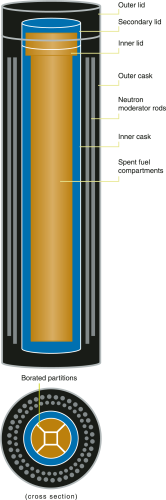
The Pollux cask, with cross section. The outer cask holds moderator rods to slow neutrons; the inner cask contains five compartments that hold about 500 spent fuel rods each.
MOX
Some civilian plutonium is being recycled into mox fuel for use in light-water reactors in Western Europe and Japan. France, Belgium, and Britain have all built mox fuel-fabrication facilities. Plutonium recycling is proceeding relatively smoothly in Belgium, France, and Switzerland.
But controversy and delays have dogged virtually every stage of German and Japanese programs. Public and political opposition forced Germany to abandon a domestic mox fabrication plant, and mixed-oxide fuel has yet to be loaded into any of Japan's commercial power reactors. At the end of 1999, nearly 50 tons of separated plutonium belonging to these two countries was stored at reprocessing facilities in France and Britain.
The United States and Russia say they intend to dispose of most of their excess weapons plutonium in mixed-oxide fuel as well. The U.S. government is in the R&D and pre-licensing phase of a disposition program that is expected to cost about $4 billion. It expects to incorporate 25 tons of plutonium taken from weapons into MOX fuel rods for burning in commercial power reactors.
The United States and its G7 partners have agreed to help fund the construction of a mox fuel-fabrication plant in Russia and modifications of five of Russia's power reactors to allow them to burn mox (at a total cost of at least $2 billion). So far, however, they have committed only about $500 million.
Using five to eight reactors, Russia will only be able to burn enough mox to dispose of about 2 tons of plutonium each year, and Russia could easily need to dispose of another 100 excess tons of weapons and civilian plutonium. Unless an additional method is made available, the process of plutonium disposal, with its attendant risks of plutonium theft, would drag on indefinitely— for decades beyond the expected lifetimes of Russia's current reactor fleet.
Neither Britain nor Russia has decided how to dispose of its separated civilian plutonium, and those stocks are expected to grow to about 115 and 40 tons respectively by the end of the decade. Britain has only one suitable reactor, and Russia's handful of light-water reactors will be fully occupied for their remaining lifetimes burning fuel made from excess weapons plutonium.
These two countries' remaining power reactors are graphite-moderated descendants of Enrico Fermi's original “pile.” The net cost of recycling plutonium in those reactors would be as much as several times higher because the concentration of plutonium in their fuel would be limited to less than half that in light-water reactor fuel. Both the British and Russian nuclear establishments are now using the problem of disposing of their plutonium stockpiles as an argument for building a new generation of reactors.
One way to increase the speed at which mox could be burned would be for countries with excess plutonium but little light-water-reactor capacity to ship the fuel to other countries. Potential recipients would include the United States, France, Japan, and Germany, all of which have large fleets of modern light-water reactors and either have or plan mox programs.
But such an idea is not practical. The U.S. government will have a hard enough time persuading the public that it should be allowed to burn its own plutonium in civilian reactors, let alone mox from overseas. The French government has rejected the idea of importing mox from Russia, in large part because it would cut into the domestic market for its government-owned national fuel-cycle company. Japan has its own excess plutonium to dispose of.
Germany's politically embattled nuclear utilities believe they might reap some potential domestic public-relations benefit by helping Russia get rid of its excess weapons plutonium—and both German and Swiss utilities might be able to ease their spent-fuel disposal problems if Russia would take back spent mox fuel. But this plan is no more likely to win public acceptance in Germany than it would in the United States.
Canada might be willing to use Russian mox in its heavy-water reactors, but more fuel would have to be fabricated because of the lower plutonium concentration in the fuel. The cost savings from the displacement of the unenriched fuel also would be much less than that from displacing low-enriched light-water-reactor fuel. As a result, the subsidy required from the G7 nations for the production of the mox fuel would have to be much higher.
Immobilization
According to its current plans, the United States intends to “immobilize” 16 tons of excess plutonium, including 5 tons from its defunct breeder-reactor development program, using the “can-in-canister” approach.
The plan is to embed the plutonium into ceramic disks 2.6 inches in diameter and 1 inch high, which then will be stacked, canned, and placed in steel frames inside 10-foot tall canisters. Molten glass, loaded with concentrated radioactive waste, will be poured into the canisters, surrounding the immobilized plutonium and creating an intense field of gamma radiation. This radioactive waste has been stored—some of it for nearly 50 years—awaiting disposal at the Savannah River Site, where it was generated in the process of producing plutonium for U.S. nuclear weapons. In the unlikely event that everything goes according to plan—funds for the Savannah River vitrification plant were omitted from the Energy Department's draft budget for fiscal 2002—the United States could begin filling canisters in 2008, eventually disposing of plutonium via this route and in mox at a combined rate of 5 tons a year.
Treating plutonium as waste material is anathema to the reprocessing industry, which is already under siege for financial as well as environmental and nonproliferation reasons. German utilities have agreed to cease delivering spent fuel for reprocessing in Britain and France after mid-2005; Belgian utilities have already made their last shipment. British and French power producers are complaining about the cost of reprocessing. Russia's smaller commercial reprocessing operation is also losing customers.
If reprocessing in Europe and Russia comes to an end in the next decade, the option of immobilizing plutonium with high-level reprocessing waste could come to an end soon thereafter, because the reprocessing industry would be under pressure to glassify its highly radioactive reprocessing waste as soon as possible.
By the end of the decade, an enormous supply of plutonium will still remain to be disposed of.
A “third way”?
In 1999, the Oko Institute, an independent German environmental think tank, came up with a third way to dispose of plutonium—fabricating it into rods of “storage mox.” Like mox fuel, storage mox would be fashioned into small cylindrical ceramic pellets (0.4 inches in diameter) that would be sealed in long zirconium-alloy or stainless-steel tubes. Instead of being used to fuel reactors, storage-MOX rods would be mixed in with spent fuel rods headed for geological burial.
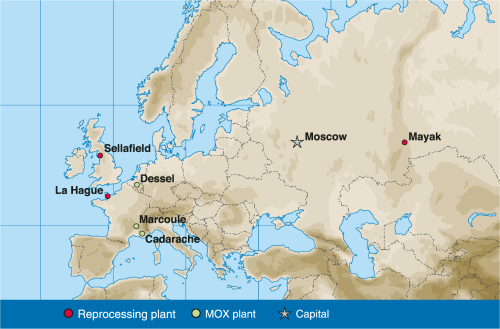
Reprocessing plants, where stocks of plutonium are stored: Mayak, in Russia, with 32 metric tons of civilian plutonium and an expected 34 metric tons of weapons plutonium; La Hague, France, with 78.1 metric tons of civilian plutonium; and Sellafield, Britain, with 72.2 metric tons of civilian plutonium. MOX fabrication plants are located at Sellafield, Marcoule and Cadarache in France, and Dessel, Belgium.
Storage mox would be cheaper to produce than mox fuel, because it would not have to be made to the same standards. It could also contain at least twice as much plutonium as the 5 to 8 percent of plutonium in mox fuel, which would reduce the cost of disposal and double the plutonium throughput of mox fuel-fabrication plants. The cost savings would be roughly equivalent to the amount that could be earned by using mox fuel to replace low-enriched uranium fuel. Therefore, the net costs of disposal of plutonium in storage mox and fuel mox would be about the same.
Criticality problems—from the increased concentration of plutonium—could be avoided by mixing neutron-absorbing gadolinium and hafnium with the plutonium, as is already planned for the U.S. can-in-canister immobilization approach.
Storage mox could therefore be a viable option for countries that need another disposal option.
Proliferation implications
From a nonproliferation point of view, the principal concern about storage mox is that it might be relatively easy to recover the plutonium that it contains—the same concern that has dogged the U.S. can-in-canister approach.
We have carried out a preliminary assessment of how difficult it would be to retrieve storage mox if it were mixed in with spent fuel in the sort of cask that will be used for the burial of Germany's spent fuel. The Pollux cask is massive, standing more than 18 feet tall and with a diameter of about 5 feet. Its layered cast iron and stainless steel walls are a foot-and-a-half thick and its empty weight is about 60 tons (see page 54).
Once the cask was placed in a deep underground repository, it would be exceedingly difficult to retrieve and extract the plutonium. We therefore focused on the question of how long it would take to extract storage mox if the cask had not yet been buried:
Potential plutonium thieves would first need to penetrate site security and locate a disposal cask, which would be difficult to open. The outer lid, weighing about 2.7 tons, would be bolted on. A middle lid, weighing a quarter of a ton, would be welded on. And an inner lid, weighing nearly another ton, would be screwed on.
If the thieves successfully removed the lids, they would also have removed the radiation shielding that the lids provide. Without shielding, they would have about 10 minutes to remove the mox rods before they were exposed to a lethal dose of radiation.
The thieves' job would be greatly simplified if they could somehow move the cask to a “hot cell,” where there would be equipment for extracting the rods remotely behind thick radiation shielding, or if they could take it to a deep spent-fuel storage pool where water would provide shielding. Heavy equipment would be needed to lift the cask, so casks containing storage mox would need to be kept behind massive barriers engineered to make moving them difficult and time consuming.
It would also take some time to separate the storage mox from the spent-fuel rods with which they were mixed. If all the rods looked the same, each one would have to be pulled out and a gamma counter swiped along it to determine whether it contained highly radioactive fission products or just plutonium, which emits relatively little penetrating radiation. There would be 2,000 to 3,000 rods in a Pollux container; if 10 percent of the rods were storage mox rods and the thieves were willing to settle for only enough plutonium to make a single nuclear explosive, they would have to sort through about 300 rods.
The task could be made more difficult if the rods were physically attached to the spent fuel rods. Because of the high levels of ionizing radiation in the cask, the “glue” would most likely have to be a low-melting-temperature metal such as lead. The trick would be to get the metal to adhere so tightly to the cladding on the rods that an end would break off before a rod could be pulled out.
With these physical barriers, in combination with multiple layers of intrusion sensors and closed-circuit television monitored by more than one surveillance agency, it would be nearly impossible to escape with either a cask or the storage mox rods it contained before being detected and apprehended.
Even with a metallic glue, however, if the country filling the casks decided to recover the plutonium for weapons, it could probably retrieve the storage mox from a cask stored on the surface within a day or so. For example, the cask could be heated to the melting temperature of the binder material and holes drilled to drain it out. The same approach could be used to drain out the radioactive glass in the can-in-canister disposition method.
However, converting plutonium to storage mox and placing it in a massive container mixed with highly radioactive waste or spent fuel is clearly preferable to storing it indefinitely in a separated form.
Meanwhile, in Britain
Britain has more than 60 metric tons of plutonium that has been separated from spent reactor fuel. Should reprocessing continue, this stockpile will grow to around 110 tons by the end of the decade. In 1998, however, the Royal Society warned that the lack of strategic direction for dealing with this plutonium was disturbing. In March 1999, a Select Committee of the House of Lords added its voice to the debate by suggesting that the bulk of the stockpile should be declared a waste.
Britain cannot dispose of this mountain of civil plutonium by burning it in MOX fuel, because most British power reactors cannot easily be adapted to use it. Only one, Sizewell B, would gualify. However, the owner, British Energy, would not modify and re-license the plant, only to pay a higher price for MOX fuel, unless it received some form of government subsidy.
British Nuclear Fuels Limited (BNFL) has suggested that the solution is to build a new generation of MOX-burning reactors. The company would like to build two “advanced passive” light-water reactors designed by Westinghouse. However, if the government bases its plutonium disposal decision on economic considerations, it is not likely to agree with BNFL. Our analysis suggests that those reactors could not generate an adeguate return on investment to be commercially viable.
Another proposal for disposing of Britain's separated civil plutonium is to immobilize it along with vitrified highly radioactive waste—a method dubbed the “can-in-canister” approach.
Although Britain appears to have the basic building blocks for such a program—it has a great deal of highly radioactive liguid waste generated in the reprocessing of spent fuel as well as a waste vitrification plant at Sella-field, it would take some 20 years to immobilize the plutonium by this method. Meanwhile, the Nuclear Installations Inspectorate (Nil) has ruled that BNFL must reduce the volume of its radioactive waste to a “buffer level” by 2015. Immobilizing the plutonium along with the waste would make it impossible to meet the Nil's target date.
As Britain explores long-term storage solutions, it will need to decide how proliferation resistant its plutonium waste form must be. The government should examine additional options, including immobilization of plutonium in “low spec” MOX, either by itself or along with spent fuel. Compared to the indefinite storage of separated plutonium, storing MOX—with or without a radiation barrier—would improve the passivity, disposability, and proliferation resistance of the material. And it would cost less than the extra expenses that would be incurred in burning MOX in the country's power reactors.
Fred Barker is an independent nuclear policy analyst and Mike Sadnicki is an independent research analyst. Their article, “The Disposition of Civil Plutonium in the UK,” March 2001, is available from
Political complications
The government-owned reprocessing companies in Britain, France, and Russia will oppose storage mox, just as they oppose immobilization with radioactive waste. It contradicts their argument for recycling plutonium in reactors because of its energy value. But if the outlook for reprocessing continues to fade, these companies will begin to focus more on opportunities for their mox fuel-fabrication plants. Producing storage mox or some other immobilized form from the more than 200 tons of separated plutonium for which a mixed-oxide fuel option may not be available would provide these facilities with an additional decade of activity.
In the early 1990s, the United States pressed other countries to reduce their stockpiles of separated plutonium. The result was the “Guidelines for the Management of Plutonium” agreed to in 1997 by Belgium, China, France, Germany, Japan, Russia, Switzerland, Britain, and the United States. The guidelines call for “balancing supply and demand, including demand for reasonable working stocks for nuclear operations, as soon as practical.”
However, neither the French nor British reprocessing company has slowed its plutonium-separation activities to allow their foreign customers to catch up with their backlogs of separated plutonium. Nor have the the British or Russian re-processors seriously considered how to dispose of their own stockpiles. Japan continues building its own large reprocessing plant despite its large and growing stockpiles of separated plutonium in France and Britain.
The renewed debate about plutonium policy—especially in Britain and Germany—could create the opportunity to push for an orderly phase-out of reprocessing and an acceleration of plutonium disposal. With the United States committed to disposing of nearly half of its weapon-grade plutonium and all of its non-weapon-grade plutonium, a renewed campaign should have increased credibility. A realistic objective would be an agreement to eliminate the world's excess plutonium stockpiles within 25 years.