




Abstract
While America Sleeps: Self-Delusion, Military Weakness, and the Threat to Peace Today
By Donald Kagan and Frederick W. Kagan
St. Martin's Press, 2000
435 pages; $32.50
You may think 2001 is a year of no particular significance, except that we have a new president who lost the popular vote and (most likely) the electoral vote. The economy may be imploding or just landing softly, and the dot-com revolution is sputtering–or then again, perhaps not.
But according to While America Sleeps, by the father-son team of Donald and Frederick Kagan, it's really 1938: “Powerful hostile states and coalitions… challenge the interests and security of the United States.” And America's response is appeasement, just as appeasement was England's answer to Hitler's annexation of the Sudetenland. Major war could be just around the corner. “America is in danger,” reads the first sentence of the book.
Then again, it may not be 1938. The authors admit that no contemporary leader rivals Hitler (although several remind them of Mussolini). Perhaps it is 1926–the heyday of the Roaring ‘20s, “only eight years after the collapse of the German Empire,” with “no credible threat” to peace on the horizon and everyone blissfully unaware that in a mere five years “the Japanese drive” would begin, followed by Nazi aggression.
Then again, maybe it's 1919, when “Great Britain found itself in a situation very similar to the one in which we live today.”
The Kagans concede that “no historical analogy is perfect,” as the analogies that mushroom on almost every page of this book prove. Yet “for all its shortcomings, past behavior remains the most reliable predictor of future behavior.” Despite the difficulties of predicting the future, the authors show that predicting the past is a cinch.
The Kagans predict the past through two-thirds of the book, revisiting “Britain between the wars” in a long historical reprise based mostly on secondary sources that support their arguments. They know that Britain, flush with victory in 1919, is headed for a long decline into economic torpor and military weakness, even though most people at the time thought the opposite. And sure enough, by page 233 they report that with each passing year, Britain was “relatively weaker and more withdrawn from the international scene. Thrust into a position of leadership in 1919, England abdicated.” (Other historians might argue that England “thrust” itself into a position of leadership after defeating Napoleon at Waterloo, a role not relinquished until a century later.)
After 1919, Britain “slashed its armed forces, allowed its military modernization program to stagnate, and pinned its hopes for peace on the economic wonders to be performed by international trade and international organizations.” Lo and behold, since 1991 the United States has done the very same things. Rarely has history repeated itself with such uncanny clarity. The United States has reduced its forces by more than a third, failed to acquire “one new major weapons system,” allowed the reckless expansion of nato, and foolishly tried to appease dangerous rising powers like … North Korea.
Ten-feet-tall North Korea is hellbent on “relentlessly developing nuclear weapons and long-range ballistic missiles.” This despite the International Atomic Energy Agency's certification that the 1994 Framework Agreement shut down the country's nuclear reactor and attempts by Kim Jong II (another Mussolini according to the authors) to pawn his long-range missiles to Bill Clinton. Almost as fearsome are China (“hostile, antagonistic, and threatening”) and Russia (“openly opposed to American policies in the Balkans and Iraq”).
The storm has been gathering for a decade, according to the Kagans, but in 1991 we failed to comprehend that we were at a critical turning point. Of course, clairvoyance was a tricky business then, what with the Berlin Wall falling, the Cold War ending, and the evil empire dissolving. And who could have known that the allies' overwhelming victory in the Persian Gulf war would lead to “another Versailles”?
It would indeed be one of the great ironies of modern times if 1991–the year the United States emerged from the Cold War as the only remaining superpower, outspending all conceivable adversaries combined on defense and launching an information revolution that would sweep the globe–was really the beginning of the end of American dominance. But the United States can still save itself, say the authors, if it spends more on defense and acquires loads of new weapons. This last message, which dominates the latter third of the book, seems to have been perfectly timed for the 2000 presidential campaign. It also serves as preface to the book's final section, “America, Wake Up!” I can attest that the authors succeeded in waking up at least one sleeping American.
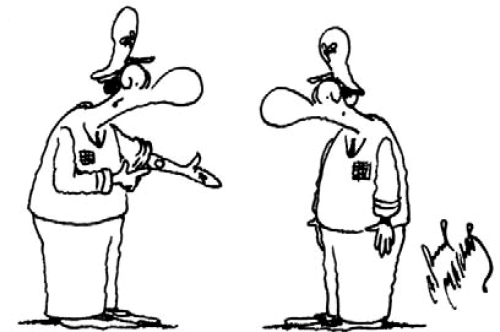
“This is my test-ban patch.”
There is one good thing about While America Sleeps: No one who reads it is going to run out and buy a flak jacket, teach kindergartners to “duck and cover,” or restock a backyard bomb shelter. This is a book to assign to students who want to know what professors mean when they say “a little history is a bad thing,” or if they want to know what David Hackett Fisher was talking about in his classic book, Historians' Fallacies. On the other hand, if world war breaks out this year or next, the Kagans will be considered prophets.