




Abstract
Described as “preventive defense” or “extended deterrence” by its supporters–but decried as “a new form of gunboat diplomacy” by its detractors–a new program called the “Counterproliferation Initiative” was unveiled in December 1993 by then-Defense Secretary Les Aspin.
There was considerable controversy over what “counterproliferation” meant. But it was widely interpreted as indicating that the United States–having recently demonstrated overwhelming military superiority in the Gulf War–would now flex its muscles even further, looking into the ways and means of preemptively striking regional troublemakers or would-be attackers.
Although there was talk of building conventional weapons capable of destroying deeply buried targets like command centers (Aspin said both new strategies and new military capabilities were needed), the initiative envisioned the use of U.S. nuclear weapons to defeat chemical or biological weapons. The idea, simply, was to “locate, neutralize, or destroy” others' weapons of mass destruction before they could be used. For the first time, the United States openly added targets in the Third World to its nuclear-weapons targeting plan.
Now, after eight years of reality, the initiative has morphed into something much less than promised. Author Henry Sokolski describes the process.
The United States wanted to achieve the ability to neutralize any proliferation threat, anywhere, any time.
The fate of President Bill Clinton's “Coun-terproliferation Initiative” was tethered to its strategic assumptions. An initial interest in devising plans for preemptive strikes against foreign proliferation activities simply ignored the American culture's bias against launching Pearl Harbor-like attacks. More important, the initiative at first presumed that some military-technical means could neutralize proliferation problems. And that, in fact, turned out to be inherently difficult, if not impossible.
Strategic weapons (long-range missiles and nuclear weapons) are of proliferation concern, after all, precisely because no effective military counter-measures against them are yet available, and because only a few strategic weapons can produce war-winning or victory-denying results. To presume that there could be some finite military solution to proliferation is to seriously underestimate what the threat is about.
The sources of these initial misunderstandings can best be understood by tracking the origins of the initiative, which were rooted in the fallout from the war against Iraq.
First, despite clear U.S. military superiority over Baghdad, Iraq's missiles and chemical and biological weapons stockpiles–and its fledgling nuclear program–heightened concern that the United States would eventually face enemies armed with strategic weapons.
Second, critics of the first Bush administration complained that U.S. export controls had failed to prevent Iraq from acquiring the advanced technologies needed to develop these capabilities. Together, these two events (and the presidential election in 1992), put tremendous pressure on the Bush administration to come up with some sort of response.
Late in the summer of 1992, the Office of the Principal Deputy Under Secretary of Defense for Strategy and Resources suggested a reorganization aimed at strengthening Defense Department efforts against strategic weapons proliferation. The proposal called for a new deputy under secretary of defense to be created to oversee the activities of the Defense Trade Security Administration, the Office of the Deputy for Nonproliferation Policy, and the Deputy Assistant Secretary for Conventional Forces and Arms Control Policy.
Ironically, the suggested title for this deputy–“Deputy Under Secretary for Counterproliferation”–had been considered for the director of proliferation countermeasures three years before, but rejected as too vague.
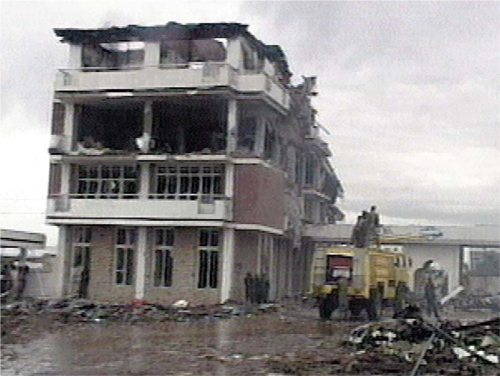
What counterproliferation became: A Sudanese pharmaceutical plant destroyed by U.S. cruise missiles, August 21, 1998.
Counterproliferation, May 1996
“If you don't think the United States government is doing anything to combat NBC [nuclear, biological, and chemical weapons] proliferation and terrorism, then you don't know what's going on. But if you think it's enough, you don't know the gravity of the threat.”
Ashton Carter Assistant Secretary of Defense
Did creating a deputy for counter-proliferation mean that the Defense Department intended to neutralize weapons of mass destruction with advanced technology? Or was “countering” to be accomplished with more traditional military counteroffensives or with counter-intelligence? Did counterproliferation–whatever it was–include traditional nonproliferation efforts, or were these activities at odds with one another?
By 1992, these questions seemed intriguing. Literally hundreds of draft view charts were composed explaining what counterproliferation might mean and what a deputy under secretary implementing it might do. But none of these briefings was ever used.
In September 1992, Deputy Defense Secretary Donald Atwood thought the better of reorganizing the department during the closing months of a presidential campaign and put a freeze on the creation of new offices. Then, two months later, President George Bush lost the election.
President Bill Clinton and the new officials he brought on were eager to reorganize the government, including the offices focused on proliferation issues. Several senior Clinton defense advisers had already considered what was needed while serving as members of the Defense Policy and Defense Science Boards of the Bush administration.
The Defense Science Board, in particular, had spent more than a year analyzing what new defensive and counterof-fensive technologies might be developed to respond if other nations threatened to use chemical, biological, or nuclear armed ballistic missiles. The board concluded that, with enough advanced sensors, counterof-fensive missile technologies, and intelligence, the U.S. military might be able to destroy the bulk of an enemy's offensive missiles before they ever left their launchers.
Two key Democratic board members–John Deutch, who later served as under secretary for acquisition and then deputy secretary of defense in the Clinton administration, and Ashton Carter, who became assistant secretary of defense for nuclear security and counterproliferation–warmly embraced the board's findings.
In an essay on intelligence requirements written for the Council on Foreign Relations prior to his appointment, Carter argued that combating the spread of weapons of mass destruction with precision weapons required precise and timely intelligence. What was most critical, he argued, was to know when a nation was about to acquire one or two weapons and where these weapons might be. It was one thing, he noted, to collect intelligence on nations acquiring fissile material to make their first bomb, but:
“Planning an air strike on the nuclear facilities of a nation approaching construction of a first bomb, by contrast, requires entirely different types of collection and analysis. Military planners need to study the building the raid is supposed to destroy. The aircraft delivering the bombs will require information about the location, radar frequencies, and signal structures, and command and control of air defenses surrounding the target. If cruise missiles and other ‘smart weapons’ are to be used, terrain contour maps, terminal area images, global positioning coordinates, and other precision guidance information will have to be assembled.” 1
Although this kind of planning would naturally be useful to limit damage once a new nuclear nation went to war against the United States, in another section of his essay, titled “Attacking a Fledgling Program or Arsenal,” Carter also emphasized that it would be particularly useful if the United States were planning an offensive attack.
Planning to fight proliferation and even to launch preemptive strikes was something new. More importantly, the idea resonated with Les Aspin, the new defense secretary, who as chairman of the House Armed Services Committee had argued that the spread of weapons of mass destruction was now the country's number one security concern. On December 7, 1993, after months of briefings on what a counterproliferation initiative might be, Aspin announced the program before an audience at the National Academy of Sciences.
Much of his speech was straightforward. In addition to working with the State Department to try to prevent the proliferation of weapons of mass destruction, Aspin called on the Defense Department to work harder to protect against these weapons' possible use. But what caught most people's attention was the secretary's assertion that providing such protection constituted a new, unique military mission, and that he had formally directed the military services to “develop new military capabilities to execute it.” 2
Although Aspin left the Pentagon soon after announcing the initiative, he tried his best to institutionalize it. First, he established a new post for Carter–assistant secretary for nuclear security and counterproliferation. Second, he instructed the military services to identify research and acquisition programs that needed to be funded to accomplish the new counterproliferation mission. He also had his deputy, John Deutch, make counterproliferation a Defense Department acquisition priority. Finally, he saw to it that language was introduced in the National Defense Authorization Act for fiscal year 1994 requiring his successor to identify precisely what additional counterproliferation spending was needed.
Not surprisingly, the first half of 1994 was a busy one for the initiative's supporters. In addition to Carter and his deputy assistant secretary for counterproliferation, another deputy assistant secretary for counterproliferation was created within the Office of the Under Secretary of Defense for Acquisition.
This new deputy was immediately put to work to answer congressional reporting requirements concerning what new spending would be required. In May, Deputy Secretary Deutch asked the military services to find $400 million a year to fund 14 “underfunded” counterproliferation programs that his acquisition staff had identified. (These programs included development of radars that might find underground command centers, systems that could acquire mobile Scud missile launchers before they fired their missiles, and non-nuclear munitions that might interfere with an adversary's electronic command, control, and communications systems.) 3
The military services were hardly enthusiastic. After months of review, they had earmarked no more than $80 million for possible use to fund programs supporting the counterproliferation mission. The Office of the Secretary of Defense dropped any further talk of securing hundreds of millions of dollars for counterproliferation, and instead, Clinton's defense appointees began to claim that the entire defense budget was in one way or another dedicated to counterpro-liferation. The Office of the Joint Chiefs of Staff, meanwhile, contended that the counterproliferation “mission” was not a separate undertaking but was incorporated into all existing military missions.
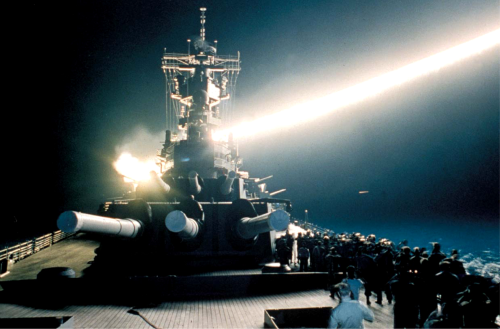
Gulf War, January 18, 1991: A Tomahawk cruise missile is fired from the USS Wisconsin.
Why was the military's initial support of the counterproliferation initiative so weak? Several Pentagon observers believe that the Clinton Pentagon simply asked the military to make too great a financial sacrifice. While Deputy Secretary Deutch was asking the military to find $400 million in existing budget authority for counterproliferation, the White House was demanding significant cuts in overall Defense spending. This undermined the secretary's credibility.
The services also resented having counterproliferation forced on them as a separate mission requirement with little or no prior consultation. Certainly, the services could see the need to do more to prepare to fight in nuclear, chemical, and biological warfare environments. But that preparation was something they believed had to be done as part of existing military requirements to assure command of sea, air, and land.
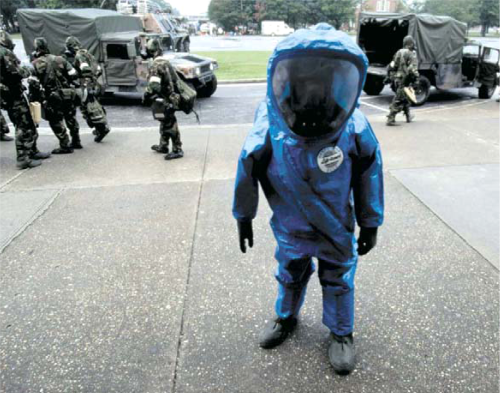
A marine models a biohazard suit, Jacksonville, North Carolina, about 1996.
Finally, some in the military were uneasy about the idea of preemptive war, although their concerns were generally not shared by Special Operations staffs: But what were the legal, moral, and operational ramifications of using U.S. military force before open hostilities began?
The military's concerns were amplified by the U.S. arms control community. They too suspected that the preemptive war aspect of the initiative was far more significant than publicly stated. They also were concerned that the Defense Department was abandoning its hardline opposition to lax export controls, especially over dual-use items (computers, diagnostic equipment, and other items useful for making strategic weapons). Counterproliferation was what the Defense Department would do after export controls had failed to prevent proliferation: The department's traditional use of military threat assessments to fortify other agencies' export control efforts no longer seemed to be a priority.
Finally, arms control supporters worried that nonproliferation itself was being challenged. On the one hand, counterproliferation's backers were arguing that with enough military effort (and spending), the United States could so mitigate the threats posed by weapons of mass destruction that it and its allies could prevail on the battlefield even if those weapons were used. 4 Yet, if this were so, existing nonproliferation taboos against their use, which the United States had always been eager to strengthen, would be undermined.
Then there was the problem of deterrence. Lacking chemical or biological weapons, the U.S. military reserved the option of deterring their use (and the use of nuclear weapons as well) by threatening U.S. nuclear counterstrikes. Yet the more the Pentagon developed this option, the more arms control advocates worried that it would make other nations' acquisition of nuclear weapons seem justified. All of this and the initiative's feared flirtations with preventive war encouraged extensive debate.
Counterproliferation also prompted substantive and bureaucratic worries at the State Department, which had traditionally maintained control over proliferation issues. But the Defense Department's initiative now threatened this. In the weeks following Aspin's announcement of the Counterproliferation Initiative, debates broke out between State and Defense officials and even within the Defense Department itself over what the initiative covered. Some officials wanted all proliferation concerns, including advanced conventional weapons, to be included; others did not.
Counterproliferation, July 1999
“According to Sen. Arlen Specter … 96 agencies are pursuing counterproliferation efforts. Creating a national director to oversee them ‘is like putting a Band-Aid on a bullet wound to the head.’”
Ivan Eland Cato Institute
There also were disagreements over who was in control of counter-proliferation policy. The State Department insisted that it should be in command of the initiative since State chaired the interagency working group on proliferation. Defense, meanwhile, was just as insistent that it have a free hand because the counterproliferation initiative was its idea, and it was footing most of the bill. The Arms Control & Disarmament Agency (acda) and the Energy Department also had a stake in the matter, as did the intelligence agencies that were trying to budget and reorganize themselves to respond to new requirements.
In January 1994, the National Security Council (nsc) staff was asked to resolve the issue. By mid-February, the council settled the key dispute between State and Defense by brokering a set of definitions that both departments could accept but that favored State. Proliferation was defined descriptively: “The spread of
nuclear, biological, and chemical capabilities and the missiles to deliver them.” Meanwhile, nonproliferation was defined as Washington's comprehensive policy against proliferation, which employed the “full range of political, economic and military tools to prevent proliferation, reverse it diplomatically, or protect our interests against an opponent armed with weapons of mass destruction or missiles, should that prove necessary. Nonproliferation tools include: intelligence, global nonproliferation norms and agreements, diplomacy, export controls, security assurances, defenses, and the application of military force.” 5
This definition of nonproliferation reduced counterproliferation to Defense Department activities “with particular responsibility for assuring that U.S. forces and interests can be protected should they confront an adversary armed with weapons of mass destruction or missiles.” 6
Although somewhat confusing, this definition had three clear advantages. First, by keeping nonproliferation as the comprehensive term to describe U.S. efforts against the spread of weapons capable of mass destruction, the policy focus was kept on the most horrible and indiscriminate weapons and on existing international and U.S. diplomatic non-proliferation efforts in general. It gave the State Department ultimate control over any counterproliferation effort; by definition, counter-proliferation was subsumed under nonproliferation.
Second, it avoided the vagueness inherent to any set of prescriptive definitions. A prescriptive definition might help clarify why weapons of mass destruction were of proliferation concern and what else might qualify and why. But those definitions were certain to generate the kind of debates over what should be included that the nsc definition memo was crafted to avoid.
Finally, by limiting proliferation to weapons of mass destruction and the missiles to deliver them, the nsc definition kept conventional military systems and dual-use items that the United States wanted to export to its friends out of the web of nonproliferation export controls.
The bureaucratic advantages that these definitions offered, however, came at price. As long as proliferation concerns were limited to weapons of mass destruction and ballistic missiles, any hope of developing truly effective military countermeasures (distinct from defenses and damage-limiting measures) would necessarily remain distant. More important, the nsc definitions and their preoccupation with weapons capable of mass destruction kept counterproliferation from addressing the technical revolution in military affairs that even smaller nations were engaged in.
Thus, some of the most interesting of emerging strategic threats were placed beyond the initiative's reach. This was regrettable because some new threats (particularly those posed by conventional cruise missiles, crude information warfare, and submersibles) were precisely the ones that were most amenable to the development of effective military countermeasures and targeted export controls.
The military services' staffs began to take more serious steps to evaluate the damage-limitation requirements that nuclear, chemical, and biological weapons might impose against U.S. forces, and in 1993 they created a Joint Program Office to address the shortcomings in U.S. preparations to fight adversaries who might use such weapons.
More important, the military finally began to conduct annual war games that focused on the effects that nuclear, chemical, and biological weapons might have on U.S. forces. A little more than a year after Aspin's announcement of the counter-proliferation initiative, the navy incorporated nuclear, biological, and chemical weapons threats into its annual Navy War College war game, “Nimble Dancer.” Serious problems were encountered in playing out these games, but the navy decided at the highest levels to continue to highlight chemical, biological, and nuclear weapons threats in follow-on war games.
Financially, however, the initiative enjoyed only mixed success. As noted before, Deputy Secretary Deutch attempted in 1994 to increase government-wide funding for counterproliferation-relevant research and hardware acquisition by some $400 million annually. Yet even the White House requested only $164 million. Moreover, the Joint Chiefs earmarked only a third of the $230 million in Defense Department counterproliferation shortfalls Deutch had identified (the other shortfalls were associated with the intelligence community and the Energy Department).
Two years later, things had not improved. In fact, an internal Pentagon review in 1996 concluded that the department was still failing to fund some of the highest priority counterproliferation programs (biological agent detectors, for instance). Finally, in 1999, the department announced it would spend approximately $1 billion over the next five years to address these deficiencies. In one controversial program, many in the military forces were vaccinated against anthrax, but the safety of the vaccine was questioned.
As for the operational implementation of counterproliferation, the Defense Department initially did some planning and actually considered two offensive campaigns.
In 1993 the United States acted on intelligence that the Chinese were shipping chemical weapons-related materials to Iran. The White House considered interdicting the shipment, but the suspect ship, the Yin He, turned out not to be carrying the illicit materials.
Second, during the 1994 nuclear crisis with North Korea, the U.S. Air Force briefed Defense Secretary William Perry on how it might bomb the North Korean nuclear reactor at Yongbyon, although the “White House chose a diplomatic approach instead. In exchange for several billion dollars in oil and nuclear energy assistance, North Korea pledged not to operate its known nuclear facilities, eventually to allow inspections, and ultimately to dismantle the facilities.
The two largest counterproliferation operations that the services actually executed came four years later. In 1998, U.S. cruise missiles were fired against a suspected Sudanese chemical weapons plant and against Iraqi chemical, biological, and missile production plants.
Neither campaign was a clear success. Following the attack against Sudan, evidence emerged that the plant U.S. missiles destroyed was a pharmaceutical facility, not a weapons factory. As for Operation Desert Fox against Iraq, its effects were only temporary. As Gen. Anthony Zinni, the commander in chief of U.S. Central Command, publicly noted, bombing Saddam's biological and chemical plants could hardly stop those programs because making chemical and biological weapons is relatively easy.
None of these events helped the initiative bureaucratically. Unable to secure large sums for a new, separate, counterproliferation mission, Defense Department officials began arguing that nearly the entire defense budget was targeted against the threat of proliferation.
In 1996 Defense Secretary Perry eliminated the posts of assistant secretary for counterproliferation and deputy assistant secretary of defense for counterproliferation. By 2000 all that remained within Defense was a counterproliferation directorate. Its most public function was to coordinate proliferation-related meetings with nato and other nations. The bulk of the initiative's acquisition activities, which focused on passive biological and chemical weapons defenses, continued.
The initiative's emphasis clearly had shifted. Originally the initiative was animated by the prospect that offensive military operations might neutralize or roll-back the threat of strategic weapons proliferation. Seven years later, however, the initiative had been reduced to a less heroic but still critical concern of limiting whatever damage U.S. expeditionary forces might suffer if, as seemed likely, chemical, nuclear, or biological weapons were used against them. In short, the word counterproliferation had survived, but the hope that the initiative might neutralize the proliferation threats the United States and its allies faced, had not.
Footnotes
1.
Robert D. Blackwill and Ashton B. Carter, “The Role of Intelligence,” in New Nuclear Nations: Consequences for U.S. Policy, Robert D. Blackwill and Albert Carnesale, eds. (New York, N.Y.: Council on Foreign Relations Press, 1993), p. 234.
2.
“Remarks by Honorable Les Aspin, Secretary of Defense, National Academy of Sciences, Committee on International Security and Arms Control, December 7, 1993,” reprinted in The Counter-Proliferation Debate (Washington, D.C.: Carnegie Endowment for International Peace, November 17, 1993).
3.
Office of the Deputy Secretary of Defense, “Report on Nonproliferation and Counterproliferation Activities and Programs,” May 1, 1994, p. ES-2.
4.
See, for example, Office of the Secretary of Defense, Proliferation: Threat and Response (Washington, D.C.: U.S. Government Printing Office, 1997), p. iii; and Ashton Carter and Celeste Johnson, “Beyond the Counterproliferation Initiative To A Revolution in Counterproliferation Affairs,” National Security Studies Quarterly, Summer 1999, pp. 83-90.
5.
Daniel Poneman, Special Assistant to the President and Senior Director for Nonproliferation and Export Controls, Memorandum for Robert Gallucci (Assistant Secretary for Political Military Affairs, Department of State) and Ashton Carter (Assistant Secretary for Nuclear Security and Counterproliferation, Department of Defense), “Agreed Definitions,” February 18, 1994.
6.
Ibid.