



Abstract

When weapons scientists talk about the “reliability” of nuclear weapons, they may not mean what you think they mean. Reliability refers to the ability of an individual warhead or an entire class of weapons to deliver explosive power exactly as designed.
Sandia National Laboratories defines reliability as “the ability of an item to perform a required function. Implicit in the above definition of ‘required function’ for one-shot devices, such as nuclear weapons, are the required conditions and duration of storage, transportation, and function. Also implicit in the above definition of ‘ability’ is the concept of successful performance. Successful performance is defined as detonation at the desired yield (or higher) and within the desired CEP through either the primary or any designed backup mode of operation. [The cep, or circular error probable, is a measure of how close a weapon comes to its target. It is usually a few hundred feet.] Thus, reliability is the probability of successful performance and has mathematical limits of 0 and l.” 1
From the perspective of the national laboratories, a nuclear weapon is either reliable or it is not. The percentage by which a weapon is considered unreliable, and how a reliability problem might affect the warhead's performance, is largely irrelevant. Potential reliability problems could include, for example, a faulty altimeter that causes a warhead to detonate at 1,500 rather than 1,800 feet above the ground; deteriorating plastics that affect the performance of a particular component or components; production-related problems with the secondary (thermonuclear) components that diminish the yield of the warhead; or a faulty micro switch that prevents proper arming and firing. Only the last problem might cause the warhead to fail to explode.
Why such stringent criteria? The answer lies in the Single Integrated Operational Plan (siop), the regularly updated document governing how U.S. nuclear weapons would be used (or “expended,” in military parlance) in the event of war. When assembling the siop, officials at Strategic Command (Stratcom) in Omaha, Nebraska, assign targets to warheads of specific yields to achieve precise levels of destruction across the entire spectrum of targets covered by the plan. Any deviation from these strict performance criteria, in the eyes of the military, threatens the ability of the United States not only to deter aggression, but to defeat an aggressor if the president orders the use of nuclear weapons. Therefore, a warhead (or class of warheads) that explodes at anything less than its designated yield, or at the wrong time, or at the wrong height or depth, jeopardizes the entire siop and with it the security of the United States. 2
Back in the real world, such concerns may seem farfetched. Surely the fate of the United States rests on more than the ability of Stratcom to deliver one or more nuclear warheads to Kozelsk, for instance, where Russian SS-19 intercontinental ballistic missiles are fielded, and be confident that the warheads will detonate in precise order at a precise time. Minor variations in yield, location, and timing would surely not alter the final result. Who would be able to tell the difference between a 400-kiloton explosion and a 475-kiloton explosion?
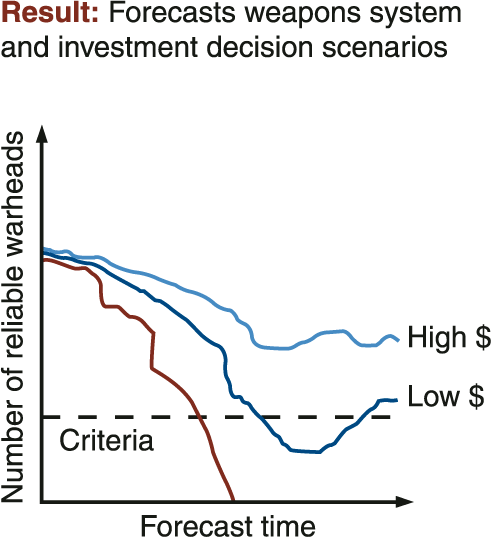
And don't try to figure out costs, either:
This graph, reproduced in its entirety, is from the December 2000 Science & Technology Review, a publication of Lawrence Livermore National Laboratory. It allegedly shows how “scientists forecast the future reliability of various weapon systems as a function of investments in science-based activities”—surely a difficult task without defined “criteria” or any actual numbers, years, or dollars.
Because deterrence rests as much on perception as reality, problems with a few warheads or even all warheads of a single type, even if they became widely known, would not detract from the well-documented belief that the United States, with a stockpile of some 10,500 weapons, is both able and willing to deliver unimaginable nuclear firepower almost anywhere in the world on short notice. But the targeteers at Stratcom are not paid to live in the real world.
An independent analysis of Energy Department data on warhead “defects” found that of the 164 “actionable” types of defects that can reduce reliability, only nine (5 percent) reduced reliability by more than 10 percent. The majority (112 defect types, or 68 percent) reduced reliability by 0-1 percent. Significantly, most defect types–81 percent–affected the non-nuclear components of the warhead. Historical experience demonstrates that for most warheads with reliability defects, there is a more than 90 percent probability that they will still perform as expected. 3
Appearing before the Senate Armed Services Committee in October 1999, as the Senate was considering the Comprehensive Test Ban Treaty (ctbt), Robert B. Barker, a physicist and former assistant to the secretary of defense for atomic energy, testified that “when I and my colleagues talk about the loss of ‘reliability,’ we are talking about the concern that all weapons of a given type will fail to perform their mission.”
John Nuckolls, a former director of the Lawrence Livermore National Laboratory, has described the different connotations of reliability as the difference between “owning an automobile ‘lemon’ and finding that your automobile is in a ‘recall’ because the manufacturer has discovered a fatal flaw in every car built of that model. The ‘lemon’ is an example of a statistical problem, where only some limited percentage is bad. We can stand some ‘lemons’ in the stockpile; we cannot afford a ‘recall’ that affects reliability or safety.” 4
Barker was arguing against the ratification of the ctbt and in favor of an immediate resumption of underground nuclear testing to identify and correct problems with warheads. But of the 1,030 tests conducted by the United States between 1945 and 1992 (when Congress enacted a test moratorium), very few were for the purpose of finding and fixing war-head problems. The purpose of the overwhelming majority of tests–nearly 84 percent–was to develop new warheads. From 1970 through 1992, only 12 of 408 tests (3 percent) were conducted to identify or verify the correction of defects in deployed weapons.
Is reliability testing necessary? Testifying at the same Senate hearing in October 1999, John S. Foster, a former director of Livermore and the current chairman of the congression-ally mandated “Panel to Assess the Reliability, Safety, and Security of the United States Nuclear Stockpile,” said that even after all those tests, conducted at a cost of more than $55 billion, scientists still had a very poor understanding how nuclear weapons work. “The testing which has been performed over the years has clearly shown that our ability to calculate and simulate their operation is incomplete. Our understanding of their basic physics is seriously deficient,” clamed Foster. The current stockpile–nine types of warheads optimized for specific missions–consists of “devices that have been highly tuned, as much by trial and error as by calculations. As a result, their performance is very sensitive to small changes.” 5 In other words, give us more money, and more weapons to tinker with, and we'll get it right, maybe.
Footnotes
1.
Sandia National Laboratories, Nuclear Weapon Reliability Evaluation Methodology Guide, July 23, 1993, p. 1-1, cited in Hisham Zerriffi and Arjun Makhijani, The Nuclear Safety Smokescreen: Warhead Safety and Reliability and the Science Based Stockpile Stewardship Program, Institute for Energy and Environmental Research, May 1996 ( ).
).
2.
Accuracy is critically important too, as noted above, but this is largely dependent on the proper functioning of the warhead's delivery system rather than the warhead itself.
3.
Zerriffi and Makhijani, The Nuclear Safety Smokescreen, pp. 26-29.
4.
5.
Ibid., p. 164.