




Abstract
The U.S. government said it would never use commercial reactors to produce weapon material.
In the waning weeks of 1998, lights burned late into the night around the Mall in Washington, D.C. At the east end, congressional staffs were preparing to impeach President Bill Clinton. To the north, at the White House, Clinton and his closest advisers were crafting his defense. But to the south of the Mall, in the gargantuan Forrestal Building, high-level officials grappled with a far different problem, related not to presidential misbehavior but to U.S. policy on nuclear arms and nuclear proliferation. Leading the deliberations was Secretary Bill Richardson, just four months into the job, but already deeply mired in the controversies and scandals of the most beleaguered of federal agencies, the Energy Department.
One of the policy issues Richardson was contemplating in December was how the United States should renew its supply of tritium, the radioactive isotope of hydrogen needed to turn an A-bomb into an H-bomb. What to do about the tritium supply was a subject that had occupied every secretary of Energy since 1988, when the last tritium-producing nuclear reactor at the Savannah River Site in South Carolina, deemed unsafe, was shut down.
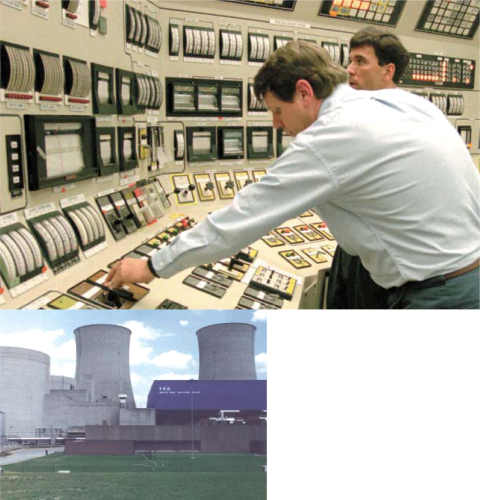
Bill Richardson gave the go-ahead for tritium production at the Tennessee Valley Authority's Watts Bar nuclear power plant, above. Top: Reactor operators power up, January 18, 1996.
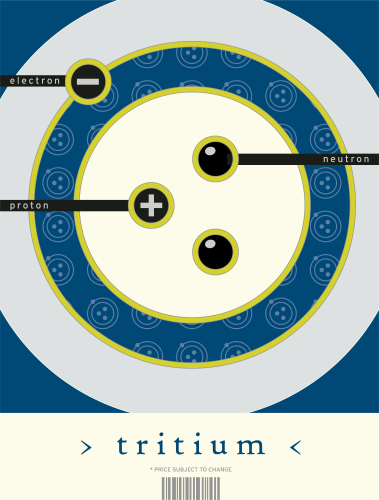
Reserve supplies of tritium had so far been more than sufficient. Still, tritium decays at an annual rate of 5.5 percent, so the day would come when a new supply would be needed to maintain the country's arsenal. For years, arguments swirled around Washington and Energy's vast nuclear weapons complex about what kind of facility should be built to make more tritium. 1
Several concepts had been proposed for the new facility, ranging from improved versions of the old Savannah River reactors to high-energy particle accelerators.
Although Richardson had a December 31 deadline for his decision, whatever time pressure he felt was mostly symbolic. Dramatic progress in the start I and start ii treaties had slashed the number of weapons the United States would maintain.
Those arms reductions affected the tritium supply in two ways: First, they reduced the total quantity the new facility would need to produce; and second, because tritium from retired weapons can be used to resup-ply active weapons, they extended the “grace period” before a new facility was needed. For example, at the start ii level of no more than 3,500 deployed strategic warheads, the United States would not deplete its tritium reserves until 2016 or so. 2
Still, Richardson wanted to show Washington that the new man at Energy was a man of action, not delay, and he fully intended to meet the deadline.
On December 22, Richardson announced the results of his deliberations. Tritium for the U.S. nuclear arsenal would be produced in two commercial nuclear power plants in the course of their normal production of electricity for the civilian electric grid. Hardware modifications would be carried out by their owner, the Tennessee Valley Authority (tva), and the modifications in their operating licenses would be the responsibility of the Nuclear Regulatory Commission. The Energy Department would provide the funds for altering the plants and pay for whatever quantity of tritium was produced. 3
The decision was a surprise even to insiders. 4 For years, the smart money had bet on an accelerator concept, which could produce not only tritium but also exotic isotopes for medical research and advanced therapies.
The path Richardson laid out would be less expensive, but there was–or ought to have been–a stunning roadblock: It violated the long-standing U.S. policy against using commercial nuclear reactors for nuclear weapons production, a policy that had been scrupulously respected by every president since Harry Truman.
How Richardson unilaterally abrogated this “no-dual-use” policy reveals just how poorly the federal machinery of decision-making about science and weaponry works.
In the early days after World War II, enormous benefits were expected from the peaceful uses of nuclear power, but there was also great apprehension about the possible proliferation of atomic weapons throughout the world. In order to reap the benefits while avoiding the dangers, the government erected a complex system of incentives and controls to manage the two sides of nuclear technology. President Dwight D. Eisenhower's Atoms for Peace program in the 1950s was the first step; it outlined a “dual track” strategy that would keep peaceful uses of nuclear energy carefully isolated from military applications. Over the years, the system expanded into a vast international nonproliferation regime that in one way or another touched each and every aspect of nuclear technology throughout the world.
Through an intrusive inspection program and a parallel system of export controls by nations that produce sophisticated materials and/or devices needed for weapons manufacture, international restraint on nuclear arms proliferation has been remarkably successful, allowing the worldwide development of nuclear power with relatively little spread of nuclear arms. Since the Nuclear Non-Proliferation Treaty (npt) went into force in 1970, only three countries–India, Pakistan, and Israel–have joined the original five “weapons states” in acquiring nuclear weapons. Even more encouraging, a number of countries have reversed course and abandoned the nuclear-weapon path. 5
Yet nuclear proliferation experts believe that, paradoxically, the risk of proliferation has increased as the two nuclear superpowers have disengaged. As Roger Molander and Peter Wilson explained in a 1994 Washington Quarterly article, without the bipolar Cold War framework, nations must now reassess their security needs independently, and some are considering or reconsidering the nuclear route.
Meanwhile, the technical barriers to entry into the nuclear club have dropped dramatically. The rapid spread of computer-aided manufacturing, the availability of powerful computers and simulation software, and the explosion of information on the Internet about nuclear weapons and nuclear science have reduced the technical difficulty of weapon design and fabrication–once bomb materials are at hand. 6
At the same time, those bomb materials could be more readily available because the collapse of the Soviet Union and the deterioration of its nuclear weapons complex have left hundreds of tons of weapons-grade uranium and plutonium–enough for 30,000 bombs–in marginally protected storage facilities. 7
All these developments would seem to point to the need for enhanced vigilance when it comes to tritium. Tritium, along with hydrogen's other isotope, deuterium, is commonly added to fission bombs to greatly boost their explosive power. “With deuterium-tritium (dt) boosting, an atom bomb becomes a hydrogen bomb. Every weapon in the current U.S. arsenal, whether a simple boosted fission bomb or a multistage thermonuclear device, uses some type of DT enhancement. 8
In the Cold War era, U.S. nonproliferation policy was based on the view that a proliferator would follow a path similar to that of the United States and the other recognized nuclear weapons states, with a first long push to achieve fission weapons followed by a second long push to achieve hydrogen bombs.
But with today's increased risk that uranium and plutonium could be diverted from Russia, the likelihood that a proliferator could acquire H-bomb capability soon after acquiring A-bomb capability is much greater than before, especially if tritium is easy to obtain or to produce. Once a basic fission weapon is available, the incentive to boost it with DT is great. Boosting allows a limited inventory of fissile material to be stretched to make more bombs. Then, too, a boosted weapon can be much smaller and therefore more easily deliverable by missile or plane. This is the main reason why the U.S. military relies exclusively on boosted weapons.
Because deuterium occurs naturally and is relatively easily extracted from ordinary water by distillation, it is not realistic to try to control H-bomb proliferation through controls on deuterium. Tritium, on the other hand, is much more difficult to come by. It is usually produced by neutron bombardment of lithium targets. A rational approach to curbing nuclear weapons proliferation would be to supplement international controls on commerce in fissile materials with an enhanced program restricting access to tritium and the technology for producing it.
Inexplicably, however, Energy is now moving in the opposite direction by ending the policy of producing tritium in dedicated military facilities only, a policy that has been followed for nearly five decades. Energy's new course is counterproductive in two ways: First, it will deepen the cynicism of non-weapon states about the U.S. commitment to the Nuclear Non-Proliferation Treaty. Second, it will lower the barriers to obtaining tritium, either through theft or duplication of the new technology for tritium production in conventional reactors.
Inexplicably,
Until 1995, the idea of producing tritium in a commercial reactor was considered fundamentally inconsistent with U.S. nonproliferation policy. Then, a behind-the-scenes change set the stage for a reinterpretation of the policy, leading in turn to the incredible claim that there had really never been such a policy at all, only confusion on the part of various na'ive officials about subtle technical issues.
The final Environmental Impact Statement (eis) for the tritium proauction program was published in 1995. A draft version had been made available for public comment in April of that year, in keeping with the provisions of the National Environmental Policy Act (nepa). In the draft version, the government rejected tritium production in commercial reactors as an “unreasonable alternative,” citing its longstanding no-dual-use policy. 9 This was the same position it took in 1991 in the eis for an earlier version of the tritium program. 10
In 1995, however, well after the end of the period for public comment on the April draft, Energy unexpectedly announced an extension for additional comment, specifically for comments on the issue of tritium production in commercial reactors. 11 The only reason cited for this unusual extension was that it was “a result of public comment.”
When the final statement was published in September, there was virtually no substantive change from the April draft except that the commercial reactor option had somehow become a “reasonable alternative.” The only explanation provided in the final eis for this remarkable change was just as ambiguous as before–the change was “based upon public comments and a re-evaluation of irradiation services” with no real explanation of how specific public comments had influenced the outcome. 12
The vague appeal to public comments can be readily judged by examining the actual comments as published in the final statement, since nepa requires a complete listing. Careful study of all written comments reveals no support for the claim. The sentiments expressed were overwhelmingly against abandoning the no-dual-use policy, both before and after the comment period was extended. Energy's claim that public comment had motivated the department to declare this unreasonable alternative now “reasonable” was a stretch, to say the least.
What was the real reason behind the change? It's hard to know for sure, but all evidence points to intervention by then-Energy Secretary Hazel O'Leary, who ordered a quick study of nuclear industry interest in the summer of 1995, and then apparently directed the change in the eis after all comments had been received. 13 Her reasons for the intervention are unclear, but she was at the end of her tenure (whether President Clinton won re-election or not), and the actions of lame duck cabinet chiefs are not always scrutable.
At any rate, Energy's unilateral re-classification of the commercial reactor option for tritium production had one immediate effect–it legitimized continued research on how commercial reactors might be modified to produce tritium. But that was just the first step in the assault on the policy of separating civilian and military uses of nuclear power.
The second step entailed even more bureaucratic legerdemain. In 1998, Congress ordered an inter-agency review of how the no-dual-use policy applied to tritium production in commercial reactors.
The reason for the request was that an option occupying a gray area between the civilian and military realms had been proposed. Energy was considering the purchase of tva's unfinished Bellefonte commercial nuclear reactor, the construction of which had been abandoned in the 1980s.
The key policy question was this: If Energy took ownership of an unfinished reactor, modified it for tritium production, and operated it as part of the weapons complex, would that be a violation of policy? And more critically, because the reactor would generate abundant high-pressure steam, could Energy sell the steam as a “byproduct” to a commercial utility for the purpose of producing civilian electricity? The answers to these questions were not obvious, and the study Congress requested seemed timely.
Energy submitted the requested report to Congress in July 1998. Inter agency Review of the Nonprolif-eration Implications of Alternative Tritium Production Technologies under Consideration by the Department of Energy is a remarkable document. Unusual in many ways, it was published only on the Internet and has no report number, authors, issuing office, or publicly available paper trail. And far from being a policy study that weighs the pros and cons of the various alternatives, it is an artful piece of advocacy and misdirection. 14
Given its importance, the Inter-agency Review is also short–a mere 10 pages. It argues that there is no real policy problem with making tritium in commercial reactors, implying that people who worried about the possibility in the past hadn't thought things through. No doubt intended to bulldoze the way clear for making tritium for bombs in currently licensed and operating commercial reactors, the review is as instructive for what it does not say as for what it does. For example, questions about the potential spread throughout the world of a new tritium production technology, or the impact on U.S. credibility among non-weapons states, are not mentioned.
Energy's report to Congress is an artful piece of
Artful ambiguities abound. The meaning of “commercial reactor” was left ambiguous, a lapse that allowed widely different interpretations of what, exactly, was getting a green light. When the report was published, most readers assumed that what was being discussed was a plan to purchase an unfinished commercial reactor, complete its construction, and operate it as part of Energy's nuclear weapons complex. 15 But the report was carefully worded to include a very different situation–one in which the tritium would be produced in a commercial reactor owned and operated by an electric utility licensed by the Nuclear Regulatory Commission.
The third part of Energy's magic trick arrived in the person of Bill Richardson, who took the top position at Energy two months after the Interagency Review was submitted. At the time there were two principal contenders for the choice of preferred technology. One option was the particle accelerator, and the second was the purchase and completion of the Bellefonte commercial nuclear plant. Bellefonte had been a nuclear white elephant for the tva since 1988, when staggering debt problems forced the federal utility to abandon its construction.
Despite a host of other vexing crises–like security breaches at Los Alamos and the president's impending impeachment–the new secretary immersed himself in the tritium supply issue, delegating the decision to no one. He was intrigued with an interpretation of the Interagency Review that permitted the production of tritium in currently operating TVA plants. Obviously, there would be cost savings, but Richardson could also see that such an arrangement had the subtle advantage that Energy would not have to carry out the arduous task of demonstrating the safety of a new nuclear facility. All that was needed was an amendment to an existing commercial reactor license.
A LITTLE SLEIGHT OF HAND
The Interagency Review of the Nonproliferation Implications of Alternative Tritium Production Technologies under Consideration by the Department of Energy ∗ examines the historic 50-year record of the separation of civilian and military nuclear programs, mentioning, for example, the 1983 Hart-Simpson Amendment to the Atomic Energy Act that expressly prohibited using “special nuclear material” from commercial reactors in nuclear weapons.
But, the report concludes, making tritium–used to boost the power of nuclear weapons–in a commercial facility would be different, because:
∗The “interagency task force” that produced this study was said to include representatives from the Office of Science and Technology Policy (OSTP), the Office of the Vice President, the Nuclear Regulatory Commission (NRC), and the Departments of Defense, Energy, and State. But Freedom of Information (FOIA) reguests have revealed that OSTP and the NRC have no record of any involvement in the study. The other agencies, with the exception of Defense, have not responded or are not subject to FOIA. Because Defense responds to FOIA reguests only at the service level, and because the task force did not indicate which service had participated, no reguest was lodged with that department.
Happily for Richardson and his overburdened headquarters staff, that would be the responsibility of the tva and the nrc. Even better, the nrc, if feeling cooperative, might review the tva's request for a license amendment by the standards of the 1970s, when these reactors were first licensed. Those standards are less rigorous than those the nrc developed for new reactors, which take into account possible core-melt accidents like the one that occurred at the Three Mile Island plant in 1979. From the secretary's point of view, as long as there was no policy problem, who would not do this?
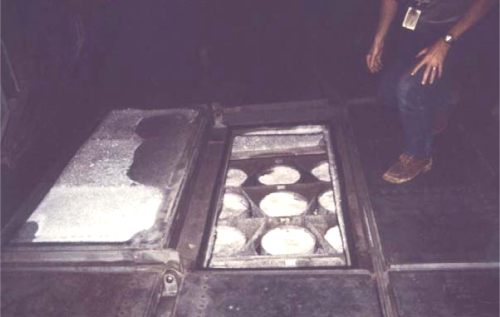
“Ice condenser” plants would use chipped ice to condense steam should a “design basis” accident occur. Here at Watts Bar, more than 1,000 tons of ice are kept on hand.
Tva had first responded to Energy's 1997 request for proposals with an offer that included using the Bellefonte plant and already operating plants at the Watts Bar and Sequoyah nuclear stations. But TVA quickly withdrew the offer of already operational plants. 16
Richardson wanted the operating plants back on the table. He invoked a statute called the Economy Act to compel the tva, a federal agency, to cooperate. 17 The act, a Depression-era law, required federal agencies to lease space or equipment or provide needed services to other agencies when it was not practical to obtain those services from the private sector. In this case Energy argued that the act required the tva, a federal agency, to provide “irradiation services” as long as those services did not interfere with its principal mission.
This turn of affairs was deeply disturbing to tva Chairman Craven Crowell, who had begun negotiating with Energy solely to turn the Bellefonte white elephant into a net asset on his account books. He repeatedly submitted revised Bellefonte-related contract offers, trying to find a combination of upfront and net operating revenues that would interest the Energy Department.
But Richardson would not be deterred. He got the tva's reluctant acquiescence in a December 8,1998 letter from Crowell, who even then continued to insist that an arrangement involving the Bellefonte plant would cost less in the long run, and would be better overall for everyone. Ignoring Crowell's pleas, Richardson announced that Energy's preferred path for reestablishing the tritium supply would be to use the tva's Watts Bar and/or Sequoyah nuclear power plants.
Over the next 12 months, the tva would struggle to escape from the trap, but Energy was playing hardball. At one point Stephen Sohinki, the Energy program manager, told a tva representative that the secretary of the navy was prepared to requisition the Sequoyah plant if the tva did not cooperate.
By the end of 1999, Energy and the tva had finally signed an interagency agreement (effectively a contract between federal agencies) covering the production of tritium in the TVA's operating nuclear reactors. In announcing the deal to the press, the tva pointed to the Interagency Review as the authorizing basis for adding the military mission to its commercial reactors. 18 Knowingly or not, Richardson had pulled off one of the greatest bait-and-switch maneuvers in nuclear history.
At no time during these bureaucratic athletics was the issue of public safety seriously considered. And from the perspective of safety, the U.S. government could probably not have made a worse selection of a commercial reactor for a new military mission. All three of the tva plants to be used for making tritium (two at Sequoyah, one at Watts Bar) are “ice condensers,” so designated because they have gigantic arrays of ice chips suspended in wire baskets to absorb steam and heat in case of a nuclear reactor accident. The containment buildings housing these great ice chests are small and weak compared to the awesomely large and strong containments that are considered the safest, a class that includes both Three Mile Island and Bellefonte.
There are only 10 ice condenser nuclear plants in the country, all manufactured by Westinghouse Electric Company. Recent safety studies conducted by Sandia National Laboratories for the nrc concluded that these plants would be exceptionally vulnerable to severe accident conditions, such as the loss of both off-and on-site electricity. 19 Sandia's calculations showed that under a so-called “station blackout” scenario, the ice condenser containment building would offer essentially no protection–the building would almost certainly rupture immediately after the nuclear core melted through its pressure vessel.
A hypothetical reactor accident of this type would have disastrous consequences for surrounding communities, but it is also true that the probability of such an event is extremely low. This dichotomy–of high consequence but low probability for core-melt accidents–has made nrc's job of regulating the existing fleet of commercial reactors extremely difficult in the era following the accidents at Three Mile Island and Chernobyl. One of the compromises the agency struck was to allow continued operation of the existing fleet of some 120 nuclear power plants (which includes Watts Bar and Sequoyah), but to require future plants to be demonstra-bly resistant to core-melt accidents.
The Energy-TVA deal cuts cleanly through this compromise. Approval of the deal will depend on nrc's review of the request to amend the Sequoyah and Watts Bar plant licenses to accommodate their new military mission.
Part of the safety review will involve classified information, and will therefore be closed to anyone without a security clearance and the “need to know.” And there is no indication that the nrc will scrutinize this unprecedented license amendment with its new-found rigor; the agency has already gone on record that it is of no regulatory concern that the plant modifications have nothing to do with either electricity production or public safety. 20
In all likelihood, the nrc will allow the plant modifications to be judged solely on whether they reduce the safety of the plant from compliant to noncompliant under the old licensing rules. And it certainly will not hurt the cause that the director of Energy's tritium program was once a lawyer for the nrc and has chosen a number of former nrc employees as his top advisers. At the very least, a high degree of skill will be brought to bear in presenting the license amendment request to the regulatory agency.
Energy is well positioned for this next step. Westinghouse is on board, under contract to prepare the safety analyses–and highly motivated to avoid discussing the vulnerabilities of ice condenser plants. The tva is equally motivated to get the process over with. Nrc has learned, Pavlov-style, to avoid controversy. And a network of personal and professional ties between the staffs of Energy's Commercial Light Water Reactor Project Office and the nrc Office of Nuclear Reactor Regulation will help overcome any communication problems. The media and the public have so far paid scant attention.
The nrc review of the license amendment request is scheduled to begin in February 2001 and is expected to last about a year. What will the outcome be? During the Cold War, many people–in the public, in the media, and in the federal government–were concerned about nuclear war and nuclear proliferation. Today, the silence is deafening.
Footnotes
1.
Rodney Carlisle and Joan M. Zenzen, Supplying the Nuclear Arsenal: American Production Reactors, 1942-1992 (Baltimore: Johns Hopkins University Press, 1996).
2.
Matthew Wald, New York Times, November 29, 1998, p. 34. The 2016 date includes the use of a five-year “reserve” supply.
3.

4.
The author was one of those insiders. See also John Harmon, Atlanta Constitution, December 23,1998, p. 3A.
5.
Rodney W. Jones and Mark G. Mc-Donough, Tracking Nuclear Proliferation (Washington, D.C.: Carnegie Endowment for International Peace, 1998).
6.
Mark Dean Millot, “Facing the Emerging Reality of Regional Nuclear Adversaries,” Washington Quarterly, vol. 17 no. 3,1994, p. 41.
7.
Matthew Bunn, The Next Wave: Urgently Needed Steps to Control Warheads and Fissile Material, report co-published by the Carnegie Endowment for International Peace and the Harvard Project on Managing the Atom (Cambridge, MA: Harvard University, 2000), p. 10. Bunn estimates the weapons-usable fissile inventory at 1,350 tons. The estimate of 30,000 weapons is based on a conservative estimate of 90 pounds per weapon.
9.
U.S. Energy Department, Final Programmatic Environmental Impact Statement for Tritium Supply and Recycling, DOE/eb-0161, October 1995.
10.
Draft Environmental Impact Statement for the New Production Reactor Program, doe/eis–0144D-Vol. 1, April 1991.
11.
Federal Register, 60 FR 44327.
12.
U.S. Energy Department, Draft Programmatic Environmental Impact Statement for Tritium Supply and Recycling, DOE/EIS-0161 Draft, March 1995.
13.
“Doe Seeks More Public Comment on Reactors as Tritium Source,” Nuclear Fuels, August 28,1995, p. 12.
14.
15.
David Ace, “Interagency Task Force Urges Pursuit of Bellefonte as Tritium Source,” Associated Press, July 17,1998.
16.
“At Richardson's Urging, TvA Revives, Revises Tritium Options,” Nucleonics Week, January 10,1998, p. 6.
17.
“Doe Decision on Tritium Production Bitter Pill for TvA, Nuclear Critics,” Nucleonics Week, January 7, 1999, p. 8.
18.
“U.S. Reactor Will Produce Tritium,” Toronto Star, December 9, 1999.
19.
M. M. Pilch, K. D. Bergeron, and J. J. Gregory, Assessment of the DCH Issue for Plants with Ice Condenser Containments (Albuquerque, N.M.: Sandia National Laboratories, April 2000), sand99-2553 (nureg/cr-6427).
20.
“Nrc Punts on Policy Issues Raised by Tritium Production,” Nuclear Fuels, January 13,1997, p. 6.