




Abstract

China could modernize its force by adapting aircraft purchased from abroad. China bought 24 Su-27SK and two Su-27UBK Flanker fighters from Russia in 1992 for $1 billion. These planes are currently with the 3rd Air Division at Wuhu airfield, 250 kilometers west of Shanghai.
In a separate agreement, Russia sold production rights to China to assemble and produce Su-27s at China's Shenyang plant. The first two Chinese-built Su-27s flew in December 1998. China's air force has requested 200 Su-27s. It will take at least until 2015 to build them under existing schedules. The Su-27 has an air-to-ground capability, although there is no evidence that the air force is modifying it for a nuclear role.
After more than 25 years in service, China's DF-3 medium-range ballistic missile is gradually being retired. The two-stage, liquid-fueled DF-4 longrange missile has both silo-based and mobile versions. The two-stage DF-21 medium-range missile is deployed on a towed erector-launcher. An improved mod 2 version has not yet been deployed. China's first test of the mobile, three-stage DF-31 intercontinental ballistic missile (ICBM) took place on August 2, 1999, at Wuzhai, 250 miles southwest of Beijing. The test involved a dummy warhead and several decoys. Other flight tests are planned for the missile, but it is unclear when it will be fielded or how many will be deployed.
Although China canceled the development of a sixth type of Dong Feng missile, the DF-41, it has begun developing a new mobile, solid-propellant ICBM.
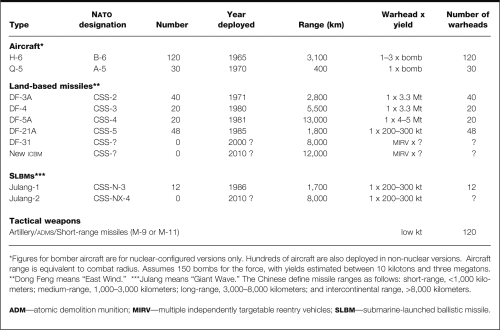
Figures for bomber aircraft are for nuclear-configured versions only. Hundreds of aircraft are also deployed in non-nuclear versions. Aircraft range is equivalent to combat radius. Assumes 150 bombs for the force, with yields estimated between 10 kilotons and three megatons.
Dong Feng means “East Wind.”
Julang means “Giant Wave.” The Chinese define missile ranges as follows: short-range, <1,000 kilometers; medium-range, 1,000-3,000 kilometers; long-range, 3,000-8,000 kilometers; and intercontinental range, >8,000 kilometers.
The nuclear capability of the 600-kilometer range M-9 and the 300-kilometer range M-11 is unconfirmed. An improved M-11 mod 2 was displayed in a military parade on October 1, 1999. There is also a 150-kilometer-range mobile CSS-8 missile, which has a solid-fuel first stage and a liquid-fuel second stage.
The Chinese have had the technical capability to develop multiple reentry vehicles (MRV) for 20 years. A MRV system releases two or more RVs along the missile's flight path at a single target, which land in a confined area at approximately the same time. The more sophisticated and flexible multiple independently targetable reentry vehicle (MIRV) system releases two or more RVs to independent targets over a wider area over a longer time.
The single sub was built at Huludao Naval Base and Shipyard in the northern Bohai Gulf and was launched in April 1981. It was deployed in January 1989 to the Jianggezhuang Submarine Base, where the nuclear warheads for its Julang-1 missile are believed to be stored. The Xia-class SSBN and the five Han-class attack subs (SSNs) have never sailed beyond their regional waters.
China is reportedly about to begin construction of a new SSBN, designated Type 094. The new sub is expected to carry the three-stage Julang-2 SLBM, a variant of the DF-31. Deployment of this system is many years away.
Taiwan's defense minister has said that the M-9 and M-11 short-range missiles are nuclear capable, and Taiwanese officials report that the number of M-type missiles in China's three southern provinces has risen from 30-50 to 160-200 during the past four years.