




Abstract

Who will the next president be? With election day only a few days away, no one can say with absolute certainty who will win. But what is certain is that the new president will face formidable challenges as well as opportunities when it comes to national security. And all of his policy choices will be complicated by that proverbial elephant in the closet—national missile defense.
The outgoing administration leaves behind an extensive list of unfinished business: massive numbers of nuclear weapons 10 years after the end of the Cold War, political pressures to deploy a national missile defense, a test ban treaty in limbo, an international community unsettled by the direction of American foreign policy, a muddled relationship with Russia and China, no clear consensus on U.S. military intervention abroad, and uncertainty on dealing with proliferators like India, Pakistan, and Iran.
Before the next administration can begin to tackle these issues, the president-elect must select his national security team. Either George W. Bush, inexperienced on national security issues, or Vice President Al Gore, who has relied primarily on his own judgment and that of a single aide, Leon Fuerth, will need to field a strong national security team. While the top officials at the Pentagon, State Department, and National Security Council are likely to have been named by inauguration day, the process of selecting and winning approval from the Senate for sub-cabinet appointees may take several months. Despite the work of a transition team, it is also likely to be months before any clear policy direction is determined.
One early action that the new advisers will have to take is rekindling the stalled process of reducing the huge stockpiles of nuclear weapons across the globe—especially in Russia and the United States. There are 36,000 nuclear weapons remaining on this planet, most of them many times larger than those dropped on Hiroshima and Nagasaki. Eight years after its signing, the START II nuclear reductions agreement has yet to enter into force.
One way to jump-start the process would be to focus on negotiating a START III agreement with Russia to reduce deployed strategic nuclear warheads to 2,000-2,500 each. However, if the two countries do not resolve their differences over changes to the 1972 Anti-Ballistic Missile Treaty, an agreement on START III is unlikely. The Clinton administration refused to de-link the two issues.
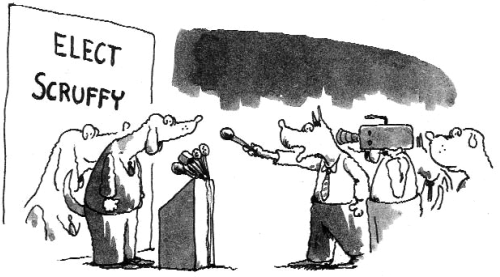
“Is it true that you were paper-trained with leftist newspapers?”
Another approach would be to propose unilateral cuts in strategic nuclear weapons. At a May 23, 2000 press conference, Governor Bush suggested the unilateral approach: “I will pursue the lowest possible number consistent with our national security. It should be possible to reduce the number of American nuclear weapons significantly further than what has been already agreed to under START II without compromising our security in any way.”
This American initiative would be consistent with the expected decline in Russian weapon numbers as a result of that country's economic crisis. On September 8, Defense Minister Igor Sergeyev confirmed that Russia is likely to cut its arsenal to 1,500 weapons— although later Russian pronouncements linking cuts to maintaining the ABM Treaty raised some doubts.
Matching unilateral initiatives would be modeled on the announcement of parallel nuclear reductions by Presidents George Bush and Mikhail Gorbachev in 1991. It is also consistent with the views of some Republicans who are skeptical about negotiating new arms control treaties.
Responding to an Arms Control Association question in September 2000, Bush said that changes in nuclear forces “should not require years and years of detailed arms control negotiations.” Congress blocked any Clintoni-an contemplation of unilateral reductions, although some members have suggested it may be more pliable for a Republican president.
Unfortunately, a key Democrat— Vice President Gore—rejects the unilateral approach. On May 27, a few days after the Bush statement, Gore told a West Point audience that he prefers negotiated agreements: “An approach that combines serious unilateral reductions with an attempt to build a massive defensive system will create instability, and thus undermine our security. Nuclear unilateralism will hinder, rather than help, arms control.”
Another issue for the new administration is the de-alerting of nuclear weapons. In his May 23 statement, Bush argued: “The United States should remove as many weapons as possible from high-alert, hair-trigger status, another unnecessary vestige of Cold War confrontation. Preparation for quick launch within minutes after a warning of an attack was the rule during the era of superpower rivalry. But today, for two nations at peace, keeping so many weapons on high alert may create unacceptable risks of accidental or unauthorized launch.”
The Clinton administration has resisted de-alerting for eight years, insisting that deactivation of warheads through START III is preferable. Gore's posture is not clear.
All nuclear issues must be considered in conjunction with the new team's approach to national missile defense. Regardless of the testing program, there will continue to be strong political pressure to proceed quickly with deployment, particularly from the GOP. Gore has indicated he will follow Clinton's cautious approach to missile defense, insisting that the technologies work and the cost to the foreign policy agenda not be too steep. After Clinton's announcement that he would defer deployment, Gore welcomed “the opportunity to be more certain that these technologies actually work together properly.” He also stated that he would “oppose the kinds of missile defense systems that would unnecessarily upset strategic stability and threaten to open the gates for a renewed arms race with Russia and a new arms race with China, including both offensive and defensive weapons.”
Bush, on the other hand, has repeatedly insisted that the country must move toward a massive national missile defense, consistent with a modified Anti-Ballistic Missile Treaty if possible, but in violation if necessary. On September 1, for example, he declared: “I intend to develop and deploy an effective missile defense system at the earliest possible date.”
Bush, of course, might wind up moving more guardedly than his rhetoric suggests. Upon taking office, he could come to understand that the technology is not ready for deployment. Moreover, there is a split among Republicans, some of whom want to complete the Clinton administration's plan for an initial base in Alaska and expand from there, and others who wish to abandon the present approach in favor of sea- and space-based defense concepts. A Bush administration could take many months or even years to determine its missile defense policy.
Another issue facing the new administration is what to do with the test ban treaty. Gore has promised to make the treaty one of his first legislative items. In an August 31 press statement, for example, he promised: “If elected president I will immediately revive the ratification process and seek to rally the full force of American public opinion behind it.” Attaining a two-thirds majority in the Senate will not be easy.
Bush is opposed to the treaty—but told Arms Control Today in September that “our nation should continue its moratorium on testing.” As president, either man will be forced to confront the fact the U.S. nuclear nonpro-liferation policy may well unravel if the test ban treaty is not ratified by the required 44 countries.

There are other national security issues on the agenda:
Next year will be key for concluding the verification protocol to strengthen the Biological Weapons Convention. The new president will need to exert international leadership if that effort is to be a success.
There remain in the former Soviet Union huge stockpiles of retired nuclear weapons and nuclear materials in less-than-secure storage. While the Cooperative Threat Reduction program has made considerable progress and enjoys bipartisan support, many of the programs have been stymied by bureaucratic inertia in both countries, rather tenuous relations between the two countries, and funding cuts in the House.
Managing relationships between the United States, Russia, and China will remain a paramount challenge enveloping all these issues. In the last eight years, the United States has cultivated a relationship with both countries that make them neither enemies nor allies. There are many irritants to the relationships, including national missile defense, proliferation of weapons and weapons materials, U.S. military intervention in the former Yugoslavia, and NATO expansion.
Deciding how to reshape U.S. armed forces to cope with twenty-first century challenges and when to use U.S. forces overseas remain unsettled questions. Both Gore and Bush have promised more money for the Pentagon, but they have been vague on new directions for the military and on overseas intervention.
While Clinton has strengthened U.S. ties to India, the word's largest democracy, the tense rivalry between India and Pakistan remains the most likely cause of nuclear confrontation. Proliferation concerns with Iran, North Korea, and Iraq are tough challenges as well.
The Clinton administration rejected the landmine treaty that has entered into force. There will be renewed attempts to convince the next president to sign on.
After years of inaction under Clinton, many in the administration—and arms control supporters—may desire speedy action on these issues. However, the new administration may well devote its first year to an extensive review of nuclear issues in order to develop a new national security consensus. On August 31, Gore promised “a thorough re-examination of the official nuclear doctrine which to this point guides our military in its planning.” The Pentagon authorization bill requires a “nuclear posture review” by October 1, 2001. Either man as president may choose a prolonged route of study—and postpone the tough choices ahead.