




Abstract

John Alexander Simpson, who died August 31 of complications following heart surgery, was a group leader in the Manhattan Project; a star of the first magnitude in the universe of astrophysics; one of the principal founders of the Bulletin and the Federation of American Scientists; and a man who reveled in being a first-class mechanic who wielded a precise soldering iron. He was 83.
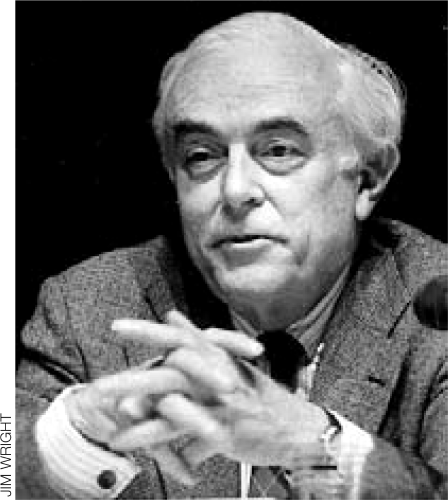
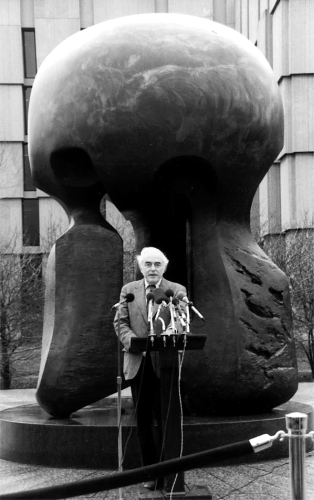
THERE FROM THE BEGINNING: John Simpson, above, at the 40-year anniversary of the Bulletin in 1985. Lower right, speaking in 1982 in front of the Henry Moore sculpture that commemorates the first chain reaction, at the 40-year anniversary of that event.
In the late 1930s at Oregon's Reed College, Simpson developed a lively interest in the history of science and technology, beginning with the Greeks and Romans and extending through the Middle Ages to the most recent discoveries in astronomy and physics.
In his later years, he described the satisfaction he took in not only analyzing scientific conundrums, but in inventing and making instruments that would provide the quantitative data needed to come up with answers. His enthusiasm for problem solving and mechanical tinkering got him drafted into the Manhattan Project.
He was a doctoral student in physics at New York University in 1943 when Volney Wilson, an administrator at the Metallurgical Laboratory at the University of Chicago, asked him to come to Chicago to help invent instruments for measuring high levels of radioactivity.
Simpson didn't want to go. The Radiation Laboratory at the Massachusetts Institute of Technology was the place to be. The work going on there, particularly on radar, would help win the war. He knew that a number of bright young scientists had gone to Chicago, but they had disappeared into a black hole.
Looking for a way out, Simpson said he couldn't go because he had heard that housing was so tight in Chicago that he wouldn't be able to find a place to live. No problem, said Wilson. He would live on the third floor of Arthur Holly Compton's home. Compton was a Nobel laureate and, as Simpson later learned, one of the two key scientist/administrators of the atom bomb project. The other was J. Robert Oppenheimer.
Although the multi-site Metallurgical Project, which Compton headed, was charged with many tasks, its overwhelming mission was to quickly figure out how to produce bomb-grade plutonium on an industrial scale.
Gen. Leslie Groves, director of the Manhattan Project, believed that the key to security was compartmentalization—keeping working groups in the dark about what other groups were up to. It was rare for anyone but the most senior people to travel between atom bomb facilities. Simpson, 26 when he joined, was decidedly “junior.”
But because of his extraordinary ability to devise instrumentation, Simpson became a group leader and shuttled between Chicago and Oak Ridge, Tennessee, where the Met Lab, as the Chicago operation was called, ran a plutonium research laboratory; Hanford, Washington, where the huge plutonium production plant was being built; and Los Alamos, New Mexico, where the bombs were being designed and built.
By late 1944, Simpson and several others at the Met Lab had begun to think systematically about the post-war implications of nuclear energy. Historians of science have puzzled over the years as to why there was so much ferment in the Chicago lab over social and political issues in contrast to Los Alamos and Oak Ridge, where there was so little.
Simpson wasn't puzzled. “Our work [on plutonium] was mostly done by late 1944,” Simpson said in 1995. “And [Leo] Szilard, [James] Franck, and [Eugene] Rabinowitch were in Chicago and they stirred things up.”
They did indeed. Szilard, Franck, and Rabinowitch were European émigrés, and they shared a philosophical tradition in which the work of scientists could not be cleanly separated from the larger social, political, and moral context.
By virtue of their training, Simpson said in 1995, scientists had unique insights into the forces that were being unleashed. Given that, they had a special obligation to recommend courses of action to policy-makers.
“You have to take a stand on big issues,” he said. “Scientists have to speak as scientists on something that is of common concern to mankind.
“But there is a thin dividing line. Scientists should speak up on matters where they have unique insight. But once that uniqueness is gone, it is just politics. Scientists should not be involved in politics as scientists, only as citizens.”
Thin line or no, by 1945 Simpson was convinced that scientists must take an active role after the war to ensure that nuclear energy was used for the good of mankind—and that meant some form of international control of nuclear energy must be worked out.
Simpson received permission from Compton to conduct a series of evening seminars on the social implications of nuclear energy. The first meeting, held March 20, was largely devoted to the possible baneful effects of continuing U.S. secrecy in matters nuclear after the war.
A rough consensus at the meeting, according to Simpson: An attempt to keep nuclear “secrets” would breed distrust and a nuclear arms race with the Soviet Union, and it would be fruitless. The Soviets had top-flight scientists; a Soviet bomb would come along in a few years, regardless of anything the United States did.
Meanwhile, if secrecy were lifted, atomic energy could benefit humankind in immeasurable and unforeseen ways. The United States and the world would be better served if data and insights on nuclear energy were shared through an international organization.
Even though Compton had authorized the meetings, General Groves banned them after he got wind of them. Groves decreed that meetings of more than three scientists could not take place unless the topic was strictly work related.
“We obeyed the general's edict exactly,” said Simpson, who continued the meetings. “I announced a sequence of three-person meetings, but I invited everyone. A colleague and I sat in small room adjoining a larger room. One by one, people would come in and meet with us. Meanwhile, everyone else was ‘waiting’ in the big room. They talked informally while waiting. That was the actual meeting.”
The meetings, though still focused on internationalizing atomic energy, increasingly turned toward the question of how the bomb should be used in the current war. A near-consensus developed that the power of the bomb should be demonstrated to the Japanese government in a test, giving the Japanese a graceful way to surrender. Met Lab scientists, particularly Leo Szilard, tried a variety of strategies to influence that outcome. All failed.
On August 7, a day after the Hiroshima bomb was dropped, Simpson convened a meeting in which Met Lab scientists discussed practical ways of informing the public and policy-makers of the perils and opportunities that lay ahead. The Atomic Scientists of Chicago was formed in September, with Simpson as its first chairman.
In December the new organization began publishing the Bulletin of the Atomic Scientists (then called the Bulletin of the Atomic Scientists of Chicago)—a periodical Simpson retained a close connection with for 55 years. He was president of the Bulletin's Board of Sponsors when he died.
Although Simpson now had a teaching appointment at the University of Chicago, Robert Maynard Hutchins, the university's president, let him take the academic year off so he could lobby Congress to pass a bill ensuring that nuclear energy would be under civilian instead of military control.
In the fall of 1945, Simpson also helped start the Federation of Atomic Scientists in Washington, which later became the Federation of American Scientists. The federation and the Atomic Scientists of Chicago were the core of what historians eventually dubbed the “scientists' movement.”
“For the first time in modern history,” Simpson said in 1995, “scientists were saying that it was necessary to make judgments about what to do with their inventions.”
Don Q. Lamb, an astronomer at the University of Chicago and one of Simpson's close colleagues, says that the idea that scientists had a social responsibility for their work was one of Simpson's driving passions.
∗ ∗ ∗ ∗
Two other passions drove Simpson: his love for science and his unwavering belief in the value of scientific openness and international cooperation. He pursued both at the University of Chicago, where he continued working until entering the hospital.
“With instruments almost continuously in space for the past 40 years,” said Edward C. Stone, director of NASA's Jet Propulsion Laboratory, “John was always probing the frontiers of the solar system for new knowledge. With several generations of graduate students, he pioneered new areas of research ranging from outbursts of solar particle radiation to the origin and lifetime of cosmic-ray particles from nearby regions of the Milky Way.”
Although Simpson was a noted researcher in questions regarding magnetospheres, the heliosphere, and solar flares, his most prolific world-class work was on the properties of cosmic rays. That was fitting. The field was largely invented by Arthur Holly Compton, the Nobel Prize-winning physicist who had been Simpson's landlord, boss, and mentor at the Manhattan Project. In 1974, the University of Chicago named Simpson the first Arthur Holly Compton Distinguished Service Professor of Physics.
In the highly competitive world of astrophysics, Simpson managed to fit experiments aboard more than 30 unmanned U.S. missions, beginning in 1958 with Pioneer 2 and continuing to his death.
And make that one Soviet mission, too. In the spring of 1986, Halley's Comet would make a sweep around the sun, which it did every 76 years. Comets are mainly ice and dust, and Simpson had designed a dust analyzer for the comet but had no vessel to carry it. The United States had decided not to send a probe.
But the Soviet Union was sending a probe—Vega. In 1982, Simpson asked Roald Sagdeev, then head of the Soviet Space Research Institute, if a made-in-Chicago analyzer could hitch a ride. The Soviet scientific bureaucracy was in near paralysis in those days, recalls Sagdeev, and he knew that he would never gain permission if he went through channels. So he simply said yes.
On the U.S. side, Simpson did go through channels. But it was not easy. The Reagan administration had labeled the Soviet Union “the evil empire” and sending an American instrument on a Soviet probe seemed to be beyond the pale. Simpson later recalled an intensive and hostile interrogation by an in-teragency commission in Washington, which was sure the Soviets would steal American technological secrets.
“To avoid it,” Simpson said, “we at the University of Chicago intentionally built our instrument only from readily available over-the-counter components, including items from the Radio Shack store on the next corner.” He got permission to piggy-back on the Soviet probe.
That pleased Simpson greatly. He had been pushing for international cooperation in science since his Manhattan Project days. In the 1950s, he had been one of 12 organizers of the International Geophysical Year, an early and successful model of such cooperation.
Of his many space experiments, Simpson spoke with the greatest pride of Pioneer 10, a tough little probe launched in March 1972 as the first mission to fly past an outer planet— Jupiter.
Pioneer 10 completed its mission successfully and it is now more than 7 billion miles from Earth and still in intermittent contact with home. The probe is expected to travel in galactic space for billions of years, carrying with it a tiny bit of handmade hardware, a charged particle collector, courtesy of John Simpson.