



Abstract
Two years after their nuclear tests, India and Pakistan are less secure, economically weaker, and plagued with increasing poverty.
An indian television commercial for a local whiskey shows two stern-faced border guards, one in the khaki of the Pakistani army, the other in Indian army olive green. They stare intently at one another. Then the guard in olive green pulls out a bottle of whiskey and offers it to the other. After a little hesitation, the guard in khaki reaches for the bottle from behind a barbed wire fence and takes a swig.
Fast forward to reality. Visitors to the Wagah border post in Punjab are struck by the unusual bonhomie among soldiers from both sides. When Indian and Pakistani patrols run into one another, they shake hands, crack jokes, and inquire about each others' families. It is common knowledge that Indian liquor may change hands during these encounters. And this has been going on since 1947, unaffected by wars, terrorists, missiles tests, or nuclear blasts.
India and Pakistan, South Asia's quarrelsome neighbors, may be pointing nukes at one another, but theirs is a love-hate relationship. Just months after New Delhi and Islamabad tested nuclear weapons in May 1998, and while they were in the midst of testing missile delivery systems, Indian Prime Minister Atal Behari Vajpayee rode a bus to Lahore to shake hands on a trade pact with his Pakistani counterpart, Nawaz Sharif. Vajpayee composed a poem on not fighting wars, which Sharif read aloud for the occasion.
Barely four months later, Pakistan began the Kargil intrusion, its most organized military action against India since the 1971 war. Still, the Kargil war did not stop the regularly scheduled bus that leaves New Delhi for Lahore. The bus is a microcosm of potential cross-border trade—enterprising passengers carry small amounts of goods in demand on the other side— medicines, textiles, and tea bound for Pakistan, dried fruit and cosmetics headed for India.
The official trade between the two countries is less than a tenth of its potential. But Pakistan's black market sells a variety of Indian goods—tea, liquor, textiles, pharmaceuticals, automobile tires, processed food, and other items—that are either smuggled in or imported indirectly via a third country. Pakistan also depends largely on India for its supply of cheap hard liquor.
India and Pakistan simply cannot come to terms with the fact that there is money to be made from one another. Every time an initiative designed to further trade ties is undertaken, it is pushed back by war, terrorism, or fundamentalist lobbying.
Less than rosy
It has been more than two years since India and Pakistan exploded underground nuclear devices and declared themselves nuclear powers. Both believed that flexing their nuclear muscles would give them an impenetrable security cover, reducing their need for conventional military hardware and permitting a greater concentration of resources on economic development. It was as if nukes were an internal cleansing mechanism that would rid the two impoverished countries of all the problems they faced.
August 15, 1999: Pakistani and Indian security guards celebrate India's Independence Day at the Wagah border post.

But events of the past two years have turned that rosy belief topsyturvy. If anything, Pakistan and India are less secure. Their currencies are weaker and economic growth has declined, unemployment increased, and investment stagnated.
The undeclared war in Kashmir in May 1999 further worsened the relationship between the two neighbors, worrying the international community that the two might blunder into the use of nuclear weapons.
The war cost India $2 million a day for two months, and the bill for Pakistan could not have been less. In the immediate few months after the war, inflation had shot up by 20 percent in India, and in Pakistan prices of essential commodities had almost doubled. However, bumper crops in 1999-2000 all over the subcontinent, where the primary economic activity is agriculture, saved the two countries from economic disaster.
Some economic recovery has been made by both India and Pakistan since Kargil. A stable government in India and Gen. Pervez Musharraf's attempts to cleanse corruption in Pakistan have helped both countries pull back from the brink.
Pakistan, more than India, has a long way to go before its public treasury can begin to earn the admiration of the World Bank and the International Monetary Fund (IMF). Pakistan has been unable to secure release of a $280 million loan, part of a $1.6 billion IMF credit that was negotiated in 1997. The IMF ruled that since Pakistan had not improved its economy since the last loan, the next installment would be delayed pending structural adjustments. Pakistan has also sought to reschedule a $600 million Eurobond loan and an $877 million debt to foreign banks, which gives one a fair idea of the state of its economy.
India's economy may be better managed than Pakistan's, but it is a long way from reaching the pre-1998 level of foreign investment. Despite Bill Clinton's visit in March 2000, New Delhi has been unable to interest American, European, or Japanese investors in its industrial sectors. Foreign investment in fiscal 1999-2000 was $8.3 billion, compared to $9.6 billion in 1997-98. The only silver lining has been the increase in software exports, but most software is created on contract to foreign firms.
The bad blood created by the May 1998 nuclear tests continues to frighten foreign investors, and foreign aid to social sectors is at a low point. Although the bumper harvest has meant there is no food shortage for India's 1 billion people, getting money to make improvements in electricity, telecommunications, water, and roads continues to be a major problem. Little effort has gone into lifting the country's 400 million poor out of abject poverty.
Conventional weapons
The nuclear weapons tests are only the most visible aspect of a relentless arms race that India and Pakistan have been pursuing for 50 years—a race that has helped to keep their people impoverished but given their defense forces the latest and best of weapons.
Pakistan ranks 138th on the Human Development Index, a U.N.-devised scale measuring the well-being of a country's population. Despite having the world's fifth largest economy, India ranks a notch lower at 139th. Ranked above these two warring neighbors are countries like Kenya, Nigeria, Vietnam, and even some other South Asian countries—Bhutan, Sri Lanka, and Maldives.
But the Indian and Pakistani armies are among the best armed outside of NATO. Pakistan has F-16 fighters, tanks, French artillery guns, submarines, anti-ship missiles, and advanced surveillance capabilities. According to the U.N. Arms Register, from 1983 to 1993 Pakistan spent $15 billion on weapons. And it spent another $3.5 billion on defense during fiscal 1998-99—15 percent of its national budget.
Pakistan is believed to have spent $5 billion on its nuclear weapons program, which it launched shortly after the 1971 war with India. When India successfully tested a “nuclear device” in 1974, Pakistani Prime Minister Zul-fikar Ali Bhutto pledged that his country would do no less. Pakistanis, he promised, might “eat grass, but we will build a bomb.” His successor, Gen. Zia ul-Haq, continued the development program, although he had to eat less grass, thanks to the U.S. support he got for helping the Afghan mujahideen in their struggle against the Soviet occupation.
When the Soviets left Afghanistan, however, the United States shut the door on military aid and drastically curtailed economic support. And when the Pressler amendment— a nonproliferation measure targeted at Pakistan—deprived that country of U.S. arms, it turned to France, where between 1995 and 1998 it purchased $2 billion worth of used submarines and ships, missile-armed helicopters, and surveillance aircraft.
Pakistan is also a big customer for China and North Korea, from whom it is believed to have purchased missiles, repainted them, and passed them off as its own indigenous development. With very little domestic defense industry, it depends on foreign suppliers for even minor spare parts. Its army is the best paid and maintained in South Asia; the average salary of $200 a month is considerably more than the average in India.
Meanwhile, the IMF regards Pakistan as a basket case. The fund has bailed it out 17 times, granting emergency loans to cover its external loan repayment commitments.
Thanks to its cozy relationship with Russia, India has been able to get more weapons for less money. India spent about $10 billion on defense in 1998 and 1999, and lesser amounts in previous years, but it has amassed the best military equipment in the Asian region. Some analysts rate India's conventional arsenal as qualitatively superior to China's, although in sheer numbers China is far ahead. During the June 1999 Kargil war, India used laser-guided bombs launched from Mirage 2000 planes to hit enemy positions. This precision-attack capability puts it right in NATO's street.
Its Sukhoi 30 fighter planes, purchased from Russia in a $1.8 billion deal in 1997, make it the only country outside Russia to possess these planes, which are said to be a match for the U.S. F-15.
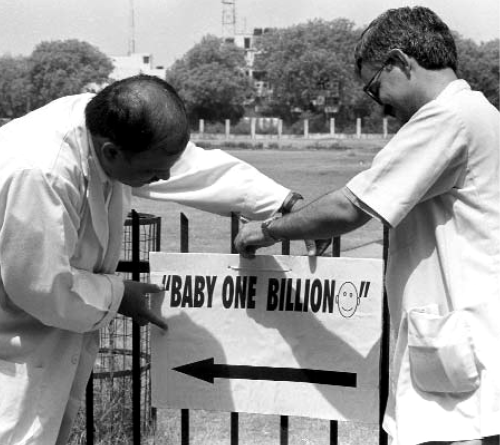
May 11, 2000: Doctors in New Delhi put up a sign pointing to the hospital where India's “one billionth” baby was born.
India's acquisition efforts have been steady, unaffected by economic ups and downs or by international sanctions. Its defense budget has stayed at around 8-10 percent of the national budget for more than a decade. Earlier this year, India announced that it would acquire six warships and four submarines at a cost of more than $2.5 billion, even though its economy was down because of economic sanctions imposed after the nuclear blasts.
The objective behind India's sustained weapons acquisitions is the perceived need to match China, not Pakistan. But Pakistan has made it its mission to do whatever India does.
India pinches resources from education, birth control, and basic health care to feed its defense machine. Every year, allocations for social programs are less than half of what those sectors request. And even after the money is granted for social programs, its release is held back if an unanticipated expenditure like the Kargil war arises.
Ever since India's defeat at the hands of China in 1962 and India's rout of Pakistan in 1971, the losers have made it a point to match the winners weapon for weapon. Thanks to India's arms race with China, it is always ahead, while Pakistan tries to catch up by shopping for the latest weapons. And the South Asian arms race goes on.
The August 1999 incident in which a Pakistani Atlantique surveillance plane was shot down is a case in point. This French-made plane is a sophisticated listening post with electronic warfare and anti-ship missile capabilities. Pakistan purchased four planes at $15 million each in an effort to match India's Russian-made maritime surveillance planes, which are significantly less sophisticated. Ever since Pakistan purchased the Atlantique, India has been negotiating with Israel to purchase an even more advanced early warning platform in the AWACS category. In March 2000, India ordered a Russian AWACS to match Israel's sale of an AWACS to China. While Jerusalem has since backed out of the deal, thanks to U.S. pressure, India is still set to acquire the Russian plane.
The cost of nukes
Pakistan's eat-grass-but-build-nuclear-weapons attitude has cost it dearly. While it was long believed in India that the aid China gave to the Pakistani nuclear weapons program was a gratis effort to counter India, it has turned out that Pakistan paid the Chinese for their help. That admission was made in 1998 by Pakistan's nuclear weapons program chief, Abdul Qadir Khan. The 1986 Sino-Pakistan agreement on atomic energy is believed to have been a commercial deal designed to formalize what until then had been a clandestine transaction. In return, Pakistan is reported to have received a single warhead design and sufficient highly enriched uranium to build a few weapons. The design of the 25-kiloton device Pakistan exploded last year is said to be the same as the one used in China's fourth nuclear test, which was an atmospheric test using a ballistic missile launch. It was widely reported in the mid-1990s that Pakistan's stockpile consisted of as many as 10 nuclear warheads based on a Chinese design.
Although the United States supported Pakistan in an effort to rid Afghanistan of its Soviet occupation, it was suspicious about Pakistan's nuclear ambitions. As long as Pakistan remained vital to U.S. interests in Afghanistan, however, no action was taken to cut off support. Once the Soviets pulled out, the United States ended military assistance to Pakistan and severely curtailed economic aid.
Pakistan's thirst for nuclear weapons deprived it of conventional weapons aid as well. If Pakistan had not procured Chinese nuclear weapons and North Korean missiles, it could have received a great deal of sophisticated American weaponry, mostly in the form of aid. And if Pakistan had heeded international appeals to refrain from testing after the May 1998 Indian tests, it would have moved into the same league as Israel and Egypt as far as U.S. weapons largesse was concerned. A golden opportunity was squandered.
The real cost of Pakistan's nuclear program is far higher than the estimated $5 billion would indicate. The loss of U.S. military and economic support cost several times as much. And the burden caused by the end of aid from other Western countries and the rejection of Pakistani goods in many Western markets as punishment for developing nuclear weapons has added to the cost.
Pakistan then followed up on the tests with a series of economically disastrous measures. The day after the tests, Pakistan froze all of its citizens' foreign currency accounts to prevent capital flight. Although it lifted the freeze the next day, the damage was done; Pakistani banks suffered a run on their foreign currency accounts. Pakistan's main hard currency source, its nationals who work in the oil-rich Gulf, cut their repatriation rate, hoping to gain more from the rapidly slipping rupee. Within a month, the Pakistani rupee had lost 25 percent of its value.
Pakistan was already subject to some U.S. sanctions, imposed in 1990 under the Pressler amendment— $650 million in military and humanitarian aid was cut off when the president was unable to certify that Pakistan did not possess a nuclear device. After Pakistan's tests, President Clinton was required by law (including the Glenn amendment, a part of the Arms Export Control Act) to impose further sanctions.
With $37 billion in foreign debt (more than half of the country's total gross domestic product), a monthly trade deficit of $150 million, foreign exchange reserves of only $1.3 billion, and interest payments of $200-500 million due each month, Pakistan is an economic mess.
Trying to end the arms race
By the mid-1980s, Pakistan seems to have realized that acquiring a nuclear weapons capability was proving a lot more costly than buying conventional weapons. General Zia and Benazir Bhutto both evidenced their concern about costs by making overtures to India to “reduce the risk of nuclear war in South Asia.”
In 1985, Pakistan initiated an informal agreement that neither India nor Pakistan would attack the other's nuclear facilities. Zia asked India to agree to several steps to end the potential nuclear arms race on the subcontinent. One was the simultaneous signing of the Nuclear Non-Proliferation Treaty. The second was a joint agreement for the inspection of all nuclear sites by the International Atomic Energy Agency. Pakistan also proposed a pact between the two countries to allow mutual inspections of sites. And finally, Pakistan proposed a South Asian nuclear-free zone. Zia appeared to be looking for a way to terminate Pakistan's nuclear program.
But to sell the idea within Pakistan, he required some concessions from India. Termination would also have gotten him out of the difficulties the program was causing with the United States, including the curtailment of aid in 1989.
These proposals, which were still on the table in the early 1990s, were supplemented by Prime Minister Nawaz Sharif's call for a roundtable discussion among Pakistan, India, the United States, Russia, and China on nuclear weapons in South Asia.
India did not respond as Pakistan would have liked; it had its own ambition to become a regional power. Its dormant nuclear weapons program was not costing it anything—raw material for its weapons was produced in its nuclear power reactors, and it had a competent group of scientists who could assemble weapons on short notice. So it did not stand to gain anything by playing ball with Pakistan on the nuclear weapons control issue.
India's costs
But the cost to India jumped skyward after its nuclear tests, as it became clear that India wanted a credible nuclear deterrent with an effective delivery system. The cost for the deterrent has been variously estimated at $10-25 billion over the next 10 years.
The nuclear weapons program and the social burden it imposes has been sharply criticized at home. S. R. Val-luri, a well-known aerospace scientist and opponent of India's nuclear weap-onization policy, has given vent to what a lot of people think in India: “The cost of a meaningful nuclear deterrent and its delivery systems, taking a requirement of 150 warheads, works out to about $70 billion. The Human Resources Development Ministry had to drop a plan to provide basic education to all school-age children as it demanded an investment of a like amount over 15 years.”
In fact, many intellectuals within India blame the government for initiating the nuclear arms race with Pakistan. “In three wars with Pakistan, we did not need nuclear arms to defeat them. Pakistan's nuclear weapons program was in response to India's 1974 testing,” says Valluri. “If the Indian nuclear weapons program is not aimed at Pakistan but at China, as some Indian politicians would like us to believe, then 150 warheads is insufficient. China has over 300 of them, including long-range missiles to deliver them. Does this mean India should match China bomb for bomb and missile for missile, irrespective of the cost?”
Interestingly, India's nuclear weapons program is not funded out of the defense budget, but by its Department of Atomic Energy (DAE). The DAE's budget (presumably for nuclear power programs and research) has increased by 25 percent over the last two years.
In any case, the cost of the nuclear deterrent is a lot less for India than it is for Pakistan. That is because both India's nuclear weapons and its missile programs are indigenous, requiring no outgo of hard currency. It might make more economic sense for India to have a nuclear deterrent with conventional ballistic and cruise missiles as offensive weapons than it would be to have a more extensive conventional arms capability, which it pays for in hard currency. In the last three years, India has pumped money into the Russian economy with several high-profile purchases worth more than $3 billion.
What they could gain from each other
If India and Pakistan took the Lahore declaration seriously and pursued cross-border trade, they could gain a lot from one another.
Children in a New Delhi slum.

History has shown that both countries have grown during periods of relative calm between wars and when there was no terrorism. In the years between wars—1967-1970 and 1975-1980—key economic indicators like job creation, health care, education, and agriculture all showed growth.
Although both economies are generally stagnant, there was one period of rapid growth. From 1992 to 1996, Indian Prime Minister P. V. Narasimha Rao initiated an economic reform program. The period was marked by a steep drop in military expenditures as Rao delayed major weapons acquisitions and turned down requests from India's defense scientists to conduct nuclear tests. Pakistan, too, began attracting foreign investment and took fewer potshots at India. Both economies grew at their most impressive levels since independence.
The Indian economy's growth rate crossed the 7 percent mark and Pakistan's was around 6.5—one percentage point higher than that achieved in the late 1960s and late 1970s, the other periods marked by less war hysteria and more focus on development.
In 1992 and 1993, Indian industry, which had been eyeing the 130 million Pakistanis as a ready market for its goods (Indian consumer goods brands are well-known in Pakistan) sent business delegations to Lahore and Islamabad. Deals to export Indian products were agreed to and official cross-border trade reached $250 million in 1995, a record. For the first time, the Indian Industry Association welcomed a trade delegation from Pakistan.
This was also a period of rapid growth in Southeast Asia, and the possibility of conflict between the two countries was put firmly on the back burner. Following India's lead in opening its economy, Pakistan also invited foreign investment.
Most economists agree that since the nuclear tests in May 1998, the Indian economy has declined. The rate of growth in 1998-99 and 1999-2000 averaged 5.5 percent, down from the anticipated rate of 6.5 percent. The Indian government admits that economic sanctions and the fall in investor confidence were largely to blame.
Blocking a trading bloc
The South Asian Association for Regional Cooperation (SAARC) was formed by the seven South Asian countries to capitalize on a regional market of 1.5 billion people. But whenever talks on liberalizing trade are initiated, Pakistan puts a stop to it by raising the Kashmir issue. As a result, all seven states have erected high duty barriers that discourage sales of each other's manufactured goods, which are far cheaper than similar goods made outside the SAARC region. There are other obstacles as well:
A move to build a rail line that would connect Bangladesh to Karachi and avoid the long shipping time to go around the subcontinent remains on paper. The Suez Canal-to-Singapore route is the busiest shipping lane in the world, and a rail route could earn millions for the state-controlled rail companies in India and Pakistan.
Islamabad and New Delhi failed to agree on a deal that would have sold surplus power generated by Pakistani utilities to power-deficient India. Without enough industry to support it, electricity in Pakistan is underutilized. But an Islamic fundamentalist lobby forced the Pakistani Electricity Board to abandon the talks.
The two countries cannot agree on a joint front for marketing “Basmati” rice. Naturally occurring Basmati, or flavored rice, is peculiar to the plains of Punjab on both sides of the border. Both countries need to pass legislation specifying the region where Basmati is grown, recognizing the other side as well. This would enable Basmati grown in India and Pakistan to enjoy a Scotch Whiskey-like identity and a unique status in the world market. Without an agreement, U.S. and Thai rice growers are free to claim that the flavored rice they produce is genuine Basmati.
After the Kargil conflict, Pakistan decided not to purchase tea from India, preferring instead to buy more expensive tea from Sri Lanka and Kenya. This has left Indian exporters with surplus stock worth $100 million. A Pakistani pharmaceutical industry's attempt to import directly from India was turned down by its government. Instead, Indian drugs are brought in via third countries at a higher cost than direct imports.
Population
Nuclear bombs notwithstanding, another bomb gets bigger by the day— the population bomb. India's 1 billion and Pakistan's 130 million make their countries among the most densely populated in the world.
On May 11, 2000, India celebrated the second anniversary of the 1998 nuclear blasts—officially declared “Technology Day.” At about the same time, the Indian population crossed the 1 billion mark. Indian Census Commissioner Dr. M. Vijayanunni estimates that India is adding 30 people to its population every minute (which adds up to 1,815 every hour—more than 15 million every year).
Unlike China, India has not turned its vast population into factory and farm workers. As many as 100 million Indians are unemployed or underemployed. Also unlike the Chinese, India's leaders did not see the population bomb coming, or they shut their eyes to it if they did. The Chinese delayed the inevitable for a considerable period by rigorously enforcing population control. But in a chaotic democracy like India, Chinese-style enforcement is not possible. The net result is that India will continue to add the equivalent of Switzerland to its population every year well into the next century. According to Vijayanunni's projections, the population will double in the next 25 years.
Waiting for water in a Karachi slum.

Pakistan's 130 million are expected to grow to 160 million in 2005 and to double by 2025. Although the abject poverty seen in India is not now present in Pakistan, it will be soon if present trends are any indication.
Indian policy-makers understandably choose to emphasize the country's impressive economic progress. They point out that India is the world's tenth largest industrial country and the second-biggest developer of computer software after the United States.
But there is a darker reality. The number of people living below what the World Bank calls the “poverty line,” people who earn less than the equivalent of $1 a day, is at least 400 million. That figure significantly diminishes the value of the statistics that Indian political and business leaders like to cite—that the country's middle class, who, for example, can increasingly afford cars, now numbers around 150 million.
One group of Indian politicians, particularly in the most populous regions of north-central India, do not view the population as an economic or social handicap, but as a mammoth voting bloc. Perversely enough, the poverty that results from rampant population growth offers Indian politicians a potent rallying cry at election time: “Garibi hatao!” they shout (“Get rid of poverty!”).
In Pakistan, the Islamic clergy views population control as un-Islamic. Family planning is at best a passive exercise. The net effect is that the numbers keep growing and resources become scarcer.
Last year, the latest World Bank report on poverty indicated that the numbers of poor in South Asia had risen substantially since the last census in 1994. Although the rise in poverty cannot be ascribed to the nuclear tests or the arms race, it certainly could be linked to the decline in investment, stagnation in the job market, and the curtailment of poverty-alleviation programs, all of which have been exacerbated by the test blasts. The poverty report, released in June 1999, predicts that by 2025 South Asia will have the greatest number of people living in poverty anywhere in the world.
In that tragedy, the India-Pakistan arms race will have played its part.