



Abstract
A small, isolated village is overwhelmed by refugees fleeing the paramilitaries.
You won't find Xoyep (“Choy-ep”), a tiny hamlet in the highland municipality of Chenalhó, on a map of the Mexican state of Chiapas. Nor will you pass it as you drive along the treacherous two-lane thoroughfare that connects the various communities of the state's highland region. In fact, there are no roads to the village. To get there, you have to hike two hours along a narrow, muddy trail leading into the mountains from the highway.
En route to Xoyep.

Xoyep: A boy stands in front of an artist's rendering of a well-known photo taken during the 1998 confrontation between refugees and the Mexican Army.

The trail is crisscrossed with obstacles—fissures, steep inclines, streams of rushing water, loose rocks, and two military checkpoints. Staffed by youthful, indigenous-looking soldiers wearing drab, olive-green uniforms and holding automatic rifles, the checkpoints are an odd addition to the bucolic trail. With no military base in sight along the trail's initial ascent, the soldiers seem to have materialized out of thin air.
In mid-June, I visited Xoyep with a group of human rights workers based in San Cristóbal de las Casas, the old colonial capital of Chiapas. During our trek to the community, we followed a small group of village girls who, with their infant brothers and sisters wrapped in bundles across their backs, were carrying various items they had picked up in a nearby town. As we neared the first military checkpoint, the girls, who were about 50 yards ahead of us, stopped in front of the soldiers and watched as we awkwardly made our way toward them.
When we reached the checkpoint, the soldiers asked the reason for our visit. Sara, one of the human rights workers, said we were representatives of the diocese of San Cristóbal and that we had come to participate in a religious ceremony at the village. It was a plausible explanation. The people I was with worked at the Fray Bar-tolomé de las Casas Human Rights Center, an organization connected to the diocese and headed by the former bishop of Chiapas, Samuel Ruíz. And although there was no ceremony that day, Xoyep is one of several villages in the highlands that is populated with members of a devoutly Catholic indigenous group called the Sociedad Civil Las Abejas (“Civil Society of the Bees”), which maintains close relations with the diocese.
There was reason to be cautious with the soldiers. Since 1995, some 400 foreigners have been expelled from Chiapas for allegedly violating their tourist visas by participating in “political activities.” And the situation in Xoyep, which is home to a large group of Tzotzil refugees who have fled violence in their home communities, has clear political undertones. On December 22, 1997, 45 members of Las Abejas were massacred in the nearby village of Acteal by paramilitaries closely tied to political bosses of the ruling PRI party in Chiapas. Since then, the plight of Las Abejas has become one of the most visible signs of the deteriorating political situation in the state.
After a few tense moments during which the soldiers asked some more questions and eyed the foreigners in the group suspiciously, we were finally given permission to go on. During the exchange, the girls remained on one side of the trail, apparently waiting to make sure the soldiers did not detain us. When I asked one of the girls, who must have been about 10 years old, why she and her companions had waited for us, she giggled nervously and stared down at her feet.
Although hidden in the folds of the mountains, Xoyep has a claim to fame. During several consecutive days in early January 1998, just a week or so after the Acteal massacre, a large contingent of soldiers tried to enter the community. Each time they approached, however, women from the community formed a barrier blocking their way. A Mexican photographer, Pedro Valtierra, was present during the confrontations. His photo of a diminutive Tzotzil woman pushing back a stunned soldier—which graced the cover of the March/April 1998 Bulletin—is one of the most widely recognized images of the ongoing conflict in Chiapas, which began on January 1, 1994, when the Zapatista National Liberation Army (ezln) staged a short-lived uprising.
During our meeting, one of the villagers described the 1998 incident. The soldiers, he said, wanted to set up a “social labor” camp in the middle of the community, which the military claimed would be used to distribute aid. But the refugees, he explained, interpreted the move as an attempt to intimidate them and force them off the land. He claimed that the military and the government were responsible for creating the paramilitary groups that had driven many of Las Abejas from their communities and massacred their brothers and sisters in Acteal. He also mentioned that although Las Abejas are nonviolent, they sympathize with the Zapatista opposition to the government and its demand for greater autonomy for indigenous communities.
Why, I asked, did the women take the lead in confronting the soldiers? “Well,” he laughed, “we have very strong women here.” The soldiers apparently thought so. After being rebuffed several times, they finally decided to build their camp outside the village, close to the mountain spring used by the community.
Los desplazados
Until 1997, Xoyep was nothing but a small settlement shared by a few families. Since then, it has been overwhelmed by a steady stream of refugees fleeing political violence. Inhabitants of the community told me that there are now nearly 2,000 refugees living there. This dramatic surge in population is a phenomenon that has been repeated in numerous other villages throughout Chiapas.
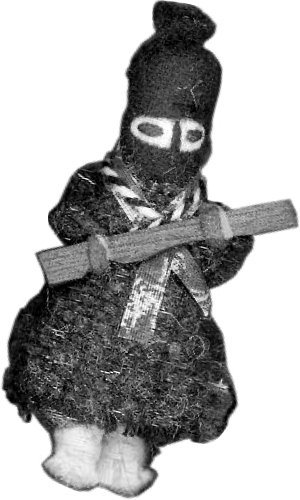
A refugee sells Zapatista dolls in San Cristóbal.

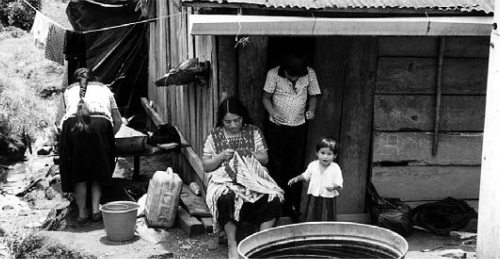
According to the Fray Bartolomé Center, since the Acteal massacre, the refugee situation in the state has gone from bad to worse. Since 1998, the population of so-called desplazados— “displaced persons”—has risen from 15,000 to more than 20,000. In the municipality of Chenalhó alone, there are more than 10,000 refugees out of a total population of 30,000. As in Xoyep, most fled their homes because of paramilitary violence and intimidation. Living conditions in the refugee camps are wretched. Without land, many refugees depend entirely on international aid groups like the Red Cross for food and medical assistance. They live in ramshackle huts pieced together with bits of wood and plastic. There are no schools for the children, no roads, no sanitation or garbage systems, no jobs—although there is lots of work, like hauling wood and water long distances every day and bending over open fires during long hours to cook tortillas and beans—and in most cases there is almost no possibility of returning home any time soon. Many refugees are afraid to return as long as paramilitaries continue to operate. And those that have returned often find their homes destroyed, their possessions stolen, and their land confiscated.
In the municipality of Chenalhó, the population is 30,000—but 10,000 are refugees.
Says Father Gonzalo Ituarte, who holds the title “vicar for peace and justice” of the diocese of San Cristóbal, “With every passing day that the des-plazados are forced to be away from their homes, their suffering increases. They have made every effort to return, but the minimal conditions necessary remain unfulfilled—the government has not provided guarantees for their safety, and the paramilitary threat remains very much alive.”
Military intelligence?
A week after my visit to Xoyep, I had a chance encounter with two agents of Mexico's Military Intelligence at a conference on indigenous rights in Mexico City. Although the two men declined an interview, they said we could talk informally. I was curious to know why the army maintained camps outside Xoyep and other communities in Chiapas. “You have to understand,” said one of them, “we are there to keep the indigenous from attacking each other.” The problem in Chiapas, he told me, is that there is a lot of strife between communities. The military is there to maintain the peace.
The chapel in Acteal where people were praying when paramilitaries attacked in December 1997, killing 45.

The other agent chimed in, “Let me give you an example of what the Indians are like down there. You know we have social labor camps in many of the villages where we hand out food and provide aid. Sometimes when we are hungry, we ask the people for something to eat. Instead of offering it to us for free, they try to sell back to us what we had given them.”
When I told him that I didn't understand the point of his story, he repeated it back to me with some slight variations. After I continued to press him for an explanation, his companion interrupted, blurting out impatiently, “Look, the point is, if the Indians were more human they would give us the food instead of selling it to us.”
Listening to the agents, I had a hard time believing they had ever visited Chiapas. But their description of the situation—especially the notion that the conflict boils down to internal strife between competing indigenous factions—was a familiar one.
Dual containment
Independent analysts and human rights observers often describe the government's approach to the situation in Chiapas as a sort of dual containment strategy. On the one hand, the Mexican Army, which has as many as 60,000 troops stationed in the region, concentrates on tightening its encirclement of the EZLN forces located primarily in the Lacandon forest in the southeastern section of Chiapas. It is not a difficult task—the Zapatistas, who have remained holed up in their Lacandon bases since almost the beginning of the conflict, have repeatedly said they are not interested in going back on the offensive.
(During the past year, the Mexican Army, supported by agents of the so-called Federal Preventive Police, have built camps in the Montes Azules Integral Biosphere Reserve, a protected ecological zone located on the eastern edge of the Lacandon forest. Government authorities argue that the new military camps are necessary to protect the reserve, which they say is being jeopardized by fires started by indigenous families living there. Analysts, however, speculate that the purported fires are just a pretext to allow the military to close off the last remaining hole in the army's encirclement of the Zapatistas. As a result of the military presence, several families have been forced to relocate to other regions of the forest.)
The second element of the government's strategy has been the creation of paramilitary groups. Aided and abetted by local bosses of the ruling PRI party, police forces, and elements of the army, the paramilitaries harass and undermine indigenous communities in the northern and highland regions of the state that have rallied to the Zapatista cause. The main targets of these forces are the so-called “autonomous municipalities,” communities that have expressed their opposition to the government and support for the Zapatistas by declaring their de facto independence from the state.
Officials in the administration of President Ernesto Zedillo apparently hoped that by using this strategy to contain the conflict, the situation would gradually blow over, and the government would not be forced to implement the peace accord it signed with the Zapatistas in 1996, which called for changes to the Mexican constitution granting limited autonomy to indigenous communities.
With the Acteal massacre, however, the government found itself on the defensive. Its counterinsurgency strategy had led to one the worst episodes of violence in recent Mexican history, and the actions of the paramilitary groups were drawing unwanted attention to the conflict. Says Ituarte, “Acteal demonstrated to the government how dangerous it is to allow paramilitary groups to operate, and thus it is being more careful with them. There have also been other cases, less atrocious than Acteal, but as well very real, which have shown that once the paramilitaries have weapons, they are no longer so obedient.” (On June 12, several gunman ambushed a police truck near the highland village of El Bosque, killing seven officers. Many believe the gunmen were paramilitaries involved in drug trafficking.)
Soon after the Acteal massacre, the Zedillo administration made a series of pronouncements about the need to rein in the violence in the state, which it attributed to intercommunal strife. Several dozen people were arrested for their complicity in the massacre, some government officials were replaced (the governor of Chiapas at the time of the massacre, Julio César Ruíz Ferro, who was implicated in the massacre, was given a post in the Mexican embassy in Washington soon after stepping down), promises were made about jump-starting the peace process, and more troops were brought in “to pacify” the region.
Despite these early actions, political violence and terror have continued apace in the two and a half years since the massacre—as evidenced by the growing refugee problem—and the peace process remains stalled.
According to Marina Patricia Ji-ménez, director of the Fray Bartolomé Center, the government argued that troop reinforcements were needed in Chiapas—and particularly in Chenalhó, where a number of paramilitary groups operate—to disarm violent groups. But, she says, there is no evidence that a single weapon has been confiscated.
Jiménez also says that despite the large number of soldiers in Chenal-hó—there is approximately one soldier for every 10 inhabitants—paramilitaries continue to act with total impunity, members of opposition parties are frequently harassed, and Las Abe-jas continue to receive death threats.
The prosecution on trial
Last November, 42 people—including members of Las Abejas and several PRI-affiliated families—from the hamlet of Canolal, in Chenalhó, fled their homes in the middle of the night after receiving repeated threats from members of the local PRI establishment.
According to the Fray Bartolomé Center, several days before the incident, the Public Security Police and the state office of the federal prosecutor (or the “PGR”) were notified by the “Special Prosecutor for Chenalhó” of a complaint filed by Las Abejas in which the group accused various individuals in the community of illegally possessing firearms. Both agencies then allegedly informed local authorities of the complaint. On November 4, during a meeting of the Canolal assembly, the authorities denounced the complaint and identified those who had filed it. Three days later, Las Abejas fled the village, joined by three priista families that had received threats because of their opposition to the treatment of Las Abejas and the maintenance of paramilitaries in the village.
In a press release after the incident, the Fray Bartolomé Center lambasted the PGR for releasing information about the complaint to local authorities, which the center claimed was “a manifestation of the complicity between authorities charged with investigating crimes and the presumed perpetrators of them. This [complicity] casts doubt on the credibility of the state's judicial institutions and their willingness to investigate paramilitary groups.”
For its part, the state prosecutor's office announced that the “displacement” was simply a “change of residence of six families who had decided to join Las Abejas.”
I asked Jose Sotelo, head of a special task force created by the PGR last September to investigate “probable armed civilian groups,” about the incident in Canolal. “When we were informed that people in the village had weapons, we went and took declarations from those making the accusations. But all the elements [necessary to make any arrests] were not there. Some said they heard gunshots in the night. Others said they had been threatened. It was impossible to put even two testimonies together that [identified a single person]. Gunshots in the night, in the countryside—what can we do with that?”
A “displaced” family in Xoyep.
A meeting with community directors in Xoyep's new schoolhouse

According to Ituarte, “[Sotelo] is in a difficult situation because he is dealing with very serious problems. The crimes he is investigating implicate public officials and members of the army. He needs evidence that has juridical value.” Ituarte also claims that Sotelo's task is made more difficult by the fact that many indigenous do not trust government agencies and often refuse to report crimes. “The diocese has very close relations with the communities, and they are willing to tell us things they won't tell Sotelo. The people are afraid to give testimony to authorities because they might pay for it later—the paramilitaries know how to kill. For us, as a diocese, the testimony [of the villagers] is valid, because our job is a moral one. If the villagers heard shots in the night, it is because the paramilitaries are training.”
Sotelo argues that before you can investigate purported paramilitary crimes, you first have to establish the the existence of paramilitary groups, which is what his task force was created to do. He told me, “The term ‘paramilitary’ does not exist in Mexican legislation. You can't establish the legal existence of something that doesn't legally exist.” He says that to legally ascertain the existence of a paramilitary organization, three conditions must be met: first, you must verify that there is an actual group; then, you have to prove it is armed; and lastly, you have to demonstrate that the group is acting with the complicity or support of government authorities.
According to Maria Jiménez of the Fray Bartolomé Center, there is abundant evidence proving each of these requirements—including army strategy texts, testimony from paramilitary leaders and local officials, and documents detailing various types of aid supplied to paramilitaries by officials and police forces. As for Sotelo's remark about the word “paramilitary” not existing in Mexican legislation, Jiménez says, “We don't need new terms, we need [Sotelo and the PGR] to investigate crimes and punish the guilty.”
Miguel Angel Gandara, the former executive secretary of the now-defunct National Commission for Mediation— the non-governmental body that mediated the peace talks between the government and the Zapatistas in 1996— says that to understand the role of the PGR in Chiapas, you have to see the agency within the framework of the government's counterinsurgency war in the state.
“First, we must remember that in Chiapas there is an internal armed conflict, which has clear implications in international law and requires the state to undertake a peace process and respect certain international conventions. But the government's strategy has been to reduce the conflict to a confrontation between rival indigenous groups. It has marshaled the forces of the army, the paramilitary, and various national security agencies in order to accomplish this goal.
“Late last year—almost five years after the first paramilitary group was identified—the PGR, under enormous pressure from national and international bodies, created the task force headed by Sotelo. His commission calls the paramilitaries ‘supposed’ armed groups because it assumes that their existence has not yet been established. To avoid recognizing the armed conflict, the government—through the PGR—has decided to go the judicial route of establishing the juridical existence of something that in the real world has existed for a long time. It is the long route, an ineffective route, a route meant to buy time and to convert a political and military problem into a judicial quagmire.”
In other words, I said, the PGR has a conflict of interest. “That is exactly the problem,” said Gandara. “How can the PGR challenge a strategy created by the same government that nourishes it? It is a huge question confronting Mexico.”
Winds of change
The year 2000 has brought a number of enormous changes to Mexico and Chiapas—the most obvious being the election of Vicente Fox Quesada, who on December 1 will take over as Mexico's first non-PRI president in 71 years. Fox's remarkable rise to power and his proposals to eradicate corruption, end narco-trafficking, and solidify Mexico's neoliberal economic program have been the focus of countless articles, analyses, and editorials. Very little, however, has been said about what his presidency might mean for Chiapas. This is partly due to the fact that he has said little about the conflict, aside from his infamous declaration early in the presidential race that it would take him only “15 minutes to smoke the peace pipe with the political and strategic head of the EZLN [Subcomandante Marcos].”
What little he has said, however, seems substantial. He broke with the official stance of his conservative party—the National Alliance Party, or PAN—in announcing that he would implement the peace accord signed by Zedillo and the EZLN. He has also called for disarming the paramilitary groups and returning the army to its pre-1994 positions.
Commentators, however, are wary of Fox's proposals. Some speculate that they may have been mere electioneering, an attempt to draw voters from the leftist PRD party. Even if he is serious about his proposals, say others, the traditional right-wing elements of his party will frustrate his attempts to implement them. Still others argue that his economic policies will only aggravate the already desperate situation of the country's indigenous groups, which is what gave rise to the conflict in the first place.
Countering this last criticism, Fox has proposed establishing a “new relationship between the state and the indigenous peoples.” During a press conference on June 13, Fox outlined a series of proposals regarding indigenous issues. He prefaced his proposals, saying, “It is time for the indigenous peoples to stop being the poorest of Mexicans; it is time for the indigenous peoples to stop being persecuted in their own country; it is time for the indigenous voice to be heard and respected.”
Fox will also face strong—and potentially violent—opposition to his proposals from the state's entrenched PRI establishment, which has ruled Chiapas as a fiefdom for decades. But the PRI is faced with its own challenge in the upcoming state elections. Pablo Salazar, an independent candidate for governor, has pieced together a formidable coalition of political parties—including the PRD and the PAN— that is favored to win. According to many commentators, the outcome of the state elections, which will be held on August 20, may prove to be more important in terms of resolving the conflict than the presidential election.
Asked by journalists whether Fox would be able to resolve the conflict in Chiapas, acclaimed Mexican poet and novelist Carlos Montemayor said, “At this point, it is very hard to guess how Fox will react [once in power]. Everything depends on the upcoming state elections. If the coalition of Pablo Salazar wins, the conflict could be halted; if it loses, the war will accelerate.”
Another critical change in Chiapas this year has been the retirement of Bishop Samuel Ruíz, who led the diocese of San Cristobál for 40 years. Often called the “red bishop” by opponents for his espousal of liberation theology, Ruíz has been a vigorous and effective champion of the indigenous. Some fear that with his retirement, the diocese's role as a defender of the indigenous will gradually diminish.
“There is no peace”
Back in Xoyep, Las Abejas were—as of this writing in early August—again considering returning home. While I was there in June, plans for a July 5 return, which had been worked out several months earlier with various government and non-governmental agencies, were scrapped at the last moment.
Alejandro Souza, head of the Chiapas office of the governments National Human Rights Commission, told me that it was a mystery to him why Las Abejas had decided not to return. He claimed that the government had agreed to meet their central demand: that they be compensated for all their losses. “We had signed an agreement that we would reimburse them for the personal property they had lost. And now there is this problem. It seems there is a dispute within their leadership about whether they should return or not.”
I said that my understanding was that before returning, Las Abejas wanted guarantees that the paramilitaries would be disarmed. “Their representatives didn't say anything about paramilitaries,” Souza replied. “The government has demonstrated its firm desire to do whatever is necessary to help them return.”
According to Gonzalo Ituarte, Souza's statements are only partly true. Yes, he says, the representatives of Las Abejas are divided over whether they should return or not, but this is because of the continued paramilitary violence. “The paramilitaries continue, the corruption of the government continues, the threats continue, there is no peace, there are no guarantees—that is why they will not return.” He also mentioned that Las Abejas fear they are being used by the government to demonstrate that everything is all right in the highlands. “Of course they want to return, but not just to satisfy the government.”
During our visit to Xoyep last June, the community's education director showed off the brand new single-room schoolhouse that had been built with help from international aid groups. He said that the building, a modest structure made of freshly cut wooden slats, could hold about 30 children at a time. As with all the other structures in Xoyep, the cold dirt ground serves as the floor, but it is relatively flat, and the tiny chairs and desks seemed to remain balanced. The director said he hoped that the school would enable most of the children to take at least some lessons, but the community had grown so much he wasn't certain if it was going to work. As he spoke, he seemed to grow increasingly discouraged, as if the daunting reality facing his school program had gradually begun to overwhelm him. The hopefulness that lit up his face at the beginning of our tour soon turned to disillusionment. Before we realized it, he started to weep. We were stunned. “I don't know what we are going to do,” he managed to say. “How can we hold out much longer? We need to go home.”