



Abstract

A new “Manhattan Project”?
There is an important aspect of our energy future which is not mentioned in the article by Steve Fetter (“Energy 2050,” July/August 2000 Bulletin). Most of the obtainable supply of petroleum will be used up by the year 2050. (Actually, it will probably take longer because the price of petroleum will rise sharply, which will decrease the rate at which it's used.)

The energy situation is critical. If things go on as usual, automobile and truck traffic will come to a screeching halt by 2050. We desperately need a “Manhattan Project” to develop alternative energies, especially fuel cell technology and the production of hydrogen using solar energy.
Speaking of the Manhattan Project, I was a researcher on that project at Columbia in 1944-45. At the time, we comforted ourselves by saying, “Electricity will be so cheap that meters will be unnecessary.” I didn't realize that this extremely naïve notion would survive into the 1960s.
R. Thomas Myers
Kent, Ohio
Steve Fetter provides a thoughtful review of energy options to tackle climate change, but he misses one important downside to nuclear power— calamities.
Maybe the probability of core damage for current U.S. light-water reactors can be calculated as averaging one failure in 10,000 operating years, but who, on historic experience, would ascribe similar remote probabilities to the possible effects of social upheavals, wars, and natural disasters?
In addition to the other problems Fetter identifies, the planet simply is not ordered neatly enough for us to confidently contemplate the widespread use of nuclear energy. In an unpredictable world, we have to focus our efforts on energy sources that we can abandon if future circumstances demand it.
Stewart Kemp, Secretary
UK Nuclear Free Local Authorities, Manchester, England
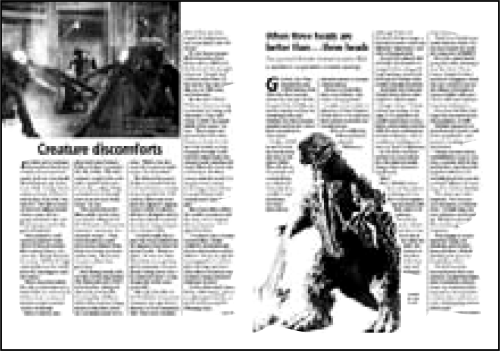
Nervous laughter
Although I never thought I'd see a picture of Godzilla in the Bulletin of the Atomic Scientists, I have to admit that I read every word of Janne Nolan's hilarious cooperative security analogy (“When Three Heads Are Better Than … Three Heads,” July/August 2000 Bulletin).
Corrections
In the July/August 2000 Bulletin, Janne Nolan, author of “When Three Heads Are Better Than … Three Heads,” was described as a national security specialist at the Brookings Institution. That description was true enough, as far as it goes. But in her “day job,” Nolan is the director of international programs at the Century Foundation.
Also in the July/August issue, Najum Mushtaq wrote: “The [Pakistani] government has pressured the Taliban on issues related to its own security, asking it to close down camps in Afghanistan that were being used to stage raids on Pakistani villages.” Author Mushtaq wants to make clear that he did not mean to suggest that the Taliban were raiding Pakistani villages. He was referring to Pakistani sectarian terrorists, wanted by the authorities for criminal acts, who have fled across the border and operate from camps in Afghanistan.
Apparently, though, you're not the only ones needing a little comic relief from the nuclear threat: I understand that the Los Alamos Study Group—a serious and very earnest watchdog organization based here in Santa Fe that keeps tabs on the Los Alamos National Laboratory—has been informally screening some favorites from that genre, including Them!, which was mentioned in your mutant monster movie roundup (“Creature Discomforts,” July/August 2000 Bulletin), as well as The Invasion of the Body Snatchers.
Dianna Delling
Santa Fe, New Mexico
Laguna Verde update
I read with great interest Michael Flynn's two recent articles in the Bulletin about Mexico's Laguna Verde nuclear power plant (“Trouble at the Green Lagoon,” May/June, and “Bernardo Salas, ‘Bad Element,’” July/August), which describe some of the most serious irregularities at the plant.
“And I got this for not nuking anyone during the entire Cold War.”

Thanks to these articles and several others published in the national and international press, Mexican authorities have been pressured to allow an independent audit of the plant. There is concern, however, that plant officials will do whatever is necessary to avoid having a serious company undertake the audit. According to Mexican law, companies qualified to undertake the audit must compete in an international bidding process. The company offering the lowest bid is then awarded the contract. Many in Mexico are concerned that the Federal Electricity Commission (CFE), together with its partners at Laguna Verde, will arrange a deal with a less-than-scrupu-lous company that might be persuaded to offer a paltry bid in return for a large payoff by corrupt officials who will then dictate the results.
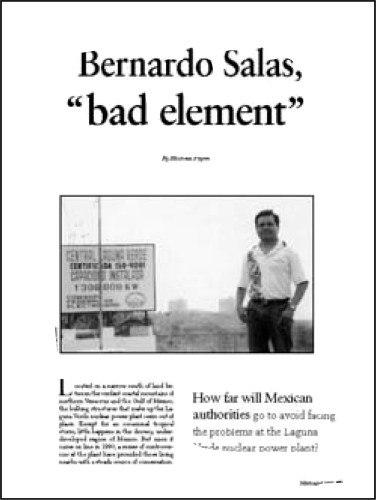
The press coverage of the plant investigation undertaken by the World Association of Nuclear Operators (WANO), which was discussed in the Bulletin article “Trouble at the Green Lagoon,” has also put Alfredo Elías Ayub, the head of CFE, on the defensive. On July 12, Elías was ordered to appear before Congress and respond to questions about plant operations. At the invitation of various congressmen, I prepared several of the questions posed to Elías, using the two Bulletin articles as annexes. Alejandro Jiménez Taboada, head of the Commission on Ecology and Environment, based one of his questions to Elías on Flynn's interview with Bill Kindley, the director of WANO. “We are concerned,” said Jiménez, “about a report in a magazine in which a WANO functionary, I think it was the director, said that he was never informed [by CFE] that Congress had requested the WANO report.” Jiménez went on to ask whether this and several other items covered in the WANO report were true. Elías was forced to confirm everything.
Elías was also questioned about my dismissal from the plant. He responded that my complaint had already been attended to by labor authorities, which ruled in favor of CFE. Unfortunately, it seems that my personal struggle will continue indefinitely. For 14 years I worked in the field of radiological protection. Although in Mexico my options are extremely limited, it is my hope that I will someday be able to work again in the nuclear industry.
Bernardo Salas
Mexico City, Mexico
Lay off Germany
The descriptive after the title “Dangerous Assumptions” (July/August 2000 Bulletin) reads: “Democracy isn't doing all that well in Central Europe,” which sums up author Daniel Nelson's bleak view of the democratic process in Austria, Germany, and the Czech Republic. I will limit my response to Germany.
Former Chancellor Helmut Kohl's actions, as deplorable and disappointing as they are, may have shaken the Christian Democrats as a party, but not democracy in Germany, as Nelson claims. Just the opposite: The matter has been handled in a responsible way, as one would expect in a functioning democracy. Unfortunately, people in power are prone to abuse it and become corrupt. That is a universal truth, and we need to look only at our own country.
We want to hear from you
Send them to: Letters, The Bulletin, 6042 South Kimbark, Chicago, IL 60637 fax: 773 702-0725 e-mail:
Be sure to include your mailing address and phone number.
So far there is no evidence of a shift to the right in German party politics. Only Bavaria's Christian Social Union has admitted sympathies with Austria's Jörg Haider. “The fertile ground for the rise of extremism” is likely to become less fertile as the economic situation in Germany slowly improves. Mainstream conservatism (not even close to the views of the Austrian Freedom Party) is well balanced by other political forces.
German political and legal institutions are well aware of the risk of neoNazis and other hate groups, which recently have used the Internet to threaten foreigners and certain other individuals. Unfortunately, the U.S. government, including the FBI, has not cooperated with German authorities to identify the responsible individuals and to prevent distribution of Nazi ideology on the Internet. ProNazi literature, forbidden to be printed in Germany, enters from the United States.
To make contributions to NATO the basis for judging the future of democracy in Central Europe is undemocratic by itself. Pluralism and democracy must go hand in hand. That means we have no right to be alarmist and judgmental when other countries and their leaders go through difficult times.
Wolfgang F. Kluge, M.D.
Seattle, Washington
Special means special
Bertram Wolfe (Letters, May/June 2000 Bulletin) whines about the attention given to the recent criticality accident at the Tokai facility in Japan. But he either does not understand or chooses to ignore its lesson.
Alvin Weinberg, Hannes Alven, Edward Teller, and several other nuclear pioneers warned of the inherent dangers of atomic power and described the extraordinary degree of managerial and professional competence atomic power requires. Weinberg's suggestion that a “nuclear priesthood” would be needed is perhaps the best known of their warnings.
We have ample evidence that the managers and professionals involved with the atomic power enterprise have not taken these admonitions to heart. I will mention only three examples, but there are many others.
My colleague Donald P. Geesaman and I visited the Kerr-McGee plutonium works at Crescent, Oklahoma, in 1974 at the request of the plutonium workers union—the Oil, Chemical, and Atomic Workers. This visit preceded the untimely death of Karen Silk-wood by a few weeks. Don pointed out that the Kerr-McGee management treated plutonium, perhaps the most toxic material ever considered for commercialization, as though it were comparable to soybean meal. He was right, and he anticipated subsequent events.
British Nuclear Fuels's (BNFL) recent admission that fuel-production-related records were falsified shows an unbelievable degree of mendacity. It may be that such practices are acceptable by certain industry standards, but it is a sorry commentary on the atomic power industry.
“The Dow! All this time I thought you meant the Tao!”

Finally, the Tokai accident exhibits characteristics of both the Kerr-McGee and the BNFL stories—an incredible lack of employee training and oversight, combined with mendacious and/or incompetent behavior by management. Special nuclear material is special.
If atomic power is to play a nontrivial role in meeting global energy demands, the industry must either respect that toxic and fissile material requires special handling and take the guidance of Alvin Weinberg and other atomic power scholars, or we can expect more serious disasters.
Dean E. Abrahamson
Minneapolis, Minnesota
Author Guidelines
The Bulletin publishes both solicited and unsolicited manuscripts. Manuscripts will not be returned unless accompanied by a self-addressed stamped envelope. Letters of inquiry before the submission of a manuscript are useful to determine whether a proposed article is appropriate for the Bulletin. Submit all material to:
Linda Rothstein, Editor
The Bulletin of the Atomic Scientists
6042 S. Kimbark Avenue
Chicago, IL 60637
Fax: 773-702-0725
E-mail:
In most cases, articles should be no longer than 3,000 words. Although the Bulletin is a serious magazine, it is not a scholarly journal. Articles should be written in a lively style and should be suitable for the non. technical reader. Footnotes should be kept to a minimum in both length and number, but they should contain s all essential information: author, title, a name of publication (if a periodical), e location and name of publisher (if a book), date of publication, and page l references.
All acronyms should be defined, and all personal first names should be spelled out. Illustrative material may be included, but the Bulletin reserves the right to use additional or alternative illustration. All materials submitted should be accompanied by brief biographical data, including the author's current position, institu-o tional affiliation, the names of reh cently published books or mono-t graphs, and address and telephone s number. Articles should have titles, d but authors' titles usually are rewritten to meet journalistic or space requirements. The Bulletin follows the Chicago Manual of Style.
Articles often are sent for review to an expert in the relevant field before acceptance. All materials accepted for publication are subject to editing for greater clarity, effectiveness of communication, and space considerations. Authors will receive edited manuscripts or galley proofs for approval. Alterations should be kept to a minimum.
Articles accepted should not be released by the author to the press or to the public before publication. Any exceptions must be discussed in advance with the editor. The Bulletin maintains the copyright to all published material.
The editors select book reviewers and books to be reviewed. Unsolicited reviews generally are not accepted.