




Abstract
Down but not out: The Strategic Rocket Force struggles but survives in today's Russia.
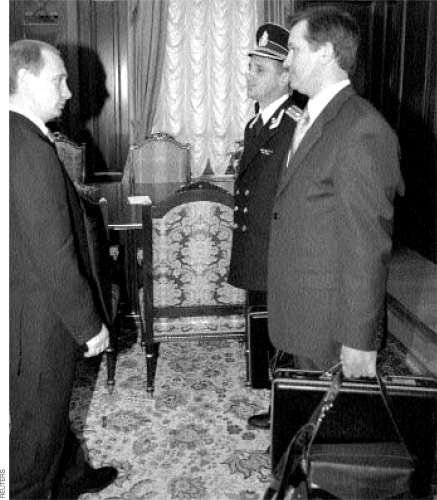
When Russian President Boris Yeltsin unexpectedly resigned on December 31, 1999, Russian television showed the transfer of the nuclear suitcase to his successor, Acting President Vladimir Putin. The hand-off followed a procedure that had been developed by the Defense Ministry and formalized by the government two months before in anticipation of the presidential election originally scheduled for June 2000. Performed in the Kremlin office, the transfer demonstrated both the increased transparency of Russian political life and the nuclear deterrent's role as the primary trapping of political power.
January 31, 2000: Acting President Vladimir Putin (left) receives the “nuclear suitcase.”
Russia's Strategic Rocket Force is the mainstay of the deterrent. The force—of about 150,000 troops dispersed over 11 time zones—is responsible for some 5,500 nuclear weapons, 2,300 of which are maintained on high alert, ready to launch within a few moments' notice. Established in December 1959 at the height of the Cold War, the force's basic mission has barely changed since the disintegration of the Soviet Union. One visible difference is that the portraits of first Communist leader Vladimir Lenin and other Communist Party general secretaries are gone, replaced by the holy image of the martyr St. Barbara, which now looks down at the officers from the wall of the Central Command Facility. The Patriarch of Moscow and All Russia personally presented the icon as a blessing to the missileers in charge of Russia's most powerful and deadly weapons.
The rocket force
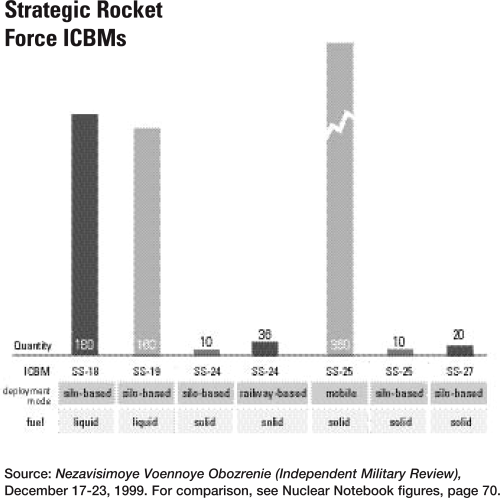
The Strategic Rocket Force has traditionally operated both mobile and silo-based intercontinental ballistic missiles (ICBMs). Before the 1987 Intermediate-range Nuclear Forces Treaty was implemented, medium-range nuclear missiles, mostly SS-20s, were also under its jurisdiction. As of late 1999, the rocket force had 776 fully deployed liquid- and solid-fueled ICBMs. Most liquid-fueled missiles have either reached the limit of their service lives or are undergoing life-extension services and will be withdrawn by the end of the decade. The Topol SS-27 is expected to constitute the bulk of Russia's ICBMs in the years to come. It was formally commissioned in April when it was transferred from experimental status to full operational status.
In July 1998, Russia's Security Council reemphasized the importance of a balanced, START II-compliant triad, but the Strategic Rocket Force is the winner in terms of available funding and preferential treatment. Before he was appointed Defense Minister, Marshal Igor Sergeev was the force's commander-in-chief, and until recently some 80 percent of the Defense Ministry's procurement budget went toward the rocket force's modernization.
Some technical mishaps outside the rocket force and interservice disagreements have also contributed to its growing clout. The sea-based leg of the triad was put in limbo when a series of test failures led to the cancellation in the late 1990s of the new submarine-launched ballistic missile (SLBM). This SLBM would have replaced the currently deployed SS-N-20, which has already been extended beyond its service life and its production discontinued.
Now, another new SLBM project is under way. As a result, construction of the Yuri Dolgorukii, the lead submarine of a new class designed for the now-terminated SLBM, was also suspended. A new submarine equipped with new missiles will not enter service before 2007 or 2008. By that time, even the most recent of the currently deployed Delta IV subs will be reaching the end of their service lives.
Russia's strategic aviation has been equally affected by economic hardship and the breakup of the Soviet Union. The air force is receiving several Tu-160 and Tu-95MS heavy bombers that were left in Ukraine in 1992—their repurchase negotiated under an energy debt-for-bombers formula. The air force was also scheduled to take delivery in May 2000 of a new Tu-160 bomber—the first new heavy bomber to reach the air force from its producer in more than 12 years, bringing the Tu-1 60 fleet to 15.
Russia's strategic bombers are increasingly vulnerable in an age of space reconnaissance and high-tech air defenses, and their limited number, expected to fall below 60 by 2008, means that the air leg cannot be too effective.
Expanding the command
In contrast, by Russian standards the Strategic Rocket Force has stayed combat ready and robust, and has grown by absorbing other commands. In 1997, both the Defense Space Command and Missile Space Defense were merged into the rocket force. The commander-in-chief of the force is Gen. Vladimir Yakovlev, a graduate of the Kharkov Higher Education Institution for Military Equipment (now in Ukraine), and the Dzerzhinsky Military Academy, which has been renamed the Peter-the-Great Military Academy. He was appointed to his position after General Sergeev, his predecessor, was named Russia's Defense Minister. (In April, Sergeev's term as Defense Minister was extended for another year.)
The space component had been rolled out of the rocket force in 1982, when it was given the mission of countering Ronald Reagan's Strategic Defense Initiative. But that reorganization led to extensive overlap, lack of coordination, and even rivalry in several functional areas, including information support. After the disintegration of the Soviet Union, the defense budget was too small to support several commands and the infrastructure that was supposed to implement common tasks.
After the three services merged in 1997, personnel was reduced by 34,000, and missile and space manufacturing facilities are currently being reduced from 1,122 to 859. As a result of the overall savings and phasing out of overlapping programs, the rocket force's share of the defense budget dropped from 19.2 percent in 1996 to 13.8 percent in 1999. General Yakov-lev's approach has been to demonstrate frugality while simultaneously campaigning for an increased share (25 percent) of the defense budget.
His current priority is more money for Missile Space Defense. In August 1998, a meeting of the Defense Ministry's Military and Technical Council recommended that some funds be shifted from land-based missiles to the space defense component.
The rationale behind the decision was that an investment in defense would increase the overall effectiveness of the nuclear deterrent much more than would a comparable investment in strike forces. Missile Space Defense detects launches of Russian and foreign ballistic missiles, provides warning of hostile missile attack, delivers relevant information to Russia's civilian and military leaders, and operates Moscow's ABM Treaty-compliant anti-ballistic missile system. In addition, Missile Space Defense troops carry out reconnaissance missions and other exercises in outer space.
Defense Space Command launches and operates space-based military pay-loads. The navy, air force, and Main Rocket and Artillery Directorate (the army) are closing down most of their own missile facilities and turning to the rocket force for testing.
Of particular importance is the rocket force's partnership with Russia's Aerospace Agency (rasa). Under its periodically adjusted statutes, rasa cooperates with the Strategic Rocket Force in selecting and awarding state defense orders for r&d, technologies, and other products. It performs missile warranty work and decides whether to destroy or recycle military rockets as they are decommissioned at its facilities. In cooperation with the Defense Ministry, it recommends which weapons or space systems should be produced or deployed. Rasa also coordinates all projects involving the conversion of strategic missile systems into space launch vehicles. The Defense Ministry is still the main procuring agency, but rasa implements the comprehensive industrial policy concerning military rocket and space technologies. The rocket force is the driving force behind a move to integrate Russia's nuclear weapons commands into a single entity that would oversee all three legs of the triad. General Yakovlev has submitted the blueprints for the consolidation to the Defense Ministry and the General Staff. The air force and navy dislike the idea, however, and they can be expected to challenge it when the proposed reorganization comes up for formal discussion. Also opposed to the consolidation effort is Gen. Anatoli Kvashnin, chief of the General Staff, who is concerned that the rocket force would become too powerful and unmanageable.
Russian public opinion overwhelmingly supports not only retaining, but expanding, the nuclear force.
Expanding the mission
In January, Putin approved the National Security Concept, which, among other things, includes formal guidelines for the use of nuclear weapons. A revised defense doctrine, but along similar lines, was approved in April. These documents introduce a lower threshold for the use of nuclear weapons consistent with the November 1993 defense doctrine abandoning the Soviet Union's no-first-use policy proclaimed in the early 1980s.
In the new documents, Russia reserves the right to use nuclear weapons if it or its allies are attacked with weapons of mass destruction, or in response to large-scale conventional aggression. The rationale behind the change is that Russia's conventional forces, which continue to deteriorate, would be no match for that of most potential adversaries. Also, some neighboring countries have developed the capability to deliver chemical or biological weapons. If Russia or its allies were attacked with these weapons, Russia would be prepared to retaliate with nuclear weapons.
Russian public opinion overwhelmingly supports not only retaining, but also expanding, the nuclear force. In a public opinion poll taken at the end of 1999, 76 percent of those polled indicated that Russia needs nuclear weapons, which, they said, play an “exclusive role” in Russia's national security [See “The Russian Public Speaks,” January/February 2000 Bulletin].
The majority of those polled believed that, compared to 15 or 20 years earlier, the threat of nuclear conflict had dramatically increased. According to another poll taken in August 1999, the United States topped the list of countries believed likely to initiate nuclear war, followed by Iraq, Iran, and China. Not surprisingly, 58 percent of those polled believed that Russia should maintain as many nuclear weapons as the United States—or even more. Unlike those asked in previous years, most of those polled last year rejected the policy of no-first-use and favored maintaining weapons on high alert.
A Russian officer gives orders to anti-ship missileers during “Zapad-99” strategic exercises
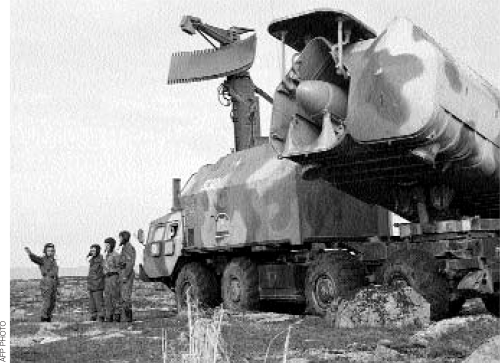
Last year's polls followed two events that stirred anti-American sentiment— NATO expansion, which was unanimously opposed by Russia's political elite, and the bombing of the former Yugoslavia. In this highly volatile environment, Russia's top brass described the evolving security posture as “extended nuclear deterrence.” General Yakovlev described the new security concept as a “credible demonstration of [Russia's] resolve and readiness to use force.”
(In June 1999, the military's Zapad-99, or “West-99,” strategic command and staff exercise, put the concept to the test. Zapad-99 was the largest war game held since the creation of the Russian armed forces and involved five military districts, five fleets, and 23 combined task forces. According to Defense Minister Sergeev, all other measures were exhausted in the course of the exercise, and “the decision to use nuclear weapons was made.”)
Until mid-1999, in the view of the anti-Western group of Russia's military, Russia's stockpile of nuclear weapons was its only guarantor of security.
A vocal promoter of this hawkish approach was Gen. Leonid Ivashev, director of the Defense Ministry's Main Directorate of International Military Cooperation. He and like-minded officers decried Washington's “hegemonistic designs,” adding that the United States intended to “remove Russia from the geopolitical scene as a competitor to its claim for world domination.”
The climactic moment in an increasingly bellicose atmosphere came during Yeltsin's visit to China, when he publicly reminded the United States that Russia was a nuclear power with a sizable nuclear stockpile.
The coming of President Putin has clearly been a watershed in strategic rhetoric, if not thinking. After approving the new security concept, Putin turned to fine-tuning and moderating Russia's military stance. He renewed an invitation to NATO Secretary General George Robertson to visit Moscow, for instance, overcoming the reported opposition of the Defense Ministry and the General Staff. And although he was not scheduled to meet with Robertson during the visit, he did so anyway. He also impressed Madeleine Albright in January meetings.
Backpedaling from the harsher line was also apparent in the text of the new military doctrine published in April. Some of the earlier and controversial anti-Western statements were jettisoned, and cooperative provisions were played up. Still sticking to conservative and nationalistic values, Iva-shev nevertheless characterized the doctrine as based on “prevention, deterrence, and partnership.” Clearly, in finalizing the text, President Putin had to deal with the hawks on the General Staff, appease the armed forces against the background of intensifying warfare in Chechnya, and continue to stretch out an olive branch to the West. It would make sense to evaluate the new doctrine in terms of Putin's limited space at that time for strategic and negotiating maneuver.
Further evolution in Russia's strategic thinking will certainly depend on a wide range of political and economic variables. But it is clear that whatever strategic orientation is adopted by the new Russian leadership—either the current emphasis on a multipolar approach, an emerging “selective involvement” concept allegedly proposed by analysts close to Putin, or some other idea—nuclear weapons will remain the main pillar of Russia's security and world stature. That—and the Strategic Rocket Force's other newly assigned roles—are likely to extend the force's clout beyond the strategic dimension.
Budgetary constraints
Still, the rocket force's performance and modernization remain hostage to the unpredictable ups and downs in the actual disbursal of funds. By law, the defense budget is supposed to be 3.5 percent of GNP. Currently, its direct allocations account for 2.8 percent of GNP and 16 percent of the total budget. Until recently most money went to maintenance and salaries, and about 80 percent of procurement funds went toward the production of SS-27s, with the rest spread throughout the defense industry to keep various production facilities afloat.
Russia's overall defense expenditures will total about $5 billion in 2000. It can afford to spend, however, only about $1 billion a year on procurement. In comparison, the United States spends more than $90 billion a year on military procurement programs.
Russian experts characterize the handling of the defense budget throughout the 1990s as highly unsatisfactory. Since most of the defense budget's items are classified, the lack of transparency has prevented any effective civilian control and led to all kinds of abuses.
Instead of the Security Council making allocations, it is the Defense Ministry that juggles available money in an attempt to deal with funding gaps. The result has been interservice wrangling and fierce competition for funds. For example, General Yakovlev's campaign to raise the rocket force's budget to 25 percent has been countered by the navy's insistence that it needs at least 20 percent of the total defense budget.
There is no long-term budgetary mechanism to provide a balance between defense and non-defense expenditures, and the newly established Commission for Military-Industrial Matters has failed to develop a comprehensive approach. As one Duma deputy, retired Gen. Alexander Pis-kunov, points out, “If we build weapons without due regard for outlays, our own army will eventually destroy us economically.”
Official budget numbers aside, the actual amount of money the Strategic Nuclear Force receives is a closely guarded secret. Insiders admit, however, that it is well below need; it may be less than half the sum appropriated. As a result, according to rocket force officials, 70 percent of ICBMs are beyond their warranty life and need to be replaced. Most command and control centers are no longer regarded as technically reliable. Forty percent of space assets operate in a much reduced capacity, and 70 percent are operating beyond their warranty life. Eighty-five percent of all launch complexes and technical support facilities are past their service life. In 1998, deliveries of rocket fuel for deployed ICBMs met only 90 percent of minimum needs.
The situation is much worse with regard to rocket fuel supplies for space launches. In some instances launch facilities received as little as 30 percent of the amount they needed. The jewel of the Missile Space Defense—the Moscow ABM system with its sophisticated Don-2N radar and intercep-tors—cannot keep up with growing challenges.
In addition, the Defense Ministry, and the rocket force in particular, have to absorb the cost of deactivation and elimination of strategic weapons systems being retired either because of age or as a result of arms control agreements. Gone are the days when any deployment of a missile led to an automatic allocation for its ultimate disposal. According to General Yakov-lev, the cost of dismantling a solid-fueled ICBM is about $73,000, dismantling a liquid-fueled missile, more than $10,000. At the same time, Russia's total fiscal 2000 budget for demilitarization in compliance with its arms control obligations is less than $66 million.
Given the delays in START II ratification and implementation, most of Russia's missile systems falling under that treaty are either close to the end of their service lives or well beyond them. But efforts to remove, convert, or destroy the missiles have been funded at only about 20 percent of the level needed. This has led to delays, corner-cutting procedures, and options for non-compliance. The Defense Ministry has been looking to raise money through other means—the reuse of liquid fuel engines, missile conversion for launching civilian payloads, and the selling of precious metals and scrap.
In more mundane areas, the rocket force's Rear Service, which is charged among other things with supplying food and providing meal service inside garrisons and missile sites, has been experimenting with unconventional approaches. Because of the continuous breakdowns in Defense Ministry supply channels, the Rear Service maintains some 300 subsidiary farming plots—often the only source of fresh food for crews on combat duty. It also has to deal with an inadequate supply of uniforms and related items. According to Gen. Vasilii Kolesnikov, its deputy commander, the Rear Service “is seeking opportunities to tap extra-budgetary resources in order to make up for existing shortfalls.”
Living quarters are also underfunded. As of now, 16,000 families of officers need housing, and only 2,900 apartments were built in 1999. Most retiring officers refuse to move, compounding the problem. The Defense Ministry has consistently asked Western donors for financial support to provide housing and professional training for retiring officers.
The impact of the protracted Chechen conflict is a widely debated and sensitive issue. One official estimate puts the total cost of the Chechen campaign at about $200 million, but non-governmental sources, including the Gaidar Institute, estimate that the campaign has cost $150 million a month since September. This is a substantial chunk of Russia's defense budget.
If until August 1999 there was a consensus that the Strategic Rocket Force had the highest funding priority, at the height of the Chechen war Defense Ministry leaders started to talk about a “balanced funding formula.” In January, Putin announced a 50 percent increase in defense procurement for the current year.
The plan includes an 80 percent increase for R&D and approximately the same for the purchase of weapons and hardware. The objective is to develop a modern mobile army. A modest increase was authorized for launching new space-based defense assets, but the bulk of the money will be spent on the modernization of general forces, for new communication systems and facilities at the tactical level, and for night-vision devices and so on. When Defense Minister Sergeev visited the Votkinsk Plant where Topol M SS-27s are manufactured, he declined to promise any increase in the rate of production. And no wonder: contrary to previous expectations of the mili-tary—who voted overwhelmingly for Putin—the 2001 defense budget is slated to go down. However, there is no clear consensus as regards long-term budgetary priorities. While ratifying the START II Treaty in April, the Duma included in its ratification resolution a series of provisions, including one bolstering the status of the rocket forces, and another making the Defense Ministry more accountable for its funding.
The evolving survival strategy
Given Russia's continued financial hardships and dramatically diminished international status, rocket force leaders have been developing and implementing a long-term survival strategy—finding ways to maintain the credibility of Russia's nuclear deterrent despite the country's socio-economic upheavals, at least until 2010. In ten years, they hope, a revived and restructured domestic economy will be able to support more costly modernization efforts.
Their strategy has four major components: extending the life of existing systems; shifting priorities as needed; commercialization; and staying flexible enough to adapt to changing international realities.
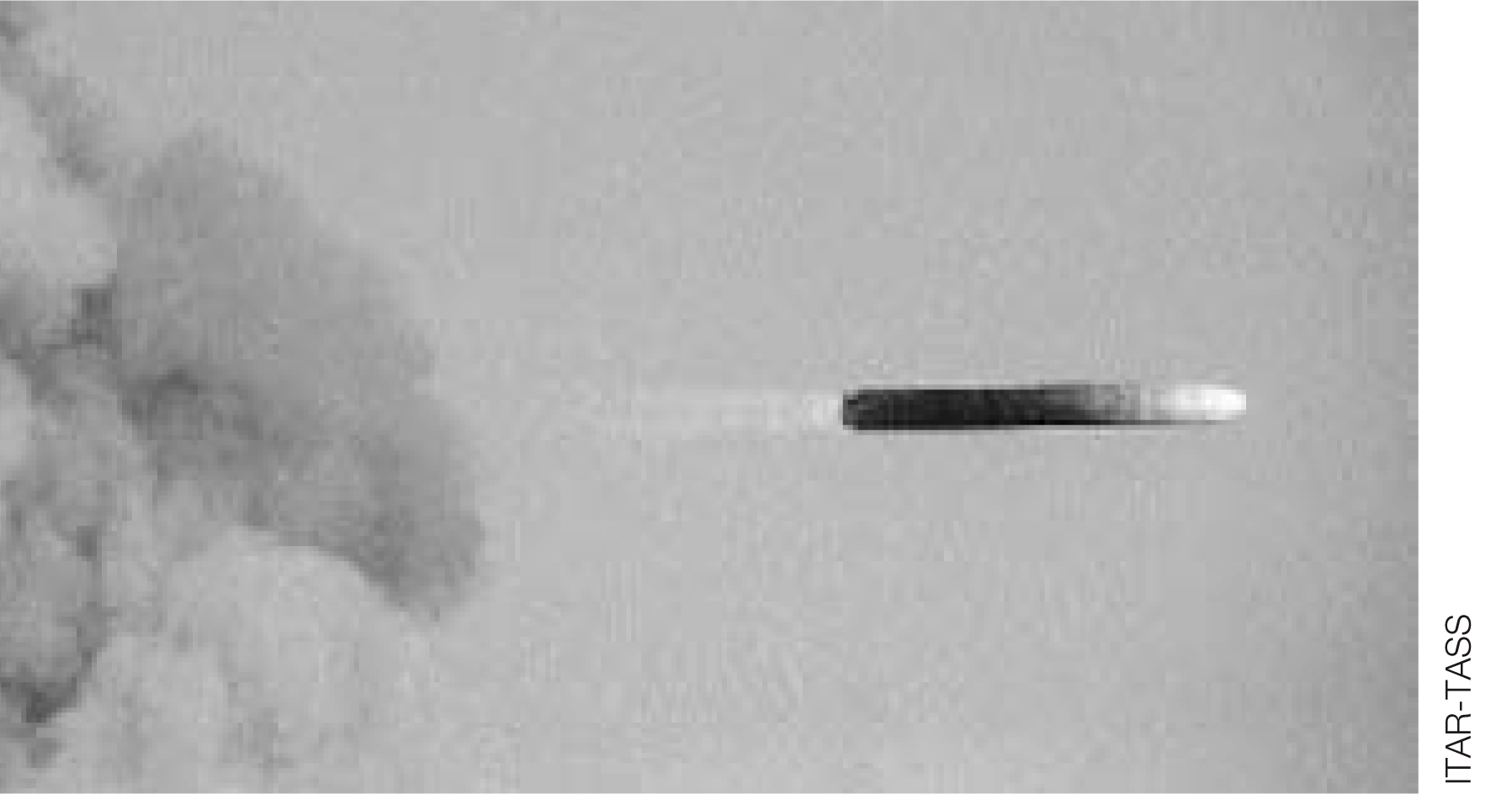
Although the original service life of the SS-18 ranged between 10 and 15 years depending on model, some SS-18s have been extended for as long as 22 years. Less spectacularly, the SS-24s have had one to two years added. A year ago, Russia's Security Council approved a new program to study other ways to extend the service life of all deployed ICBMs, but especially SS-18s.
The SS-18 ICBM has had its service life extended.
One system that does not fall under START II is the mobile SS-25 ICBM. Its life has already been extended by 50 percent. The SS-25s need to remain operational until they are replaced by mobile SS-27s. So far, however, only 10 silo-based SS-27s were produced in 1998, and 10 more in 1999, making it highly unlikely that all 360 mobile SS-25s will be replaced any time soon by the mobile version of the SS-27, which is still in the design and experimental production stage.
Of course, the Defense Ministry could be intentionally misleading the Russian public and Western analysts about the reliability of those weapon systems whose lives have been extended. Test firings are not transparent and they are hard to verify. Considering their past reputations for massaging the truth, it is possible that in the absence of any alternative, Russian defense officials are simply manufacturing credible-seeming evidence that their aging strategic systems are still fully operational and combat ready.
A major weakness is the disintegrating early warning system. Some facilities have been lost: The Skrunda facility that covered the northwestern sector was located in Latvia and has now been dismantled. It is reported that because of budgetary restraints funding for most early warning requirements was frozen from 1996 to 1998. Writing in the Washington Post in February 1999, David Hoffman described Russia's early warning system as covering only a fraction of the space from which potential attacks could come.
Defense is desperately trying to build a new radar at Baranovichi, in Belarus, to close the gap. It is also investing in ground-based radars on Russian territory and in other former Soviet republics. The rocket force has been working hard to strengthen agreements with Belarus, Ukraine, Kazakhstan, and Azerbaijan, for the exchange of information in case of missile attack.
Despite its efforts to increase space assets, including its partnership with the Russian Aerospace Agency, the Defense Ministry does not believe it will meet its minimum security needs before 2005.
Another priority is the deployment of highly survivable command and control centers. The Defense Ministry also plans to shift sensitive launches from Baikonur in Kazakhstan to two Russian-based spaceports, Plesetsk and Svobodnyi. The rocket force, RASA, and the Moscow-based Research Institute of Thermal Technologies (the developer of the Topol SS-25 and Topol-M SS-27 ICBMs) have entered into a cost-sharing agreement to operate the Svobodnyi space launch facility in Russia's Far East. Russia's space companies have been invited to invest in the infrastructure at Plesetsk and operate some of its facilities.
Space experts are skeptical, however, about how many orders there will be for converted ICBMs. Others say it would be difficult to convert more than 50 missiles before 2007, after which most will be judged too old and unsafe to operate. Then, too, there are already a number of dedicated and versatile launch vehicles manufactured by the same companies involved in ICBM conversion projects. The Soyuz-2, Proton-M, and An-garav will soon be on the market.
The rocket force is also raising money by leasing satellite-based communication channels to private companies, as well as selling space information and other services. The Defense Ministry and RASA have developed a list of space-based assets to be jointly funded and operated. So-called dual-use satellites are designed to work both in civilian and defense modes. The Ministry is eager to emulate RASA's ability to tap commercial funding—in 1998, the Russian Aerospace Agency received $200 million from the federal budget, but its foreign contracts yielded more than $800 million.
A second scenario might be similar, except that nuclear reductions might remain at the levels negotiated in START II.
In a third scenario, Russia would need to provide for asymmetric measures to react to a possible disintegration of arms control and arms reduction agreements, non-compliance with the ABM Treaty, and unregulated military uses of outer space. According to General Yakovlev, under this scenario Russia would need, among other things, to extend the service life of SS-19 Mod3 ICBMs up to 30 years and convert the new SS-27 into a MIRVed ICBM.
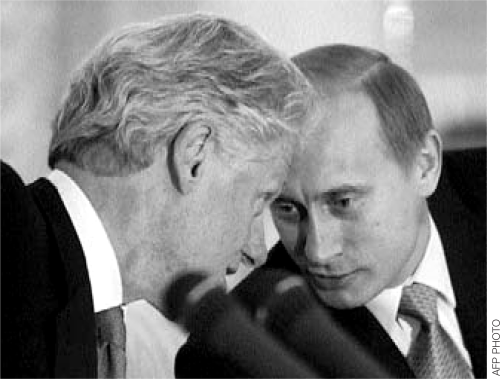
June 4, 2000: Presidents Clinton and Putin at the Kremlin.
Similarly, Russia is threatening to withdraw from several arms control agreements, including the Intermediate-range Nuclear Forces Treaty. Apparently officially inspired leaks in the Russian media have indicated that, if needed, the Soviet anti-satellite program successfully implemented in the 1970s and the 1980s could be easily restored and updated to thwart a U.S. national missile defense system. The bottom line is that Russia's integrated rocket force command would become an active player in any meaningful response to U.S. unilateral actions to undercut the ABM Treaty or withdraw from it.
On the other hand, if the deadlock is broken and a compromise solution found, most arrangements would involve a substantial positive role for the Strategic Rocket Force. This would possibly cover the joint development and deployment of an ABM system or boost phase interceptors, as suggested by some members of the U.S. Congress and some Russian officials; Russia's ideas about the global monitoring of missile and proliferation technologies; and other initiatives that both sides may come up with to clear the way for further reductions in strategic nuclear weapons. The most recent evidence is the U.S. Russian Memorandum of Agreement on establishing a Joint Center for the Exchange of Data from Early Warning Systems reached at the Moscow summit in June. That understanding will get the Strategic Rocket Force involved in close cooperation with its U.S. counterparts.
The Strategic Rocket Force—the most important and unique remnant of Russia's past as a Great Power—remains a tool to project power and influence. Under Russia's new political leadership, the force's expanded command is interacting—and will continue to interact—with its U.S. counterparts as negotiator, implementer of treaties, and important Cooperative Threat Reduction player. In April it actively lobbied for the ratification of START II and further drastic reductions under a START III treaty. If U.S.-Russian relations take a turn for the better and generate a momentum for new arms control and confidence-building agreements, Russia's Strategic Rocket Force command is well positioned to contribute to this process—in its own self-interest, and as the best option under the existing circumstances.