



Abstract

On April 28, the Alaska, the first of four Ohio-class nuclear submarines slated for a controversial missile system upgrade, sliced its way through the waters of Hood Canal on its way to the Puget Sound Naval Shipyard in Washington state. The sub was greeted by protesters objecting to the plan to modify four subs to carry Trident II (D-5) missiles, which are larger, more powerful, and more expensive than Trident Is. The Bangor Naval Submarine Base, the subs' home port, will also have to be modified. The protesters questioned the wisdom of starting a multi-billion dollar upgrade immediately after Russia's mid-April ratification of the start ii treaty. That treaty requires the United States to substantially shrink its warhead totals by 2007, and brings the logic of the upgrade into serious question.
April 28: Protesters flush “money” down a gold-painted toilet.

It's elementary
Brian Watson of the Ground Zero Center for Nonviolent Action, the anti-nuclear group leading the protest, said the issue is “simple mathematics” because the United States already possesses more nuclear warheads than the arms accord will allow. Even though the start ii deadline is seven years away, he said, the United States ought to be moving toward the treaty guidelines now.
The U.S. Navy already deploys more warheads aboard submarine-launched ballistic missiles (SLBMs) than will be allowed under start ii. The 24 Trident II missiles aboard each of the 10 Trident submarines stationed at Kings Bay, Georgia, carry up to eight W76 or W88 warheads each, for a total of 1,920 warheads. The eight submarines based at Bangor carry an additional 1,536 W76 warheads aboard 192 Trident I missiles, bringing the total to 3,456 warheads. Under START II, the United States would be required to reduce its total inventory of SLBM warheads to 2,160 by the end of 2003, and then to no more than 1,750 by the end of 2007, roughly half of current levels.
When the Bush administration signed START II in 1993, it planned to reduce the Trident fleet to just those 10 submarines carrying Trident IIs, but the number was raised to 14 after the Pentagon's 1994 “Nuclear Posture Review.” Current plans call for the four oldest subs, out of 18 total, to be decommissioned, with the Alaska, the Henry M. Jackson, the Alabama, and the Nevada set to receive D-5 upgrades.
But if the United States is ever to comply with START II, all the warheads scheduled to be installed in the four subs will have to be retired. And since the accord's obligations kick in on December 31, 2007, the deadline makes this missile system upgrade little more than an expensive warhead “rental.”
The price tag
How expensive? After purchasing the missiles themselves, the price tag will crack $9 billion. On the other hand, if the United States were to decommission eight subs instead of four—which would be in line with the 10-boat fleet proposed by the Bush administration—the navy would save more than $14 billion over the next 20 years, according to Bob Aldridge, a former Trident engineer.
Kevin Stephens, a Bangor Submarine Group public affairs officer, disagrees. He claims that the dollar figures associated with the upgrade are misleading. “Even though it's a big up-front cost, it will be cheaper over the long run to have one weapons system.”
He explained that all 10 vessels in the Kings Bay fleet are outfitted with the newer Trident II, while the Bangor-based Pacific fleet is home to eight vessels with the Trident I. Stephens said that having two separate missiles results in redundant purchases and added expenses.
“If you don't make the conversion, you're going to have to be training for two different sets of skills,” he added. “But when you have a commonality in the kinds of weapons systems, you can have commonality in terms of training.”
But do different training procedures really cost $9 billion? That is how much upgrading these four submarines will cost in the short term, and the cost of operating the ships instead of retiring them will inflate the bill further over the long term.
First, there's the $3.86 billion cost of modernizing the four subs to handle the larger missiles, an 18-month process for each. Then add another $462 million to refuel the subs' reactors, which will be done during the Trident II overhaul, and the cost comes to about $4.32 billion.
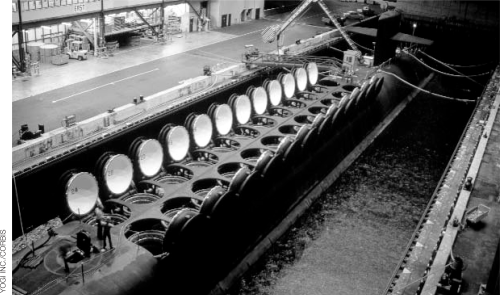
The Nevada, missile hatches open, at its home port in Bangor, Washington.
Then there's the $173 million needed to upgrade Bangor's facilities for the new weapons system—including funds for establishing a missile-processing capability at the Strategic Weapons Facility Pacific, outfitting a training program, and supporting construction projects. Not including shipyard costs, that puts the project at about $4.5 billion.
Now add the missiles
Most cost estimates that have appeared in the media—which have estimated the project at $5 billion based on the preceding numbers—don't include the missiles themselves.
Each Trident II missile costs $40.9 million, and the navy plans to purchase 106 of them by the end of 2005 for a cool $4.3 billion. That brings the total near the $9 billion level. And, as Aldridge is quick to point out, that doesn't include projects for which no costs have been specified.
Among those projects are extensive modifications and additions to five key buildings, which should boost the total upgrade cost substantially.
If the United States went with the Bush administration's initial plan to retire these subs, an additional $6 billion in operating costs could be saved over the next 20 years, Aldridge estimates. Cancelling the upgrade, he concludes, would not only help bring the United States in line with START II—it would save taxpayers a great deal of money.
Jobs, jobs, jobs
Usually when such a whopping expenditure is presented to the public, it's sold as an opportunity to create more jobs. That's particularly true in places like Kitsap County where the navy is the region's leading employer by a wide margin.
However, although the Trident II project may mean new, more complex work for existing employees at Puget Sound Naval Shipyard, it doesn't require new workers.
Instead, current shipyard personnel will stop their work deactivating submarines and will be charged with upgrading the four Tridents. Shipyard public affairs officer Mary Anne Mas-cianica admitted this when she said that the existing work force of about 7,850 employees will perform the upgrade largely on its own, taking minimal assistance from outside contract workers. The Trident II conversion, she said, “will not create additional jobs” at the shipyard.
Re-enter the activists
In addition to public demonstrations and leafletting actions, activists from Ground Zero have waged a fervent campaign against the upgrade, including acts of civil disobedience. In 1998 and 1999, groups of activists were arrested and charged for blocking roads into Bangor with their bodies. In both cases they were acquitted.
And it was the cost issue that prompted members of the group to demonstrate against the Alaska's arrival on April 28. But even if the upgrade didn't carry such a high cost, they say, long-term economic stability in the region shouldn't be based on the Trident system.
“We have to honestly assess the effectiveness of pouring billions of dollars into the defense budget every year. That's not the kind of product you want to base economic stability on,” Ground Zero's Watson said.
The Alaska demonstration was not as dramatic as other Ground Zero protests, where many individuals have risked arrest. Instead, the event focused on representing the issue visually with a paper maché replica of a missile, which activists hit with sticks until it “exploded” in a flurry of monopoly money. The group then “flushed” the money down a gold-painted toilet.
More demonstrations are planned, including attempts to block the trucks that will carry nuclear warheads into Bangor. The Kitsap County prosecuting attorney has already announced he will no longer pursue charges against the protesters because past juries appear unwilling to convict them.
Does Ground Zero expect to stop the upgrade?
“Realistically, no,” said activist Brian Sorensen. “I just want the word to get out that not everybody is following the lemmings off the cliff.”