




Abstract
On March 14, U.S. Secretary of State Madeleine Albright previewed President Clinton's trip to South Asia, which was to begin a few days later, by saying that the president would “seek to begin a new chapter in our relations” with India. Such bridge building was sorely needed. Albright quoted an unnamed Indian ambassador to the United States as having once said that Indo-U.S. ties during the Cold War exhibited “a pattern of misunderstanding, miscalculation, and missed opportunities.” He might have added “endless complexities.”
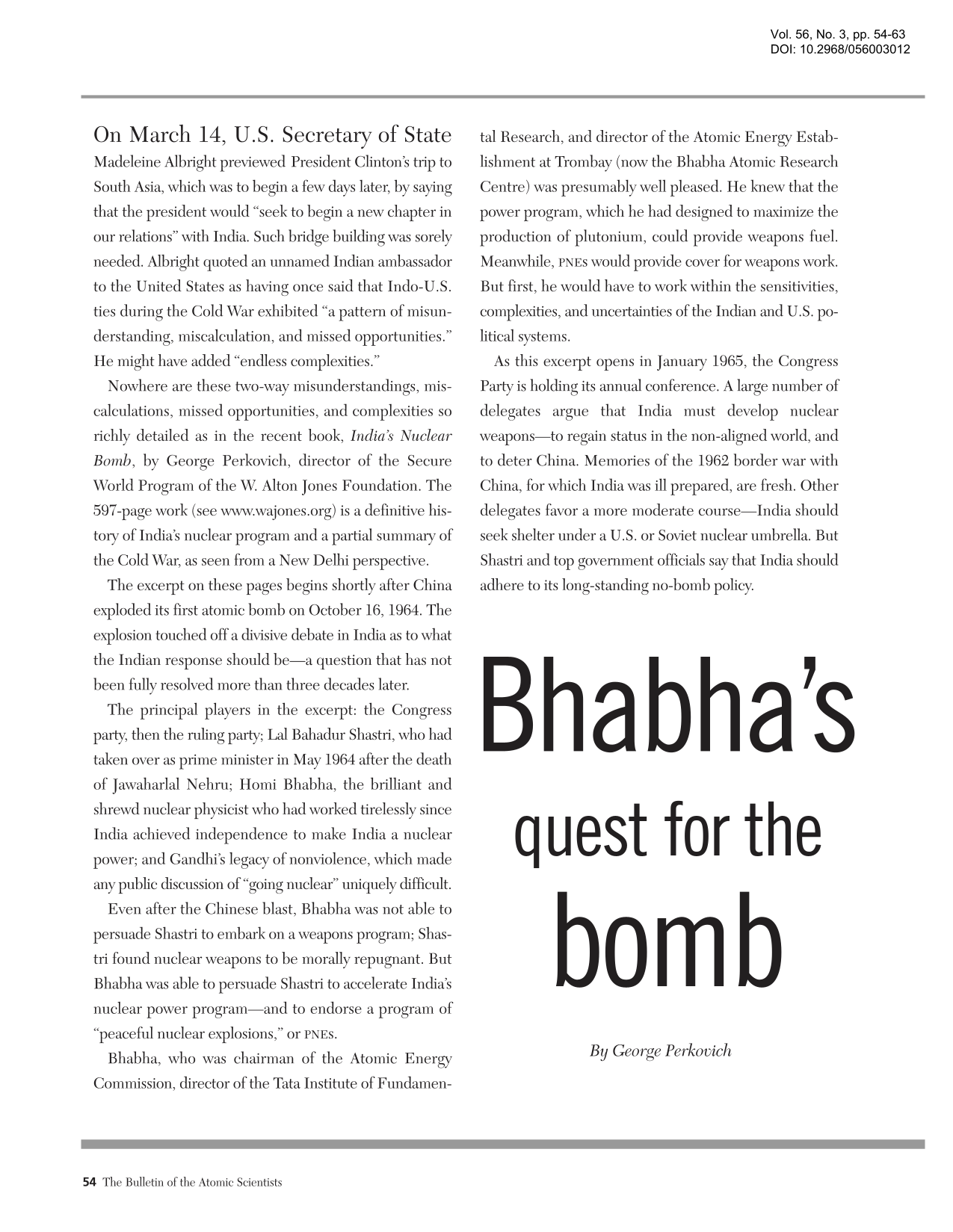
January 20, 1947: Prime Minister Jawaharlal Nehru and physicist Homi Bhabha at the inauguration of the Atomic Energy Establishment at Trombay, later renamed the Bhabha Atomic Research Centre.
Nowhere are these two-way misunderstandings, miscalculations, missed opportunities, and complexities so richly detailed as in the recent book, India's Nuclear Bomb, by George Perkovich, director of the Secure World Program of the W. Alton Jones Foundation. The 597-page work (see www.wajones.org) is a definitive history of India's nuclear program and a partial summary of the Cold War, as seen from a New Delhi perspective.
The excerpt on these pages begins shortly after China exploded its first atomic bomb on October 16, 1964. The explosion touched off a divisive debate in India as to what the Indian response should be—a question that has not been fully resolved more than three decades later.
The principal players in the excerpt: the Congress party, then the ruling party; Lal Bahadur Shastri, who had taken over as prime minister in May 1964 after the death of Jawaharlal Nehru; Homi Bhabha, the brilliant and shrewd nuclear physicist who had worked tirelessly since India achieved independence to make India a nuclear power; and Gandhi's legacy of nonviolence, which made any public discussion of “going nuclear” uniquely difficult.
Even after the Chinese blast, Bhabha was not able to persuade Shastri to embark on a weapons program; Shas-tri found nuclear weapons to be morally repugnant. But Bhabha was able to persuade Shastri to accelerate India's nuclear power program—and to endorse a program of “peaceful nuclear explosions,” or PNEs.
Bhabha, who was chairman of the Atomic Energy Commission, director of the Tata Institute of Fundamental Research, and director of the Atomic Energy Establishment at Trombay (now the Bhabha Atomic Research Centre) was presumably well pleased. He knew that the power program, which he had designed to maximize the production of plutonium, could provide weapons fuel. Meanwhile, PNEs would provide cover for weapons work. But first, he would have to work within the sensitivities, complexities, and uncertainties of the Indian and U.S. political systems.
As this excerpt opens in January 1965, the Congress Party is holding its annual conference. A large number of delegates argue that India must develop nuclear weapons—to regain status in the non-aligned world, and to deter China. Memories of the 1962 border war with China, for which India was ill prepared, are fresh. Other delegates favor a more moderate course—India should seek shelter under a U.S. or Soviet nuclear umbrella. But Shastri and top government officials say that India should adhere to its long-standing no-bomb policy.
The nuclear debate was intense. According to the Statesman, “Most of the members who took part in the debate objected to the views expressed in the official resolution [not to acquire nuclear weapons] and pleaded for India's entry into the nuclear camp either through direct manufacture of the atom bomb or by accepting the nuclear umbrella.” Bomb advocates argued that [Prime Minister] Shastri had been unable to persuade any other Asian or African nations to support a mission to Beijing to press China not to produce nuclear weapons and that none of these nations had condemned China's test.
How then could India rely on international measures to blunt China's nuclear program or possible aggression against India? Bibhuti Mishra, the general secretary of the Congress Parliamentary Party, argued that India's prestige had suffered following the 1962 war and was now plummeting further in the aftermath of China's nuclear test. If Indian leaders saw fit to increase overall defense spending to deal with China, he saw no reason not to extend the logic and produce nuclear weapons. Mishra added that the public wanted India not to lag behind China in nuclear capability and that if the government did not move accordingly, “the people will remove us from power.” K. C. Pant urged the formation of a committee to consider what India should do in light of the Chinese test.
A “peaceful” device
Shastri and those closest to him simply steamrollered their pro-bomb colleagues, powered by the authority of the highest office. According to the New York Times, “Each delegate who had proposed an amendment was asked publicly and individually to withdraw it. Most of those who were present did so. Those who failed to reply were regarded as having withdrawn.” As a result, Shastri managed to pass a resolution declaring that for “the present” India would restrict its nuclear program to peaceful purposes. “I do not know what may happen later, but our present policy is not to make an atom bomb and it is the right policy,” he said. The resolution emphasized that efforts should be “redoubled for the development of the peaceful use of atomic energy.” This formulation represented a compromise between those like Moraji Desai and Krishna Menon who categorically rejected India's acquisition of nuclear weapons and the outspoken delegates who urged a major shift toward manufacture of a deterrent. Though Desai's morally inspired stance did not reflect the majority of his party, he framed the issue in a way that highlighted the nation's predicament. According to the account in the Statesman, Desai said, “India … was now grappling with vital problems of providing food, clothing, and shelter to her needy millions. ‘How far is it sensible to divert the nation's already meager resources to the fruitless pursuit of making nuclear devices?’ he asked.” In a quintessentially Indian analysis, Desai added that he appreciated the logic of those arguing for Indian nuclear weapons, “But life is not logic and we are to consider the entire range of questions, both moral and practical.”
Lal Bahadur Shastri's new emphasis on speeding the development of nuclear energy for peaceful purposes gradually seemed to calm the opposition within the party and garner support in the press. The Hindu editorialized: “Nobody can seriously question the wisdom of the decision. We cannot, on moral and economic grounds, start making the atom bomb ourselves at this stage. And the prime minister was wise in leaving it at that and not committing the Government into abjuring the nuclear weapon for all time and under all circumstances.”
But as the Hindu and others noted, the “not for now” policy begged many questions. During a press conference on January 20, a journalist inquired whether anything should be made of the “ambiguity” in Shastri's statement. Shastri replied, “When I say for the present, the present is a very long period. It is not going to be a short one…. I cannot say anything as to what might happen in the distant future. So long as we are here, our policy is clear that we do not want that atom bombs should be manufactured in India.”
Behind the scenes, however, policy had changed. The Atomic Energy Establishment now had permission to begin theoretical preparations for a peaceful nuclear explosive. Homi Bha-bha and his colleagues busied themselves to that end. Most intriguingly, the effort was not confined to Indian territory or technology, despite India's determination to develop nuclear capability in a self-sufficient manner. Incomplete evidence indicates that Bha-bha may have sought an American nuclear explosive device or blueprints for one. Important American files covering U.S. interactions with the Indian Atomic Energy Commission in this period remain classified, but a handful of declassified documents, and the recollection of at least one American official serving at the time, suggest that Bha-bha made entreaties to receive a Plowshare device (a peaceful nuclear explosive) or blueprints in late 1964 and early 1965. This evidence is presented here with the important caveat that additional documentation is required to confirm the matter.
The evidence suggests that Bhabha tried to get a Plowshare device (a peaceful nuclear explosive) from the United States, or blueprints for one, in late 1964 to early 1965.
America's nuclear salesmen
By way of background it is important to record that the U.S. Atomic Energy Commission and officials in the State Department and the Pentagon at the behest of Secretary of State Dean Rusk were contemplating two independent, parallel alternatives to satisfy India's possible interest in acquiring nuclear capabilities to offset China's bomb. Existing evidence does not indicate that the officials involved in developing each of these alternatives knew about the other.
In 1964, the U.S. Atomic Energy Commission was stoking international enthusiasm for peaceful nuclear explosions (PNEs) for use on massive engineering projects such as canal excavations. The U.S. nuclear establishment saw PNEs as a potentially useful spinoff from the nuclear weapon program. The AEC hoped that nuclear explosives could be used to excavate a second Panama Canal and won significant congressional funding for the PNE program with this in mind. Internationally, the leaders of the U.S. nuclear establishment, such as AEC Chairman Glenn Seaborg, proposed that the United States conduct explosions at low cost for non-nuclear weapon states. This would protect against the proliferation risks that would otherwise be posed by nations independently producing their own nuclear explosives. Seaborg and his colleagues hoped that the international market for U.S.-conducted PNEs would boost the popularity of nuclear technology and augment the AEC's standing and budgets in the United States.
Desiring to help India offset the impact of China's nuclear test, the AEC in late November 1964 included Plowshare projects in their consideration of areas of potential cooperation with India. An AEC “discussion paper” noted that various U.S. agencies and the World Bank had expressed passive interest in “the role nuclear excavation projects might play in solving some of India's basic river problems.” The brainstorming paper suggested that the United States could undertake preliminary conversations with Bhabha on a joint U.S.-India evaluation of Plowshare applications, recognizing that any prospective cooperation would involve “U.S. devices, under sole U.S. control.” In a paragraph revealing faulty intelligence, the AEC wrote:
“There has been a great deal of speculation (due to remarks made by Dr. Bhabha) that India might elect [to] embark on Plowshare device development program as a “cover” and rationalization for a nuclear weapons program. This appears to be a highly remote possibility due to technical and economic considerations as well as the recent statements made by Mr. Shastri disavowing any intention on the part of the Indian Government to embark on a nuclear weapons program.” 1
Ironically, Shastri had announced his support of a PNE project in India (thereby enabling a “cover” for a bomb) the same week that the AEC discussion paper began circulating in Washington. The AEC paper concluded strangely that if the United States did conduct Plowshare detonations in India, “It could help deter India from embarking on an independent device development program of its own.”
A proposal to arm India
While the U.S. Atomic Energy Commission was contemplating providing Plowshares services to India, advisers to Secretary of State Dean Rusk had requested Assistant Secretary of Defense for International Security Affairs John McNaughton and his staff to study “the possibilities of providing nuclear weapons under U.S. custody” for use by “friendly Asian” military forces in the event that China threatened or attacked them. 2 McNaughton provided a preliminary version of the requested study to Deputy Under Secretary of State Llewellyn E. Thompson in the late fall of 1964, and Thompson forwarded it to Rusk on December 4. The study, which had not been cleared by Defense Secretary Robert McNamara, sought to give the United States means to counter the geopolitical and military gains China might otherwise win through its new nuclear weapon capability.
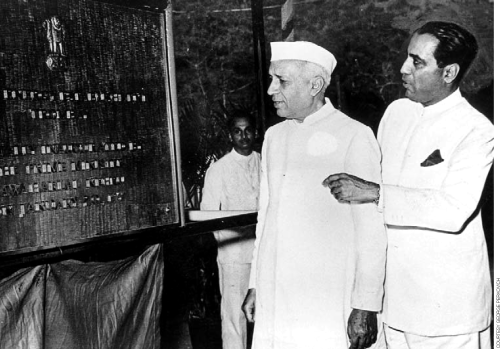
Prime Minister Atal Behari Vajpayee, Defense Minister George Fernandes, and Abdul Kalam, R. Chidambaram, Farooq Abdullah, and Bhairon Singh Shekhawat (left to right) celebrating the May 1998 nuclear tests at Pokhran.
The basic idea was to make arrangements for friendly Asian countries to receive and militarily deliver low-yield tactical nuclear weapons that the United States would provide to them in the event of Chinese aggression. The study contemplated making nuclear weapons available to Japan, India, Australia, New Zealand, the Philippines, the Republic of China (Taiwan), Pakistan, Thailand, and the Republic of Korea (South Korea). The authors noted that American personnel would have to train military units in the recipient countries to handle and deliver the weapons.
The study paid special attention to India. The authors estimated that India could produce and test a nuclear device “in one to three years after a decision to do so,” and could produce “by 1970 about a dozen weapons in the 20 kt [kiloton] range.” While noting that the balance of political opinion in India still inclined against the bomb, the study averred that the “chances are better than even that India will decide to develop nuclear weapons within the next few years.” The authors believed that American security assurances in the face of Chinese nuclear threats would not be adequate to stem other Asian countries' demands for “some national capability.” Thus, “the primary objective of a U.S. nuclear assistance offer to India would be to preclude an independent national nuclear development program.”
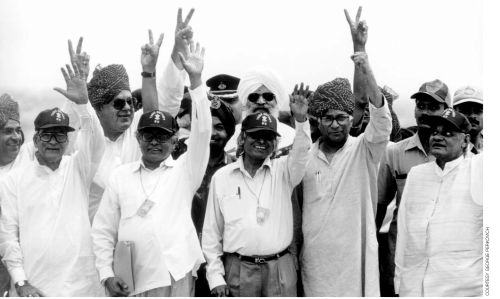
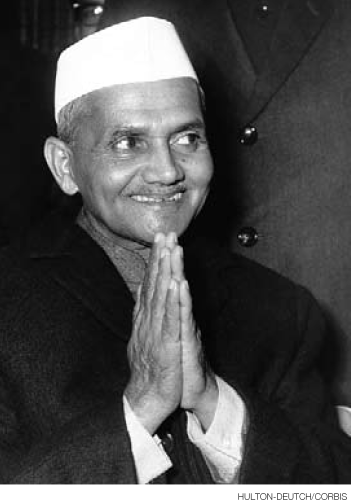
Indian Prime Minister Lal Bahadur Shastri argued against building a bomb.
Someone at the State Department asked Defense for a study on “the possibility of providing nuclear weapons under U.S. custody” for use by “friendly Asian” military forces.
The study recognized that providing nuclear weapons to India would complicate American relations with Pakistan. Thus the authors suggested that the offer to India “should be low key.” The United States would help India modify its fleet of Canberra bombers, train air crews, provide dummy weapons for exercises, and supply “weapons effects data for planning and necessary target data to support the feasibility and desirability of weapon use.” Washington would provide the same basic assistance to Pakistan, too, in part to offset that country's reaction to the proposed U.S. arrangement with India. The United States would not store nuclear weapons in either country but instead would develop facilities in each to handle weapons if and when they were needed.
Beyond reducing the proliferation incentives of China's neighbors, the Defense Department staff argued that the plan would give the “U.S. President … the option of allowing controlled use of nuclear weapons” against China, without running the more direct risks of escalation to a global conflict involving major U.S. forces. “It could assist in avoiding a direct confrontation between the United States and the [Soviet Union] in a Far East regional conflict.” This suggested a possible way to satisfy the desire to “use” nuclear weapons to deter or prosecute war on foreign soil while avoiding escalation that could lead to attacks on the U.S. homeland. Nuclear deterrence ultimately rests on the threat of massive devastation being visited on combatants' homelands, but the United States sought to escape this pitfall of deterrence by finding ways to contain nuclear exchanges to the foreign battlefield or theater level. This possibili-ty—as much as the aim of stemming proliferation in India and other states—motivated the Pentagon's approach to the problem.
However, the McNaughton staff study did not win higher approval over the subsequent months. Members of McNaughton's staff found the proposal highly problematic and prevailed upon their boss to bring the issue to Defense Secretary McNamara's concentrated attention, in hopes that Mc-Namara would reject the proposal and prevail upon its initiator, Secretary of State Rusk, to abandon it. The study also was contrary to the thrust of the Gilpatric Committee, which had been established by President Johnson at this time to determine what should be the U.S. approach to the proliferation challenge. Indeed, Rusk's response to Llewellyn Thompson's cover memo conveying the Pentagon staff study indicated that the secretary of state wanted the Gilpatric Committee to “consider possible exceptions to our policy of discouraging nuclear prolifer-ation.” 3 The Gilpatric Committee report concluded that the United States should try its utmost to stop the spread of nuclear weapons, precluding provision of American weapons to other countries. This approach also precluded the U.S. Atomic Energy Commission's proposal to provide peaceful nuclear explosives to India or other states.
Bhabha makes his move
Of course, Bhabha did not know about the Defense Department's top secret study, or the U.S. AEC's internal deliberations on providing Plowshares assistance to India. However, he pursued the Plowshare issue himself on January 19, 1965, when former presidential science adviser Jerome Wiesner (then president of MIT) visited Trombay. A declassified cable from the State Department to the American embassy in New Delhi, Karachi, and London reported that Dr. Wiesner's “mission should focus on two of our major objectives in our effort [to] influence Indian nuclear policy. First of these is to help India demonstrate that its scientific and technological capabilities are at least equal to those of Chicoms.” 4
The second objective was to reinforce Indian awareness of the “dangers and implications of proliferation” and evaluate the likelihood of India's “building and detonating a device to offset the Communist bomb.” The cable mentioned four types of cooperative projects: plutonium recycling, thorium recycling, training regarding peaceful uses of nuclear energy, and cooperation in space technology. The cable stated further that “we are interested in eliciting Indian ideas as to possible cooperative projects but wish to avoid reacting to them in manner which might suggest tentative acceptance.” No mention was made of the possibility of cooperation in studying or developing peaceful nuclear explosives. However, when Wiesner arrived in Bombay, Bhabha apparently broached the matter of American supply of a Plowshare device. On January 21 Wiesner, now back in New Delhi, left a report for John Palfrey, an AEC member who was arriving in India to attend the inauguration of the Trom-bay plutonium reprocessing plant. The report was also cabled to the secretary of state and the White House. In it, Wiesner recorded that “Bhabha is anxious to explore availability of Plowshare with you. He is interested in the possibility of making harbors and water reservoirs.” 5
Bhabha's apparent request, as relayed by Wiesner, elicited a quick cable back from the State Department to the AEC's John Palfrey in New Delhi. The department instructed Palfrey that “you may also, in your discretion, discuss generally Plowshare-type projects with Bhabha, bearing in mind limitations [in] this area with which you [are] fully familiar.” 6
Wiesner's report to Palfrey and the officials in Washington shed light on a number of other important issues. He concluded that the “main motivation to date” for those advocating an Indian bomb “is political, but there is also some desire for a deterrent against China and some vague feeling that if a nuclear minefield makes sense in Europe it could be useful on India-China border.” The alternatives being considered in the “violent debate” going on in India “range from taking all necessary steps just short of building a bomb, to the actual construction of both a bomb and a delivery system.”
Wiesner reported that Bhabha's October 24, 1964, statement about the low cost of a nuclear explosion had misled many in India, including the prime minister. This had prompted “many scientists” to complain to Shas-tri. Wiesner believed that Bhabha still underestimated the cost: “He told me that he could make and test a crude nuclear device for approximately $10 million.” Thus, Wiesner recommended a U.S. effort to give the Indians a better cost estimate. He continued:
“Bhabha is still saying that it would be possible to make a nuclear explosion in 18 months. Many of the scientists object to this optimistic figure and at least two have written to the Primin stating that it was too optimistic. Bha-bha apparently wants authority and resources to move forward without final decision regarding actual explosion. No one has estimated what a real weapon system would cost or understands what will be done with it.”
Wiesner's account of Bhabha's views and his critical evaluation of them illuminated the debate and decision-making process to come. According to former AEC Chairman Homi Sethna, there were only eight to 10 scientists and engineers working around Bhabha on nuclear explosives questions, while hundreds of others worked on less controversial matters. 7 This led to tensions within the scientific community that Wiesner detected. Yet there was no system of checking and balancing Bhabha, no open means by which scientists could inform political decision-makers of costs and benefits of particular policies. This lack of mechanisms for independently evaluating the AEC's claims and proposals would handicap India for decades.
The next available reference to Bha-bha's quest for American nuclear assistance appears in a memorandum of a conversation between Bhabha and Under Secretary of State George Ball on February 22, 1965. Bhabha was visiting Washington for talks on nuclear cooperation and requested the meeting with Ball. Bhabha steered the conversation to “the dilemma India faced regarding what to do to counteract the ‘noise’ of Communist China's nuclear explosion.” According to the official notes, Bhabha “explained that India needed to make some dramatic ‘peaceful’ achievement to offset the prestige gained by Communist China among Africans and Asians.” 8
Ball argued that the objective should be to persuade the major non-nuclear nations to forgo nuclear weapons. Bhabha countered that to do this “a way must be found so that a nation will gain as much by not going for nuclear weapons as it might by developing them.” Bhabha then turned the conversation to the relative nuclear capabilities of various nations, including China and India. “Dr. Bhabha explained that the Chinese were greatly indebted to the [Soviet Union] for helping them on their weapons program.” He emphasized that the Soviet Union must have “left the blueprints for a nuclear device with Communist China.”
Bhabha then dropped the bait in front of Ball. “Dr. Bhabha explained that if India went all out, it could produce a device in 18 months; with a U.S. blueprint it could do the job in six months.” To reinforce the logic of the tacit request, Bhabha reiterated how important the Soviet assistance had been in quickening China's capability. The logic of Bhabha's presentation, and the not-too-subtle mention of how an American blueprint would augment India's capacity, can fairly be interpreted as a backhanded request for an American blueprint or device. This interpretation is buttressed by Wiesner's earlier report that Bhabha asked about availability of a Plowshare device and by further evidence discussed below.
Bhabha closed the discussion by stating that India's plutonium separation plant was “quite large” and could in five years give India the capacity to “produce 100 nuclear bombs a year.” Nevertheless, Bhabha said, India retained its policy not to seek nuclear weapons. However, he added that “if his government is to justify this policy … ways must be found by which his country could gain at least as much by sticking to peaceful uses as it could by embarking on a weapons program.” In Bha-bha's view, production of peaceful nuclear explosives could be distinguished politically or legally from a weapons program. Yet, technically, a peaceful nuclear device could “gain” India as much as a weapon could.
“Apsara” was the first reactor designed and built by Indian scientists at the Bhabha Atomic Research Centre.
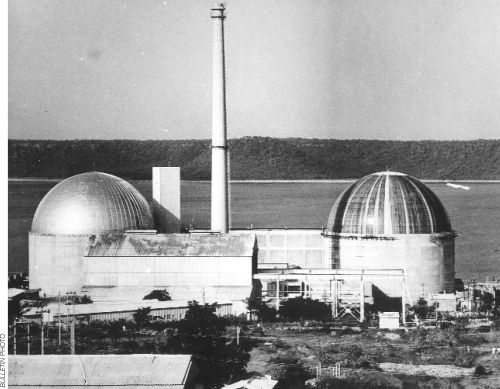
The Plowshare issue was also referenced in a long cable from the scientific attaché of the American embassy in New Delhi reporting on a visit by several American officials, including the aforementioned John Palfrey, to Trom-bay for the January 22, 1965, formal inauguration of the plutonium reprocessing plant. This report revealed interesting details of the Indian Atomic Energy Establishment. For example, it noted that the maintenance of apparatuses throughout the establishment “is very difficult since cases were mentioned where it took over a year to get needed replacements and supplies from abroad.” 9
The plutonium separation plant experienced surprises, according to the report. “While the plant was designed to handle 30 tons per year of rods, it is now felt it will handle at least five times this amount.” Less fortunately, the plant manager correctly told the American delegation, the plant “probably had experienced an explosion during operation but he did not realize it previously.” Overall, “the operation is currently wholly dependent on the availability and utilization of fittings and supplies from USA or elsewhere. In fact the plant is now down for a month or two awaiting foreign parts and supplies. While it has been claimed by some this is an all Indian design, an engineer pointed out that an American firm designed and provided the dissolving section among other things.” The report also mentioned that “from several sources Dr. Bhabha is said to favor the opportunity of proceeding to a point just short of the bomb…. Other influential scientists such as Dr. K. Chandrasekaran [a prominent mathematician at the Tata Institute] are very much against this proposal.”
With this general background, the embassy report concluded by referring to a prior discussion of an Indian request for a Plowshare nuclear device from the United States. Since the report was written almost two months after Wiesner's visit to Trombay, and after Bhabha's February visit to Washington, it appears to refer to discussions between January and March within the U.S. government regarding the possibility of providing India with a Plowshare device that India could then detonate as if it were indigenously made.
“The possibility of aiding India with something dramatic to give her status comparable with the Chinese bomb looks very difficult. Any country possessing something new would first use it themselves since everyone wants such status. By controlling newspaper releases the bulk of the population could be fooled by a Plowshare device, but all her neighbors would know and claim that India had not developed such a sophisticated device but obtained it elsewhere…. India's own capabilities for Plowshare and its applications are rather long term; furthermore India's scientific reputation would enjoy greater favor if some kind of non-nuclear work were exploited.”
The bulk of India's population might be “fooled by a Plowshare device,” but the neighbors would know India had not developed such a sophisticated device on its own.
Further hints of Bhabha's entreaty to the United States appeared in a letter that the Chairman of the U.S. AEC, Glenn Seaborg, drafted to Bhabha summarizing their February 1965 discussions of potential nuclear cooperation between the two countries. (This draft was not sent.) Seaborg noted that Bhabha had “indicated that it was conceivable that the U.S. Plowshare Program might be able to make an important contribution, in time, to the solution of some of India's basic engineering problems.” 10 In keeping with U.S. policy, Seaborg sought to limit the potential range of U.S. cooperation in this area to lectures and evaluation of how the technology could help India “solve some of its engineering problems.” He reminded Bhabha that the United States could not make a commitment to “proceed further on the matter” and stated that “political considerations” including “whatever implications the specific project involved had insofar as the Limited Test Ban Treaty is concerned” must be evaluated.
The tone of Seaborg's draft indicated that Bhabha had initiated the discussion and that the United States was mindful of the strict limitations that would be put on any U.S. provision of services or expertise in the area of nuclear explosives. Bhabha wanted a device or blueprints, or both, that could be used in India's own development of the technology, but American nuclear officials recognized the need to maintain strict U.S. controls on the technology.
Nonproliferation beats out PNEs
By April 1965, the U.S. Atomic Energy Commission had become even more conservative regarding cooperation in the peaceful nuclear explosions field. Between Bhabha's February visit to Washington and April, nonprolifer-ation became a great priority of American policy. All of this was revealed in a letter Seaborg wrote to the chairman of the U.S. Congress Joint Committee on Atomic Energy on April 30, 1965. The letter listed seven potential cooperative ventures between the United States and the Indian Atomic Energy Commission. While this was the number of areas suggested in Seaborg's unsent draft letter to Bhab-ha, all reference to cooperation regarding Plowshare devices was omitted in the April letter. Instead of Plowshare, Seaborg discussed, as Bhabha had inquired, “Whether we would be prepared to make a moderate amount of plutonium available for research and development.” 11 Bhab-ha's interest in receiving plutonium from the United States was curious, given the recent opening of the Indian plutonium separation plant at Trombay, but for the purposes of this discussion the omission of reference to Plowshare indicated Washington's sense that Bhabha's request had undesirable proliferation implications.
Recently declassified correspondence between Ambassador to India Chester Bowles and William J. Hand-ley, the deputy assistant secretary of state for Near Eastern and South Asian Affairs, illuminates the matter further. Bowles wrote Handley on April 12 asking for more extensive updating from Washington, specifically regarding nuclear cooperation: “Right now we haven't the slightest idea whatever happened to our proposals to deal with India's nuclear dilemma which was so much the subject of discussion late last fall. After getting Jerry Wiesner and Jack Palfrey to India and generating what we thought was a good deal of constructive effort, the problem has dropped from sight.” 12
The response to Bowles's query came nearly a month later. It began by lamenting that Bowles's job in New Delhi had been complicated by the postponement of a visit Prime Minister Shastri was scheduled to make to Washington in June 1965 and by the U.S. decision not to supply F-5 aircraft to India, due to the Rann of Kutch incident. Turning to the nuclear question, Handley stated that the department was finally able “to dislodge the Palfrey to Bhabha letter on scientific cooperation.” 13 (This letter appears to have been based on Seaborg's earlier draft discussed above.) Handley wrote that the letter “had been stuck because of a major controversy in Washington over Ploughshare. As it came out, the Ploughshare portion of the letter was a casualty: this was the only way we could get the letter to move.” Clearly there had been a bureaucratic struggle over Plowshare, and even a rather minimal expert dialogue on the subject was ruled out. In any case, all of the cited documents suggest that Bhabha had in mind something more ambitious: supply of a nuclear explosive or blueprints for one.
The Indian military apparently was thinking similarly to Bhabha regarding assistance from the West. In a secret December 1964 paper on “The Indian Problem,” an Arms Control and Disarmament Agency official, Henry S. Rowen, wrote that “an Indian military study is reported to have concluded that India cannot afford a nuclear program, and that even if it had these weapons, they would be useless because of the lack of delivery means against China.” 14 According to Rowen, the study concluded “that India should seek an arrangement with the West involving the commitment of Western nuclear support. This arrangement would involve concentrating on a delivery capability and ‘know how’ for the use of nuclear weapons.”
Assuming that Rowen accurately reflected the Indian military view, several interesting conclusions can be drawn. First, the military backed Shas-tri and others who resisted political pressures to manufacture nuclear weapons, although relatively little was made of this in debate. Second, whether or not Bhabha was aware of the military's recommendation, his apparent entreaty for U.S. assistance in procuring a nuclear explosive device or blueprints was consistent with the military's preference for Western help, even if the military preferred more generic assistance than Bhabha had in mind. Third, the Indian military, unlike the powerful political class, cared less for nonalignment than for practical assistance in balancing China's power. In any case, the military did not enjoy significant influence in the policy-making process.
Bhabha's apparent effort to gain U.S. assistance in acquiring nuclear explosives had important implications. It reaffirmed the baselessness of his and Nehru's earlier claims that India could produce a nuclear weapon in “one year,” or “18 months,” or “two to three years.” Bhabha and his colleagues appeared to lack the design knowledge and the technology required even to make an informed estimate of the cost and time required for India to produce a device. Despite the frequent claims of the nuclear program's self-sufficiency, it was highly dependent on information and technology from abroad. At the same time, neither Nehru, Shastri, nor others debating nuclear policy had the expertise required to question or scrutinize Bhabha's claims. The secrecy and autonomy of the nuclear establishment and the lack of qualified scientific expertise outside the establishment badly impaired the policy-making process. Yet, Bhabha found himself on the spot once Prime Minister Shastri approved the request to begin preparations for a peaceful nuclear explosive. To avoid having the entire nuclear program fall into disrepute for failing to deliver a nuclear explosive capability in a short time, Bhabha would have welcomed an important boost from the United States in the form of a Plowshare device or a design for one.
One former colleague suggested in an interview that the Western-accul-turated Bhabha may have also wanted to link India politically and strategically to the West. Given Bhabha's autonomy and Shastri's own leanings, it can be speculated that Bhabha would not have informed Shastri or other political leaders of his approach to the United States. Indeed, U.S. officials in briefing Under Secretary of State Ball indicated that Shastri had excluded Bhabha “from certain high level [government of India] discussions of nuclear policy matters.” 15
The conflict with Indian policy
Bhabha's quiet quest for U.S. help in nuclear explosive acquisition did not comport with India's overall policy line, much as the nuclear-weapon-sharing idea of Secretary of State Rusk and Defense Department officials did not fit the evolving U.S. policy. However, both approaches—now that they are visible—shed historical light on the boxes in which Indian and American officials operated. (Additional relevant documents remain to be declassified.)
Bhabha's maneuverability was limited by his desire to minimize awareness of the time required for his team to build an explosive device. More important, American assistance in such a sensitive area would have badly weakened the credibility and moral-political essence of India's nonalignment policy. Bhabha or others could have argued that this actually would have served India's national interest, but the issue was not open for real questioning. Even if Indian leaders had been willing to reconsider nonalignment, they then would have confronted the U.S. government's determination to maintain control over whatever nuclear explosive capability might be “shared” with developing countries.
Halfway around the world, the small number of American officials who contemplated providing nuclear weapons to India in extremis also were thinking creatively against the grain. However, they, too, did not adequately comprehend either the internal or the Indian resistance to their ideas. The Americans overestimated the priority Indian political leaders put on nuclear questions relative to more pressing domestic challenges. They badly underestimated the degree to which national pride and nonalignment would have made India's elected leaders reject prearrangements for the supply of American nuclear weapons. India's moral disdain for countries engaged in nuclear arms racing would have made it politically awkward to prepare in peacetime for provision of the same weapons that had been condemned. (In the event of war with China, the calculation would have changed, but then it likely would have been too late to prepare Indian forces to receive and effectively use American nuclear weapons.) While some American officials and Bhabha could think of ways to effect a wary nuclear embrace between the United States and India, broader considerations were driving the two states apart.
The United States provided India neither assistance in designing or producing a nuclear explosive device nor the promise of American nuclear weapons “on account.” Although American officials, particularly in India, recognized the need for strengthening Shas-tri's position in order to reduce demand for the bomb, Washington would not offer decisive support.
In sum, the United States rebuffed India's dual efforts—for guarantees or technical assistance—to seek international help in countering China's gains in prestige and potential political and military power. Instead, the United States launched a drive to draft and negotiate a nonproliferation treaty. India would be the primary target of this campaign, but it remained unclear how the effort to stop the further spread of nuclear weapons would solve the problem that China's nuclear weapons posed for India, militarily and politically. India would be left to its own devices.
Footnotes
1.
U.S. Atomic Energy Commission, “Discussion Paper on Prospects of Intensifying Peaceful Atomic Cooperation with India,” forwarded to Amb. Llewellyn E. Thompson, November 23, 1964, Freedom of Information Act (FOIA) files, India, National Security Archive, Washington, D.C.
2.
Deputy Under Secretary of State Llewellyn E. Thompson to Secretary of State Dean Rusk, memorandum, “Review of Non-Proliferation Policy,” December 4, 1964, p. 1, cover attachment to Defense Department staff study, “U.S. Nuclear Assistance to Pacific-Asian Countries,” Nuclear Non-Proliferation Policy, FOIA files, National Security Archive, Washington, D.C.
3.
Ibid.
4.
State Department to U.S. Embassies in New Delhi, Karachi, and London, January 12, 1965, p. 1.
5.
Dr. Wiesner, U.S. Embassy (New Delhi) to Secretary of State, cable no. 2054, January 21, 1965, p. 2, FOIA files, India, National Security Archive, Washington, D.C.
6.
State Department to John Palfrey at U.S. Embassy (New Delhi), cable, January 21, 1965, in Virginia Foran, ed., U.S. Nuclear Non-Proliferation Policy, 1945-1990, no. 01100 (Washington, D.C.: National Security Archive, 1992). This cable also noted that the U.S. intelligence community believed that “expenditures for a modest weapons program (up to testing the first device) would total no more than $30-40 million” and that “given present facilities, believe India could produce and test first nuclear device one to three years after decision to do so.”
7.
Sethna, interview with author, February 26, 1997, Mumbai.
8.
U.S. Department of State, memorandum of conversation, February 22, 1965, p. 1, in Foran, U.S. Nuclear Non-Proliferation Policy 1945-1991, no. 01108. Participating in the conversation were B. K. Nehru, ambassador of India, Homi Bhabha, secretary of the Department of Atomic Energy, India; George Ball, under secretary of state; Robert Anderson; and David T. Schneider.
9.
Donald Fuller, scientific attaché, U.S. Embassy (New Delhi) to Department of State, airgram no. A-964, “Trombay and Atomic Energy in India,” March 16, 1965, p. 6, Nuclear Non-Proliferation Policy, FOIA files, India, National Security Archive, Washington, D.C.
10.
The draft of the letter was appended to a memorandum from Llewellyn E. Thompson, acting deputy under secretary of state, to members of the Committee on Nuclear Non-Proliferation, “Progress Report and Minutes of the Tenth Meeting of the Committee,” March 29, 1965, Nuclear Non-Proliferation Policy, FOIA files, India, National Security Archive, Washington, D.C.
11.
Atomic Energy Commission Chairman Glenn Seaborg to Joint Committee on Atomic Energy Chairman Chet Holifield, correspondence, April 30, 1965, Joint Committee on Atomic Energy files, International Affairs, India, National Archives.
12.
Ambassador Chester Bowles to William J. Handley, correspondence, April 12, 1965, p. 1, Nuclear Non-Proliferation Policy, FOIA files, India, National Security Archive, Washington, D.C.
13.
William J. Handley to Ambassador Chester Bowles, correspondence, May 7, 1965, p. 1, Nuclear Non-Proliferation Policy, FOIA files, India, National Security Archive, Washington, D.C.
14.
Henry S. Rowen, “The Indian Nuclear Program,” Department of Defense, background paper, pp. 3-4. The referenced Indian military study was not made public in India.
15.
Briefing memorandum from Phillips Talbot to Ball, regarding February 22 meeting with Dr. Homi Bhabha, February 20, 1965, p. 1, FOIA files, India, National Security Archive, Washington, D.C.