




Abstract

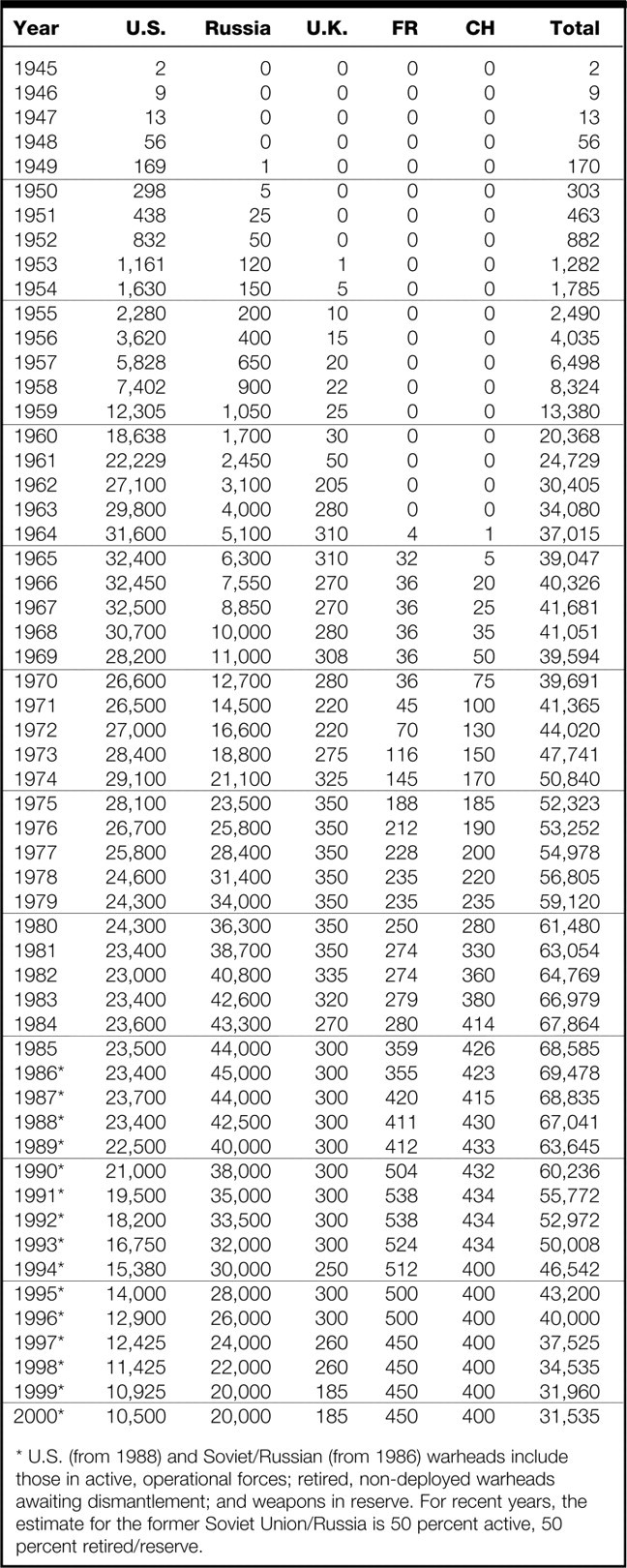
U.S. (from 1988) and Soviet/Russian (from 1986) warheads include those in active, operational forces; retired, non-deployed warheads awaiting dismantlement; and weapons in reserve. For recent years, the estimate for the former Soviet Union/Russia is 50 percent active, 50 percent retired/reserve.
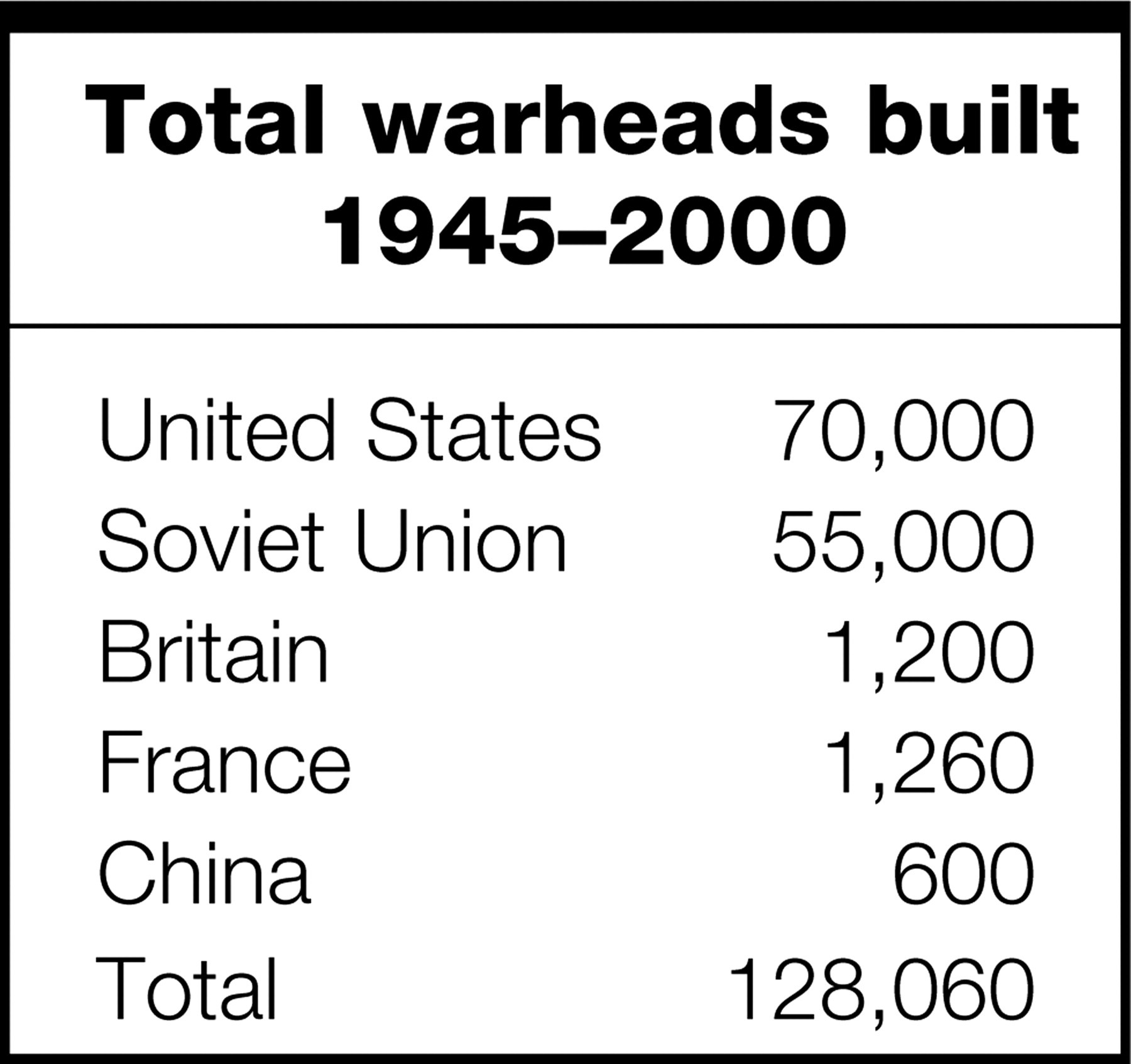
The five acknowledged nuclear powers still possess more than 30,000 nuclear weapons. (Three other countries–Israel, India, and Pakistan–possess an unknown number of nuclear weapons.) The table provides estimates of each country's stockpile by year. We estimate that more than 128,000 nuclear weapons have been built. Global stockpiles peaked in 1986 at nearly 70,000 warheads. Ninety-eight percent of the world's nuclear weapons were produced by the United States (55 percent) and the Soviet Union/Russia (43 percent). As more information becomes available, these figures may be refined. (Only the U.S. numbers for 1945-1961 and 1986 are official.)
Total warheads built 1945-2000
The U.S. stockpile is divided into four categories–active, “hedge” (or augmentation), inactive reserve, and retired (awaiting dismantlement). By the end of 2000, the dismantlement work at Pantex will be almost complete, leaving approximately 10,500 weapons in the active, inactive reserve, and hedge categories.
Much more information is needed to determine the composition and categories of the Soviet/Russian stockpile. It is unclear, for example, what then-Atomic Energy Minister Victor Mikhailov meant in 1993 when he said that the Soviet stockpile had peaked in 1986 at 45,000 warheads. This figure could include active, inactive, and retired warheads, which would mean that some very old warheads had been retained–and counted–long after the weapon systems for which they were built were withdrawn from operational service.
In the United States before 1990 the “retired” category was a limited and temporary designation, because obsolete warheads were routinely dismantled and their nuclear material reused in new warheads. The stockpile's turnover rate was fast, with several new generations of weapons systems having been introduced since 1945. As a result, the same highly enriched uranium and/or plutonium may have ended up in a bomb in the 1950s, in an ICBM warhead in the 1960s and 1970s, and in a cruise missile warhead in the 1980s.
The Soviet Union does not appear to have had a comparable modus operandi. There seems to have been little recycling of fissile material, and the weapons program lacked efficiency and accountability. If more plutonium or highly enriched uranium was needed, more was produced.