




Abstract

Bergen, Norway–In April 1998, I broke the story about how an American radar named HAVE STARE with a potential missile defense application was coming to Norway. My series of stories did not create an uproar. Norwegians are not easily excited over national security issues now that the Cold War has ended. But the articles surely produced some degree of official consternation and confusion.
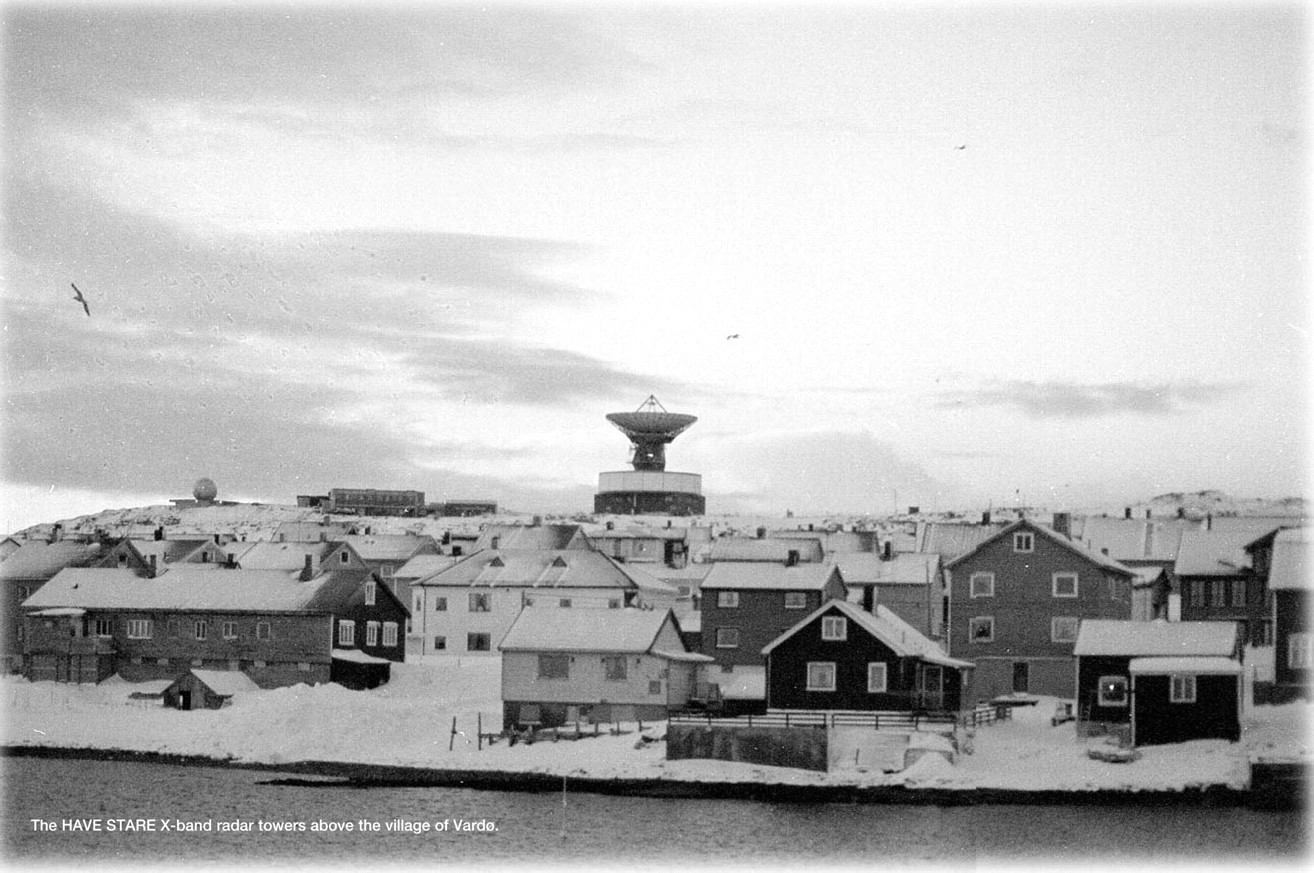
The HAVE STARE X-band radar towers above the village of Vardø.
On March 24, 1998, the Norwegian Defense High Command issued a press release stating that Norway was establishing a new radar called Globus II in Vardø. The radar would monitor and catalogue space objects, both active satellites and so-called “space debris.” The radar would also strengthen the “Norwegian intelligence agency's capacity to observe our areas of national interest.”
The Oslo newspaper Aftenposten carried an article based on the press release. It profiled Globus II as a “space junk” radar and had a NASA illustration showing earth's space debris environment. I worked for a newspaper based in Bergen, Norway's “second city,” and I was curious.
Naïvely believing that NASA was somehow involved in the effort, I contacted Nicholas Johnson, the head of the NASA Space Debris office at Johnson Space Center in Houston. He had not heard of any new Norwegian space debris radar. Perhaps, I thought, the press release was not the whole story.
Since the 1960s, Norway has operated an intelligence radar called Globus in Vardø in cooperation with the U.S. Air Force, monitoring Russian submarine-and ground-launched missile tests. Could Globus II be in this tradition?
The press release said that Globus II represented a cooperative effort between the Norwegian Military Intelligence Agency and the U.S. Air Force Space Command, but did not identify the radar as an American machine.
However, the project had been described in the March 1998 issue of Forsvarets Forum, the official Norwegian defense magazine. The article said the radar was currently located at Van-denberg Air Force Base in California.
Internet research on Vandenberg eventually led me to a page on the website of the Federation of American Scientists (FAS), which described a radar called HAVE STARE. The radar, according to the FAS page, had been transferred from the intelligence budget to the Air Force Spacetrack program in fiscal 1993 and was to be deployed at a classified overseas location.
I contacted John Pike, director of the Space Policy Project at FAS, and asked if Globus II could be HAVE STARE. Pike advised me to contact the Globus II project leader, Tom Rykken, and ask him if he could give me the technical designation for Globus II.
During the Cold War, it would have been impossible to get this kind of information. But Rykken provided it–AN/FPS-129. Pike said he was now persuaded that HAVE STARE and Globus II were probably identical. The radar had been installed at Vandenberg Air Force Base in California where it had been used in the test program for the proposed U.S. National Missile Defense (NMD) program.
“I am surprised that HAVE STARE is to be deployed in Norway,” Pike said. “Since the radar is mentioned in NMD plans, I anticipated that it would go to Misawa, Japan. There it would be useful for getting a close look at North Korean ICBMs launched toward the United States, one of the fears motivating the missile defense program.”
Pike added that the Norwegian description of the radar project was a “thin cover story.” While he had no doubts that Globus II would engage in some tracking of debris, “there is no way HAVE STARE would be moving to Norway if debris tracking were its only or even its primary function.”
In addition to tracking objects in space, said Pike, the radar could probably observe missile test launches from submarines in the Barents Sea as well as ground-based test launches from Plesetsk, Russia's main missile test facility. A further possibility:
“The U.S. Air Force and missile defense communities believe the aurora provides a simulation of an environment disturbed by a high-altitude nuclear explosion. The military planners fear that such an explosion might precede a missile attack. To use the radar in auroral measurement tests, objects will have to be released from sounding rockets or satellites.”
Strictly Norwegian
When I called Tom Rykken again, he confirmed that the radar was called HAVE STARE and that it was coming from Vandenberg. He insisted, however, that the tests at Vandenberg “had a completely different application” than the function the radar would have in Norway. “National Missile Defense is an American effort and does not include Norwegian areas. The radar will have no such function in Norway.”
“There is no way this radar would be moving to Norway if debris tracking were its only or even its primary function.”
The main purpose of the Globus II project, he added, was just “as we have described in our press release. The project has gone through a national decision process which builds on this description. Globus II will enhance the ability of Norwegian military intelligence to monitor its geographical area of interest and the main function of the radar is to monitor objects in space. Have stare is coming to Norway on these conditions and is subjected to full Norwegian national control from day one.”
But why, I asked, do you call the radar Globus II when its real name is have stare?
“Globus is a name we have used for radars in Vardø for a long time. What the radar is called elsewhere in the world is of no interest to us. It moves to Norway and we mean that Norway is entitled to call the radar whatever we like. We are a sovereign nation and we are not obliged to adopt an American name.”
The book Top Secret, an authorized history of Norway's intelligence service, says the Globus station in Vardø–up to 1970 when the book ends–was part of a project to monitor Russian sea-launched ballistic missile tests. Is that also the purpose of Globus II?
“I have no comment.”
Is it a continuation of Globus I?
“It is not correct to use the expression ‘continuation.’ However, we are doing an update technologically speaking. The fact that we use the name Globus does not mean that different radars by this name have anything to do with each other.”
Can the new radar do auroral measurements?
“That is not within the use areas we have envisioned. However, the Norwegian Defense and Research Establishment is running a parallel project to make sure the radar is applied in such a way in Norway that we get the best out of it.”
Why did you not say in the press release that the radar was American?
“This is no big revelation. In an article in the Norwegian defense magazine we wrote that the radar presently is located at Vandenberg. That is all there is to say. To us it is a Norwegian project.”
Nothing to hide
Parliament was in Easter recess when my page-one story appeared in the April 4, 1998 edition of Bergens Tidende. Nevertheless, it raised some eyebrows among the members. Socialist parliamentary party leader Erik Solheim, for instance, told me that he would ask “why full and confident information about the radar” had not been presented in Parliament.
But Hans J. Rosjorde, chairman of the Parliament's Defense Committee, told me that both Parliament and the Defense Committee had been properly informed.
However, Rosjorde confirmed that the name of the radar–HAVE STARE–had not been mentioned in the committee's briefing. “That has to do with what I will call the heritage of Globus I and is more site-related than function related.”
Did you know, I asked, that the radar had participated in national missile defense tests?
“I was not aware of that in detail, but I would like to add that there is considerable interest both in the United States and in Russia for creating a worldwide defense against so-called loose missiles carrying chemical, bacteriological, or nuclear warheads.”
Can the radar have a missile defense function?
“That depends on which systems will make use of the radar and where it is located in relation to potential threats. I will not exclude that the radar can have a missile defense function. However, the U.S. defense authorities have not mentioned any wish in that direction.”
Why did the Norwegian defense ministry not state that the radar is American?
“In retrospect, one always can present more details. My comment in this case is: Much of the material used for these purposes has been, is, and will remain American.”
Are you surprised that there is discussion about the radar?
“Actually, we expected a discussion when the press release was issued. We were kind of surprised that no one objected. Now when the discussion starts, we have nothing to fear–or hide. This project is totally under Norwegian national control.”
Deception
On May 5, 1998, I ran a story concerning Einar Hanssen, a retired intelligence agency official, who claimed that the Norwegian intelligence agency had been deceiving Norwegian political authorities for 30 years by saying that the original Globus radar was serving national purposes.
“The radar has been collecting data about Russian missile launches which is of interest only to the United States,” Hanssen said. He served in the Norwegian Intelligence Agency for 40 years, 30 years in the electronic intelligence division and in the last eight years before his 1995 retirement as head of the electronic intelligence operational division. According to Hans-sen, the United States initiated the HAVE STARE project in the late 1980s as an update to the old Globus radar.
“When the Cold War ended, the United States lost interest in the old Globus radar,” Hanssen said. “The Russian threat was significantly reduced and there was no longer need for a U.S. intelligence radar in Vardø. The Americans told their Norwegian partners that they would no longer pay for the maintenance of the radar and asked for a substantial yearly sum from Norway if the radar should continue to operate.”
At the same time the U.S. Congress removed the HAVE STARE project from the intelligence budget.
“Now,” said Hanssen, “the HAVE STARE project is reintroduced with the Norwegian name Globus II and seems to have an operational function in connection with the proposed U.S. missile defense.
“In the information about the project, I recognize the distorted picture of the Globus I radar presented to the authorities. The intelligence agency uses the classic argument that the radar is under full Norwegian control. Once again the phrase about strengthening of Norwegian intelligence gathering capacity is repeated.”
Top of the heap
On May 6, after Parliament had reconvened, a Socialist member, Hallgeir Langeland, questioned Dag Jostein Fjarvoll, the Norwegian Secretary of Defense, about Globus II.
Fjarvoll said that Globus II was now at an American air force base and that it would be taken apart and sent to Norway. It would be manned by Norwegian personnel and only Norwegian personnel would have access to data in “real time.”
“There is in other words no coupling between Globus II and the American air force in ‘real time.’ The radar can therefore not contribute to the U.S. missile defense. This has been neither a Norwegian nor an American precondition for establishing the radar system in Norway.”
After he answered questions in Parliament, I asked Fjarvoll a more pointed series of questions about Globus II. He repeatedly denied that the new radar would have any connection with the U.S. national missile defense program.
Finally, I asked: “The official purpose of the radar in Vardø will be to monitor space objects? Why is this important to Norway?”
“We are a top space nation,” he answered. “No one is better than Norway in space technology at the moment.”