




Abstract

An Iraqi tank burns during the Gulf War.
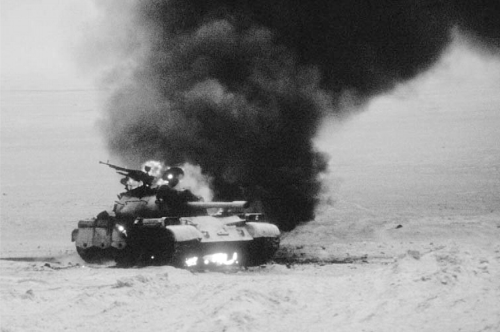
The NATO air war against Yugoslavia last spring led to fresh outcries about the use of depleted uranium (DU) munitions, long a controversial practice.
It “adds a new dimension to the crime NATO is perpetrating against the Yugoslav people–including those in Kosovo,” said a spokesman for the International Action Center early in the war. Another spokesperson predicted that DU “threatens to make a nuclear wasteland of Kosovo.”
Their outrage echoed years of anger and dismay regarding the use of depleted uranium in the Gulf War. In particular, some have suggested that depleted uranium contributed to “Gulf War Syndrome,” an array of chronic illnesses that have apparently affected tens of thousands of U.S. soldiers. Further, say critics such as the Action Center, a leader in the anti-DU movement, depleted uranium has had terrible consequences in southern Iraq, where much of the depleted uranium was ex-pended–causing an increase in stillbirths, birth defects, childhood leukemia, and other cancers.
In contrast, government contractors and the army itself have issued a series of reports and studies suggesting that depleted uranium represents no real threat to health and safety.
We have surveyed publicly available studies and employed our own calculations in an attempt to put the controversy into perspective. Our conclusions: The health risks associated with radiation from exposures to depleted uranium are relatively low–so low as to be statistically undetectable, with one exception: Radiation doses for soldiers with embedded fragments of depleted uranium may be troublesome.
Apart from radiation, however, the risks related to the heavy-metal toxicity of uranium inhaled and ingested by soldiers in direct and unprotected contact with vehicles struck with DU munitions could be significant. Primarily at risk are those who were in vehicles when they were struck, or their rescuers, as well as those who worked for extended periods in cleanup efforts inside the vehicles without adequate respiratory protection.
Unfortunately, despite army regulations, no timely measurements of actual quantities of uranium inhaled or ingested by any U.S. soldiers appear to have been made.
Du in the Gulf War
The principal DU munitions used in the Gulf War were tank-fired shells containing 4- or 5-kilogram DU penetrator rods and 30-millimeter rounds (each with a 0.3-kilogram du penetrator) fired by the A-10 “Warthog,” a “tank killing” aircraft later used over Kosovo.
About 4,000 large-caliber rounds and about 800,000 small-caliber rounds were fired. An additional 10,000 large rounds were used in practice in Saudi Arabia or destroyed in accidents–including a fire at Dohoa, Saudi Arabia. In all, about 300 tons of depleted uranium were scattered in southern Iraq, Kuwait, and Saudi Arabia.
Uranium is used in anti-tank weapons partly because of its high density, which is almost twice that of lead. Du rods traveling almost a mile a second have great penetrating power. Because of its metallurgical properties, depleted uranium is more penetrating than tungsten, which is equally dense. In addition, when it strikes a hard target it forms small particles that burn in air.
Natural uranium would work just as well. But large quantities of depleted uranium are available as a waste product from decades of uranium enrichment.
Depleted uranium differs from natural uranium only in that most of the chain-reacting uranium 235 has been removed to make nuclear weapons and reactor fuel. The percentage of non-chain-reacting uranium 238 rises from 99.3 in natural uranium to about 99.8 percent in depleted uranium.
Radiation effects
Uranium 238 has a half-life of 4.5 billion years, which means that depleted uranium is roughly 200,000 times less radioactive than plutonium 239, the most important plutonium isotope. It follows that very prolonged exposure to high concentrations of depleted uranium is required to give radiation doses significantly above background.
Pieces and particles of depleted uranium lying about would be sources of most of the external radiation dose, which would come primarily from penetrating gamma rays. Inhalation of DU-contaminated dust–either directly or after resuspension–would be the source of most of the internal dose, which would be primarily from very short-range alpha particles.
A souvenir hunter who picked up a piece of a depleted uranium penetrator rod (the core of large DU munitions) and carried it in his pocket for a few days would also receive a relatively high dose of short-range beta radiation to the skin adjacent to the souvenir. But it would not be enough to cause a burn–much less a significantly elevated risk of skin cancer.
To obtain an estimate of possible external gamma-radiation levels on the battlefield, we assumed that 100 tons of depleted uranium had been distributed uniformly over a one-kilometer-wide strip along 100 kilometers (62 miles) of the “Highway of Death” between Kuwait City and Basra, a city in southern Iraq.
The average dose for someone who lived in the area for a year would be about one millirem–or about 10 percent of the dose from uranium and its decay products already naturally occurring in the soil. The dose rate immediately around a destroyed vehicle could be about 30 times higher. But even that higher figure would only add about 10 percent to the natural background radiation.
For perspective, the driver of a tank equipped with DU munitions would get dose rates up to five times natural background dose, corresponding to a doubling of the background dose if the driver spent 40 hours per week in the tank all year.
Internal radiation doses could be higher. Depending on the nature of the impact, a significant fraction of a DU penetrator can burn, oxidizing into an inhalable aerosol. If we assume that 20 percent of the depleted uranium burns, a reasonable estimate based on army tests, the impact of a heavy DU penetrator might generate a kilogram of uranium oxide aerosol.
For soldiers outside struck vehicles, the aerosol inhaled in the minutes immediately after a vehicle was struck by DU munitions would be greatly reduced by the fact that the kinetic energy was turned into heat by the impact. For a heavy penetrator, the released energy would be equivalent to the explosion of as much as a kilogram of TNT, lifting the aerosol upward on a column of hot air. Because of this vertical dilution, the amount of depleted uranium inhaled by a nearby person would probably not exceed 0.1 milligrams. The dose to a person a mile away directly downwind would be about ten times less.
The main cancer risk from inhaled depleted uranium would be from tiny insoluble particles lodged deep within the lungs. According to the inhalation-retention model constructed by the International Commission on Radiation Protection, 15 percent of an insoluble inhaled uranium oxide aerosol could be retained in the lungs for more than a year.
However, because of the low radioactivity of depleted uranium, the radiation doses would be quite low. For someone close to the battle who inhaled one milligram of depleted uranium–an unlikely scenario because he would have to be exposed to several close hits–the equivalent whole-body dose would be up to 0.1 rem. That is roughly half the annual average dose from inhaled radon and its decay products in a typical single-family home in the United States. An individual's estimated added risk of dying from cancer from such a dose would be about one in 20,000. (To put that figure in perspective, we in the United States have a one-in-five risk of dying of cancer.)
We also estimated the added collective cancer risk for a more distant population downwind by assuming that 10 percent of the 300 tons of depleted uranium dispersed in Desert Storm was converted into inhalable aerosols that blew over an area with an average population density of 50 people per square kilometer–the average for Iraq.
The result: up to 10 excess lung cancer deaths in the lifetimes of the exposed population. This risk would be mostly distributed over a population of up to one million.
The ground the DU-contaminated plumes passed over would be coated with a thin layer of DU dust, some of which would be later kicked up by wind and human activity. Over a period of several years, however, the particles would sink into the soil or become attached to particles too large to lodge in the lungs. For a resident population, we estimate that the inhalation of re-suspended uranium oxide could roughly double the initial inhalation dose.
Unlike the situation in the desert, which has scant vegetation, depleted uranium might more easily enter the food chain in an agricultural area such as Kosovo. The munitions could deposit a layer of dust on crops that could be eaten directly by humans or by animals later consumed by humans. However, rough estimates suggest that the cancer risk from consumption of contaminated produce would be less than the risk from inhalation.
Doses via more indirect routes would be very much less. That's because uranium oxides in the environment are relatively insoluble, which means their concentrations would be greatly reduced as they went from soil to water or food and then into the body.
Although radiation doses from ingestion and inhalation of depleted uranium appear to present a health risk too small to detect through epidemiological means, cumulative doses would be high around fragments of depleted uranium embedded within the bodies of soldiers who survived an attack with DU munitions.
The Veterans Administration is monitoring the health of 15 U.S. soldiers with embedded fragments from “friendly fire” and is carrying out experiments to determine the health effects of such fragments in rats. The number of Iraqi soldiers with embedded DU fragments could be in the thousands.
Heavy-metal effects
The most important health effects from exposure to depleted uranium may be from chemical heavy-metal effects wholly unrelated to radiation–and unaffected by the differences in isotopic mixtures between natural and depleted uranium.
The best understood of these effects–kidney damage–requires an amount of uranium in the body well above the level that persons not in direct contact with vehicles struck by DU munitions would have absorbed as a result of inhalation or ingestion.
However, we cannot estimate accurately the quantities of dust that might have been inhaled or ingested by individuals spending prolonged periods without adequate respiratory protection inside vehicles that had been struck by DU rounds.
The greatest hazard from depleted uranium's chemical effects would come from its soluble oxides. Army tests indicate that 17 to 43 percent of the uranium oxides produced initially as a result of hard impacts of DU penetrators are relatively soluble. For very small aerosol particles, about half of the inhaled soluble oxides would dissolve into the blood after being inhaled and five percent after being ingested.
The U.S. Occupational Safety and Health and Administration sets a limit on the eight-hour average exposure for unprotected workers to soluble forms of uranium at 0.05 milligrams per cubic meter, the same as for lead.
In high-dose animal experiments, the kidney was found to be the organ most sensitive to dissolved uranium, because the uranium attacks the tubule surfaces in the acid environment created by urine.
Significant cell death apparently occurs when the concentration of uranium exceeds three parts per million in the kidney tissue. For a “standard man,” this would correspond to a total loading in the kidneys of about one milligram of uranium.
Such a loading would not be easily accomplished. The International Commission on Radiological Protection model assumes that about one-eighth of the uranium that finds its way into the bloodstream will deposit in the kidneys. The rest will either be rapidly eliminated in the urine or attach itself temporarily to bone surfaces. For one milligram of uranium to be deposited in the kidneys, the blood would have to absorb about eight milligrams of soluble uranium compounds. If the fraction of soluble uranium oxides were one-third of the total uranium oxides released in the DU attack, then about 50 milligrams would have to be inhaled.
That would not be a casual exposure. Such a dose might be possible if one were inside a vehicle when it was hit. Otherwise, one would have to crawl inside such a vehicle immediately afterward in a rescue effort, or be involved in a lengthy cleanup effort in the interior without proper respiration gear or in other activities leading to the inhalation of resuspended dust.
Urinalyses shortly after exposure would have been the best way to assess the magnitude of these exposures. Unfortunately, no such tests were made for almost two years. By then, the tests were pointless. They simply revealed concentrations near background levels for all–except those carrying embedded DU fragments.
The measurement of exposures to other agents in the Gulf War generally was like that: too little too late. Nevertheless, these conclusions regarding depleted uranium seem reasonable:
▪ Although the use of DU munitions has been controversial since the end of the Gulf War, the radiological effects from exposures to depleted uranium are almost surely minor–certainly too small to be detectable.
Given that, radiation from depleted uranium is highly unlikely to have been responsible in any way for either the “Gulf War Syndrome” among veterans or for any of the variety of illnesses observed in the Iraqi population since the war.
▪ Some soldiers in armored vehicles hit by DU munitions, their rescuers, and individuals who spent prolonged periods of time in the vehicles as part of cleanup details (and who were not wearing adequate respiratory protection), may have inhaled enough DU dust to suffer heavy-metal effects.
Natural curiosity may also lead children and other passersby to investigate the interiors of destroyed tanks and other vehicles used by the Iraqis. This would subject them to danger from DU dust as well as to live munitions that have been destabilized by fires. Such vehicles should be made inaccessible, perhaps by being buried and then pumped full of concrete.
Depleted uranium is a dangerous material when used in war fighting. But not primarily because it is radioactive. It is dangerous because it penetrates armor easily and kills by blast and fire. In terms of the health impacts on the general population in and near the war zone, the effects of the use of DU munitions pale in comparison with the other direct and indirect effects of war.