



Abstract

This is where I came in. In February 1950, I was an undergraduate student at the University of California, Berkeley. That month, Sen. Joseph McCarthy of Wisconsin spoke before the Ohio County Women's Republican Club in Wheeling, West Virginia. He claimed to have in his hand a list of 205 members of the Communist Party who, he said, were employed in “shaping the policy of the State Department.” He went on to say:
Wisconsin Senator Joseph McCarthy's “Red baiting” in the early 1950s gave the nation a new noun: McCarthyism.

“Five years after a world war has been won, men's hearts should anticipate a long peace, and men's minds should be free from the heavy weight that comes with war. But this is not such a period–for this is not a period of peace. This is a time of the ‘cold war.’ This is a time when all the world is split into two vast, increasingly hostile armed camps–a time of a great armaments race. … Today we are engaged in a final, all-out battle between communistic atheism and Christianity. The modern champions of communism have selected this as the time. And, ladies and gentlemen, the chips are down–they are truly down.”
A week and a half later, when McCarthy put his Wheeling speech into the Congressional Record, he reduced the number of alleged communists from 205 to 57. As it would turn out, he had no list at all. But it didn't matter. McCarthy and the Republican Party had found the issues they needed to pummel the Democrats, who had been in control of the White House for 18 years. “Who,” they asked, had “lost China?” “Who was un-American?” “Who tolerated spies and communists in sensitive positions?” Their efforts produced one of the most dishonorable eras in American history.
Fifty years later another congressman is well on his way toward launching a new Cold War with China. Christopher Cox, a California Republican from Orange County, born in 1952, has no personal knowledge of the devastation that McCarthy's partisan opportunism caused. But as chairman of the House Select Committee on U.S. National Security and Military/Commercial Concerns with the People's Republic of China, Cox has nonetheless found a way to improve on Joe McCarthy's basic technique. (Created in 1998, the “Cox committee” was one of Newt Gingrich's last contributions to American government.)
In his committee's report, a declassified version of which was made public on May 25, 1999, Cox accused various American citizens of being spies for China. He asserted that through espionage, China had achieved a nuclear weapons capacity “on a par” with that of the United States. The reality is that China has roughly 20 old, liquid-fueled, single-warhead intercontinental-range missiles; the United States has about 7,200 strategic warheads that could be delivered against China via missiles, submarines, and bombers. Further, a U.S. Navy fleet is permanently based off the China coast.
Cox asserted that there are “more than 3,000 [Chinese] corporations in the United States, some with links to the [Chinese military], a state intelligence service, or with technology targeting and acquisition roles.” He also claimed that China's weapons industry has profited enormously from American computer exports, although three weeks later he voted to lift the restrictions on sales to China of very highspeed computers (those that perform more than 10,000 “MTOPS”–millions of theoretical operations per second).
Taiwan still calls itself the “Republic of China”—a constant irritant to China—and Taiwanese troops, seen here during maneuvers, train endlessly with Americanmade weapons to defend the island from possible attack from the mainland.

The Cox report also included other claims intended to mislead and inflame rather than to enlighten. For example, the report said that the People's Republic of China has asserted territorial claims against Japan backed by military force. But this can only refer to the uninhabited rocky islands called Senkaku by the Japanese, which are actually more aggressively claimed by Taiwan than by either mainland China or Japan.
When asked whether he had any evidence for his cries of alarm or his charges against citizens who were given no chance to defend themselves, Cox invariably replied that he did but it was classified. He could not show it to us. As reported in the May 26 Los Angeles Times, when challenged on the number of Chinese “front companies” mentioned in the report, Cox said he could not offer a specific estimate “because the government's estimates are secret.” He had used the number 3,000, he said, “to suggest the possible scope of the problem” and to make the point that the number “overwhelms our limited resources.” Presumably, Cox meant that the U.S. government does not have enough Chinese-speaking FBI agents to watch and wire-tap every store in America owned by a citizen of Chinese ancestry. In any event, James Mulvenon of the Rand Corporation, a specialist on the Chinese military's commercial activities, puts the number of front companies at between 12 and 30. In 1997, the State Department could identify only two.
Another charge–that a Chinese spy was responsible for revolutionizing the Chinese ballistic missile program in the late 1950s–is actually based on a book by Iris Chang, Thread of the Silkworm. She is also the author of a bestseller, The Rape of Nanking. The Silkworm book is a biography of Tsien Hsuehshen (Qian Xuesen). Tsien was a protégé of Theodore von Karman, a professor at MIT and Cal Tech, a U.S. Air Force officer, and one of the founders of the Jet Propulsion Laboratory in Pasadena.
Chronic Chinese distrust of Japanese intentions has roots in Japan's imperial behavior. Here, Chinese troops surrender to Japanese forces in 1937, after Japan invaded China.

After Tsien was deported in 1955–a victim of the original witch-hunt fostered by McCarthy–he worked for a while on China's Silkworm missile. Chang, however, says she found no evidence that Tsien was a spy or even a communist.
After the report was released, Chang called the Select Committee to ask whether it had new evidence proving Tsien's espionage. As reported in the June 3 issue of AsianWeek, on May 29 she told an audience of 600 Asian-Americans that she was not trying to defend Tsien, but rather to find out whether the government was making unsubstantiated accusations. The committee's press secretary responded that if the sources of the allegations could not be found in the endnotes section of the report (where there are nine references to her book), then the Select Committee had used classified information to make those allegations. Chang was told that she would simply have to take the committee's word that the report was factually correct.
The Cox report is not the only straw in the wind. On May 7, 1999, the United States “accidentally” bombed the Chinese embassy in Belgrade, killing three Chinese nationals. On May 24, 1999, the Japanese Diet, under strong U.S. pressure, passed new U.S.-Japan “Defense Guidelines” making Japan a secure sanctuary for American military operations anywhere in the world.
Ten years after the demise of the Soviet Union, the United States continues to deploy an expeditionary force of 100,000 troops in East Asia and refuses to recognize the North Korean government even though China and Russia both long ago recognized South Korea. The United States also continues to try to deploy a theater missile defense against China that would give it a first-strike capability. Together with its high level of sales of weapons and munitions to Taiwan (the number-two U.S. customer globally), the United States seems well and truly embarked on a second Cold War–this time one of its own choosing.
Evolution, not revolution
In contrast, the news from China itself, 50 years after its revolution, is basically good. China is continuing to evolve in the same general direction as Taiwan, whose government was born under similar revolutionary and Leninist circumstances. The Chinese revolution of the twentieth century ranks with the French and Russian revolutions in terms of its aspirations and the ferocity of its ideology. It outclasses them in terms of the numbers of its victims–at least 30 million died as a result of a harebrained development scheme called the “Great Leap Forward.”
However, compared with its decades of ideological and revolutionary activism under Mao Zedong, the leader who achieved victory for the communists, China today should not be difficult to live with. It has a centrally planned economy which is in the process of dismantling the institutions of state ownership and control it borrowed from its former ally, the Soviet Union. But it is trying to dismantle them in ways designed to avoid the pain and resentment that free market economics caused and continues to cause in Russia.
The mutual U.S.-China policy of engagement suffered greatly last May, when a U.S. B-2 bombed China's embassy in Belgrade during NATO's war against Yugoslavia.

Regardless of the recommendations of foreign academics and banking theorists, China's leaders are devoted first and foremost to providing jobs for a huge population during a period of transition. At the same time, since the 14th Congress of the Chinese Communist Party in 1992, China has accepted the primary lesson of the East Asian “capitalist developmental states”–that the market under enlightened state guidance is a more powerful engine of development than either socialist displacement of the market or American-style laissez-faire.
China has started to emulate Asia's Japanese-type economies and is today the fastest growing economy on earth (it grew at a rate of 7.8 percent during 1998). Its people are also greatly enjoying this hitherto virtually unthinkable status. The Chinese are thus far the biggest winners to emerge from the global economic crisis of 1997–largely because they refused to heed the “no pain, no gain” siren song of international financial speculators.
On many other fronts the news from China is equally promising, or at least not menacing. Hong Kong, which began its colonial existence in the nineteenth century as booty of the English opium cartel, was returned to the nation from which it was seized in a procedural and nondisruptive manner. Consistent with their penchant for publishing only bad news about China, the New York Times, Wall Street Journal, Washington Post, Time, and News-week all predicted that the reversion of Hong Kong would go badly and questioned whether China could administer the territory successfully.
Yet so far nothing much has gone wrong. The government of Hong Kong is today similar to what it was under the British between 1842 and 1989–it was only after the so-called Tiananmen Massacre that the English rulers of Hong Kong thought of introducing any democratic reforms before giving the place back to China.
Tiananmen still stands as the potent symbol of China's willingness to suppress its own people in the name of security and stability, but even it has lost some of its sting among politically observant Chinese inside and outside the country. China's repression of students and workers in Beijing in 1989 was not a pretty sight, and it still has the potential to spark a Solidarity-type movement within China against the communist regime. But the Chinese people appear to have accepted an authoritarian government as the price of avoiding the social disintegration and corruption that accompanied Russia's attempt to move away from Leninism.
Yet we complain
American criticism of China runs the gamut: Americans complain that China is not as environmentally sensitive as richer nations. They condemn the Chinese for selling arms to what Americans dub “rogue states”–even though Chinese sales do not come remotely close to America's own overseas arms sales, including to nations surrounding China. Some Americans like to say that China does not yet enjoy the “rule of law,” even though many big American corporations are manufacturing there precisely because China does not have laws that protect workers from exploitation.
Grand strategists fault China because it retains a minuscule nuclear deterrent, even though the United States will not renounce its first-use policy and reserves to itself the right to reintroduce nuclear weapons into U.S. bases in Okinawa in times of military emergency in Korea or the Taiwan Strait.
Reflecting domestic social and moral controversies, some Americans with little interest in international politics condemn China's stringent birth control policies, even though with 1.2 billion people, China needs to do something. Others fault China for not welcoming various sects of the Christian religion into its midst, forgetting that a century ago Christianity was the handmaiden of Western imperialism, a fact the Chinese have certainly not forgotten.
In external affairs, the Chinese are at most pursuing irredentist claims–claims that are unquestionable in the case of Taiwan, more dubious but difficult to challenge in the case of Tibet, and in the South China Sea, moderated by its need to live with the only truly Asian international organization independent of Japanese and American influence, the Regional Forum of the Association of Southeast Asian Nations.
The United States has a long history of making confused and misleading pronouncements about its “vital interests” in China. Starting with the Open Door Notes of 1899 and 1900, the United States claimed that it was committed to maintaining China's “administrative and territorial integrity.” Many Chinese believed they had a friend in the United States who would come to their rescue when they were threatened by foreign powers.
But when Japan threatened in 1915, seized Manchuria in 1931, and invaded the country in 1937, the American government issued pious statements of disapproval but did nothing. The public in the United States simply did not support its leaders' commitments to a country that was as remote from ordinary Americans as China. Although shocked by what Japan did to China between 1937 and 1941, the United States did not enter World War II until it was itself attacked by Japan.
After the war, the United States helped suppress information about Japan's war crimes in China–its “rape” of Nanking in 1937, its systematic testing of war gases and biological agents on civilians and prisoners of war, and its dragooning of women and girls in occupied areas to work as front-line prostitutes for the Imperial Army. During the Cold War, the United States forgot that China had been its wartime ally and tried to pretend that Japan had been all along a misunderstood democracy.
American provocateurs?
Today, new Cold Warriors are greatly exacerbating tensions between mainland China and Taiwan through their incessant sabre-rattling. Some are doing so for partisan political advantage at home; others hope to profit by selling extremely expensive if unreliable arms in the area. Some are acting as paid lobbyists for Taiwan, which seeks to ensure that the United States would be drawn into any conflict, even if Taiwan's own policies provoked it. The United States would have no basis in international law for intervening on Taiwan's side in what is still an aspect of the not-yet-fully-resolved Chinese civil war, yet American provocateurs are leaking false intelligence reports, prodding Japan into closer military cooperation with the United States, and promoting the eventual deployment of theater missile defenses in the region.
China lacks the capability to invade and conquer Taiwan, but in its highly nationalistic domestic political climate, no government in Beijing could acquiesce in Taiwanese independence and survive. Mainland China may threaten to attack Taiwan with missiles to deter it from declaring independence, but it does not want to actually use its missiles because it understands that Taiwan would retaliate with massive force against mainland cities. The way to avoid conflict in the area is to perpetuate the status quo: continued self-government for Taiwan, but no formal declaration of independence.
On July 12, President Lee Teng-hui of Taiwan threw prudence to the wind and declared that Taiwan no longer considers itself a part of China without actually saying it was independent. China, predictably, responded that Taiwan was playing with fire and reiterated Beijing's intention “to uphold national sovereignty, dignity, and territorial integrity.” Lee was almost surely responding to continuous signals he had been receiving from Republican leaders in Washington that they would welcome a confrontation with China and want to see Taiwan take this extremely provocative step. Republican Cong. Benjamin Gilman, chairman of the House International Relations Committee, has been particularly blunt in his statements criticizing American attempts to get along with China.
During the regime of Mao Zedong, cultural and religious artifacts of the “old” China languished, and many were destroyed. Today, China has refurbished Buddhist temples and ancient structures, partly in an attempt to reestablish ties with the past. Here, two youngsters enjoy Shanghai's ancient Yuyuan Garden.

Lee was also trying to upstage his domestic opposition by appearing more belligerent toward China than his Nationalist Party actually is. With over $30 billion invested on the mainland, it is questionable whether the people of Taiwan really want a worsening of relations. But Lee's unexpected remarks served to remind us that World War III could break out tomorrow between China and the United States over Taiwan without either nation having instigated it.
From Beijing's point of view, Taiwan is the ultimate test of whether the United States is prepared to adjust to China's reemergence as a great power. An American pledge to defend Taiwan is actually an American pledge to go to war to keep China in a subordinate position. Arms sales to Taiwan–such as the sale of an advanced early-warning radar system that Clinton agreed to in May 1999–do not actually enhance Taiwan's security. Any real threat of war would cause an instantaneous flight of people and capital from Taiwan into other areas of the Chinese diaspora, as occurred in 1996 when China and the United States faced off in the Taiwan Strait. American pledges to defend Taiwan would actually be destabilizing if China were to take them seriously. The only policy that makes sense is a hands-off approach that allows for quiet diplomacy–in other words, a continuation of U.S. policy since the Nixon-Kissinger breakthrough of 1972.
Sabre-rattling
The debate in the United States today is whether to “engage” or to “contain” China. What is not being discussed is how to “adjust” to the reemergence of China as a great power.
Adjustment does not mean appeasement. And it is always possible that China will miscalculate and undertake some major initiative so damaging to the rights of others that U.S. retaliation would be appropriate. But the United States daily predicts such an outcome rather than undertaking diplomacy and statecraft to head it off.
I believe that the contradictions and inconsistencies of American policy toward China are not caused by conditions in China. U.S. policy toward China is the same policy it has toward the rest of the world–namely, it wants a Washington-centered world, hegemony, to be the “lone superpower,” the “policeman of the world,” the “reluctant sheriff” (the title of a Council on Foreign Relations book), “soft power,” or any of the other euphemisms for a world order that is American-inspired, dominated, and led. The problem is that while American hegemonism vis-à-vis Germany, Japan, Latin America, Russia, and the United Nations results only in what Paul Kennedy has called imperial overstretch and long-term American decline, attempts at establishing American hegemony over China are doomed to failure from the outset.
Imperial overstretch can go on for a long time, only slowly undermining American pretensions, if all sides are careful to avoid confrontation. But an imperial attitude toward China will precipitate a crisis. China, the world's most populous nation, has only recently achieved an economy that promises to provide it with commensurate wealth and power. But China is also an old civilization, and its humbling by foreign imperialists over the past two centuries has instilled a powerful, nationalistic determination not to be humbled again.
The United States refuses to see that Chinese nationalism is rooted not in “manipulated mobs” but in real events–from Japan's attempted protectorate in 1915 to Douglas Mac-Arthur's threat to use atomic bombs in 1950, just as America's memory of Pearl Harbor is based on something that really happened. American editorial writers, almost totally ignorant of China, want to argue that the demonstrators at Tiananmen in 1989 were genuine, but those protesting the U.S. bombing of China's embassy in Yugoslavia were puppets, stage-managed by the Communist Party. The truth is that both outbursts were genuine and that the police–described as standing idly by while rocks were being thrown at the U.S. embassy–were probably there to prevent it from being burned down.
China does not owe obeisance to the United States. From 1950 to 1953, China and the United States fought to a stalemate in Korea. Post-war Japan may have been willing to exchange basing rights and public anti-communism for American transfers of technology and market access, but China does not have the same interests–although it does want the same access to the American market.
It has become increasingly apparent as the 1990s have progressed that there is something naïve about the popular American understanding of the Cold War as being aimed at Soviet communism and having come to an end with the dissolution of the Soviet Union. In the post-World War II world, the United States sought to do more than simply balance and check the power of the Soviet Union. It also sought to institutionalize American notions of democracy and free enterprise around the world.
This project did not end with the end of the Cold War. American leaders now openly say they would like to keep American troops in Korea even after North and South Korea are united, and that the NATO alliance is even more important without a Soviet adversary. During the mid-1990s, the main focus of American foreign policy in East Asia was enlarging and strengthening the military aspects of the U.S. alliance with Japan, even though military threats to Japan had become virtually nonexistent. These policies have been pursued in the face of both domestic Japanese and ASEAN skepticism and even hostility.
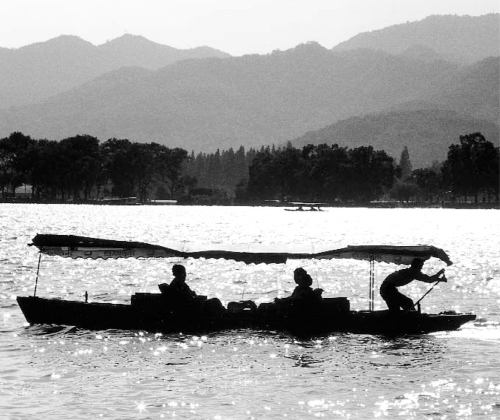
Once the site of a lavish private resort for Communist Party officials, West Lake in Hangzhou is now a major destination for middle-class Chinese vacationers.
In the United States, new villains are being created. The intent is not primarily to curb bad guys; it is to maintain American supremacy in political and economic terms around the globe. The Europeans and Japanese have often found it served their national interests to let the United States take the lead (Vietnam, the Gulf War, Taiwan Strait, Bosnia, Iraq), but the Chinese do not see the world that way. And the United States alone is no longer rich enough, or its people militaristic enough, to force China to kowtow. It is this conundrum that produces the serious disarray that surrounds all American discussions of China, revealing the contradictions embedded in the longstanding policies of hegemony and imperial overstretch.
The contradictions of American hegemonism have always been most evident in East Asia. Its Asian allies were not free-market democracies but developing states willing to trade verbal support of anti-communism for access to the U.S. market. Its Asian enemies–North Korea, China, Vietnam–were also not classic communist regimes, but anti-imperialist nationalists who fought with the fervor and staying power of patriots. As a result, the United States has not been militarily victorious in East Asia since 1945. Equally important, as soon as they recovered from war damage, its post-war Asian allies began to enjoy persistent trade surpluses with the United States, and the American economics establishment had to pretend that its trade deficits were the natural result of market forces rather than a consequence of the mercantilism and protectionism of its clients.
This pretense has started to come to an end because the Chinese economy is only incipiently some sort of capitalist economy and because China has no reason even to give lip service to the principles of American hegemony. It wants U.S. trade and investment, but it also wants a non-hierarchic relationship with the United States. China may be pursuing a Japanese-type strategy of economic development, but it does not want to repeat Japan's pattern of subservience to the United States. The emergence of China from its Leninist straitjacket and its adoption of market-based development policies is exposing many of the latent contradictions in American policy in the Pacific. The United States may need not only a new China policy, but a new policy toward all of East Asia and elsewhere.
Threat creation
Perhaps the most vivid illustration of the contradictions in current U.S. policy is the so-called Nye report (named after former Assistant Secretary of Defense for International Security Affairs Joseph Nye, a professor at Harvard who spent a few months working in the CIA and the Pentagon during the first Clinton administration). Issued by the Defense Department in February 1995 and reaffirmed at the end of 1998, the report proclaimed that the United States intended to keep an expeditionary force of 100,000 troops forward deployed in Japan and Korea for the next 20 years. Nye worked hard to justify this foreign legion in every way he could, but he could not seem to say why it was needed. In the process, he promoted North Korea from a failed communist country–an East Asian Albania–into a formidable threat to the entire region. And he suggested that the Japanese could revert to militarism if the Americans were not there to keep an eye on them.
The Chinese, not unreasonably, concluded that these U.S. forward-deployed armed forces were aimed at them, and they openly questioned American and Japanese motives–particularly since Japan was the former colonial overlord of Taiwan. Nye has repeatedly stressed that his target is not China. But if China is not the specific target of this huge military deployment, then the American government's purpose must be to prevent both Japan and China from challenging American hegemony in the area.
It is in the triangle of Chinese, Japanese, and American relations that the anachronisms of American policy stand most clearly revealed. On May 24, the Japanese Diet passed legislation implementing American-sponsored plans for joint Japanese-American operations during the next war in East Asia. These “Defense Guidelines” do not say which nation or nations might be the enemy or whether a war is likely to occur. But Japanese-American planning for a new war in East Asia goes ahead anyway, with virtually no scrutiny from the American press and strong encouragement from the war-hawk wing of the Republican Party.
These arrangements are the fruit of the summit meeting between President Clinton and Prime Minister Ryutaro Hashimoto in Tokyo in April 1996. The two leaders pretended to respond to Okinawan protests against American bases while committing the two nations to an enhanced military alliance. The new guidelines are supposed to replace an old Japanese-American strategy drawn up more than 20 years ago against a real menace–the Soviet Union.
Under the general heading “Cooperation in Situations in Areas Surrounding Japan,” the guidelines propose that “the [Japanese] Self-Defense Forces will conduct such activities as intelligence-gathering, surveillance and minesweeping, to protect lives and property and to ensure navigational safety. U.S. forces will conduct operations to restore peace and security in the areas surrounding Japan.” This means that if a threat were ever to arise, American lives would be at risk while the Japanese conducted “intelligence activities.” Meanwhile, Japanese commentators are anxious that even minesweeping and intelligence activities go beyond what their “peace constitution” allows. The Chinese are alarmed by the Americans' harping on the need for Japan to do more to help the United States in case of war.
The report gives no reason at all why these new guidelines are needed or why the United States is trying to integrate Japan into its military plans for a conjectural military contingency. The biggest mystery of all is why Japan is going along with these ideas instead of trying to exercise some restraint over its North American ally. Japan strives to convince China that it is not preparing for war, but the Americans continue to send the opposite signal. In mid-1997, it was revealed that the American military had been surveying more than 30 civilian and commercial ports in Japan, including Kansai International Airport, the new Chitose Airport in western Hokkaido, and the port of Naha, Okinawa, that they want to take over and use in the event of an emergency or armed conflict “in the area surrounding Japan.”
China of course has a long experience in the twentieth century of the Japanese central government expressing a desire for peace while Japan's military was simultaneously going ahead with war plans. The distrust of public pronouncements of peace while paying attention to concrete military acts is part of the Chinese heritage of international relations. It played a role in Chinese thinking during the Korean War, when differences between General MacArthur in Tokyo and President Harry Truman in Washington helped fuel China's decision to intervene. Contemporary American actions in East Asia, as distinct from statements from Washington, trigger old memories in Beijing.
From a Chinese perspective, the United States seems to be overreacting to the possibility, even the likelihood, that China is emerging as the regionally dominant power. Not that China will physically dominate the region, but the U.S. role as sole arbiter of international events in the Pacific is coming to an end. The United States must learn to live in a multi-polar world, particularly in Asia.
Like Soviet specialists such as George Kennan, who warned that many Cold War policies merely fed traditional Russian paranoia about being encircled, I worry that current American suspicions about Chinese spying only confirm that nation's experience with Western imperialism and racism. As Christopher Layne, an international relations scholar and MacArthur Fellow, has observed, the pre-1914 relationship between Britain and Germany reminds us of what can happen when a dominant state refuses to accord a rising power the prestige and status to which it is entitled. Unfortunately, the U.S. bombing of the Chinese embassy in Belgrade, combined with its flaccid apology and refusal to produce those responsible, may have created the suspicion in China that the march toward a new Cold War is gaining momentum.