




Abstract
Len Ackland, the Editor of the Bulletin from 1984 to 1991, has written Making a Real Killing: Rocky Flats and the Nuclear West, which is excerpted below. The book is a highly readable and informative history of the government-owned plant a few miles outside of Denver where plutonium was processed into “pits” or “triggers” for thermonuclear weapons.
Like all the weapons production plants, Rocky Flats had difficulties. But no other plant's problems were as ingloriously trumpeted in newspaper headlines: In June 1989, following “Operation Moonglow,” the FBI raided the 6,500-acre site, which by then included more than 100 buildings. And no other plant management has plea-bargained criminal charges. (Then-manager Rockwell International was charged with the illegal dumping of hazardous substances and the knowing contamination of nearby streams.)
From the start, Rocky Flats was ill-starred. Its location was based on a miscalculation of area wind patterns. Instead of siting the plant where the prevailing winds were unlikely to send emissions over Denver, planners set it down so that Denver was directly downwind.
The emphasis at Rocky Flats, which operated from 1952 to 1989, was always on production, not safety. Over the years, some 70,000 plutonium pits were produced there for the Cold War arsenal. But the work was dangerous. And it was made even more dangerous because plutonium, a lethal substance that always requires careful handling, could, and sometimes did, spontaneously ignite.
In September 1957, fire broke out in Room 180 of Building 771, which was packed with gloveboxes made of flammable plastic and nearly 140 pounds of plutonium that was being machined into triggers for thermonuclear weapons. As firefighters fought to contain the blaze, the fire spread to the elaborate air filtering system on the second floor. There, a combination of gases and dust that had accumulated for the past four years–during which time the filters had not been changed–caused an explosion that knocked flat the firefighters on the floor below. Heat-detecting equipment in the filter bank had been designed to shut down exhaust fans in the case of fire, but this highly sensitive equipment had sometimes slowed production, so it had been disabled. The explosion also blew out the cap at the top of Building 771's smokestack, sending contaminated air out into the Denver area.
Bad as the 1957 fire was, scarcely any information about it was made public, and it is doubtful if lessons were learned. At least that's the way it seemed in 1969, when the next major fire occurred. Back then, Dow Chemical was managing the operation, and Ackland picks up the story.
Fires flared frequently at Rocky Flats. The plant's fire department had been called out to hundreds of fires in the years since the 1957 blaze heavily damaged Building 771. The most serious was a 1965 plutonium fire ignited in Building 776-777 when workers tried to unplug a clogged drain. Although the fire was quickly extinguished, more than 400 employees were contaminated during this accident. Most of them inhaled radioactive particles and received internal exposures from alpha radiation, so their exposures didn't show up in the plant's figures for external penetrating radiation caused by beta particles, gamma rays, and neutrons. From 1966 to May 1969 alone, the department responded to 164 fires. Thirty-one were plutonium fires, 22 in Building 771 and nine in Building 776-777. 1
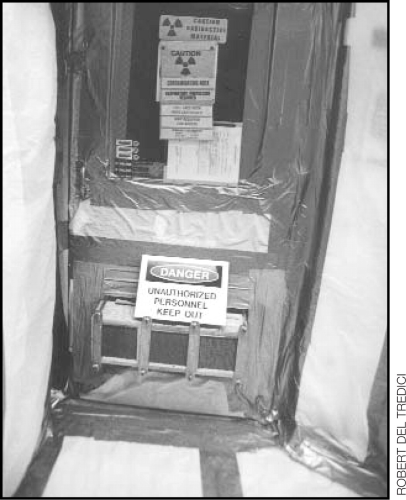
After the fire: Rocky Flats workers inspect the plutonium storage vault in Building 707, which replaced the fire-ravaged buildings.
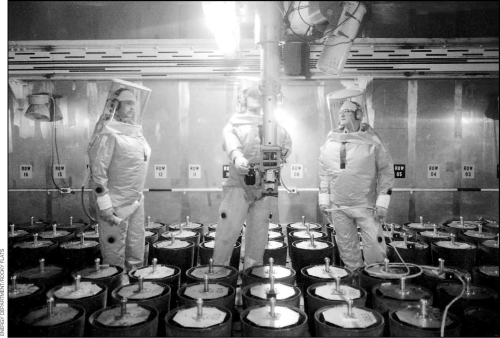
Countless other plutonium fires had broken out but were extinguished by workers and the fire department was not even called in. “There is no good estimate of the number of plutonium fires not reported to the Fire Department,” a 1969 Rocky Flats document stated. When plutonium filings, or chips, ignited spontaneously, workers dropped the chips into machining oil to put them out. “This kind of fire is considered routine,” the document noted. 2
Instead of alerting plant managers to an ever-present danger, the “routine” small fires bolstered their attitude that burning plutonium could easily be controlled. In reality, however, managers and scientists in the late 1960s knew little more about plutonium's strange characteristics and behavior than they had known before the 1957 fire. “The unpredictable nature of plutonium metal is well recognized but not completely understood,” a 1969 document stated. “Many physical variables affect the behavior of plutonium, but the complexity and interactions of those variables have not been determined.” Still, everyone dealing with plutonium at Rocky Flats knew it was pyrophoric–some forms could ignite spontaneously in air at low temperatures. The document noted, “It is difficult to assign an ignition temperature to the many physical forms and crystalline phases of plutonium metal.” For example, small plutonium filings ignited easily, while plutonium metal, such as “buttons” or components weighing more than 200 grams (seven ounces), did not. 3
From 1965 on, workers handled increasingly large quantities of plutonium metal in Building 776-777. At any one time, more than 7,000 pounds were located there. Most arrived through an underground tunnel from Building 771 as hockey-puck-sized “buttons” weighing more than a pound apiece. Other buttons were trucked from the AEC's [Atomic Energy Commission] Hanford and Savannah River plants, which employed nuclear reactors to produce plutonium from uranium 238. Old warheads returned from the stockpile and manufacturing scrap recycled from Building 776-777's own machining operations accounted for the rest. 4 The workers in Building 776-777 went through an elaborate process to make plutonium metal into shells and assemble them and other parts into nuclear pits, used most often as H-bomb detonators.
Super housekeeping needed
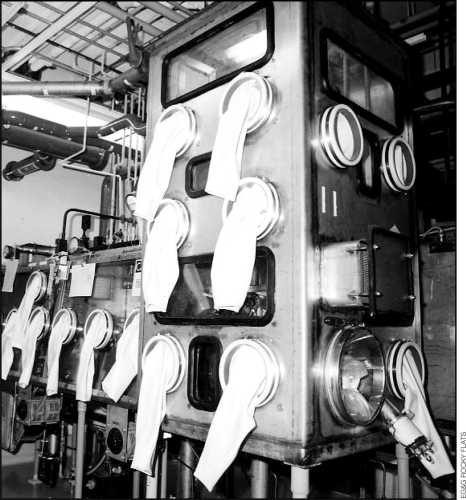
The factory floor in Building 776-777 was surreal, resembling a cross between a huge laboratory and a cluttered laundromat. Hundreds of stainless steel gloveboxes, raised off the floor like rabbit hutches, were welded together to form four major glovebox lines, like assembly lines. A “chainveyor” system ran above each glovebox line. Individual gloveboxes, with leaded plastic Plexiglas windows and portholes for arms, or sets of gloveboxes branched off the main lines at short intervals. Some boxes, often stacked two or three high, contained furnaces about the size of household ovens to melt the plutonium for casting. Others held machines to roll, cut, grind, and shape the bomb parts. When gloveboxes were not in use, the long rubber gloves hung inside out from the portholes. Underpasses about six feet deep and four feet wide were located in a few places along the glovebox lines so employees could go from one side of a line to the other by walking beneath it. These underpasses, dubbed “sheep dips” by workers, had no floor drains. 5
Building 776-777 became even more crowded after Benelex plastic anti-radiation walls were installed. The building also had no sprinkler system, due to fears that water would react with the plutonium and cause a localized “criticality” chain reaction which could deliver a lethal dose of radiation to anyone close by. Fire inspectors were worried. In March 1969 David Patterson, chief of the AEC's Industrial Safety and Fire Protection Branch in Washington, D.C., inspected the building. “This facility is one of the most important to the program, but has practically no built in fire protection or suppression equipment,” Patterson wrote. His report mentioned that a Dow official asked what could be done about the building's vulnerability. “I commented that the problem is apparently recognized by the [AEC] Commissioners, since a recent report expressed concern about the fire and safety risks in Rocky Flats facilities, which concentrate ‘all the eggs in one basket.’” 6
Building 776-777 was a firetrap. Besides the flammable plastic walls, many of the pendants hanging from the chainveyor were made of magnesium. Although lightweight, this metal was flammable. Finally, the “super” housekeeping of gloveboxes and equipment called for in Dow's January 1968 radiation report was occurring at a snail's pace even though workers discovered large amounts of waste. A waste pit beneath one machine cleaned in March 1969 “contained approximately 74 kilograms [148 pounds] of sludge from which 13 kilograms [28.6 pounds] of plutonium was recovered,” the AEC's fire investigation report noted. 7
Plant managers probably assumed that the cleanup problems would go away when Building 776-777 was replaced by a huge, modernized facility called Building 707, which was nearing completion in spring 1969. But some employees were worried about the state of Building 776-777. Worker Larry Crehore complained to union president Jim Kelly about rags and other waste in the plutonium-filled glovebox lines. Although the building usually operated three shifts (day, evening, and midnight) five or six days a week, the production lines occasionally were left unattended. Crehore and Kelly proposed that Dow assign roving radiation monitors to the building to do spot checks around the clock. The company declined. “Dow Chemical would have nothing to do with that because they hated that monitor classification. They always considered that classification to be overhead,” Kelly said. 8
Two of Building 776-777's four major glovebox lines, the north and south foundry lines, originated in Room 134, the main manufacturing space on the structure's west side. These two foundry lines were nearly identical, each 100 feet long and containing eight furnaces inside gloveboxes as well as the production and storage gloveboxes. Foundry workers melted the plutonium, both buttons and scrap, and cast it into “feed” ingots weighing between 15 and 18 pounds apiece. After assaying them to determine the content of plutonium isotopes, workers remelted and blended most of these ingots and cast them into flat, rectangular 24.2-pound ingots about the size of thick elementary school tablets. Ingots with a high americium content were sent to a special extraction unit.
The chainveyor carried the plutonium production ingots to the fabrication line, also enclosed within gloveboxes. There, workers rolled out the ingots like cookie dough and cut them into pieces for presses to shape into thin hemispheres, or half shells, weighing a couple of kilograms each. Workers machined the hemispheres to the correct specifications. Conveyors carried the parts to the 777 assembly side of the building where workers eventually welded the plutonium metal hemispheres together and joined them with other components to form the nuclear bomb pits.
Inside Building 776 after the 1969 fire.
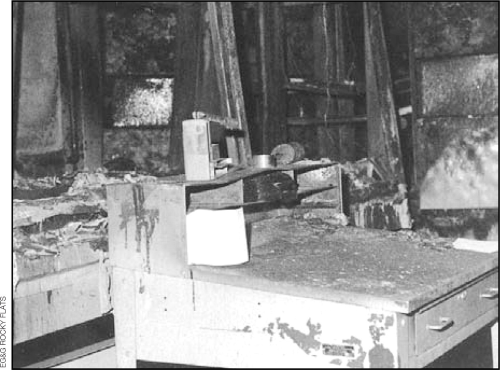
The plutonium machining process created considerable waste. The lathes, milling machines, and other machine tools left fine metal chips as well as larger pieces, all of which were to be recycled. Workers put this plutonium scrap, still oily from the machining lubricant used with the cutting equipment, into steel cans within the gloveboxes and returned them by conveyor to Room 134. To prepare these plutonium chips for remelting in the foundry furnaces, hydraulic presses squeezed them together to form 1-inch by 3-inch briquettes weighing about 1.5 kilograms (3.3 pounds) each and resembling big coconut macaroons because of their composition. The finished briquettes were placed in stainless steel “soup” cans 5.5 inches deep and 4 inches in diameter and kept in storage gloveboxes. Although the cans had lids, they didn't fasten and frequently fell off when the cans were moved, so workers just left the lids off. 9
Before being pressed into briquettes, the plutonium chips were supposed to be dipped in successive baths of carbon tetrachloride cleaning solvent to remove the machining oil still sticking to the surfaces. Such degreasing was dangerous, however, since the chips spontaneously ignited so easily–the cause of many “routine” fires. Workers had learned from bitter experience that burning chips which came into contact with carbon tetrachloride could cause small explosions. To avoid such accidents, production managers curtailed the degreasing. Consequently, when the hydraulic presses made briquettes, they also squeezed out oil and some tiny plutonium pieces onto the glovebox floors. Workers wiped up the oil with rags, frequently leaving them in gloveboxes until they were saturated. 10
Mother's Day
Sometime late in the morning of Sunday, May 11, 1969, plutonium flecks in rags on the floor of a briquette press glovebox on the north foundry line spontaneously ignited. The rags began burning. The glovebox ventilation fans, which continually pulled air into filters on the building's second floor, sucked heat from the oily rag fire into a nearby storage glovebox and eventually ignited a plutonium briquette sitting in a lidless can. It began burning like a charcoal briquette. 11
When the Building 776-777 day shift had ended on Saturday, May 10, the facility held 7,641 pounds of plutonium at various stages of manufacture. Seven of the eight furnaces on the north foundry line contained ingots. Most of the magnesium parts carriers on this line, the north-south conveyor line, and the center glovebox line were full. Everything was ready for production to resume with the midnight shift Sunday night. 12
Although no operations were scheduled in the building's 776 wing on Mother's Day Sunday, two utility operators were on duty because the fans and ventilation equipment required continuous monitoring. A three-worker team reported to the building's 777 side about noon to prepare a specialorder shipment for Los Alamos. They packaged finished bomb parts in the extreme northeast corner of 777. By that time, the plutonium briquette in glovebox number 134-24 on the building's northwest side had been burning for one or two hours, charring a hole in the 14-by-2-foot Benelex plastic “jewel box” in which it was stored. While the Benelex didn't flame up, it released combustible gases. The heated gases ignited other briquettes and initiated a slow burning of more plastic in the storage box. The fire should have immediately triggered heat detectors, but they had been removed from the storage gloveboxes about two years earlier to make room for the new anti-radiation “jewel boxes.” The detectors sat useless on the floor under the glovebox. 13
The smoke in the north line's exhaust system gradually clogged the filters. More plutonium ignited. Heat spread to the combustible rubber gloves and plastic windows and flames erupted. “Up to this time, the fire was still undetected by the few people who were in the building that day because the smoke, flames, and heat were contained within the glovebox system,” according to the AEC's December 1969 accident report. 14
The fire spread quickly once the glovebox's Plexiglas windows and glove portholes were breached. Because the glovebox lines were maintained at low air pressure to keep plutonium particles from escaping, the inrushing air fanned the fire into the north foundry line and toward the building's 777 wing. Luck then intervened for the first time, but not the last. During the Saturday shift, workers doing measurements had left a metal plate blocking the north line. So the fire turned into the north-south chainveyor line instead of racing into 777, much of which had no second floor and, consequently, an extremely vulnerable roof. 15
At 2:27 p.m., the building's heat detectors finally triggered an alarm at the Rocky Flats fire station. A minute later, utility operator F. H. Coleman, who had been checking another building, returned to the second floor of 776. He smelled smoke and pulled a manual alarm. Already on their way, Fire Capt. Wayne Jesser and three firemen arrived at the building's west end within minutes and entered the building. They found heavy smoke and fire, with flames shooting 18 inches above the top of the north foundry line. Jesser ordered one fireman to attack the fire with a hand-held carbon dioxide extinguisher, while he moved to the east end of the line with a 50-pound carbon dioxide carrier mounted on a cart. He inserted the nozzle into the conveyer line and discharged it. The carbon dioxide had no effect. The fire was out of control. 16
Jesser faced a momentous decision. The Rocky Flats firefighters had been ordered repeatedly never to use water on a plutonium fire because of the dangers of a criticality, an explosion–or both. The fact that the 1957 fire had been successfully fought with water was regarded as a lucky fluke. Jesser, who had battled the 1957 fire, realized water could put his firemen's lives at risk. And if the water caused a hydrogen explosion, the whole building might be destroyed and the Denver area contaminated. Against those risks, Jesser knew for sure that if the fire weren't controlled the building would collapse and radiation would be released. Water was his only option. At 2:34, just five minutes after entering the building, Jesser ordered the men to bring in fire hoses. 17
Plutonium at Rocky Flats was contained within “gloveboxes,” which were stacked or welded end-to-end into glove box lines. Employees fashioned the material into nuclear weapons cores, also known as “pits” or “triggers.”
Dense black smoke filled the huge factory floor. An explosion sent two fireballs the size of basketballs hurtling toward the ceiling. The edges of the thick plastic safety walls, intended to protect workers from radiation exposures, were burning. The glue in the laminated plastic fueled the fire. Hanging fluorescent light fixtures clattered down as intense heat melted the fasteners attaching them to the ceiling. Glowing drops of lead fell like rain from the shielding around the overhead conveyers. The firefighters, finding their way through the smoke by following emergency evacuation arrows painted on the floor, wore hardhats along with their moon suits and air tanks. They used fine spray nozzles and sprayed into the ceiling where the gases from the disintegrating plastic were burning. They tried to avoid spraying water directly onto the plutonium.
The blaze burned brighter than anything Bill Dennison, a plant guard and auxiliary firefighter, had ever seen. It reminded him of forest fire movies, “except that back in the smoke and flame we could see the distinctive brilliance of burning metal, which we assumed was plutonium, but was probably both plutonium and [the] magnesium carriers.” 18 Even as firefighters battled the fire inside the two-story concrete building, the huge ventilation fans pulled flames into the filter system designed to prevent plutonium contamination from leaving the building. Two of the three banks of paper filters already had burned out and the third was beginning to burn when the second and most significant stroke of luck occurred. A fireman accidentally backed his truck into a power pole outside the building and cut off the power. The fans, which had been sucking the fire into the filter bank, stopped spinning, just as similar ones stopped during the 1957 blaze. But this fire was still out of control. 19
Smoke and a soft roof
Jim Kelly's phone was ringing when he and his family walked in the door after a Mother's Day lunch at a local restaurant. “Jim, I need you to come out here right away–776 is burning,” his boss told him. “We've really got a mess this time.” Kelly left immediately. He wouldn't return home for 20 hours. 20
Dozens of other workers were arriving at the plant when Kelly got there at about 3:15 p.m. After passing through the checkpoint, he got to the building and put on coveralls, shoe booties, and a respirator. He was told to check Building 776-777's flat roof for radiation. “I was scared,” he recalled. “When I got up there, I could see no flames coming up.” The building's roof vents curved downward so that any exhaust would first hit the top of the roof. “I went to the exhaust areas, then did some quick checks by shuffling around with the booties and then checked the bottom of the booties to see if they were picking up any radiation count. There was nothing there.” The filters were holding. He came down. Shortly afterwards, around 3:45, gray and black smoke began pouring from the exhaust vents. It rolled off the building rather than rising high in the sky. Still, drivers on the Denver-Boulder turnpike 10 miles away could see the smoke plume. Several firefighters were ordered onto the roof to keep it hosed down. 21
The roof was a typical 1950s layered design. Fluted steel sheets were fastened to steel ceiling girders and covered by 3/4-inch flame retardant Styrofoam. Plywood sheets, 5/8-inches thick, were glued to the Styrofoam and coated with thick butyl rubber. The roof was exposed directly to the first floor over the building's 777 east wing, which had no second floor, and over three two-story-high work bays in the 776 wing. The intense heat, later estimated at 400 degrees Fahrenheit on the metal roof's underside and 320 degrees on the upper side, particularly affected 776's bay areas. “The most severe damage in that area appears to be a nearly complete melting of the Styrofoam component of the roof,” according to one July 1969 report. The decomposition of this material caused smoke which traveled along the fluted roof to its edges and was emitted. Although the fire didn't break through the roof, one area got soft. The firefighters managed to keep the roof relatively cool by spraying thousands of gallons of water onto it. 22
By about 4:00 p.m., the water was beginning to contain the fire inside the building. But it caused extreme danger for the firefighters. Moving along the glovebox line, they saw the foundry area ablaze. The only way to get there was through the “sheep dip” passageways. But these underpasses, which had been built without drains because anything that went into them was considered contaminated and had to be cleaned up, were now filled with water. Bill Dennison, fully aware of a possible criticality from the plutonium and water combination, took a deep breath and waded through. The fire in the foundry was so hot that it dried his wet coveralls. A falling light fixture hit him on the head, but only dazed him slightly thanks to his hardhat. 23
At this point, plutonium's unknowns worked in favor of the firefighters. The plutonium oxide “ash” from the burned metal became sticky like dough when it was drenched with water. “One fireman told us how he tried to take a hose and push all the plutonium down into one corner so he could really squirt it. It wouldn't move, he was unsuccessful,” said Rowland Felt, an AEC scientist sent to investigate the fire. Felt explained that if the fireman had been able to push the plutonium together, he probably would have triggered a chain reaction criticality. 24
Although no criticality occurred, 41 firefighters, guards, and other employees who fought the fire sustained radiation doses. The firefighters inside the building had to work in short shifts due to the fire's intense heat. Radiation monitors checked them each time they came out of the building. Those contaminated were sent to Building 559 to shower with water and a sodium hypochlorite solution. Fifteen employees sent to be decontaminated had received significant doses. A fireman whose respirator mask had been torn off momentarily received the highest dose. 25
The firemen contained the fire by 6:40 p.m. and by 8:00 had extinguished it “for all practical purposes,” according to the fire investigation report. Still, as in 1957, plutonium continued to smolder and fires reignited. Lending credence to the conclusion that heat and moisture would ignite plutonium, workers discovered a fire Monday morning in a plutonium storage glovebox on the south foundry line far away from the big fire. 26
Hundreds of square miles
The Denver and Boulder newspapers all carried stories about the fire on Monday, May 12. The Denver Post story was typical. The afternoon paper's page three headline read “Radioactivity: AEC Weapons Building Burns.” Readers were told the production building hit by fire Sunday was still too “radioactively hot” for fire investigators to enter, the fire caused “no injuries,” that no radioactivity had been released into the atmosphere, and the contamination was confined to the building itself. The last claim would be challenged a few months later by a local group of independent scientists who discovered plutonium in soil near the plant.
An AEC investigation team arrived at the plant Tuesday, May 13, to determine the fire's cause and assess damage. The plant's managers and workers began the task of cleaning up Building 776-777 and shifting production to Building 707, the nearly completed replacement facility. “We had a meeting with the whole plant and said, hey, everybody's going to have to be involved,” Jim Kelly recalled. “We got the message across that this was survival, that if the plant didn't get cleaned up all the jobs were going to be gone.” The plant then employed 3,216 people, of whom 1,761 were rank and file workers.
The AEC completed its initial investigation in August. Its report, classified secret, concluded that two tons of the Plexiglas windows on two glovebox lines and one conveyer line were consumed by fire and tons of the plastic walls were also damaged. Investigators estimated that less than 10 percent of the 7,641 pounds of plutonium in Building 776-777 was damaged or burned to oxide and that 99 percent of the plutonium had been retrieved. Unlike a wood fire, where the ash can't be turned back into wood, the oxide left from burning plutonium can be reprocessed into metal without a significant loss of material. The AEC estimated the plutonium recovery costs and the value of the lost plutonium as $22.3 million. Added to the $48.4 million in damage to the production building, the fire's total $70.7 million price tag broke all previous records for U.S. industrial accidents. 27
The AEC investigation report estimated the fire would cause a six to nine months delay in Rocky Flats nuclear bomb production, but concluded that the AEC's commitments to the Defense Department for warheads could be met with one minor exception. The report also noted that the fire didn't breach the building, although contaminated smoke had escaped the damaged filters and plutonium had been deposited on the roof and nearby ground. Firemen leaving the building also had tracked some plutonium outside. Investigators concluded that no contamination had gone offsite. Later studies found that little or no contamination was dispersed. 28
The long-secret AEC fire investigation report of August 1969 sharply criticized both AEC and Dow management for neglecting fire safety in the Building 776-777 complex. Among the problems, the report said managers made decisions to add equipment and structures on an ad hoc basis. “This ‘Topsy-like’ growth led to overcrowded conditions that made compliance with fire safety regulations even more difficult, if not impossible.” It faulted the managers for the series of decisions leading to the installation of combustible radiation shielding materials in the building. It blamed Dow for lacking “a competent and centralized safety organization” at the plant. Finally, the report concluded, “A major loss to a vital weapons production facility occurred because of the failure of the AEC management system to assure compliance with AEC fire safety policy.” 29
The AEC investigation report equivocated about the fire's origin, as did the Serious Accident report the agency issued in December. “The exact cause of ignition is unknown; however, plutonium in the form of chips or lathe turnings is a pyrophoric material,” according to the December accident report. The fire investigators' conclusion that the fire originally started in oily rags laced with plutonium did not appear in the investigation report. Aec officials “were afraid it was going to implicate certain individuals so the lawyer didn't allow us to put that into the report,” investigator Felt revealed in 1996. The agency preferred to imply that the fire's origin was a mystery. Moreover, aec officials didn't want to remind anyone that they had completely ignored the findings of the investigation report prepared after the 1957 fire at Rocky Flats. “If they had read that, digested it, and thoroughly implemented it, we wouldn't have had a fire in ‘69,” Felt said. 30
After the 1969 fire, Dow managers shrugged off the plant's near miss with disaster, according to the aec investigation report. “The Dow official in charge of nuclear safety emergency planning advised the [investigation] Board that there was no need to have plans for possible off-site damage or personal injuries, since it was not possible for serious off-site contamination to occur, and expressed the view that if such contamination were possible the plant should not be located where it is,” the report observed. “He seemed singularly unswayed by the fire on May 11. The possibility that it might have resulted in a significant off-site release of plutonium was countered by the observation that it did not happen. The same general attitude and approach was reflected by Dow General Manager's [Lloyd Joshel] comments when this subject was discussed with Operating Board members.” 31
In contrast, top AEC officials knew Denver had barely escaped a catastrophe. If the fire had burned through Building 776-777's already softening roof, thousands of pounds of deadly plutonium in the form of powdery ash would have exposed hundreds of thousands of women, men, and children living nearby to toxic radiation. Only the “heroic efforts of the firefighters” limited the blaze, the investigation report noted. Otherwise, “there would have been complete loss of Building 776-777 and its contents and a major release of plutonium to the environment.” 32
The AEC's director of military application, U.S. Air Force General Edward Giller, described the Rocky Flats fire in less bureaucratic language. Testifying before Congress in 1970, Giller admitted that if the fire hadn't been contained “hundreds of square miles could be involved in radiation exposure and involve cleanup at an astronomical cost as well as creating a very intense reaction by the general public exposed to this.” He continued, “In the fire we had last year we kept it in the building. If the fire had been a little bigger it is questionable whether it could have been contained.” 33
The 1969 fire had been contained, physically, but it demonstrated that the plant posed a serious danger to the community. Even the little that was publicly known about the fire jolted local scientists, the Denver area media, and some citizens. Had they known the full truth about the risks to which they and their families were being subjected, they would have been outraged. The fire could have caused a Chernobyl-scale disaster 17 years before that 1986 nuclear accident in the former Soviet Union became an everyday word. Secrecy's thick walls prevented full disclosure about the Rocky Flats fire.
Footnotes
1.
ChemRisk, Rocky Flats History, Rocky Flats Toxicological Review and Dose Reconstruction Task 3/4 Report prepared for the Colorado Department of Health, Feb. 1992 draft, p. 235; Atomic Energy Commission (AEC), Report on Investigation–1969 Fire, vol. 1, p. 97.
2.
“Fire Experience 1966-May 1969,” in AEC, Report on Investigation–1969 Fire, vol. 2-B, App. J-2, p. J-7, App. H-2, pp. H-34, 36. When larger pieces of plutonium such as ingots caught fire, workers were instructed to cover the burning metal with magnesium oxide sand, place it on the glovebox floor, and cool the underside of the glovebox by spraying it with carbon dioxide. This efficiently removed heat from the fire and extinguished it.
3.
“Ignition and Burning Characteristics of Plutonium,” ibid., App. H-2, pp. H-29-34.
4.
Ibid., vol 2-A, App. B-1. As nuclear weapons designers at the Los Alamos and Lawrence Livermore laboratories came up with new warhead designs, older warhead models in the weapons arsenal were returned to the Pantex plant in Texas (or a plant in Burlington, Iowa) for disassembly. The plutonium components were then shipped back to Rocky Flats and broken or cut up on the 777 side, and the plutonium placed in steel cans and sent to the small foundry furnaces in 776 to be cast into 7-8-kilogram feed ingots. Ingots meeting plutonium assay specifications went to the molten salt facility for americium removal. If not, they were sent to Building 771 for “chemical purification” and returned to the foundry as fresh buttons.
5.
Ibid., vol. 1, pp. 8-44, vol. 2-A, App. B-1.
6.
David E. Patterson, “Trip Report–Rocky Flats Plant–March 11-15, 1969,” ibid., vol. 4, app. 1.
7.
Ibid., vol. 4, p. 22.
8.
Jim Kelly, interview, February 9, 1996.
9.
Aec, Report on Investigation–1969 Fire, vol. 1, pp. 38-39.
10.
“Fire Experience,” ibid., vol. 2-B, App. J-2; vol. 1, p. 39; Rowland E. Felt, “Fire Safety at Rocky Flats,” briefing at Rocky Flats, January 24, 1996, author's tape recording.
11.
Felt, “Fire Safety.” Felt said, “As a result of this–now this is not in the literature, this never came into view before today–they had an oily rag fire in the press box.” Felt, an Energy Department nuclear materials specialist in Idaho Falls, Idaho, was a member of the 1969 fire investigation team. His account fills in holes left in the original aec investigation report.
12.
Aec, Report on Investigation–1969 Fire, vol. 2-B, App. E-7, Table E-74; vol. 1, pp. 65-66.
13.
Ibid., vol. 1, p. 44; aec, “Fire–Rocky Flats Plant–May 11, 1969,” Serious Accidents report, No. 306, Dec. 1, 1969.
14.
Aec, Serious Accidents Report, p. 4.
15.
Ibid. vol. 3, pp. 5-6; Felt, “Fire Safety.”
16.
This and the following account of the fire have been pieced together primarily from aec, Report on Investigation–1969 Fire, vol. 1, pp. 45-59; aec, Serious Accident Report; Felt, “Fire Safety,” and Dennison, “Fires of Rocky Flats.” Felt described the fire as out of control.
17.
Scientists had hypothesized that burning plutonium would decompose the water and cause hydrogen explosions. aec, Report on Investigation–1969 Fire, vol. 1, p. 68. Felt (“Fire Safety”) said that Jesser disobeyed every rule in the book, but used his knowledge of the situation, which far exceeded that of the criticality experts.
18.
Dennison, “Fires,” p. 76.
19.
The direction and spread of the fire were largely controlled by the continued operation of Booster system #1. aec, Report on Investigation–1969 Fire, vol. 1, p. 110; Felt (“Fire Safety”) said the fireman told investigators he hit the utility pole by accident.
20.
Jim Kelly, interview.
21.
J.F. Willging, “Possible Origins of the Smoke Seen Evolving From Bldg. 776 on May 11, 1969,” Dow Chemical Co., Oct. 3, 1969, p. 2; aec, Report on Investigation–1969 Fire, vol. 1, p. 55; vol. 2-A, App. D.
22.
R. E. Giebel, et al., “Building 776 Roof Burning Tests,” July 21, 1969, p. 1 (in Willging, “Origins of the Smoke,” App. A).
23.
Dennison, “Fires of Rocky Flats,” pp. 78-79, 92.
24.
Felt, “Fire Safety.”
25.
Aec, Report on Investigation–1969 Fire, vol. 1, pp. 89-94.
26.
Ibid., vol. 1, p. 57.
27.
Ibid., vol. 1, pp. 2, 74; aec, Serious Accidents Report.
28.
Ibid., pp. 10, 102-3; Paul Voilleque, “Estimated Airborne Releases of Plutonium During the 1957 Fire in Building 71,” May 1995. He presented this report to the Health Advisory Panel, Colorado Department of Health.
29.
Ibid., vol. 5, “Management Conclusions,” pp. 1-5.
30.
Aec, Serious Accidents, p. 4; Felt, “Fire Safety.”
31.
Aec, Report on Investigation–1969 Fire, vol. 4. pp. 35-36.
32.
Ibid., vol. 3, p. 2.
33.
House Subcommittee on Public Works, Hearings on U.S. Atomic Energy Commission, 91st Cong., 2nd sess., Oct. 1, 1970, p. 295.