




Abstract
Last June, President Bill Clinton was the toast of China. This year, he is toast. Indeed, the whole U.S. policy of constructive engagement, pioneered by that old liberal Richard Milhous Nixon, is in jeopardy, under attack by xenophobic nationalists in China and equally xenophobic China-bashers in the United States.
Engagement was in full flower in June 1998 when Clinton visited China. The president was wined and dined in a feel-good haze of mutual declarations of friendship between the American and Chinese peoples.
By last May, however, a Chinese historian could suggest in China Daily, a publication in which nothing important appears quite by accident, that the United States was attempting to cause the disintegration of the European Union and the complete collapse of Russia so these two entities would not be able to get together and threaten global U.S. economic interests in the future. The next U.S. target, the historian said, would be China.
The “H word”–as in U.S. hegemony–had returned to the official Chinese vocabulary. Meanwhile, in the United States, talk radio and the internet were ablaze with the word “treason,” when applied to current U.S. policies toward China.
Allegations de jure
It is not surprising that U.S.-China relations have turned dissonant. The nato bombing campaign against Serbian forces in Yugoslavia alarmed China, as did the accidental nato bombing May 7 of the Chinese embassy in Belgrade. China cherishes its sovereignty, particularly after having its territory so frequently violated by Europeans, Americans, and Japanese in the nineteenth and twentieth centuries. (And also, one suspects, because it doesn't want multinational organizations looking too closely at the plight of Tibetans or minorities in western China.)
More urgently, though, once the self-serving jingoistic rhetoric is stripped away, a reading of opinion as expressed in the Chinese press suggests that the elite is deeply worried about a resurgent right-wing campaign in the United States against the Middle Kingdom, aided and abetted by a voraciously hungry U.S. news media and fed by allegations of a miraculously successful Chinese espionage campaign.
A steady stream of allegations has poured forth this year in the U.S. press, sometimes on a daily basis, as to how China has stolen virtually every American secret under the sun, from the recipes for America's most advanced nuclear warheads and missile guidance systems to, presumably, the Colonel's secret formula for Original Kentucky Fried Chicken. (See “A Very Convenient Scandal” in the May/June issue of the Bulletin.) A few recent chapters in the continuing saga include:
▪ Allegations in the April 28 New York Times that FBI investigators had determined that Wen Ho Lee, a Los Alamos expert on computer codes who was fired in early March, had downloaded nuclear weapon “legacy codes” and nuclear-design input data from a secure computer system at Los Alamos to a non-secure system at the lab.
“American officials,” said the Times, “said there was evidence that the files were accessed by someone after they were placed in the unclassified network. Other evidence suggest that this was done by a person who improperly used a password, officials said.”
▪ Assertions in the May 2 Times that U.S. counterintelligence officials had determined that China posed an “acute intelligence threat” to U.S. nuclear weapon laboratories. The report, said the Times, was given last November to more than three dozen government officials, including Bill Richardson, secretary of energy; William S. Cohen, secretary of defense; Janet Reno, the attorney general; and Sandy Berger, President Clinton's national security adviser.
According to the Times, the report said China “conducts a ‘full court press’ consisting of massive numbers of collectors of all kinds, in the United States, in China, and elsewhere abroad.” It concluded: “This effort has been very successful and Beijing's exploitation of U.S. national laboratories has substantially aided its nuclear weapons program.”
▪ A denial on May 8 by a lawyer for Wen Ho Lee that Lee had been involved in spying.
▪ An announcement May 11 by Energy Secretary Bill Richardson that he would consolidate Energy's widely dispersed security apparatus under a “security czar”–perhaps a “three-star general” with an extensive background in security.
“It is clear that over the past several decades security and counterintelligence have not been given the necessary priority and attention,” Richardson said, while describing past security operations as “nondirectional” and “diffuse.” He added that all foreign visits to weapons labs and other Energy facilities would be tracked and cleared by a central office, and that declassification of Cold War-era documents would be slowed. (See “Wrong-headed Protection,” page 6.)
▪ The May 25 release of the long-awaited report of the House Select Committee on U.S. National Security and Military/Commercial Concerns with the People's Republic of China. The bipartisan committee was chaired by Christopher Cox, a Republican from California who has been waging a not-so-lonely war against Clinton s engagement policy for years. (“Today, while the Senate argues whether to remove Bill Clinton from office for perjury and obstruction of justice,” Cox told the Republican National Committee on January 22, “I will argue that at the next election, Americas voters should remove both Bill Clinton and Al Gore and their entire administration from office for failing to protect the national security.”)
The classified version of the Cox report was submitted to the White House in November. The three-volume, eight-pound unclassified version released in May said that over the past two decades the Chinese had obtained–through espionage, the scouring of unclassified technical publications, and extensive interactions with scientists and technicians in the labs and in private businesses–a vast array of sensitive weapons-design information.
That information included advanced missile technology–with a particular focus on guidance systems–and top-shelf data on the W56, W62, W76, W78, W87, and W88 nuclear warheads as well as detailed information about an enhanced radiation weapon, a so-called “neutron bomb” (the W70) that the United States has never deployed.
A tempting legacy
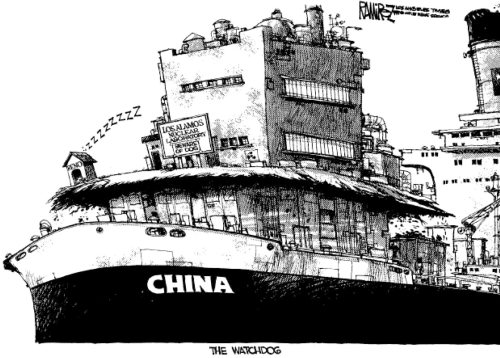
The Cox report makes serious allegations, some of which–or many of which–may even be true. But that raises an intriguing question. Even if one accepts the worst-case scenario it offers, what does it mean?
Surely one would not expect a major nation to refrain from spying. The notion that countries run by gentleman do not spy on one another expired with the last century. China scarcely can be faulted for successfully doing what the United States and every other advanced nation does routinely, if perhaps not always as efficiently.
But that is not said to minimize the seriousness of the apparent leakage. A high-level team of U.S. intelligence experts issued a damage assessment April 21 that foreshadowed the release of the Cox report. Yes, said the team, China's espionage program had been “ambitious” and successful.
Espionage “probably accelerated [China's] program to develop future nuclear weapons,” although the espionage was supplemented by “contact with U.S. and other countries' scientists, conferences and publications, unauthorized media disclosures, declassified weapons information, and Chinese indigenous development.” (In a burst of candor, the assessment team also said it could not determine the “relative contribution of each.”)
Ray Kidder, a retired weapons physicist at Lawrence Livermore National Laboratory, has watched the unfolding of the alleged spy scandal with intense interest. He focuses most closely on two possibilities: that the legacy codes could have been transferred to a non-secure system which could be tapped by an outside party, or that they could have been downloaded directly onto a removable data-storage disk to be spirited from the laboratory.
“The legacy files contain the input data and source codes that can be used to simulate the performance of U.S. nuclear stockpile warheads of the past and present,” Kidder says. “The input data provides the computer with a detailed description of the nuclear explosive component or ‘physics package’ of the weapon itself, and the source code instructs the computer how to process this data to simulate and predict the warhead's performance in detail.”
In addition to these instructions, says Kidder, “the source code is interspersed with numerous ‘comment statements’ that are provided to make it clear to the user what the code is doing. The comment statements in the legacy codes are particularly extensive, because those codes that apply to the warheads in the current ‘enduring’ stockpile were written 20 to 30 years ago and were intended to be readable long after the originators of the codes were no longer available to interpret them.”
The legacy codes contain mountains of detailed information concerning the design of the nuclear explosive component of U.S. warheads, Kidder says, as well as “the materials of which they are made and how they work.”
That information would be of great interest to any country with a present or possible future interest in nuclear weapons development, says Kidder, not just China. The codes would be of great value to India and Pakistan, which seem to have a keen interest in achieving a thermonuclear capability, he notes, and presumably Iraq might also have an interest, and possibly North Korea, should it ever resume its bomb program.
“To extract this information,” Kidder says, “the codes would need to be carefully studied, translated, and read by a dedicated group of programmers and physicists. This would require considerable time and effort, but motivation would be high and it could be done successfully.”
Doing the wrong thing
If the allegations in the Cox report are true, and if the legacy codes were indeed compromised–major “ifs”–the United States may have given away the very store, or at least many of the goodies on the shelves.
It is conceivable that with the help of purloined data, combined with the competence of its own scientists and technicians, China in the next decade or two might be able to field nuclear weapons as sophisticated as those possessed by the United States, albeit in far lesser numbers.
If so, that would give China a “survivable” nuclear retaliatory force based on mobile missiles with multiple warheads, as both the intelligence community's damage assessment team and the Cox committee suggest.
(China's current force lags far behind those of the United States and Russia, each of which has thousands of modern nuclear warheads, not to mention Britain and France, which have modern arsenals numbering in the low hundreds. China's long-range force is composed of about 20 1950s-technology liquid-fuel missiles, each with a single warhead. The United States or Russia could theoretically “disarm” China's nuclear capacity in a matter of minutes.)
Nevertheless, the strategic meaning of a modern “survivable” force has somehow escaped a lot of people in Congress, in the news media, and even in some think tanks. A populist newspaper columnist in Chicago, for instance, condemned the administration for going “into full reassurance mode” following release of the Cox report.
“It's nice to reassure people,” said the columnist. “Especially while you're telling them that secrets to build weapons of mass destruction have ended up in the hands of unfriendly governments that might want to kill us.”
One does not have to be a China apologist to be stunned by that sort of near hysteria. A survivable retaliatory or “second-strike” force is not a first-strike force. Under deterrence theory, such a force is supposed to prevent war, not start one. Even hard-line, pro-nuclear balance-of-power theorists argue that a survivable second-strike force enhances strategic stability rather than degrading it.
China's antiquated force lacks “crisis stability,” because its old, silo-based missiles can so easily be destroyed. In a time of high tension–say, over a Taiwan–China might find itself in a “use-‘em-or-lose-’em” launch-on-warning situation. That's a nightmare scenario for both the United States and China–and that's why China is apparently developing a hard-to-target, second-strike, road-mobile missile, the DF-31.
But one should never underestimate the capacity of a government–any government–to do the wrong thing. Over the next decade or two, China might well plunge ahead in a full-throttle effort to expand and modernize its strategic forces–particularly if the United States decides to deploy a limited national ballistic missile defense system, as it seems intent on doing.
The Chinese, after all, have regarded such a system as an expressly anti-Chinese measure since the fall of 1967, when Defense Secretary Robert McNamara said that the United States would build a “thin” defensive system–not to counter the Soviets but to defang the Chinese.
Meanwhile, if the United States comes to believe that China is fielding or is about to field more sophisticated weapons–and it is probable that Christopher Cox will be among the many who will nurture that belief–it may engage in yet another Cold War-style nuclear arms race. There is no shortage of demagogues on the right who have been promoting for years the idea that China is the Next Great Threat to U.S. security.
Millennial vision
After four decades of nuclear posturing, the United States and the Soviet Union managed to finally step back from the brink, but only after spending many trillions of dollars and rubles on their respective nuclear-weapons enterprises while subjecting hundreds of millions of men, women, and children to the ever-present possibility of instant or lingering death.
As the new millennium gets under way, will the world witness the beginning of yet another nuclear arms race? Or might the United States have the vision and courage to finally take the lead in negotiating a multilateral nuclear disarmament treaty?
For many years, the Chinese have declared their enthusiasm and readiness to take a spin down the nuclear disarmament road. Upon signing the Comprehensive Test Ban Tr eaty in September 1996, for instance, Vice Premier Qian Qichen reminded delegates to the U.N. General Assembly that China had always stood “for the complete prohibition and thorough destruction of nuclear weapons.”
Have the Chinese been blowing smoke all these years? Possibly. But the United States, as the world's only superpower, is securely in the driver's seat. Its conventional forces and economic muscle are unequaled. It can safely afford to call China's hand, and now is a good time to do it.
If the United States can find a way to bring China and the other nuclear powers into negotiations on a nuclear disarmament treaty–admittedly, not a likely prospect–that would set an engagement standard worthy of a new millennium.