




Abstract

China maintains an arsenal of about 400 warheads: some 250 “strategic” weapons in a triad of long-range land-based missiles, bombers, and submarine-launched ballistic missiles; and some 150 “tactical” weapons–pre-sumably lower-yield bombs for tactical aircraft, possibly artillery shells, atomic demolition munitions, and short-range missiles like the Dong Feng (or DF-) 15 and 11. These missiles are better known by their export names: The DF-15 is known as the M-9, and has a 600-kilometer range; the DF-11, or M-11, has a 300-kilometer range.
Chinese nuclear forces are estimated to be deployed at about 20 locations. They are under the ultimate control of the Central Military Commission (cmc), which is chaired by Chinese President Jiang Zemin. Other members of the cmc are generals from the Peoples Liberation Army, several of whom also serve on the Politburo of the Communist Party.
The use of the term “strategic” in the Chinese case needs some qualification. China has only about 20 missiles capable of intercontinental distances, and another 100 with ranges from 1,800 to 4,750 kilometers. Although bomber forces are normally considered part of strategic forces, Chinese bombers cannot go great distances, and China's single ballistic missile submarine does not venture far. Compared to the nuclear weapons systems of the other powers, especially to those of the United States, Chinese forces are modest in size and capability.
Information on Chinese tactical nuclear weapons is limited and contradictory, and there is no confirmation from official sources of their existence. China's initial interest in tactical weapons may have been spurred by worsening relations with the Soviet Union in the 1960s and 1970s. Several low-yield nuclear tests in the late 1970s–and a large military exercise in June 1982 simulating the use of tactical nuclear weapons–suggest that they may have been developed.
Taiwan's defense minister has specifically referred to the M-9 and M-11 as nuclear-capable, and Taiwanese officials report that the number of M-type missiles in China's three southern provinces has increased from 30-50 to 160-200 over the past three years.
It is important to keep China's military modernization and nuclear forces in perspective. Historically, it has taken a long time for a missile, submarine, or bomber to enter service with Chinese forces. From initial research through development and testing to deployment can take a decade or two, by which time the system is largely obsolete by American standards.
The natural desire of every military is to want better weapons; it is no surprise that China has looked abroad to enhance its armed forces through commercial or clandestine means. Recent allegations of Chinese spying at U.S. weapon laboratories are not surprising, given that Los Alamos and Lawrence Livermore National Laboratories are the world leaders in designing sophisticated, compact, and lightweight warheads.
But there are no indications of any Chinese crash programs or dramatic increases in warhead numbers in the foreseeable future. As a Pentagon report to Congress stated recently: “Evidence suggests … that China will develop her military strength at a measured pace. A more rapid or large-scale military build up is seen by the Chinese leadership as unnecessary and detrimental to continued economic growth.”
China has four types of nuclear-capable ballistic missiles in the Dong Feng family, the DF-21, DF-3, DF-4, and DF-5. The DF-4 is a fixed, longrange ballistic missile deployed at five bases: Da Qaidam, Delingha, Sundian, Tongdao, and Xiao Qaidam. The DF-5A, an upgraded ICBM version deployed at Luoning and Xuanhua, was first deployed in the early 1980s. The U.S. government estimates that there are about 20 in the Chinese arsenal.
Some 40 DF-3 medium-range ballistic missile launchers are deployed at Jianshui, Kunming, Yidu, Tonghua, Dengshahe, and Lianxiwang. The mobile, two-stage DF-21 medium-range missile is replacing the DF-3 at some of these sites (Tonghua, Jianshui, Lianxiwang) and the process is likely to continue at the other sites. An improved, longer-range version called the DF-21X is nearing deployment, according to the Japanese Defense Agency.
Two future ballistic missiles are often mentioned in newspaper accounts, though very little is known about them. The DF-31 and the DF-41 are said to have ranges of 8,000 and 12,000 kilometers respectively. More than likely these missiles would have improved accuracy and guidance, mobile launch platforms, solid-fuel technology, and possibly, multiple warheads. (The United States first deployed MIRVed missiles in 1970. The Soviet Union, France, and Great Britain followed suit in 1974, 1985, and 1994.) These missiles could also be capable of launching penetration aids, such as decoys or chaff, released during reentry to confuse missile defense systems.
Neither the DF-31 nor the DF-41 has begun flight-testing. It could take many years before either missile is deployed. If they are fielded, it is not known how many missiles might be deployed or how many warheads they might carry.
China conducted 45 nuclear tests from 1964 to 1996, 22 of them underground. In anticipation of signing the Comprehensive Test Ban Treaty, China conducted nine tests from 1992 to 1996. These tests had multiple purposes: to ensure the reliability of warheads currently in the stockpile and to confirm designs of future warheads, should China decide to produce and deploy them.
The single existing SSBN was built at Huludao Naval Base and Shipyard in the northern Bohai Gulf and was launched in April 1981. It was finally deployed in January 1989 to the Jianggezhuang Submarine Base, where the nuclear warheads for its Julang-1 missile are believed to be stored. The Xia-class SSBN, and the five Han-class attack submarines (SSNs), have never sailed beyond their regional waters. No additional Xia-class SSBNs are projected to be built, but there is a replacement design under development.
The Julang-1 SLBM on the Xia remains China's first and only solid-fueled ballistic missile. The missile underwent a series of flight tests between 1981 and 1984, including one successful at-sea launch from a Chinese-built, modified Soviet-designed Golf-class submarine in 1982. A second-generation SLBM, presumably the Julang-2, a variant of the DF-31, is under development. It seems unlikely that the future Chinese fleet will number more than four to six submarines.
For more than a decade China has been developing a supersonic fighter-bomber, the Hong-7 (or FB-7) at the Xian Aircraft Company. The plane is not believed to have a nuclear mission.
Modernization of China's bomber force could occur through adaptation of aircraft purchased from abroad. China bought 26 Soviet/Russian Su-27 Flanker fighters in 1992 for $1 billion. These planes are currently with the 3rd Air Division at Wuhu airfield, 250 kilometers west of Shanghai.
In a separate agreement, Russia sold production rights to China to assemble and produce Su-27s at the Shenyang plant, with Russian engineers ensuring quality control. The first two Su-27s built in China flew in December 1998. The Peoples Liberation Army Air Force wants 200 Su-27s; it will take at least until 2015 to build them under existing schedules. The Su-27 does have an air-to-ground capability, although there is no evidence that China is modifying it, at this time, for a nuclear role. China also wants to purchase the Su-30 Flanker, but talks with the Russians have stalled.
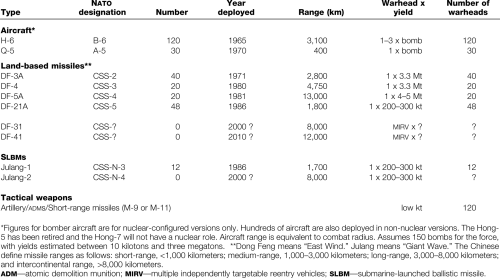
Figures for bomber aircraft are for nuclear-configured versions only. Hundreds of aircraft are also deployed in non-nuclear versions. The Hong-5 has been retired and the Hong-7 will not have a nuclear role. Aircraft range is equivalent to combat radius. Assumes 150 bombs for the force, with yields estimated between 10 kilotons and three megatons.
Dong Feng means “East Wind.” Julang means “Giant Wave.” The Chinese define missile ranges as follows: short-range, <1,000 kilometers; medium-range, 1,000–3,000 kilometers; long-range, 3,000–8,000 kilometers; and intercontinental range, >8,000 kilometers.