




Abstract
Our Own Backyard: The United States in Central America, 1977-1992 By William M. LeoGrande, University of North Carolina, 1998, 773 pages; $45.00
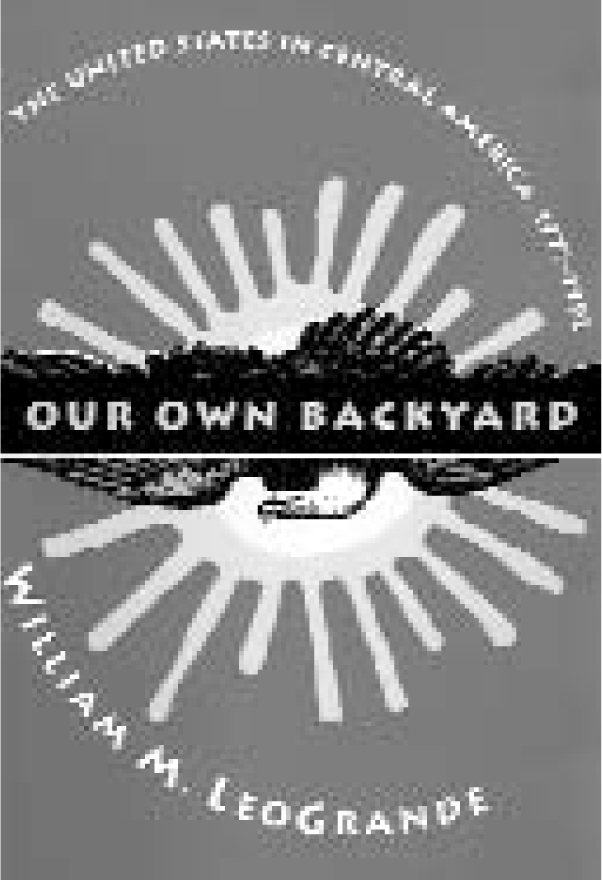
At a massive 590 pages of text, this book will not find its way onto many peoples night-stands–particularly now that Central America has faded back into obscurity. But it should be read: Our Own Backyard tells us a lot about U.S. policy-makers and about the United States as a nation.
William LeoGrande, a professor of government at American University and a specialist in Latin American politics and U.S. foreign policy, is one of the few left-liberal academics who advised congressional committees during the 1980s. His experiences enable him to combine extensive research with an insider's knowledge of the policy-making process.
The author's insights into how Washington works, together with his penchant for detail, fairness, accuracy, and extensive sourcing, make Our Own Backyard a “must read” for students of Central American policy during the Reagan-Bush years. LeoGrande also has an ear for the well-crafted sentence and a fondness for the policymaker's glib but revealing soundbites. Add his pithy thumbnail bios of major players, and you have a good reason for the non-academic to keep turning pages as well.
This book should be of particular interest to U.S. citizens who opposed U.S. policy in Central America, but never followed the threads of events far enough to fully appreciate why their opposition–which was the majority view, after all–had so little effect in Washington.
LeoGrande untangles a number of threads, particularly the ones leading to the complicated and divisive congressional votes that gave aid to El Salvador's army on the one hand and to Nicaragua's rebels–the contras–on the other. He explains why the votes went as they did, and how hard it would have been to alter their outcomes.
LeoGrande takes the reader on a guided tour through the multi-tiered field on which the war for those votes was fought, including the bedrock debate over whether foreign policy was or was not an exclusively executive prerogative. The author spends most of his time, however, on where the pitched battles took place–between the Democrat-controlled House and the Republican-controlled Senate, explaining how the hawks and doves of both parties devised their schemes to win over fence-sitters at voting time.
LeoGrande traces the confusing shifts of tone and tactics to the Republican schism, where the debate was mainly over methods, not goals. Administration hard-liners and pragma-tists alike thought they could “reassert U.S. strategic superiority over the Soviet Union” by treating Nicaragua and El Salvador as if they were Marvin Gardens and Park Place on the superpower Monopoly board. As a bonus for passing go, they would make Central America safe for right-wing allies and a living hell for left-wing enemies–never mind that those enemies were often the local populations.
Hard-liners methodically viewed any compromise with squeamish Democrats as tantamount to communist collaboration, while pragmatists preferred to massage Congress to get their way. At first, the hard-liners won: They got rid of Assistant Secretary of State for Latin America Thomas Enders, who annoyed them by seriously considering negotiating with the Sandinistas. Later, when Congress limited aid to the contras, the hard-liners made their famous end-run–the maneuver known as Iran-Contragate.
The author does a good job of explaining various Byzantine schemes used to win votes. One year, the request for contra aid was an amendment to a bill providing summer jobs for domestic youth. Tactics varied depending on outside events, the number of vacillators at vote time, and congressional leadership styles.
LeoGrande demonstrates how old-fashioned horse-trading could sometimes pull enough undecided votes to shift the balance–for example, labeling aid to the contras “humanitarian aid” and attaching human rights conditions to it in order to overcome legislators' moral objections. But the Republicans' most useful tactic was redbaiting. Throughout the dozen or so years of the U.S.-financed war in Central America, the one rule that no player–Democrat or Republican–ever took issue with was this: the Central American left was somewhere between a useful tool of the Soviets and a threat to all humankind.
In the House, enough Democrats objected to a strictly military solution in the two countries that, with the support of moderate Republicans, they could usually defeat–or at least modify–military aid bills on the first round. Liberals, however, drew the line well short of arguing that the Sandinistas should be allowed to govern Nicaragua in peace, even if they agreed to some sort of nonaggression pact with the United States. And they would not have dreamt of defending the Salvadoran guerrilla movement's power-sharing demands before the United States had shaped the country's cruel but inept army into a competent adversary. Reagan had only to threaten Harlingen, Texas with a Sandinista invasion and the Democrats backed down.
“Wait, Hoskins! Don't give them a martyr!”
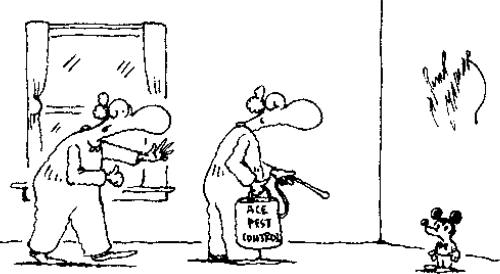
Challenging the administration's distorted premises, double standards, and outright lies about the leftist groups in El Salvador and Nicaragua would have required tremendous political courage at the time. The surprise is that Leo-Grande–writing in 1998, by which time red-baiting ought to have been passé even in the United States–doesn't challenge them either. And he sidesteps the argument that the congressional opponents of military aid who bought into red-baiting deserve some of the blame for what happened in Central America.
One example illustrates the superficiality of most opposition to contra aid. Nicaraguan President Daniel Ortega went to the Soviet Union in April 1985 at a time when an important vote was looming in Congress. Ortega's trip made it “untenable,” said contra-aid opponents, to be seen as defending the Sandinistas, since it buttressed Reagan's charge that the Sandinistas were Soviet puppets. Some liberals said they felt personally “betrayed” because they had “gone out on a political limb for Nicaragua”; others said the trip was “intentionally timed to insult and embarrass” them.
But, as LeoGrande acknowledges, Ortega went to Moscow because he desperately needed oil. The great irony was that the trip was forced on him because the United States had pressured Mexico and Venezuela to stop supplying Nicaragua with oil. These facts were public at the time, but the Democrats ignored them. The aid votes took place a month and a half later, after Reagan had slapped a full trade embargo on Nicaragua and sent his minions out to “exploit the Democrats' chagrin.” LeoGrande characterizes the episode as a “debacle” for aid opponents.
Am I being too hard on the liberals, and on the author himself? Is it nitpicking to point out that LeoGrande includes only half a dozen leftist references in his 200 pages of footnotes? Or that, although his original intent was to “write an account of the domestic opposition” to Reagan's policy, he never mentions the existence of two internationally recognized U.S. umbrella organizations–the Committee in Solidarity with the People of El Salvador (CIS-PES) and the Nicaragua Network–both of which supported a left alternative in Nicaragua and El Salvador?
One might argue that it was only a quirk that one of the last presidents elected before the fall of the Berlin Wall was a true believer in the most arrogant Cold War ideology. Perhaps we should just write off the damage Reagan and his like-minded team did in Central America to tough luck, and feel relieved it's over.
In the early 1980s, a paper commissioned by a pro-Reagan think tank defined both CISPES and the Nicaragua Network, as well as the Institute for Policy Studies and the bimonthly magazine NACLA Report on the Americas, as “outside the framework of democratic debate on Central America.” Why? Not because they opposed U.S. policy, but because they were on the left; they were illegitimate a priori. Sadly, that premise raised few eyebrows in a nation that–in the name of “democracy”–has for decades committed or encouraged war around the world against people who think differently and want different things. Until this approach to international affairs ends, there is little to be relieved about.
One reviewer summed up Our Own Backyard as a book that “liberals will love and conservatives will find plenty to disagree with.” But those of us who actively fought Washington's policy during those years or who live in the region that still suffers the aftereffects may find it hard to imagine how either conservatives or liberals could love their reflection in this book's mirror.