




Abstract

March 6, 1997: A rebel points a gun at the head of the Albanian president's bodyguard. The United Nations is fighting the proliferation of small arms on several fronts, including devising a plan to reclaim weapons looted from Albanian armories.
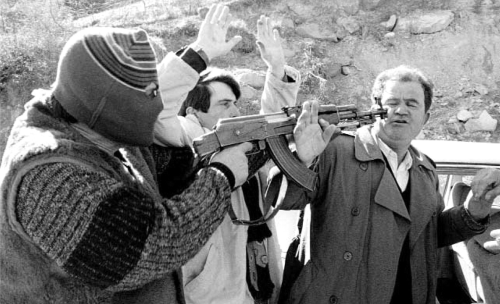
The United Nations has been attempting to define its role in controlling the spread and use of small arms since former U.N. Secretary-General Boutros BoutrosGhali first introduced the concept of “micro-disarmament” in 1995, and the U.N. Institute for Disarmament Research commissioned a series of reports on light-weapons hot spots (including Cambodia, Mozambique, and Bosnia) and published analyses of the global dimensions of the problem. In 1997, Secretary-General Kofi Annan upgraded the U.N.'s disarmament office to the Department for Disarmament Affairs. One of the reasons for the upgrade, he said, was to place greater emphasis on small arms and light weapons.
Annan and the Undersecretary-General for Disarmament Affairs, Jayantha Dhanapala, have been lobbying for a comprehensive approach to the light-arms problem. At an international conference in Brussels in October, Dhanapala said, “I believe that a program of ‘deweaponization’ of civilians and demobilization of former combatants … will be more sustainable when carried out as a part of a package containing community development projects to create more employment and generate additional income for poorer sections of society.”
The U.N.'s broadest approach to the issue appears in the report of the Expert Panel on Small Arms, published in August 1997, the first comprehensive U.N. report on small arms. Because U.N. panels operate by consensus, there were few expectations that the report would contain anything of substance. The panel's ambitious mandate included identifying the types of weapons used in conflict, “the nature and causes of the excessive and destabilizing accumulation and transfer” of small arms, and the ways “to prevent and reduce” these accumulations.
Most delegates and experts expected only modest statements from the panel on a few non-controversial issues. Thus, the panel's expansive final report came as a surprise. The report listed the weapons in use around the world, examined modes of transfer and the illicit trade, and analyzed “regional realities.” It also made more than a dozen recommendations, including the institutionalization of arms destruction in peace processes, the adoption of “a proportional and integrated approach to security and development,” and an investigation of the feasibility of an international marking system for all small arms.
However, virtually none of the panel's recommendations (except for a study on ammunition and the planning of an international conference on the illicit arms trade) are being implemented. The United Nations is waiting for a second panel to issue a progress report in 1999.
Coordination and consensus
In June 1998, the United Nations launched the Coordinating Action on Small Arms (CASA), its most ambitious attempt thus far to institutionalize the issue within the U.N. system. Undersecretary Dhanapala said that CASA would make the Department for Disarmament Affairs “a focal point” within the United Nations “to coordinate on a U.N.-wide basis all action on small arms. This is in recognition of the fact that there are humanitarian and human rights aspects to the use of small arms in conflicts,” as well as concerns related to development and security.
The policy paper for CASA argues that small arms, as “the instruments of choice in intrastate conflicts,” belong on the U.N. agenda as a security, humanitarian, and developmental concern. Therefore, its delineation of responsibilities aims to be inclusive of as many U.N. entities as possible. The Office of Humanitarian Affairs, for example, will collect data on the effects of small arms use on humanitarian aid work; the Department for Peacekeeping Operations “will be a major partner in drawing lessons from the collection of weapons as part of disarmament and demobilization exercises in the United Nations”; the U.N. Development Program will focus on “an integrated approach to disarmament and development [that] will entail closer cooperation between the economic and disarmament sectors of the secretariat”; and the U.N. Children's Fund and the Special Representative on Children and Armed Conflict “will provide support for advocacy measures to prohibit children from being forced or allowed to take up arms.”
The policy paper also makes a subtle reference to the lack of consensus among member states on the small arms issue, noting that “there is some risk that the mandate of the [United Nations] may be pulled into directions not supported by political consensus which is so necessary for taking effective global action.” Consensus on any of these issues is hard to come by. The Register of Conventional Arms is the primary U.N. tool for dealing with conventional weapons, but it deals with heavy weapons only. Efforts to reach consensus on expanding the arms register to include light weapons (and to include stockpiles as well as imports and exports) have failed. The U.N. Disarmament Commission, which makes consensus recommendations to the international community, placed light weapons on its agenda in 1997. Regarding “practical disarmament measures,” the commission is scheduled to complete a set of guidelines by 1999 on integrated approaches to small arms disarmament, peacekeeping, and conflict prevention.
The most influential U.N. body on disarmament issues is the Conference on Disarmament in Geneva, which negotiates arms control conventions. While conventional weapons have been on its agenda for years, a negotiating committee has never been established.
From Timbuktu to Gramsh
Although the United Nations is hampered by the differing views of its member states, some bilateral arrangements with individual states show promise.
The poor, land-locked nation of Mali has emerged as an example of how small arms disarmament can be effective when the problem is approached from all angles–political, social, military, and judicial–in a coordinated manner. In 1990, revolts in northern Mali led to civil war. After a dictatorship was replaced by a democratic government in 1992, President Alpha Oumar Konare's government and the rebels signed a peace agreement in January 1995, calling for greater autonomy for northern Mali. The agreement also included a series of confidence-building measures, including disarmament by both the rebels and the government.
It was at this point that the United Nations and other international players, including donor nations and international financial institutions, were asked to help. In a process that has since been dubbed “security first,” the international community provided economic incentives for both sides to disarm and assisted the integration of former combatants into civilian society. The linking of development aid and arms control was based on the simple idea that peace will not come to a nation if the people are poor and distrustful. The United Nations also provided expertise in collecting and destroying the weapons that were turned in as part of the peace process. On March 26, 1996, some 3,000 weapons fueled a bonfire in a square in Timbuktu during a ceremony that became known as the Flame of Peace.
In Mali, the United Nations supported the initiatives of the government, but U.N. initiatives in Albania put the United Nations in the center of the action. Early in 1998, the Albanian government asked the United Nations to examine ways to retrieve weapons that had been looted from armories in 1997 following the social unrest caused by the collapse of a pyramid scheme. Dhanapala led a mission to Albania in June 1998, selecting the district of Gramsh for a pilot study. The U.N. mission decided that any plan involving the purchase of stolen weapons would not work because the amount of money required for the buy-back would be inflationary to the country's weak economy. Instead, the team recommended linking weapons collection to development incentives.
A follow-up mission by the U.N. Development Program made a more detailed survey of the problem and outlined possible solutions. Gramsh authorities reported that they had already collected some 4,000 weapons, including automatic weapons, anti-aircraft machine guns, mortars, and more than 12 million rounds of ammunition. They estimated that there were at least 10,000 weapons still in civilian hands–this in a district of only 56,000 people.
According to the mission report, “Most programs offering money for weapons failed because they created new arms trades with weapons coming from other places rather than reducing the weapons circulating among the civilian population. … The effort to create a better public security environment by strengthening the law and order capacities, together with development actions in return for weapons, could be a more promising approach.”
The team recommended an incentive package–building new roads, establishing a cheap telephone system to link the communities of the district, rebuilding schools. Strengthening the abilities of the local police was also included: “The civil population has no great incentive to turn in their weapons if they see that the local police cannot guarantee their security.” The estimated cost of the project is about $3 million.
Other initiatives
There are a number of other new U.N. initiatives that address diverse aspects of the small arms problem.
Ironically, disarmament has seldom been a part of peacekeeping mandates. Even when mandates have included disarmament (as in Cambodia and Angola), commanders have usually given priority to matters like separating troops and clearing mines. But the CASA plan calls for the U.N. Department of Peacekeeping Operations to make disarmament an integral part of its activities by including “a disarmament component within each peacekeeping operation to study, assess, and report on the results of each exercise.” Because only one limited peacekeeping mission has been established since CASA was instituted, it is not yet possible to judge the effect the plan will have.
The first serious attempt to gauge the effectiveness of an embargo was mandated in 1995 when the Security Council created the International Commission of Inquiry to investigate violations of the arms embargo against the former officials of the genocidal government of Rwanda. The commission, not surprisingly, uncovered numerous violations and published a report that highlighted specific incidents and included names, dates, and even flight logs. The commission also made a number of recommendations to strengthen arms embargoes.
In late 1998, the Security Council adopted two resolutions dealing with this issue. Resolutions 1196 and 1209 put the council's weight behind national and regional initiatives to enforce embargoes, including assistance in investigating violations, establishing regional arms registers, and identifying black market arms dealers.
A limited or expansive approach
The United Nations functions best when its member states are clear about what they want from the world body. Ambiguity or profound differences lead to paralysis or extreme caution. The United Nations is coming to grips with the tragedies caused by the proliferation of small arms without a clear, comprehensive mandate from its membership. Despite this handicap, in the past two years the United Nations has begun to make its presence felt in the field and in diplomatic circles.
The General Assembly's Disarmament Committee approved four resolutions in November dealing with small arms: two dealt exclusively with illicit arms, the third focused on a proposed convention on illicit trafficking, and the fourth dealt with controlling small arms in peacekeeping operations and in post-conflict settlements. The emphasis on illegal arms, of course, is meant to minimize the role of nations in the proliferation of small arms. This narrow approach contrasts with the scope of the initiatives the United Nations is trying to pursue. As Secretary-General Kofi Annan told the Security Council in September, “If we recognize that peace and prosperity must be sought as one, with equal priority and equal persistence, then we must also understand the broader nature of the human security we seek. That is why the United Nations increasingly is taking a comprehensive, holistic approach to all our peacekeeping and peace-building activities.”
The diplomatic tension between the limited and expansive approaches to the problem of small arms will not be resolved anytime soon.