




Abstract
Arms merchants–dealers, middlemen, politicians, and military officers–engage in deals that operate on a number of levels–legal, quasi-legal, and nowhere-near-legal.
The story was reported in the British press in the late 1980s: a cargo plane had crashed in a mountainous region of the Middle East, killing its crew of four. There were no details about the plane's origin, its destination, or its cargo. It was one of those stories that appears on the inside pages one day, and then disappears the next.
But the story behind the story is far more interesting. According to sources familiar with the crash, the plane was returning from a Middle Eastern country at war with a neighbor, where it had delivered a load of Israeli-made light arms. The sale had been brokered for an Israeli firm by a freelance dealer–a professional middleman–who worked with the knowledge of the Israeli government, but against the wishes of both the United States and the Soviet Union.
Despite back-channel warnings from Washington and Moscow to close the arms supply line, the shipments con-tinued–until a Soviet MiG downed the plane and ended the operation. Although the shoot-down occurred in the airspace of a NATO country, the two superpowers were content to let the matter drop. But because the delivery had already been made, the middleman still collected his 10 percent commission–in this case, more than $20 million.
In the sometimes shadowy world of arms dealing, the story is still told–as a reminder of the dangers, as well as a reminder of the great potential for profit.
The art of the deal
The international arms market operates on a number of levels–legal, quasi-legal, and nowhere-near-legal–and employs a network of manufacturers, dealers, middlemen, politicians, military officers, and others in every part of the world. While most transactions are not surrounded by spy-novel intrigue, the market remains one of the least understood of the world's big businesses. Recently, a man who has been involved in the global arms market for more than 20 years–I'll call him P.D.–discussed the ins and outs of his trade over drinks in an upscale bar in Lisbon.
Tall, with an elegant face and manners, P.D. is a little over 50 years old. In a dark suit and an Italian tie, he is the model of discretion and self-confidence, whether he is in a luxury restaurant in Lisbon, in a presidential palace in Africa, or in one of the Middle East's intercontinental hotels–places where bottles of scotch are consumed before crates of arms are bought.
P.D. is a senior manager at one of Portugal's oldest arms production companies, which offers a traditional catalog of products–low in technology but still in great demand worldwide: Heckler and Koch (HK) G-3 assault rifles, ammunition for light arms of several calibers, and a vast range of artillery ammunition.
“The arms-dealing sector follows the same rules as any other,” he says. “You have to have a good product for a competitive price, know the market–know exactly who uses your products–and keep a clean name in an international, though very familiar, environment. Success is found in your ability to influence the buyer, convincing him that he needs your product.
“The only parts specific to this business,” he adds with an ironic but not insincere smile, “are that secrecy is an obligation and also that you need to get all the information you can on your client's political, social, and financial profile so that he doesn't surprise you in an unpleasant way.”
Although knowing everything about a client is a golden rule for him, P.D. recognizes that seldom “do you know who the final user of the weapons is.” For obvious reasons, this “is the most sensitive problem of the weaponry business.”
Even the simplest deal can turn into a political and diplomatic crisis, as P.D. knows from experience. One such crisis began on a rainy afternoon in Lisbon in 1988, when two executives from a British company came to his office. “They were representatives of one of the company's subsidiaries in a very stable, English-influenced African nation and they wanted to buy a considerable amount of HK G-3s, about 5,000 of them, as well as the corresponding 7.62 caliber ammunition.”
P.D. indicated that he had the weapons ready to ship, and at the lowest price his clients could find, and within a few months, they were back to discuss specifics. This time, the two Englishmen brought another executive, a citizen of the African country they had mentioned earlier. The three of them visited the production line of the Portuguese arms company, and they were pleased with the quality of the product. “We arranged for the weapons to be shipped by boat in three phases,” P.D. says.
Weeks later, P.D. was in possession of two documents without which no arms deal can be accomplished: The first was the final destination certificate–a standard document worldwide–signed by the government of the country buying the merchandise and certified by its foreign affairs ministry, acknowledging that the weapons would be used by its armed forces or security forces. The other document was a credit note, which is how this kind of deal is paid for. Basically, a bank from the country that is buying makes a deposit large enough to pay for the product in a bank known for handling international transactions. At the same time, the buyer drafts a memorandum outlining the conditions under which that money can be deposited in the seller's account.
In this phase, the country selling the arms analyzes the conditions in detail. If all is right, the country ships the product and, with the shipping documents in its possession–a “bill of lading” or “aero way bill”–a representative presents himself to the bank, which proceeds with the money transfer. A clean and safe operation. “All was well and the deal held up to the end,” says P.D.
A year later, however, the executive of the African company contacted P.D. “There was a problem with most of the weapons sold–the gun barrels became too hot in some thousand of them–and they wanted a solution,” P.D. says. After a couple of meetings, P.D. contacted executives from the African country and informed them that a team from the Portuguese manufacturer would fly down and solve the problem.
“Our decision surprised them and only later did I understand why,” he says. Once the team arrived in Africa, it was shown only four or five weapons. The other weapons were never shown to them, and they eventually returned to Portugal. The African executive never called again and the British company, which P.D. knew very well, never did business with the Portuguese company again.
With Britain and another African country acting as middlemen, Portuguese rifles ended up in the hands of RENAMO guerrillas like these.
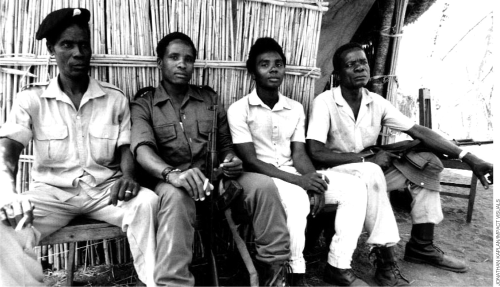
P.D. learned after investigation what most certainly happened. “They had given the weapons to RENAMO, Mozambique's guerrilla movement, and, when the soldiers noticed the defect and started to protest, the African country's government–the one that officially bought the weapons–must have heard something about it. They expected that we would simply replace the whole stock of rifles.” There were just two options, says P.D.: “Do what the Africans wanted and keep a client, or spend no more money. In this case we thought it was less costly to lose a client.”
Three ways of doing business
In P.D.'s world, there are three basic types of sales: deals made with states, deals born out of initiatives of local agents, and deals brokered by a shadowy middleman. In the first case, he believes that “although these offer more legal guarantees, they can also be the most dangerous.” The danger lies in having your products wind up in the wrong hands–which can be politically embarrassing for a state-owned company such as the one for which P.D. works. He explains by using the U.S. and British methods as an example:
Those nations' defense agencies announce a global contest for the supply of, say, ammunition for 105-millimeter artillery pieces. The company that presents the best price/quality offer wins, and payment is made in 45 days. “Only, [the United States and Britain] do not show the final destination certificate.” he says. “They just say that the merchandise is for them. However, if, by any chance, we are aware that their armed forces no longer use 105-millimeter pieces, then we begin to worry.” The worry is that the reputation of the company–and the country–could be sullied if unpopular governments or insurgents suddenly start toting Portuguese-made arms. With no evidence to tie the armaments to the United States or United Kingdom, Portugal looks like the bad guy.
Local agents, who get a percentage of the value of each deal they manage for the seller, are the kind of men “that really have a feeling for the business, as well as a great influence over decision-makers.” Normally, agents present themselves to arms sellers at arms fairs, or just show up when they find the opportunity. Such men can also be in strategic positions, in which case the seller himself tries to get to them. “I did huge deals with a South American country because the chief of the local dictator's airborne division was Portuguese, and the dictator would listen to him,” says P.D.
P.D. added that before any deal gets under way, an agent “is totally checked out and when you know he's got a suitable profile, he'll be hired.” What constitutes a “suitable” profile? “He has to be near the decision-makers and those who will use the arms. Anywhere in the world, the buy always results from the action of a triad: the one who wants the product, the one who influences the buy, and the one who decides about it.
“The agent has to be close to the decision-maker and to the user, as he has to make the adjustments–convincing them our product is the best for them, lubricating the parts–which is about knowing whom they will have to pay to fulfill the deal, and leading the decision-maker to sign the contract with us.”
The deals put together by agents tend to be above-board transactions that do not originate on a government bid sheet–legal deals that rely on personal contacts to bring together the buyer and the seller. In contrast, says P.D., “the middleman is the most fascinating and dangerous character in the world of arms dealing. He is the man who shows his face in a deal in which neither the buyer nor the seller can show up. He is a loner who depends only on his instincts and his reputation to make the deals. And to stay alive.”
The man in the middle
“A.F.” is such a man. Just under 50, very discreet, and Portuguese–although for a long time a citizen of the world–he is the kind of man no one notices. For more than 25 years–al-ways carrying a mobile phone, from which he calls anywhere and to which he is called from everywhere–A.F. makes deals, mostly covert, and mainly for Israeli and South African arms. Both countries place the greatest confidence in him. During his career, A.F. has flown in private jets owned by Arab sheiks, visited with leaders of the Chinese Communist Party, and traveled to the gray palaces of Caucasian leaders–always as a special guest.
For A.F., covert deals are the same as official ones: “Born out of a need that has to be satisfied.” The only difference, he argues, is: “The seller needs the money, the buyer needs the product. But for both, to be exposed can be fatal. That is why they really need a man whom they can both trust.” That kind of trust “takes years to achieve, and is only obtained after an intimate relationship. After that you have to find the need, the right partner to satisfy, and see that everybody agrees. It takes lots of time, lots of meetings in luxury places, lots of phone calls, and lots of patience,” A.F. says.
He also says that any covert arms deal–whether it concerns machine guns or aircraft–follows the same procedures as an official one. “The buyer evaluates ‘in loco’ the dealer's product as the seller makes sure of the buyer's financial capacity. The official documents, the mode, and the delivery dates are arranged.” The only difference, A.F. explains, “is that the buyer deposits the money in an off-shore bank, opening an account in the middleman's name. The middleman creates a credit line in the seller's name and proceeds with payment.”
The middleman also makes sure that all of the paperwork is in order. “When it is shipped, the merchandise always has a clean destination, which corresponds to the country that agreed to issue the final destination certificate. Of course, in the middle of its trip, the boat or the plane stops somewhere and unloads the cargo.”
When the four players–“buyer, seller, fictitious destination country, and middleman–play ‘honestly,’ the deal is silently made and everybody is happy.” For A.F., the middleman “is a shrewd and experienced person, who, above all, has one worry: to be as careful as he can be with the people he operates with, and to refuse all contacts his instincts are suspicious of.” Nevertheless, he admits that even the best people in the business are sometimes tripped up.
In an effort to insulate himself from mistakes and bad judgment, A.F. says, “There are borders you can never cross. The secret in this business is to avoid illegality, although sometimes that is not enough.” Avoiding illegal activity in A.F.'s line of work sounds easier said than done, but he insists that as long as he does not deal with outlaw organizations–and he has the paperwork to prove where the weapons were supposed to be delivered–he cannot be held responsible if the weapons turn up in someone else's hands.