




Abstract
When Charles Taylor invaded Liberia, he unleashed the most deadly combat system of the current epoch–the adolescent human male equipped with an AK-47 assault rifle.
May 7, 1996: A member of Charles Taylor's National Patriotic Front steps on the body of a victim in Monrovia, Liberia.
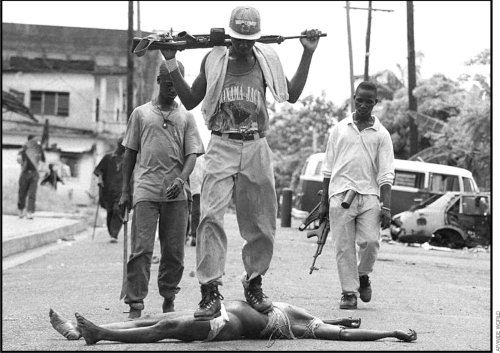
On Christmas Eve 1989, Charles Taylor marched into Liberia with a ragtag invasion force of some 150 amateur soldiers–members of the self-styled National Patriotic Front of Liberia (NPFL)–and set out to conquer the country. In the months that followed, Taylor seized control of the Liberian hinterland, exacting tribute from its inhabitants, recruiting additional soldiers, and killing all who stood in his way. As many as 200,000 people died in the cataclysm, and millions more were driven from their homes. Taylor had unleashed the most deadly combat system of the current epoch: the adolescent human male equipped with a Kalashnikov–an AK-47 assault rifle.
Since Taylor's invasion of Liberia, this deadly system has been employed with devastating effect in more than a dozen countries, producing a casualty rate normally associated with all-out war between modern, mechanized armies. In Algeria, Angola, Bosnia, Burundi, Cambodia, Chechnya, Colombia, Congo, Haiti, Kashmir, Mozambique, Rwanda, Sierra Leone, Somalia, Sri Lanka, Sudan, and Uganda, young men (and some women) equipped solely or primarily with AK-47s and other “light” weapons have produced tens of thousands–and sometimes hundreds of thousands–of fatalities.
Most of the casualties in these conflicts are non-combatants. Civilians constituted only five percent of the casualties in World War I, but they constitute about 90 percent of all those killed or wounded in more recent wars. Children have been particularly victimized by these conflicts: According to the U.N. Development Program, as many as two million children are believed to have been killed–and 4.5 million disabled–in armed conflict since 1987; another million have been orphaned, and some 12 million left homeless. 1
The widespread slaughter of civilians in recent conflicts forces us to rethink what we mean by the concept of war. In the past, “war” meant a series of armed encounters between the armed forces of established states, usually for the purpose of territorial conquest or some other clearly defined strategic objective. But the conflicts of the current era bear little resemblance to this model: most take place within the borders of a single state and entail attacks by paramilitary and irregular forces on unarmed civilians for the purpose of pillage, rape, or ethnic slaughter–or some combination of all three.
Ethnic and internal warfare is the most common form of armed violence in the late twentieth century, and it is likely to remain the dominant form for some time to come. The proliferation of this strife will produce massive human tragedy, stretch the capacity of the United Nations and other international peacekeeping organizations to their limits, and erase all hope of economic and social development for hundreds of millions of desperate people. It is essential, therefore, that we come to terms with this phenomenon–and, most important, devise strategies for its prevention and control.
The pathology of contemporary conflict
Although each of the conflicts that fall into this model has its own origin and trajectory, all exhibit some common characteristics. In almost every case, unscrupulous and ambitious demagogues have sought power and/or wealth by arousing the ethnic prejudices of their kinfolk, forming militias and paramilitary bands, and conducting attacks on civilian targets–usually neighborhoods or villages inhabited by members of a different ethnic group. Although the fighters may espouse a particular ideology or religious dogma, ethnic hostility, poverty, and a craving for booty usually fuel these conflicts.
Violent attacks on unarmed civilians, including women and children, are common. Although seemingly random and senseless to outside observers, the violence has a purpose: to exact tribute from the population (to acquire additional arms and ammunition); to obtain fresh recruits (often young boys who are enticed or dragooned into combat or young women who are used for sex); to destroy people's faith in the ability of the established government to protect them; to drive members of another ethnic group from their ancestral lands; or to exact revenge for earlier acts of resistance. 2
Although violence of this sort is usually associated with ethnic militias and other non-state actors, government forces often behave in a generally similar manner. In many countries, the national army is just another ethnic or sectarian faction in a highly fragmented society; in others, the army serves largely to protect the privileged status of the ruling family or elite. (In Rwanda, for instance, the army was once a tool of Hutu domination; now it is an instrument of Tutsi domination. In Haiti the army was for decades the exclusive instrument of a small wealthy elite.) In these situations, violence against civilians is routinely employed to discourage public support for insurgents, to disrupt insurgent supply lines (villagers cannot provide food to the rebels if they have no food to provide), and to punish members of the ethnic group, political party, or social class from which the rebels are drawn.
All too often, war becomes a permanent way of life for combatants, whether they belong to the insurgent or the government side. Usually deprived of an education or training in marketable skills, the young recruits who make up these armies often find that soldiering is the only occupation for which they are equipped. In societies where food and shelter are scarce, membership in an armed band that preys on the civilian population is a plausible route to survival. It is not surprising that many of these bands continue their violent activities long after the original, strategic rationale for their formation has ceased to have meaning.
In a significant number of cases, the dividing line between political warfare and outright banditry disappears. Under these circumstances, armed militias sell their services to local warlords or go into business for themselves–extorting money or goods from civilians, trafficking in drugs, or fighting for control over valuable resources (such as diamond mines, virgin forests, or rare animal skins).
These conflicts occur only when certain preconditions have been satisfied. These include a weak or unrepresentative government, a history of ethnic and social antagonisms, economic hardship and uncertainty, widespread corruption, and a lack of safeguards for targeted minorities. But such conflicts require one more element: access to large quantities of small arms and light weapons.
The centrality of small arms
Light weapons are the weapons of choice in contemporary conflicts–the weapons most often used in battle and in attacks on civilians. Some 80-90 percent of all casualties in recent wars have been produced by such weapons, which include rifles, grenades, machine guns, light mortars, land mines, and other “man-portable” systems. 3
It is true, of course, that a militant gang or a frenzied mob can inflict great damage on a community with clubs and knives alone. But these groups quickly melt away when faced with any type of organized resistance. It is the unique combination of adolescent male fighter and modern assault rifle that gives these paramilitary groups their lethal potency: equipped with AK-47s alone, a small band of teen-aged combatants can enter a village and kill or wound hundreds of people in a matter of minutes.
The November 1997 attack at the Temple of Hatshepsut at Luxor in Egypt provides a gruesome example of this capability: in a period of just 30 minutes, six youthful gunmen equipped with automatic rifles stormed into the temple area, killing two armed guards and then mowing down 58 foreign tourists. Each of the gunmen reportedly fired hundreds of rounds of ammunition at the cowering tourists before they themselves were shot by police reinforcements.
In some instances, paramilitary groups will supplement their light weapons with limited numbers of heavy weapons–tanks, artillery pieces, aircraft, and so on. Rarely, however, can irregular forces pay for weapons of this type; and, even if they can, it is almost impossible to operate and maintain major weapons in the rugged, back-country environment in which many of these forces operate. Then, too, the teen-aged combatants who make up most of these forces lack the training and discipline to operate large, complex weapons systems.
In most instances, then, assault rifles and other light weapons are the weapons of choice. These weapons have attained this position of prominence for a number of critical reasons:
▪ They are cheap and easily accessible. As a result of the Cold War's end, millions of weapons have been declared surplus by their original owners and dumped on the world market–often falling into the hands of corrupt or criminal dealers with no compunctions about selling them to groups like Charles Taylor's NPFL.
▪ They are rugged and easy to use. AK-47s and M-16s left over from the Vietnam War (and earlier conflicts) remain in widespread use, requiring only simple maintenance. With only a few hours' training, a young teenager can learn all he or she needs to know in order to aim and fire them into a crowd of people.
▪ They are easy to hide and carry. A single pack-horse can carry a dozen or so rifles through dense jungles or over high mountain passes, bypassing government checkpoints; a column of horses can supply a small army. Because paramilitary groups often operate in remote areas behind government lines, portability is essential.
▪ They can inflict enormous damage. A modern assault rifle fires hundreds of rounds per minute, allowing a handful of combatants to spray a village square and kill or wound everyone in sight. Even when used with relatively light ammunition (.22 caliber or 5.56 millimeter is standard), these weapons expel bullets at such high velocity that impact on any part of the human body can produce massive trauma or death.
For all of these reasons, these weapons have become the principal tool of combat in the overwhelming majority of conflicts in the post-Cold War era. Of the 49 regional conflicts that have broken out since 1990, light weapons were the only arms used in 46; only one conflict–the Gulf War–was dominated by heavy weapons.
A vicious circle
“While there are some agreed global norms and standards against weapons of mass destruction, there are no such norms or standards that can be used in reducing the excessive and destabilizing accumulation of small arms and light weapons. These are the weapons increasingly used as primary instruments of violence in the internal conflicts dealt with by the United Nations, they are responsible for large numbers of deaths and the displacement of citizens around the world, and they consume large amounts of United Nations resources.
“The excessive and destabilizing accumulation and transfer of small arms and light weapons is closely related to the increased incidence of internal conflicts and high levels of crime and violence. It is, therefore, an issue of legitimate concern for the international community. Groups and individuals operating outside the reach of state and government forces make extensive use of such weapons in internal conflicts. Insurgent forces, irregular troops, criminal gangs, and terrorist groups are using all types of small arms and light weapons. …
“Accumulations of small arms and light weapons by themselves do not cause the conflicts in which they are used. The availability of these weapons, however, contributes toward exacerbating conflicts by increasing the lethality and duration of violence, by encouraging a violent rather than a peaceful resolution of differences, and by generating a vicious circle of a greater sense of insecurity, which in turn leads to a greater demand for, and use of, such weapons.”
–United Nations, General and Complete Disarmament: Small Arms, U.N. document A/52/298, August 27, 1997, pp. 9-10.
Global availability
The widespread popularity of light weapons has generated enormous demand for their production and sale. Unfortunately, no government or private agency publishes statistics on their manufacture and distribution, so it is impossible to calculate the exact number in worldwide circulation. Estimates of the total number of fire-arms–handguns, rifles, carbines, submachine guns, and so on–in global use range from 500 million to a billion, of which some 200-250 million are thought to be owned by private individuals and public agencies in the United States. 4
Of greatest concern is the global spread of military-type automatic weapons. An estimated 60-70 million AK-47s and other AK-type weapons have been produced since 1947 (the origin of its numerical suffix), and more are manufactured every year in Russia, China, Bulgaria, Egypt, Iraq, Poland, Romania, and North Korea. In addition, some eight million copies of the U.S. M-16 rifle have been produced in recent decades, along with seven million German G-3s, 5-7 million Belgian FALs, and 10 million Israeli Uzi machine pistols. All in all, perhaps 125 million automatic weapons are currently in circulation around the world. 5
Keeping track of the worldwide supply of small arms is complicated by the fact that so many countries now produce them. Only a handful of nations manufacture major weapons systems–tanks, jet aircraft, warships, and so on–but about 50 countries produce small arms and ammunition. They include most of the industrialized nations, as well as Argentina, Brazil, Chile, Egypt, India, Iran, Iraq, Israel, Mexico, Pakistan, Peru, Singapore, South Africa, Taiwan, Turkey, and the two Koreas. Many of these countries also produce grenades, mortars, and machine guns. 6
Although the total worldwide trade in conventional weapons has declined since the end of the Cold War–from an estimated $88.5 billion in 1987 to $46.3 billion in 1997 (in constant 1997 U.S. dollars)–the small arms portion of the trade is thought to have grown. This reflects heavy buying of firearms and counterinsurgency gear by states facing internal conflict (Algeria, Angola, Burma, Colombia, India, Indonesia, Mexico, the Philippines, Serbia, Sri Lanka, Sudan, and Turkey, for instance). All told, sales of light weapons probably total $5-10 billion per year, or 10-20 percent of the total worldwide trade in conventional arms. 7
Large quantities of small arms and ammunition have also been funneled through black-market channels to ethnic and insurgent forces, including the NPFL of Liberia, the Tamil Tigers of Sri Lanka, the Kurds of Turkey and Iraq, UNITA of Angola, RENAMO of Mozambique, and the SPLA of Sudan. Most clandestine arms transactions are relatively small, only a few million dollars, but some are substantial: UNITA, for example, is believed to have spent as much as $250-500 million in the mid-1990s on black-market munitions, using funds obtained from the illicit sale of diamonds. 8
Many more weapons fall into the hands of belligerents through theft from government arsenals, purchases from corrupt military and police personnel, gifts from members of their ethnic group living abroad, or from friendly governments. Again, it is impossible to calculate the exact numbers of weapons involved, but these transactions are a fairly reliable source for ethnic militias and other irregular forces.
The imperative of control
With the dawn of a new century only months away, the world faces a continuing epidemic of ethnic, sectarian, and criminal violence. Millions of people are at risk of death and dismemberment, and millions more face hunger, homelessness, and psychological trauma. No combination of private and public agencies is equipped to handle the resulting humanitarian disaster. We must, therefore, find ways to reduce the incidence and intensity of armed conflict.
The conflicts of the current period have many causes, of which poverty, corruption, and demagoguery are paramount. Addressing these factors will require a concerted and imaginative effort. However, conflicts last only so long as belligerents receive a steady stream of arms and ammunition. By shutting off that stream, it should be possible to reduce both the duration and the severity of contemporary combat.
Curbing the international production, stockpiling, and diffusion of small arms and light weapons must be a central feature of any strategy for preventing and controlling armed conflict. This does not mean cutting off the flow of arms altogether–established governments enjoy a right to self-protection under the U.N. Charter, and most will continue to produce or import some weapons for this purpose. But it should be possible to choke off the flow of black-market munitions to irregular forces and to significantly restrict the conditions under which governments can acquire arms through legal channels. Ultimately, it should be possible to block all but a small trickle of weapons to current and prospective belligerents in areas of persistent conflict.
In the essays that follow, a distinguished group of scholars and journalists examines the structure and dynamics of the light-weapons trade, and provides case studies of its actual operation. In addition, specific strategies are proposed for curbing the trade. Although they require further refinement, these strategies provide a sound basis for developing and imposing new international measures for the control and significant reduction of the global flow of small arms and light weapons.
Footnotes
1.
U.N. Development Program, Human Development Report 1998 (New York and Oxford: Oxford University Press, 1998), p. 35.
2.
For discussion, see David Keen, The Economic Function of Violence in Civil Wars, Adelphi Paper no. 320 (Oxford: Oxford University Press, 1998); William Reno, Warlord Politics and African States (Boulder, Colo.: Lynne Rienner, 1998). See also Human Rights Watch (HRW), Sierra Leone: Sowing Terror (New York and Washington: HRW, 1998).
3.
For background on light weapons and their effects, see Jeffrey Boutwell, Michael Klare, and Laura Reed, eds., Lethal Commerce: The Global Trade in Small Arms and Light Weapons (Cambridge, Mass.: American Academy of Arts and Sciences, 1995); Michael Renner, Small Arms, Big Impact (Washington, D.C.: Worldwatch Institute, 1997); Jasjit Singh, ed., Light Weapons and International Security (New Delhi: Indian Pugwash Society and British-American Security Information Council, 1995); United Nations, General and Complete Disarmament: Small Arms, UN document A/52/298, August 27, 1997.
4.
The estimate of 500 million light arms in worldwide circulation is from Singh, Light Weapons and International Security, p. viii; the estimate of a billion is the author's. Estimates for the United States are from Renner, Small Arms, Big Impact, p. 21.
5.
See Renner, Small Arms, Big Impact, p. 20.
6.
For data on the worldwide production of small arms and light weapons, see Jane's Information Group, Jane's Infantry Weapons (annual).
7.
For discussion and additional data, see Michael Klare and David Andersen, A Scourge of Guns (Washington, D.C.: Federation of American Scientists, 1996).
8.
For data on black-market arms deliveries, see reports published by the Human Rights Watch Arms Project, including Angola: Arms Trade and Violations of the Laws of War Since the 1992 Elections (1994); Stoking the Fires: Military Assistance and Arms Trafficking in Burundi (1997); and Sudan: Global Trade, Local Impact (1998).