






Abstract
Rhopalurus caribensis Teruel & Roncallo, 2008 (n. syn.) is synonymized with R. laticauda Thorell, 1876, based on a review of morphological variations of characters listed by Roncallo and Teruel (2008). The biogeographic assumption presented by Teruel & Roncallo (2008) as an argument to justify the description of R. caribensis is refuted.
Introduction
Rhopalurus laticauda Thorell, 1876 the type species of the genus, is distributed in open areas of savannas and lowlands of northern South America between Venezuela and Colombia. R. laticauda has been considered to be a polymorphic species due to coloration and size variations (Lourenço 1991; Manzanilla & Souza 2003).
Rhopalurus caribensis Teruel & Roncallo, 2008 was described on material from northern Colombia (Caribbean Region). The description was justified on the basis of morphological differences and a biogeographic rationale. The main arguments for the recognition of R. caribensis as a new species were: pattern of coloration, sculpturation, and differences in the number of pectinal teeth, which were whiter, smaller, less sculpturation and fewer pectinal tooth than specimens from the eastern Savannas ("Llanos Orientales") of Colombia. These differences, in conjunction with the fact that the new species was allopatric with populations of R. laticauda, (at that time considered a single taxon), led the authors to conclude that a new species R. caribensis should be recognized for populations of northern Colombia.
The specimens studied are deposited in the Arachnological Collection of the Instituto de Ciencias Naturales of the Universidad Nacional de Colombia, Bogotá (ICN-MHN). The material represented 12 specimens from the Caribbean Region (seven females, one male and four juveniles) and four specimens from the Eastern Savannas (three females and one male), allowed us to preliminarily evaluate the diagnostic characters used by Teruel and Roncallo (2008) for the circumscription of R. caribensis.
Table 1 and figures 1-2 presents data that shows variations and characters overlaps occur with respect to the characters listed by Teruel & Roncallo for both regions. The coloration, sculpturation and size characters vary both in specimens from different localities from of the eastern Savannas and among sympatric specimens from Santa Marta (Caribbean region), while number of pectinal tooth, although are more homogeneous than Teruel and Roncallo (2008) specimens and Botero-Trujillo and Fagua (2007), show overlap between the two regions, reaching the highest numbers in specimens from Caribbean region, it is in contradiction to what was observed and postulated by Teruel and Roncallo (2008).
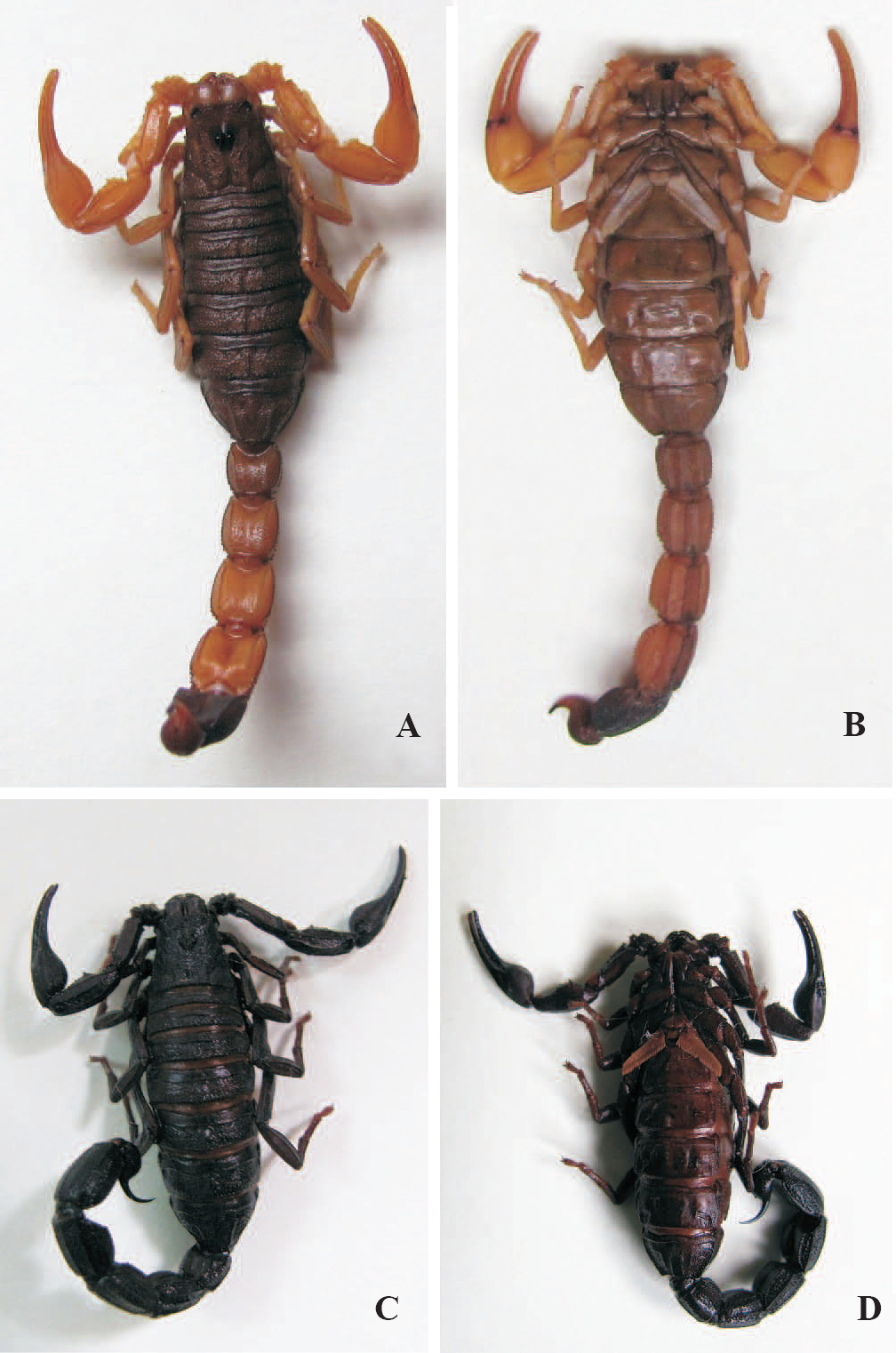
A-B. Habitus of Rhopalurus laticauda from Orocue, Casanare, (Llanos Orientales) Colombia (ICN-As-486); A. Dorsal view. B. Ventral view. C-D. Habitus of Rhopalurus laticauda from National Park El Tuparro, Vichada, (Llanos Orientales) Colombia, (ICN-As-404); C. Dorsal view. D. Ventral view.
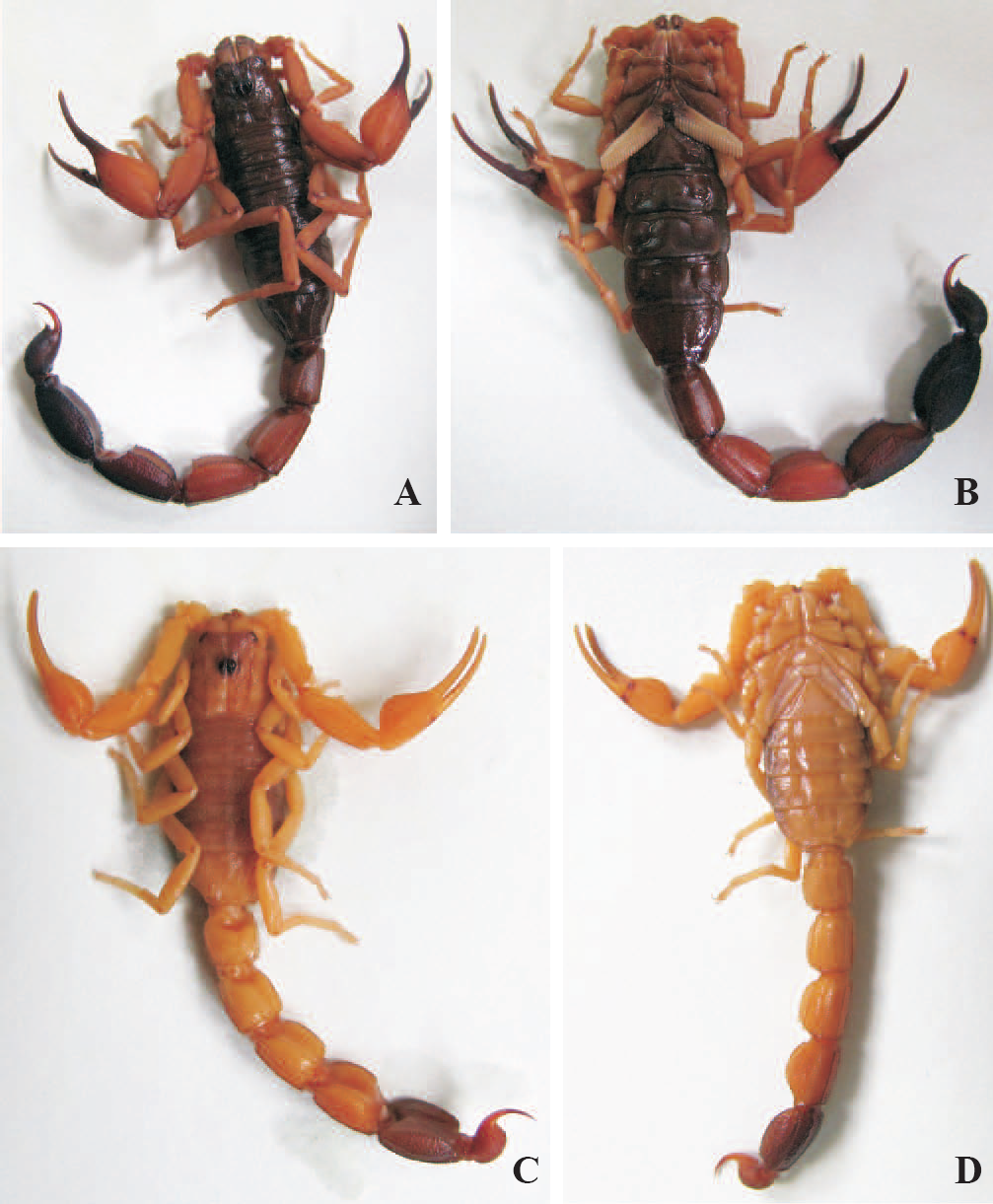
A-B. Habitus of Rhopalurus laticauda from Santa Marta, Magdalena (Caribean region) Colombia (ICN-As-669); A. Dorsal view. B. Ventral view. C-D. Habitus of Rhopalurus laticauda from Santa Marta, Magdalena (Caribean region) Colombia, (ICN-As-487); C. Dorsal view. D. Ventral view.
Comparative table of character among individuals of genus Rhopalurus from eastern Savannas and Colombian Caribbean region.
Eastern savannas.
On the other hand, the biogeographic argument outlined on the Roncallo and Teruel (2008) paper is a misconception of Kattan et al. (2004) study, since they consider a supposed biota separation between Caribbean region and Eastern Savannas correspond to subregions called in Kattan et al. (2004) as "Perijá-Sierra Nevada de Santa Marta" and the "eastern slope of the Andes", respectively. They overlooked the fact that Kattan et al. (2004) biogeographical analysis focused exclusively on the recognition of biogeographic patterns of the Andean regions (mountain) in Colombia, therefore not included the lowlands where are located the Eastern Savannas and the Caribbean region. The map 1 presented in Kattan et al. (2004), illustrates a precise biogeographical demarcation reported.
The information presented is congruent with by Lourenço (1993), Flórez (2001), and Botero-Trujillo and Fagua (2007), considering these disjoint populations as belonging to the same species, and therefore synonimize R. caribensis under R. laticauda.