






Abstract
A new species of
Introduction
Materials and methods
The examined specimens came from the entomological collection of Instituto de Investigación de Recursos Biológicos Alexander von Humboldt (IAVH), Villa de Leyva, Colombia. The samples were mounted and imaged with a Nikon SMZ25 stereomicroscope and DS-Ri2 camera with NIS Elements software at the New Jersey Institute of Technology (NIJT).
The terminology for external morphology follows Bolton (1994) for most body structures, as well as Harris (1979) for sculpture. Terms more specific to
Results and discussion
Key to workers of the species of Eurhopalothrix for Colombia (adapted from Longino, 2013a)
In profile, posterior face of propodeum with broad, rectangular lamella, not differentiated into acute propodeal spines (Fig. 1A); HW<0.6 ………….. 2
- In profile, posterior face of propodeum with distinct acute propodeal spines (Fig. 1B, C); HW variable … 3
Larger-sized species (HW 0.53–0.58); dorsal surface of the scape uniformly covered with scale-like, fully appressed setae, absence of differentiated setae projecting from the anterior margin of the scape; promesonotal profile elevated, three pairs of projecting pompon-like setae on promesonotum (Fig. 1B) …
-Smaller-sized species (HW 0.42-0.44); dorsal surface of scape with differentiated setae projecting from the anterior margin; promesonotal profile low, single pair of projecting pompon-like setae on promesonotum (Fig. 1A) …
Relatively small species (HW <0.56; CI = 96); basal pilosity conspicuous, spatulate; distinct erect setae, strongly spatulate, as wide as they are long; first gastral tergum with spatulate setae in double row, 4-5 pairs from the middle down, flanked by 2 or 3 additional setae …………..
- Relatively large species (HW> 0.55; CI > 95); other traits variable; not with the above combination of features … 4
Masticatory margin of mandible with double row of teeth, outer series of lower triangular teeth, inner row of 3 long, spiniform teeth; erect setae on face strongly spatulate; frons with a distinct raised median carina … 5
- Masticatory margin of mandible with single row of teeth; erect setae on face weakly spatulate to simple; frons without a distinct raised median carina … 6
Larger species (HW 0.83-0.94); basal lobe of scape less developed, SLI < 14; vertex of head straight to slightly convex; posterior mesonotum with pronounced longitudinal keel (Fig. 1C) …
- Smaller species (HW 0.57–0.66); basal lobe of scape strongly developed, SLI > 15; vertex of head strongly convex; posterior mesonotum lacking pronounced longitudinal keel …
Promesonotal dorsum with 3 pairs of large, broadly spatulate setae; projecting setae of face prominent, spatulate, of uniform size, strongly differentiated from ground pilosity; ground pilosity of face more or less uniformly distributed across frons, vertex lobes, and frontal carinae; first gastral tergite with 4 pairs spatulate setae, these of similar size and shape to those on face, distributed in two longitudinal rows …
- Promesonotal dorsum with 0-2 pairs of filiform to spatulate setae, clearly differentiated from ground pilosity; ground pilosity of face relatively thin and sparse; face often with pair of spatulate setae on outermost angles of sides of head, such that full complement of projecting setae is often 20; first gastral tergite with 4 pairs projecting spatulate setae …
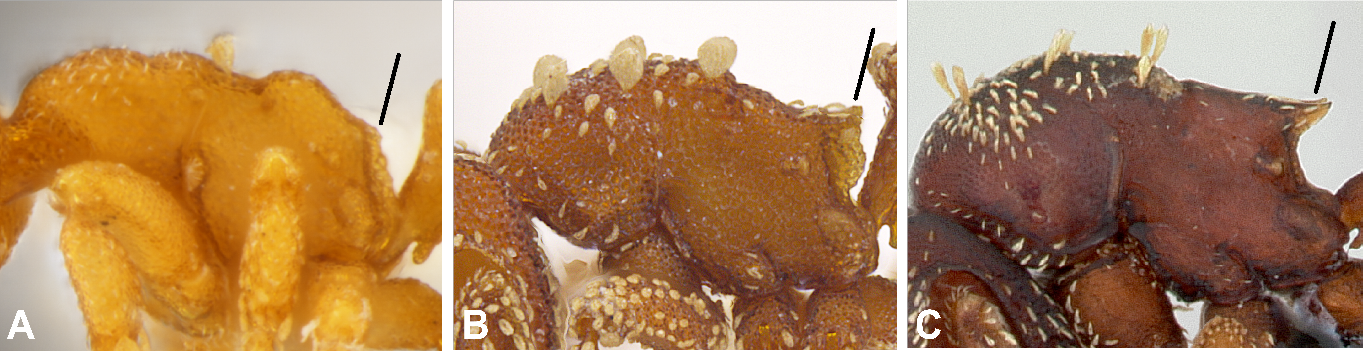
Propodeal spines in some Colombian
Taxonomy
Order: Hymenoptera Linnaeus, 1758
Superfamily: Formicoidea Latreille, 1809
Family: Formicidae Latreille, 1809
Subfamily: Myrmicinae Lepeletier de Saint-Fargeau, 1835
Genus:
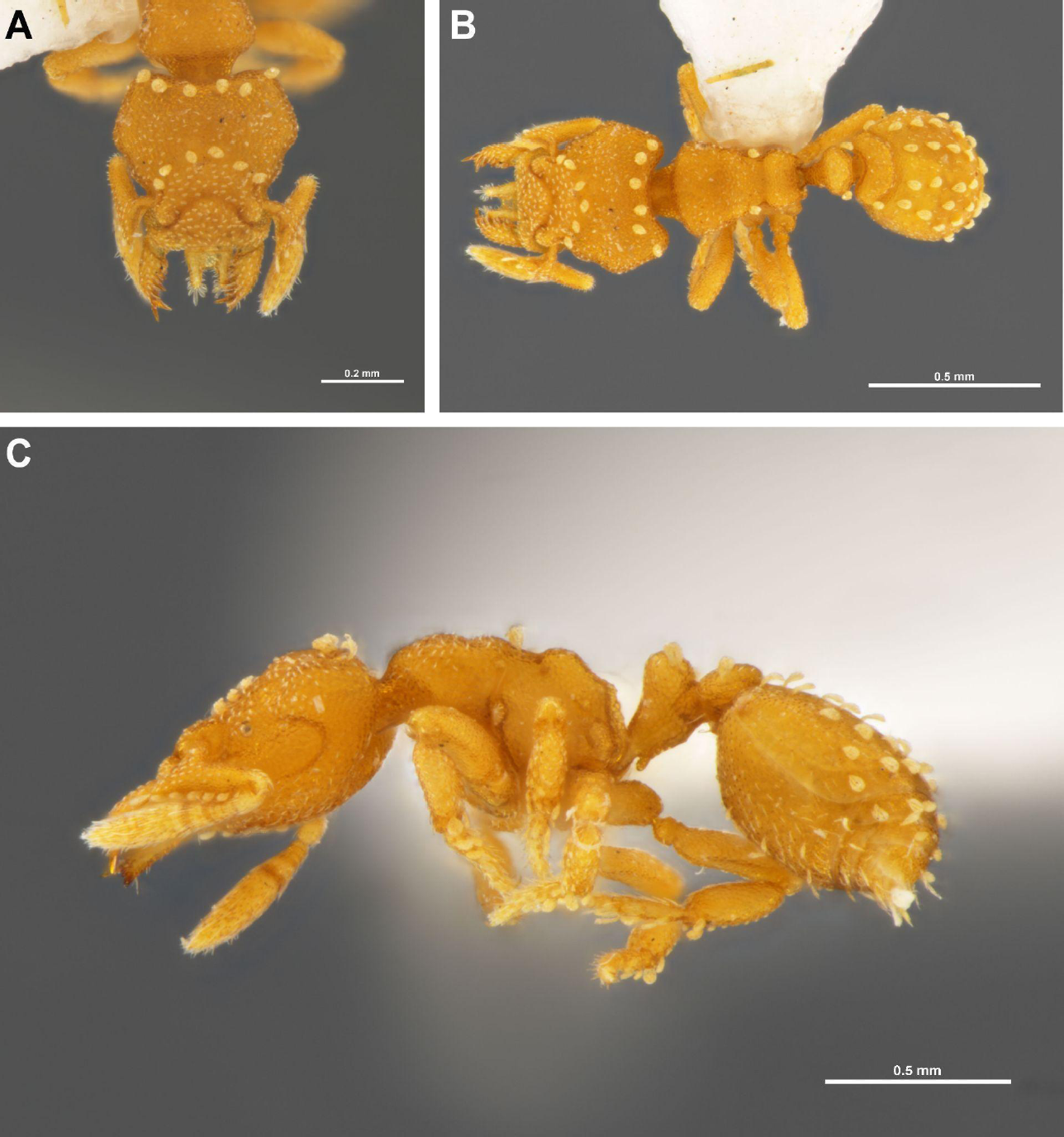
Eurhopalothrix amati Fiorentino, Tocora & Fernández, n. sp. (Fig. 2A, 2B, and 2C).
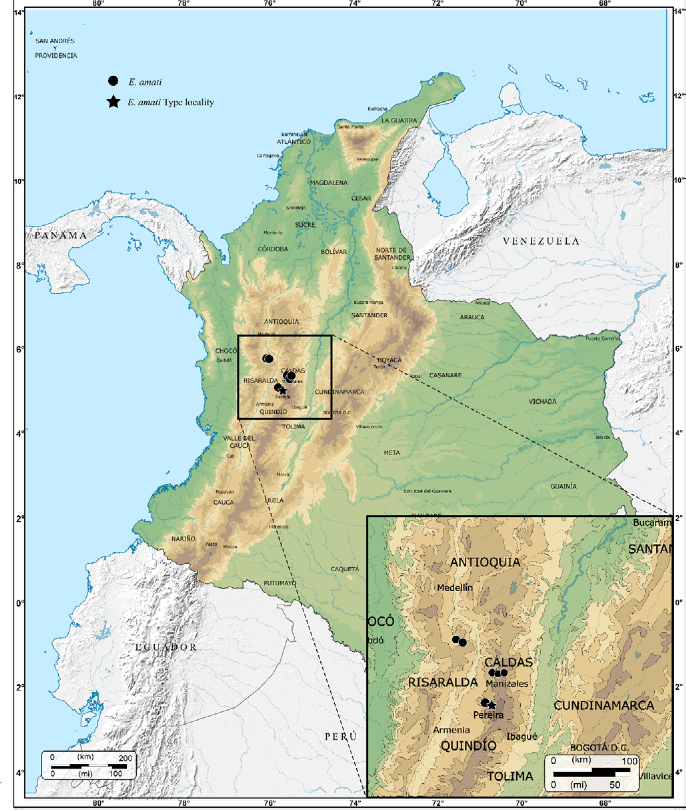
Geographic distribution of
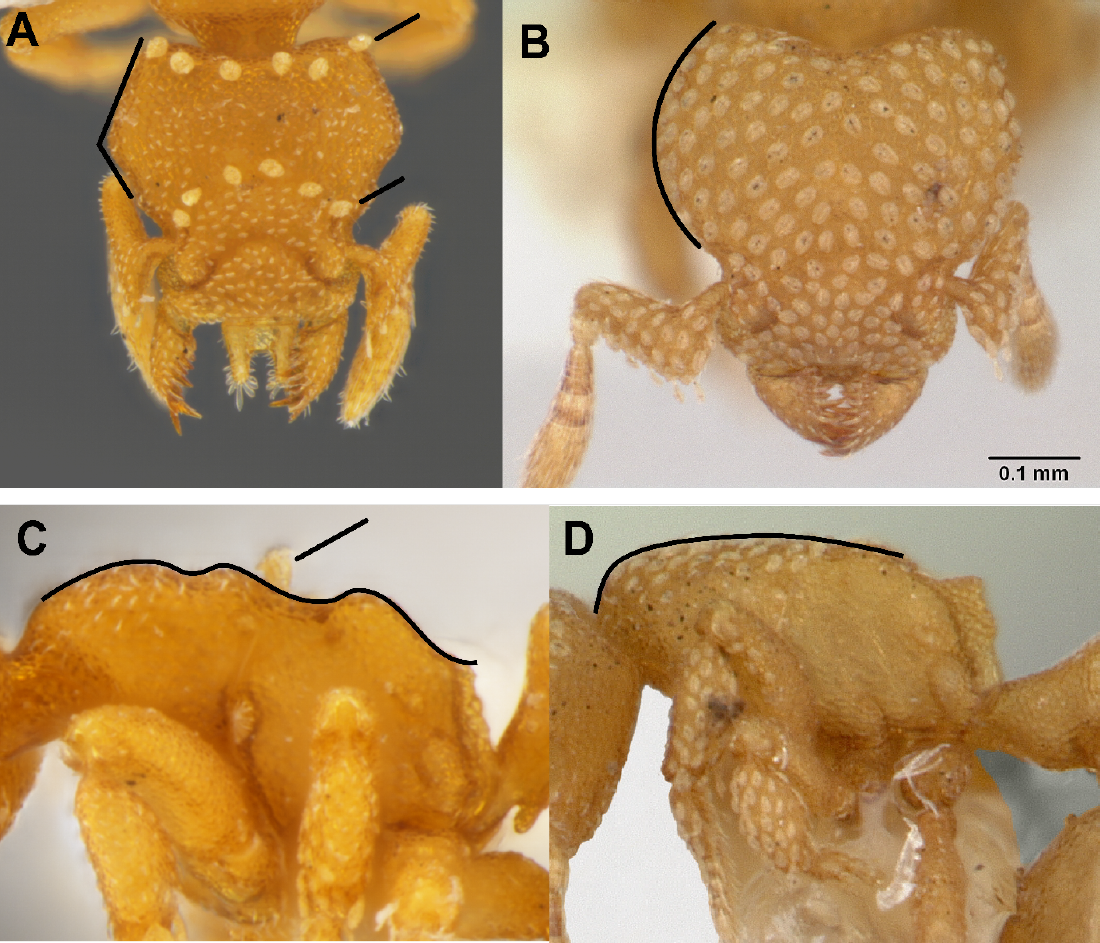
General differences between
Origin and funding
This study was performed at the Universidad Nacional de Colombia and was a self-funded endeavor by the authors.
Author contribution
GF, MCT wrote the paper. All authors contributed to the taxonomical description, read and approved the final manuscript.
Conflict of interest
The authors participating in this publication made significant contributions to the manuscript; all authors agree and express that there are no conflicts of interest in this study.
Footnotes
Acknowledgments
We would like to thank Dr. Jhon Cesar Neita of the Instituto de Investigación de Recursos Biológicos Alexander von Humboldt (IAvH), Villa de Leyva, Colombia for his collaboration granting access to the entomological collection. Many thanks to the anonymous reviewers whose comments helped improved the manuscript. Finally, we would like to again recognize Professor German Domingo Amat for inspiring us, and many, to continue studying the Colombian Biodiversity. He will be missed.