






Abstract
The objective of this study was to describe and illustrate the morphological characteristics of some species of Brazilian Fidicinoides to aid in their identification. Descriptions and illustrations are given of the head, thorax, abdomen, right forewing and the last urosternite of the male of the Fidicinoides besti, Fidicinoides brunnea, Fidicinoides duckensis, Fidicinoides pseudethelae and Fidicinoides sucinalae species. The main diagnostic characteristics of these species are markings on pronotum and/or mesonotum and male sternite VIII characteristics.
Introduction
According to Moulds (2005) the families Tettigarctidae and Cicadidae are grouped under the superfamily Cicadoidea. The family Cicadidae family includes some species of economic importance for Brazil (Metcalf 1963), mainly because some species infest coffee plantations (Martinelli and Zucchi 1989a, 1989b).
Fidicinini, within the Cicadinae, includes genera of Neotropical cicadas whose timbale organ is prominent displayed (Distant 1906). After a review of the tribe by Boulard and Martinelli (1996), the genus Fidicinoides was created, which is distinct from Fidicina in presenting narrow lateral-metascutellar plates that do not extend to the timbals and do not completely close the timbal chambers. Some species previously belonging to Fidicina were included in this genus. Currently the genus Fidicinoides is now composed of 35 described species, 18 originally described in the same and 17 that were the result of generic reassignment (Santos et al. 2010).
Morphological and occurrence studies of species of the genus Fidicinoides have been carried out by Boulard and Martinelli (1996), Sanborn (2008), Sanborn et al. (2008), Santos and Martinelli (2007, 2009a, 2009b) and Santos et al. (2010). These studies are important for the recognition and identification of cicada species, for the development of dichotomous keys, and for greater knowledge of the cicada fauna in Brazil and the New World. In this sense, the objective of this work was to characterise morphologically some species of Brazilian Fidicinoides, presenting illustrations of the head, thorax, abdomen, right forewing and male sternite VIII of the species F. besti Boulard and Martinelli, 1996, F. brunnea Boulard and Martinelli, 1996, F. duckensis Boulard and Martinelli, 1996, F. pseudethelae Boulard and Martinelli, 1996, and F. sucinalae Boulard and Martinelli, 1996, thereby complementing the characterisation of these species, originally described by Boulard and Martinelli (1996).
Material and Methods
The research was carried out between 2002 and 2004, studying specimens of cicadas from five Brazilian institutions (Fundação Oswaldo Cruz/FIOCRUZ, Rio de Janeiro (RJ); Instituto Nacional de Pesquisas da Amazônia/INPA, Manaus (AM); Faculdade de Ciências Agronômicas (FCA/UNESP), Botucatu (SP); Museu Nacional do Rio de Janeiro/MNRJ, Rio de Janeiro (RJ); Faculdade de Ciências Agrárias e Veterinárias (FCAV/UNESP), Jaboticabal (SP)) and one international institution (Muséum national d'Histoire Naturelle/MNHN, Paris, France).
Specimens were compared with their respective holotypes and paratypes, deposited in FCAV/UNESP. The studied specimens were placed in a humid chamber and afterwards, slides were made with the wings distended in a position oblique to the body. For the study of the male genitalia, the abdomen was separated with the aid of forceps, heated in a potassium hydroxide solution (KOH to 5%) in a water bath for approximately 30 minutes, periodically checking the clarification of the piece. Genitalia were then washed with distilled water in order to eliminate all the material from the inside of the body, for subsequent examination under a stereoscopic microscope (Carl Zeiss Jena® lenses). The genitalia were placed in labelled Eppendorf plastic tubes (4cm in height), containing glycerine (60%), and afterwards, compared to the descriptions made by Boulard and Martinelli (1996). The terminology adopted was based in Moulds (2005).
The structures for the morphological characterization of the species were illustrated with the aid of a camera lucida attached to the stereoscopic microscope. The following structures were illustrated: head and thorax (dorsal view), abdomen (ventral view), right forewing and male sternite VIII. Such illustrations are not present in the work of Boulard and Martinelli (1996). Illustrations of the male genitalia, the operculum, and of the right fore femur were all omitted, as they were given by Boulard and Martinelli (1996). All measurements were taken using a precision caliper.
Results and Discussion
Fidicinoides besti Boulard and Martinelli, 1996
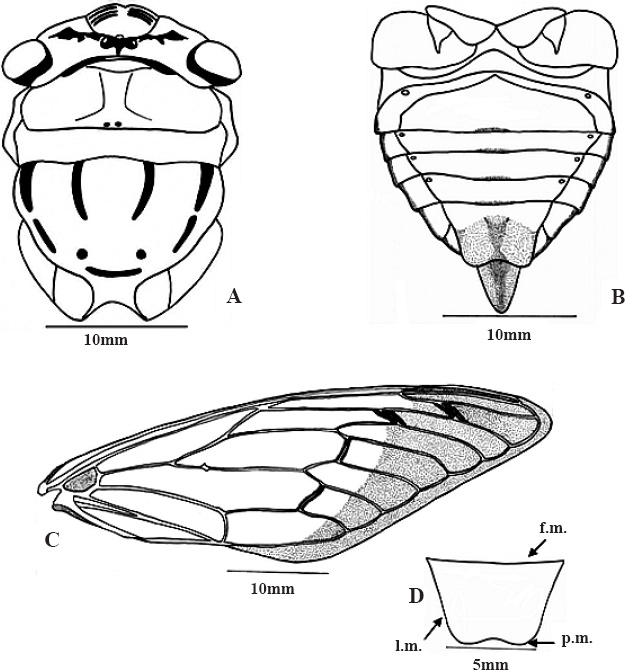
Head (Fig. 1A): lateral ocelli and medial ocellus situated on a black transverse irregular shaped band which extends to the base of the antennae and vertex; median ocellus in a subfrontal position; distance between lateral ocelli nearly two and half times the distance that separates them from the corresponding eyes; salient eyes, rounded, oblique, with joined sub-ocular marks; postclypeus dorsal portion short and arched; postclypeus face distinctly arched, ochre, with nine dark transverse ridges on both sides of the medial furrow; black anteclypeus; rostrum brownish, long, with the apex reaching the base of the hind trochanters.
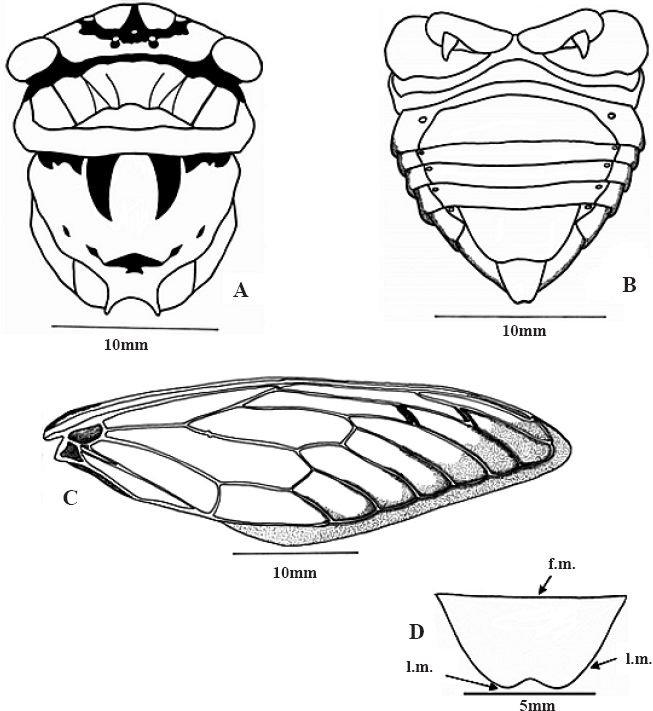
Fidicinoides besti: A. Head and thorax (dorsal view); B. Abdomen (ventral view); C. Right forewing; D. ♂ sternite VIII (f.m. – front margin anterior; l.m. – lateral margin and p.m. - posterior margin).
Thorax (Fig. 1A): pronotum longer than head; with four shallow furrows; lateral angle of pronotal collar poorly developed and brownish; mesonotum light brownish, with submedian sigilla dark brown well-defined and comma-shaped; the lateral sigilla light brown; a transverse, irregular-shaped stripe and two small black punctiform marks, above the cruciform elevation; cruciform elevation not very long, flattened and with the back apices short, rounded and close together (Fig. 1A); operculum very short, in small arched, ochre-coloured lamina.
Abdomen (Fig. 1B): a little shorter than the distance from the vertex to the back apices of the cruciform elevation; broad base, not tapering towards the last abdominal segment; ochre tergites; timbal cover dorsally short; sternites ochre, including the last abdominal segment; male sternite VIII twice as long as wide, with anterior margin almost straight, lateral margin oblique, and the posterior margin invaginated (Fig. 1D).
Forewing (Fig. 1C): hyaline; light brown fumose on the apical area; forewing with blackened basal cell; costal vein relatively short and ochre; veins ochre, becoming brownish in the apical area; the extremities of the veins with dark brown markings on both sides, and with deep brown infuscation on the radial and radiomedial crossveins; ambient vein dark brown; apical area octoloculate.
Examined material: BRAZIL. Amazonas: Amaná Lake. INPA. 17.IX.1979. (Best. R.), Holotype ♂; ibidem, 13.IX.1979, 5 paratypes ♂♂; Rio Negro. 28.VIII.1969. (several collectors), 1 ♂, ibidem, Humaitá. FCA/UNESP/Botucatu. X.1974. (Scivittaro), 3 ♂♂; ibidem, Ducke Reserve. INPA. 14.VIII.1969. (A. Faustino), 1 ♂; Rondônia: Porto Velho. INPA. 01.IX.1979, 07.IX.1979, 28.IX.1979. (J. Campbell), 7 ♂♂; ibidem, Vilhena. INPA. 06.XI.1979. (Penny and Arias), 1 ♂; Mato Grosso: Humbolt Reserve, Colina Highway. INPA. 26.IX.1975, 27.IX.1975, 03.X.1975. (L. P. Albuquerque and J. B. Moraes), 3 ♂♂; Pará: Cachimbo. FIOCRUZ. 09.X.1956. (Travassos, Oliveira and Adão), 4 ♂♂.
Comment: Medium-sized species, similar to F. brunnea, but distinguished by the submedian sigilla, being commashaped on the mesonotum.
Fidicinoides brunnea Boulard and Martinelli, 1996
Head (Fig. 2A): lateral ocelli and median ocellus situated on broad irregular-shaped black mark, that extends to the base of the antennae and vertex; medial ocellus in an almost frontal position; distance between the lateral ocelli nearly three times the distance that separates them from corresponding eyes; eyes slightly salient, oblique, with joined sub-ocular marks; postclypeus dorsal portion a little longer than the vertex, arched, ochre, darker on the sides; postclypeus face arched, brown, with eight transverse ridges on both sides of the medial furrow; black anteclypeus; rostrum long, brownish, with apex reaching the medial hind femur.
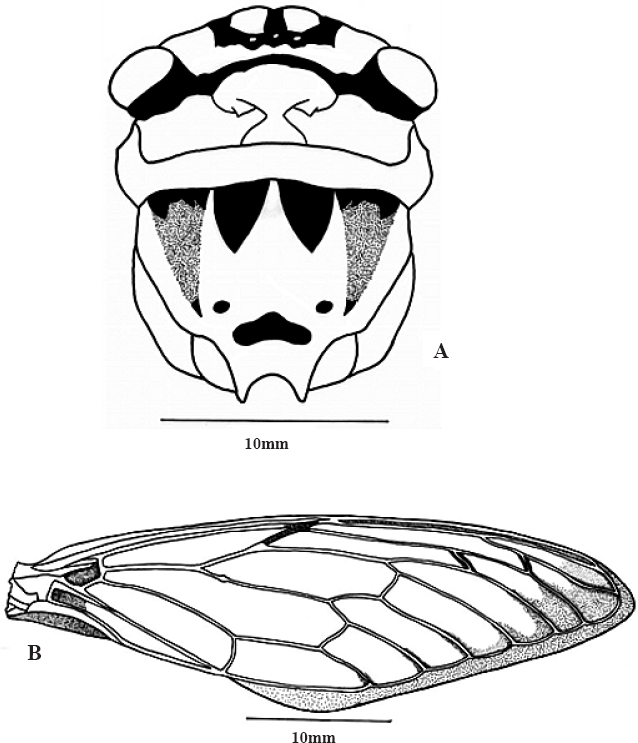
Fidicinoides brunnea: A. Head and thorax (dorsal view); B. Right forewing.
Thorax (Fig. 2A): pronotum longer than head; lateral angle of pronotal collar little developed; mesonotum brown, with green markings; lateral sigilla dark near the pronotum and on the distal extremities, with the central area lighter and comma-shaped; submedian sigilla short, dark and fusiform; a broad mark and scutal depression black above the long cruciform elevation, flattened, with posterior apices short, rounded and close together (Fig. 2A); very short operculum, flattened, covered with golden hairs.
Forewing (Fig. 2B): hyaline; light brown fumose in the apical area; forewing with basal cell opaque brown; brownish veins, darker in the apical area; the extremities of the veins marked with dark brown on both sides, with deep brown markings on the radial and radiomedial crossveins; ambient vein dark brown; apical area octoloculate.
Examined material: BRAZIL. Mato Grosso. FCAV/UNESP/Jaboticabal (Roppa and Alvarenga). 1 paratype ♂.
Comments: Medium-sized species, similar to F. besti, but distinguished by the short and fusiform submedian sigilla on the mesonotum.
Having previously been removed for the study of the genitalia, illustrations of the abdomen and male sternite VIII were not made.
Fidicinoides duckensis Boulard and Martinelli, 1996
Head (Fig. 3A): lateral ocelli and medial ocellus situated on an irregular-shaped broad black mark which extends to the vertex, not extending to the base of the antennae; median ocellus in a frontal position; distance between the lateral ocelli nearly twice the distance that separates them from the corresponding eyes; eyes salient and oblique, with discrete sub-ocular marks; long postclypeus dorsal portion, brownish and slightly arched; postclypeus face distinctly arched, ochre, with nine transverse ridges with black and light brown markings on both sides of the black medial furrow; black anteclypeus; rostrum ochre, long, with apex reaching the insertion of the hind femur.
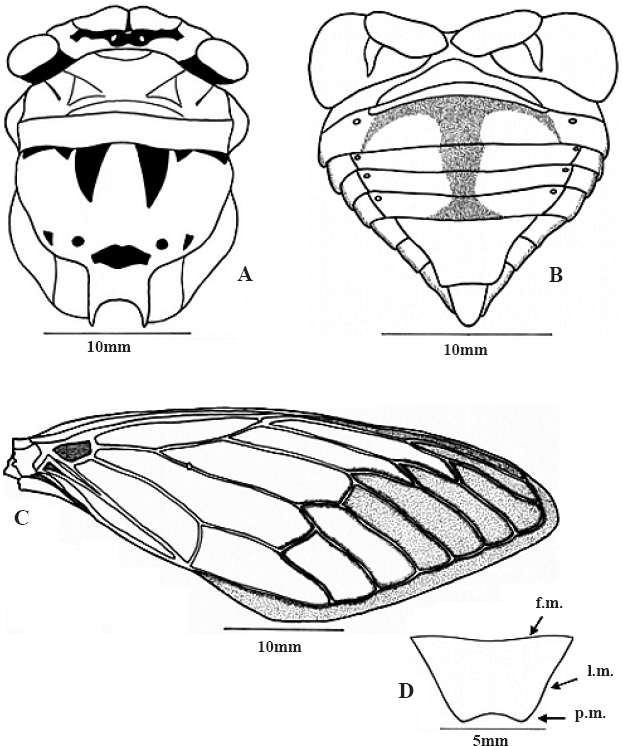
Fidicinoides duckensis: A. Head and thorax (dorsal view); B. Abdomen (ventral view); C. Right forewing; D. ♂ sternite VIII (f.m. – front margin; l.m. – lateral margin and p.m. - posterior margin).
Thorax (Fig. 3A): pronotum longer than head; lateral angle of pronotal collar poorly developed; mesonotum ochre, with soot black markings; lateral sigilla light coloured triangular-shaped outer markings, the base being two brownish irregular-shaped marks near the pronotum, central area colourless and two small marks at the apices; submedian sigilla triangular, broad, short and black, an irregular-shaped mark and two black punctiform marks above the cruciform elevation; cruciform elevation not very long, with posterior apices pointed and close together (Fig. 3A); operculum with short lamina, broad, arched, ochre-coloured lamina, with dark brown markings on the outer side.
Abdomen (Fig. 3B): a little shorter than the distance covered from the vertex to the back apices of the cruciform elevation; base wide, tapering in the direction of the last abdominal segment; brown and black tergites covered with golden hairs; timbal cover arched, dark brown; sternites brown, sparsely covered with golden and black hairs; male sternite VIII nearly twice as long as wide, with the front and side margins slightly concave and the back one having a half moon-shaped invagination, and the apices close together (Fig. 3D).
Forewing (Fig. 3C): hyaline; light brown fumose on the apical area; forewing with basal cell partially opaque and ochre coloured, costa long and of the same colour; veins ochre turning brown in the apical area, the extremities of the veins with fumose brown markings on both sides; infuscation on the radial and radiomedial crossveins and the ambient vein, slightly marked brown; apical area octoloculate.
Examined material: BRAZIL. Amazonas: Ducke Reserve. INPA. 13.VIII.1979. (H. M. Savage), Holotype ♂; ibidem, INPA. 11.II.1976. (B. C. Ratcliffe), 1 paratype ♀; ibidem, Humaitá. FCA/UNESP/Botucatu. X.1974. (Scivittaro), 1 paratype ♂; ibidem, Manaus. INPA. 04.VIII.1978. (Rodolfo), 1 paratype ♂; ibidem, 24.III.1982. (Latorre L. R.), 1 alotype ♀; ibidem, MN/RJ. 27.IX.1955. (Elias and Roppa), 1 ♂; ibidem, Humaitá. INPA. FCA/UNESP/Botucatu. X.1974. (Scivittaro), 1 ♂; Rondônia: Porto Velho. INPA. 20.VIII.1979, 01.IX.1979. (J. Campbell), 2 ♂♂; ibidem, 11.IX.1963. (Eduardo), 1 ♂; Mato Grosso: Humbolt Reserve. INPA. 26.IX.1975. (L. P. Albuquerque), 1 ♂; Pará: Cachimbo. FIOCRUZ. 09.X.1956. (Travassos, Oliveira and Adão), 1 ♂; ibidem, Rio Trombetas. INPA. 14.IV.1985. (J. E. Binda), 1 ♂.
Comments: Medium-sized species, similar to Fidicinoi des poulaini Boulard and Martinelli 1996, but distinguished by male sternite VIII having the anterior and lateral margins slightly concave.
Fidicinoides pseudethelae Boulard and Martinelli, 1996
Head (Fig. 4A): lateral ocelli and the medial ocellus situated on an irregular-shaped, broad black mark which stops short of the base of the antennae and vertex; median ocellus in frontal position; distance between the lateral ocelli nearly three times the distance that separates them from the corresponding eyes; eyes in short ellipsoids, wide, oblique, with subocular joined marks; postclypeus dorsal portion short and arched; postclypeus face arched, brown, with nine transverse ridges on both sides of the medial furrow; anteclypeus black; rostrum brownish, long, with apex reaching the level of the insertion of the hind trochanters.
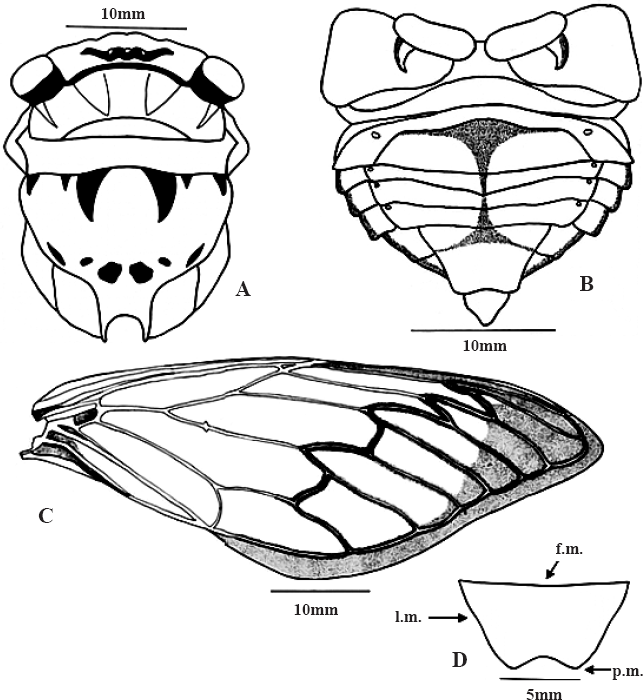
Fidicinoides pseudethelae: A. Head and thorax (dorsal view); B. Abdomen (ventral view); C. Right forewing; D. ♂ sternite VIII (f.m. – front margin; l.m. – lateral margin and p.m. - posterior margin).
Thorax (Fig. 4A): pronotum longer than the head; lateral angle of pronotal collar poorly developed; mesonotum brown, with black markings; lateral sigilla triangular, dark near the pronotum and apices, lighter in the central area; submedian sigilla short, dark and curved; two joined or separated, irregular-shaped markings, scutal depression with almost circular black marks; cruciform elevation flattened, with posterior apices short, pointed and close together (Fig. 4A); operculum with short lamina, with wide, slightly arched, ochre and brown lamina.
Abdomen (Fig. 4B): Shorter than the distance from the vertex to the back apices of the cruciform elevation; broad base, tapering in the direction of the last abdominal section; blackened tergites; black timbal cover, arched and with black markings; brownish sternites with green markings; male sternite VIII nearly twice as wide as long, with the anterior margin almost straight, lateral margin oblique, with a concavity approximately midway, posterior margin concave and rounded, with apices apart from one another (Fig. 4D).
Forewing (Fig. 4C): hyaline; dark brown fumose on the apical area; forewing wide, with basal cell opaque, black; costa long and brownish, becoming brown at the apical area; the extremities of the veins with dark brown fumose markings on both sides; radial, radiomedial, medial and mediocubital crossveins with strong dark brown infuscation, the ambient vein also being the same colour; apical area octoloculate.
Examined material: FRENCH GUIANA. MNHN/Paris. 25.IV.1992. (M. Thouvenot), 1 paratype ♂; ibidem, 16.XII.1992. 1 paratype ♀; BRAZIL. Pará: Cachimbo. FIOC. 21.IX.1955, 18.I.1956. (L. Travassos and S. Oliveira), 4 ♂♂; ibidem, 09.X.1956. (Travassos, Oliveira and Adão), 35 ♂♂; ibidem, Amazonas: Humaitá. FCA/UNESP/Botucatu. X.1974. (Scivittaro), 4 ♂♂; ibidem, Rio Juavá. INPA. 02.VIII.1980. (Francisco, B.), 1 ♂; Rondônia: Porto Velho. INPA. 26.I.1980. (P. Arias and J. Arias), 1 ♂.
Comments: Large-sized species, similar to Fidicinoides dolosa Santos and Martinelli 2009 but distinguished by the submedian sigilla being comma-shaped internal marks on the mesonotum.
Fidicinoides sucinalae Boulard and Martinelli, 1996
Head (Fig. 5A): lateral ocelli and medial ocellus situated on a long irregular-shaped black band, that stops short of the base of the antennae and vertex; median ocellus in sub-frontal position; distance between the lateral ocelli nearly three times the distance separating them from the corresponding eyes; eyes salient with sub-ocular discrete marks; postclypeus dorsal portion long, curved, with nine brownish transverse ridges on both sides of the medial furrow; anteclypeus black; rostrum long, ochre, with apex extending between the second and third pair of legs.
Fidicinoides sucinalae: A. Head and thorax (dorsal view); B. Abdomen (ventral view); C. Right forewing; D. ♂ sternite VIII (f.m. – front margin; l.m. - lateral margin and p.m. - posterior margin).
Thorax (Fig. 5A): pronotum longer than the head; lateral angle of pronotal collar poorly developed; two punctiform black markings on the posterior part of the internal area; mesonotum light brown with four dark streaks, lateral sigilla long, narrow and discontinuous; submedian sigilla equally narrow, curved and short; one narrow, long black markabove the cruciform elevation; scutal depression black; cruciform elevation broad, flattened, with posterior apices not prominent and apart from each other, at the level of the mesocutellar expansions (Fig. 5A); operculum with short lamina, broad, arched lamina with ochre-coloured markings.
Abdomen (Fig. 5B): a little shorter than the distance from the vertex to the posterior apices of the cruciform elevation; base equal to the width of the thorax, slightly tapering; brown tergites; timbal cover bordered with black on the front part; sternites ochre, except the eighth, which is darker brownish; last abdominal segment light brown; male sternite VIII nearly one and a half times wider than long, anterior margin almost straight, outer margin oblique and slightly concave, posterior margin with non-pronounced invagination, and apices apart from each other (Fig. 5D).
Forewing (Fig. 5C): hyaline; light brown fumose on the apical region; forewing with basal cell opaque, brown; costa long, ochre; veins ochre turning brown at the apical region; radial, radiomedial, medial and mediocubital crossveins with deep brown infuscation; apical area octoloculate.
Examined material: BRAZIL. Amazonas: Humaitá. FCA/UNESP/Botucatu. 3.VII.1975. (L. C. Petri), holotype ♂; ibidem, 4 paratypes ♂♂; ibidem, 1 paratype ♂; ibidem, IX.1973. (Scivittaro), 3 paratypes ♂♂; ibidem, X.1974, 2 paratypes ♂♂; Rondônia: Porto Velho. INPA. 21.VIII.1979. (J. Campbell), 1 paratype ♂; FCA/UNESP/Botucatu. 24.X.975. (A. A. G.), 1 paratype ♂; Pará: Cachimbo. FIOCRUZ 21.IX.1955. (L. Travassos and S. Oliveira), 2 ♂♂; ibidem, 09.X.1956, (Travassos, Oliveira and Adão), 1 ♂; Without location. INPA. 11.IX.1963. (Eduardo), 1 ♂.
Comments: Medium-sized species, having two marks, adjoined or discrete on the posterior margin of the inner region of the pronotum, as well as having long and discontinuous external markings of the mesonotum.
Footnotes
Acknowledgments
To Allen F. Sanborn Ph.D. (Barry University, Miami Shores, USA) for the revision of the manuscript, and the curators for providing specimens of Cicadidae for study.