






Abstract
Branches of coffee-plant were collected in São Sebastião do Paraíso County, Minas Gerais State, at the Experimental Station of the Agricultural Research Company (Empresa de Pesquisa Agropecuária de Minas Gerais - EPAMIG), with the aim of studying various aspects of oviposition by Quesada gigas (Hemiptera: Cicadidae). The number of branches with Q. gigas egg nests was analyzed, as well as the number of nests per branch, the eggs per nest and the diameter of the egg nest location on the branch. The preference for oviposition either on alive or dry branches and the size of the egg were assessed. Egg-laying occurred only on dry branches. The mean of the branch diameter on which the egg nests occurred was 2.5 ± 0.53 mm. The number of eggs per nest averaged 13.2 ± 4.9, and the number of egg nests per branch was 2.2 ± 1.74. The eggs were 1.9 ± 0.08 mm long by 0.5 ± 0.04 mm wide. The largest diameters of the branches containing egg nests were found on the upper third of the trees, as well as the greatest amount of branches with egg nests, of egg nests per branch and of eggs per nest. The correlation relationship between all of the experiment variables was positive.
Introduction
In Brazil, the occurrence of cicadas (Hemiptera: Cicadidae) on coffee plants Coffea arabica L. (Rubiaceae) causes damage when the nymphs occupy the plant roots. The species most often responsible for coffee plant damage are Quesada gigas (Olivier, 1790), Fidicinoides pronoe (Walker, 1850), Carineta fasciculata (German, 1830), Carineta spoliata (Walker, 1858), Carineta matura (Distant, 1892), Dorisiana drewseni (Stål, 1854) and Dorisiana viridis (Olivier, 1790) (Martinelli and Zucchi 1997).
Souza et al. (1983) found that when holes were dug around infested coffee plants in the region of São Sebastião do Paraíso, state of Minas Gerais, Q. gigas and Fidicina sp. were found in 87% and 13% of the holes, respectively. In severely affected coffee plantations from the south of Minas Gerais state, an average of 242 moving nymphs were found per dug hole as many as 540 nymphs per hole were found on one occasion (Souza 2003).
The most damaging species for coffee tree plants is Q. gigas, which, in the nymph stage, requires a large amount of sap from the plant roots to complete its development (Souza et al. 2007). The infestation of this species in coffee crops is concentrated in some municipalities from Alto Paranaíba region, including the south of Minas Gerais state or more precisely São Sebastião do Paraíso and neighbouring municipalities. Thus, this region constitutes a center of infestation for all coffee tree plantations in this region (Martinelli 2004). The cicadas cause damage to mature crops and millions of coffee plants become infested to some extent (Souza et al. 2007).
Once oviposition is completed, some species use a type of wax to cover the opening created by the penetration of the ovipositor. This makes it difficult to locate the nests on the branches (Osborn and Metcalf 1920) and necessitates the manual opening of the branches in order to find the eggs. The discovery of the eggs is essential since they can indicate an infestation in a specific area.
Although recognized as a significant pest, studies concerning the biology Q. gigas on coffee plants have not been reported. Furthermore, little information about the behaviour and interaction of Q. gigas with its host are known. Such knowledge is crucial for the development of management techniques to control this pest. In the present study, the aim was to gather information related to oviposition by Q. gigas on coffee plants.
Materials and Methods
The experiment was set up in two areas of the Experimental Station of Minas Gerais Agricultural Research Corporation (EPAMIG) located in São Sebastião do Paraíso County 20°54′S 46°59′W 940 masl. This area has an average annual rainfall of 1,627 mm (Cwa). Two areas of approximately 1 hectare each were used. Area I contained plants of cultivar Catuai IAC 99 and area II contained plants of cultivar Acaiá Cerrado MG 1474. The plants were 10 and 13 years old, respectively, and grown in a dense system of cultivation.
Branches were collected on October 22nd and on November 4th and 27th in 2008. Based on reports by professionals of EPAMIG, who registered the flights of Q. gigas during this time, these collection dates corresponded with the period of the greatest incidence of cicada adults for the above mentioned location.
Starting from the center of each plot, the sampling points were distributed every 10 meters, in the north, south, east and western radii, up to 50 meters. At each sampling point, the respective plant was sampled along with one plant to the right on the same line. The collection points of each block refer to the four radii with the same distance in relation to the center, totalling five blocks for each area and four repetitions per block (Fig. 1).
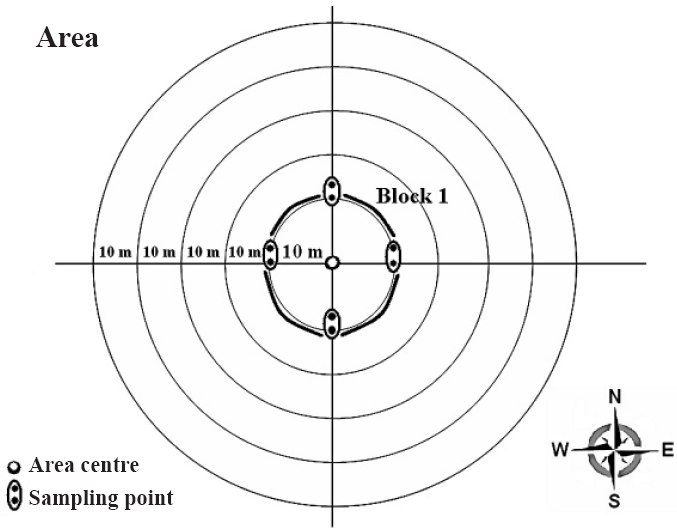
Distribution of the sampling points by block in each analysed area. São Sebastião do Paraíso, Minas Gerais, Brazil. 2008.
Dry branches 40 cm long from the apex were collected. For branch collection, the coffee plant was divided into thirds. Two branches were removed from each upper, medium and lower third of the two sampled plants. In total, from the two areas, 40 points and 80 plants were sampled, totalling 1,440 dry branches for the experiment. To confirm only the dry branches as egg-nest oviposition substrates, 300 live branches of full physiological activity were also collected in the same areas and from different thirds of the coffee plant height.
The sampled plants had already been harvested of coffee grains, such that a considerable proportion of dry branches were available, to the detriment of the live and physiologically active branches. To eliminate potential interference, the plants were located far away from hedges and trees as well as from legal reservations or permanent preservation areas that host cicadas of the Q. gigas species.
The method of evaluation included the longitudinal opening of each branch with a blade, so that the wood fibers of the branch were carefully revealed in a manner that would not cause damage to the egg nest. The branches were analyzed very soon after collection to ensure that possible egg hatchings would not result in an underestimation in the counts of oviposition and eggs.
The number of branches with egg nests, the number of egg nests per branch, the number of eggs present in each egg nest and, using a paquimeter of 0.05 mm precision, the branch diameter at the location in which the egg nests were found were measured. For a sampling of 40 Q. gigas eggs that were collected, the length and width was measured, using a graded eye-piece attached to a stereoscopic microscope. The experiment was based on the first treatment (I), in accordance with the upper, middle and lower thirds, and secondary treatment (II), referring to the period of the branch collection.
The experiment design was based on entirely random blocks with two treatments and five repetitions per block, in the 3 x 3 factorial design. The values of the averages obtained in the experiment were transformed into the natural logarithm of x + 5 to diminish the coefficients of variation and stabilize the variances. The data was then subjected to the F test and the Tukey test, at a 5% probability level. To determine a relationship between the variables, a calculation of correlation was performed. The AGROESTAT v.1.0 program (Barbosa and Maldonado Jr., 2008) was used. The measurements presented in the text represent the mean ± standard deviation.
Results and Discussion
No egg nests were found in the 300 live branches analyzed, indicating a non-preference for Q. gigas oviposition in live branches. Of the 1440 dry branches analyzed, a minimum of one egg nest was found on 109 branches, representing 7.57% of the total dry branches analyzed. According to this result and in agreement with Souza et al. (2007), the Q. gigas egg nests occur exclusively on dry branches. With an absence of leaves, the dry branches facilitate the movement of the Q. gigas adults and provide necessary substrates for the oviposition to occur. According to Fonseca (1945), this preference for dry branches during oviposition may be explained by the absence of sap which, when present, is capable of making the eggs unable to hatch.
In total, 241 egg nests of Q. gigas were counted, with 2.2 ± 1.74 nests per branch. However, the greatest frequency of nest-containing branches contained only one egg nest (51%). The number of eggs per nest was 13.2 ± 4.9, providing a total of 3,181 eggs at the experiment.
The Q. gigas egg nest is endophytic and difficult to locate since the female cover the opening where the ovipositor was inserted. This seals the egg nest inside the branch and leaves no apparent mark. As there is not an entrance to permit access to the egg nest, this constitutes an adaptation to protect against possible predators, parasites, pathogens and rainwater. In general, the ovipositor insertion into the branch occurs a short distance below the apical node of each internode. The ovipositor is inserted into the branch core at nearly one centimeter towards the base of the internode, and thus indicates that the female positions her body parallel to the branch axis with her head pointing towards the branch's apical region. The arrangement of the Q. gigas eggs in the egg nest occurs in a double line, with each egg being placed after the previous one and alternating the sides with an inclination angle relative to the branch axis (Fig. 2).
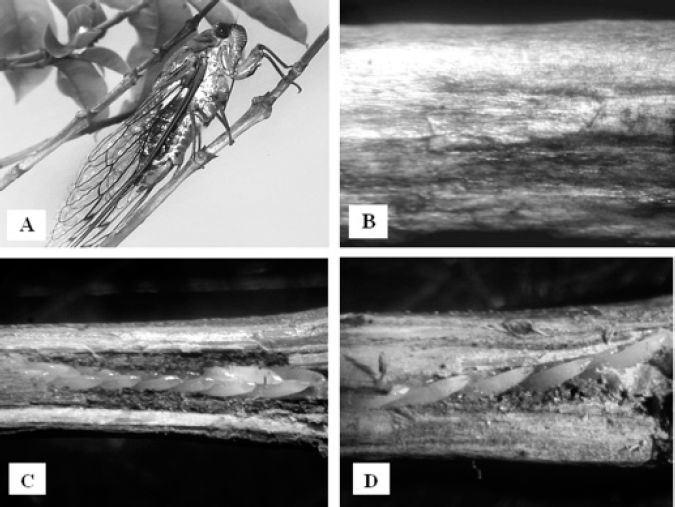
Oviposition by Quesada gigas on a dry coffee-plant branch. A. Female depositing eggs inside the branch. B. Insertion point of ovipositor that was sealed after egg-laying. C. Mass of eggs shown from upper view. D. Mass of eggs shown in lateral view. São Sebastião do Paraíso, Minas Gerais, Brazil. 2008.
The eggs are milky white in color and spindle-shaped. The eggs measured eggs being 1.9 ± 0.08 mm long and 0.5 ± 0.04 mm wide (Fig. 3). These measurements are consistent with the size of the Q. gigas nymphs of the first instar shown in Maccagnan and Martinelli (2004). Depending on the developmental stage of the embryo, it is possible to see the eyes through the chorion as well as the completely-formed nymph during later developmental stages.
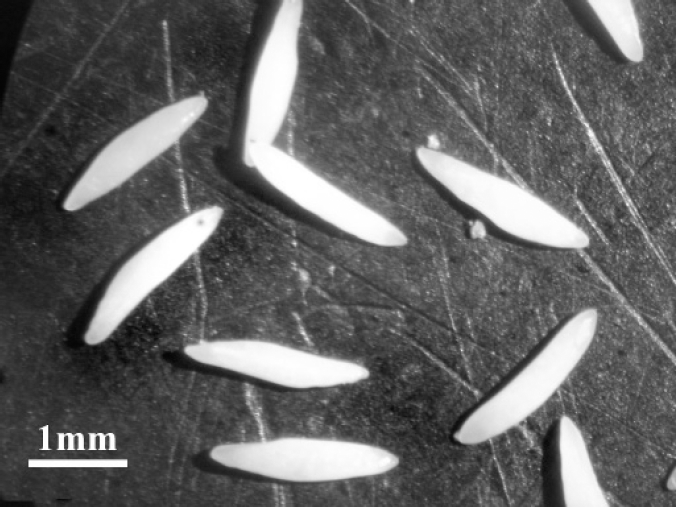
Quesada gigas eggs collected from dry coffee-plant branches. Scale: 1 mm. São Sebastião do Paraíso, Minas Gerais, Brazil. 2008.
In both of the areas studied, the vertical distribution of the egg nests on the coffee plant indicated an insect preference for the upper third of the plant. The upper third had a larger average of egg nests, and this difference from the middle and lower thirds was statistically significant at a 5% probability level using the Tukey test (Fig. 4; Table 1). The upper third of the plant is where the largest number of plagiotropic branches producing coffee occur (Sany et al. 2009). Many leaves are lost from these branches during harvest, causing the branches to dry out. This may explain the insect's preference. Furthermore, the presence of dry branches can also be attributed to physiological and nutritional disturbances, the action of pathogenic agents and attack by pests.
Means of the values transformed from branches with Quesada gigas egg nest on the thirds of the coffee-plant for areas I and II. São Sebastião do Paraíso, Minas Gerais, Brazil. 2008.
Transformed means of the values [ln(x+5)], followed by the same letter in the same column, do not differ with the Tukey test, to the level of 5% probability.
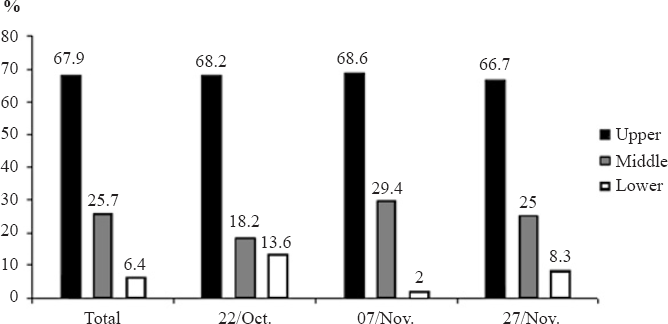
Percentage of branches with Quesada gigas egg nest in the two areas of the experiment, in different thirds of the coffee plant height and in the collection periods of the branches. São Sebastião do Paraíso, Minas Gerais, Brazil. 2008.
In the coffee-growing regions of Minas Gerais, harvesting occurs predominantly between the months of June and August (Matiello et al. 2005). This period precedes the appearance of Q. gigas adults, which occurs in September (Martinelli and Zucchi 1987; Martinelli 2004). The concurrency between the availability of oviposition substrate, supplied by the quantity of dry branches, and the period in which the reproduction of Q. gigas occurs is an important factor that favors pest infestation.
In area II of the experiment, due to the periods in which collection took place, there was a difference in the average number of branches with egg nests. The averages from the second and third collections were greater, with 1.65 and 1.64 transformed values, respectively, compared to the first collection with 1.62, according to the Tukey test. The increase in the number of branches with egg nests in the collection made on November 7th relative to the collection on October 22nd is probably associated with the accumulation of oviposition by Q. gigas adults. This level was likely sustained for the collection made on November 27th because the majority of egg-laying activity had occurred prior to the date of the second collection. Thus, at that time, the cicada population was already diminished.
The diameter of the location on the dry branches on which the Q. gigas egg nests was present were found averaged 2.5 ± 0.53 mm. In this manner, the egg nests occurred mainly among the first 20 centimeters of the branch's apical extremity.
In area I, differences in branch diameter size were noted upon comparing the thirds of the coffee plants (Table 2). In area II, there were differences between the averages of the diameter sizes compared with the thirds of the plants and compared with the averages corresponding to the collection period of the branches, as the branches were larger at the second collection. Q. gigas prefer the upper third of the plant for egg-laying and the female oviposits on larger diameters to avoid the overlapping of different egg nests. This fact is confirmed by the increase in branch diameter where the egglaying occurs over time.
Means of the transformed values of the diameters found at the location of the Q. gigas egg nest in the branches, in relation to the thirds of the plants in areas I and II. São Sebastião do Paraíso, Minas Gerais, Brazil. 2008.
Transformed means of the values [ln(x+5)], followed by the same letter in the same column, do not differ with the Tukey test, to the level of 5% probability.
Interactions were observed, by means of correlation calculation, revealing a positive correlation between all the experiment variables (Table 3). Thus, any increase of a certain variable will result in the increase of the others.
Correlation between the studied variables in area II, involving Q. gigas oviposition. São Sebastião do Paraíso, Minas Gerais, Brazil. 2008.
F Test to the level of 1% significance.
The presence of dry branches in coffee plantations where Q. gigas occurs may indicate susceptibility. These plants may serve as hosts for Q. gigas egg nests and, consequently, nymphs of its species. Therefore, as a first effort to reduce Q. gigas egg-laying, removal of dry branches from the crops is necessary. These branches must be collected on the upper third of the coffee plant, which is the preferred egg-laying location. The branches of the upper third are suitable for egg-laying spatial distribution studies aimed at Q. gigas management, studies of species biology under laboratory conditions, studies of infections by entomopathogenic fungus and many others studies involving species egg nests. The greater the dry branch diameter collected, the greater the likelihoods of finding egg nests. Furthermore, future research concerning the use of eggcide products for Q. gigas control must first consider the species' endophytic oviposition on dry branches.
Footnotes
Acknowledgements
To Darlan Einstein do Livramento and Eguimar Pereira Xavier, from EPAMIG, and their whole Experimental Station for their support. To Tomomassa Matuo and Tomás Kanashiro Matuo, from IDEIA Enterprise, for their assistance offered during the work. To Walter Maldonado Junior, from FCAV/UNESP, for his help on the experiment design. To Revista Colombiana de Entomología staff for the opportunity to send the present work. To the suggested evaluators for the analysis. To Universidade Estadual Paulista for its support.