






Abstract
The diamondback moth Plutella xylostella is an important pest of cruciferous plants, particularly of cabbage (Brassica oleracea var. acephala). The activity of an ethanolic leaf extract of Annona muricata on the development of the larvae and pupae of a laboratory culture of P. xylostella was evaluated, together with the seasonal variation of this activity. Neonate larvae were fed with kale leaf discs that had been treated by immersion in solutions of A. muricata extracts, and the effects on the duration and viabilities of the larval and pupal phases of the insect were determined. The activities of the extracts varied significantly according to the time of collection of the leaf material and were maximal for leaves collected during the dry period of the year (October-February). At the highest concentration tested (5 mg.ml-1), the most active extract caused 100% larvae mortality; at lower concentrations, the duration of the larval phase was increased by up to 2.6 days and the larvae survival was significantly reduced. The pupal phase was affected far less by exposure to the extracts, although such duration was increased by up to 1 day in the presence of non-lethal concentrations. The significance of these results with respect to the use of extracts of A. muricata for their insecticidal activity is discussed.
Introduction
The cabbage or diamondback moth Plutella xylostella (Linnaeus, 1758): Lepidoptera, Plutellidae, known in Brazil as "traça-das-crucíferas", is one of the main pests of Brassica crops and is to be found throughout the country (Castelo Branco y Quimarães 1990). The larvae of this insect feed on the epidermis of Brassica leaves, particularly of kale and cabbage (Gallo et al. 2002), and, depending on the region and on the time of planting, can cause a considerable reduction in the commercial value of the crop (Villas Bôas et al. 1990). Commonly employed tactics for the control of this pest require the application of synthetic insecticides at a frequency of up to three times a week (Castelo Branco 1998). More acceptable methods of insect control are, however, available and include the use of natural insecticides extracted from plants (Jacobson 1989), particularly within the context of an integrated pest management program.
Numerous plant extracts have been screened for their lethal, repellent, ovicidal, anti-feedant and anti-fertility activities against insects, and, perhaps most significantly, for their effects on insect hormonal systems (Hill 1990). The results obtained, however, have shown divergence not only with plant species but also with the part of the plant assayed, the age of the specimen when harvested, the time of collection and the precise form of extraction. Thus, Kumar et al. (2000) found a large variation in the insecticidal activity against the second instar of P. xylostella of seeds obtained from 38 Neem trees growing in six localities. Such variations could be directly attributed to qualitative and quantitative differences in the chemical compositions of the seeds.
Along with their importance as sources of food materials and of popular medicaments, many members of the Annonaceae are also valued as insecticides (Leatemia and Isman 2004b; and Isman 2006; Seffrin et al. 2009). Indeed, according to Hernández and Angel (1997), about 29 species of Annonaceous plants exhibit insecticidal properties. Components with insecticidal activity have been isolated from both the leaves and the fruits of annonaceous plants and have typіcally been found to be acetogenins and alkaloids (González Esquinca et al. 2002; Isman 2006). Compounds with insecticidal activity are particularly abundant in the genus Annona, having been detected in no fewer than 13 species. In this context, the species Annona muricata L. (Annonaceae), commonly known as graviola, originates from Central America and is widely cultivated because of the commercial value of its edible fruit (Bories et al. 1991).
There have been very few studies concerning plants that exhibit potential for the control of the cabbage moth, and none that have examined the variability of such insecticidal activity through the growing season. For this reason, the aim of the present work was to evaluate the larvicidal potential of extracts of leaves of A. muricata in the control of P. xylostella, and to determine seasonal variation activity of the leaf material through the calendar year.
Material and Methods
Plant material and preparation of plant extracts
Specimens of A. muricata were harvested from a commercial plantation located at the Sítio Aldeia Verde in Maceió (Alagoas, Brazil) and identified by Cícero Barros (Instituto do Meio Ambiente do Estado de Alagoas - IMA, Maceió, Alagoas, Brazil). A voucher specimen was deposited in the herbarium at IMA with the identification number 8530. Samples consisting of both young and mature leaves were collected in October 2001 for the larvicidal study, and on the 17th day of each month between April 2002 and March 2003 for the seasonal evaluation of extracts. Data concerning the levels of precipitation during this period were obtained from the meteorological station of the Centro de Ciências Agrárias, Rio Largo, Alagoas, Brazil (9º27'S 35º27' W 127 m.a.s.l).
A crude extract of the leaves of A. muricata was prepared by steeping freshly comminuted material (200g) in 95% ethanol (1L) in a glass flask maintained at room temperature (26± 1°C) for 72h. The ethanolic mixture was filtered and concentrated under reduced pressure using a Buchi (Flawil, Switzerland) model R-114 rotary evaporator, and stored in a labelled screw-capped bottle at 4°C until required for bioassay in 2009. If water remained in the concentrated crude extract, the material was stored in a vacuum desiccator over silica gel. For the larvicidal assay, an accurately weighed aliquot (5g) of the crude extract was dissolved in 10ml of dimethyl sulphoxide (DMSO; Merck, Darmstadt, Germany) and the volume made up to 1L with distilled water. This stock solution was diluted with an appropriate volume of distilled water to yield test solutions containing 1, 2, 3, 4 and 5mg concentrated extract.mL−1.
Determination of larvicidal activity
A population of second generation of P. xylostella in the Laboratory of Ecology and Insect Behaviour (UFAL) under standard culture conditions (26±1°C; 60±10% relative humidity; 12h photoperiod).
Seeds of cabbage [Brassica oleracea var. acephala (Brassicaceae)] were germinated in expanded polystyrene trays containing a commercial soil/compost mixture (top soil: coconut fibre: sugarcane bagasse, 2:1:1) and maintained for 35 days in the greenhouse. Seedlings were transplanted into seedbeds at the Institute of Chemistry and Biotechnology (Universidade Federal de Alagoas - UFAL, Maceió, Alagoas, Brazil) using standard procedures prescribed for the cultivation of this species (Filgueira 2003) but in the absence of insecticides.
Discs (10cm diameter) were cut with a scalpel blade from around the midrib of leaves harvested from kale plants that had been cultivated for 40-55 days following transplantation. The discs were then immersed in an aqueous solution of the test extract for 30s and air dried. Twelve newly hatched larvae were placed onto the leaf discs contained in a Petri dish and incubated under standard conditions. Larval lethality was assessed at the start of the incubation period, again on day three and then each day thereafter until the commencement of the pupal phase (ca. 12 days). Leaf discs that were completely consumed were replaced with fresh discs that had been treated with the test extract in the same manner as the originals.
Effects of the test extract on larval development, the duration of the larval and pupal stages and the survival of larvae and pupae were evaluated. The experimental design consisted of six randomized treatments with five replicates per treatment each involving observations of 12 larvae. In all cases appropriate control experiments were conducted employing kale leaf discs that had been immersed for 30s in distilled water containing 1% (v/v) DMSO. Data were submitted to analysis of variance (ANOVA), and means were compared using the Tukey test: statistical analyses were carried out using SANEST software (version 3) (Machado y Zonta 1991).
Seasonal variation in larvicidal activity
Variations in the larvicidal activities of leaves of A. muricata were measured using the assay previously described. In each case, an appropriate amount of crude extract was dissolved in DMSO and diluted with distilled water to give a test solution with a final concentration of 5 mg.ml−1. The experimental design consisted of 13 randomised treatments (12 months + control) with five replicates per treatment, each involving observations of 12 larvae. In all cases appropriate control experiments were conducted employing kale leaf discs that had been immersed for 30s in distilled water containing 1% (v/v) DMSO. Data were submitted to ANOVA, and means were compared using the X2 test: statistical analyses were carried out using SISVAR software (Ferreira 2008).
Results and Discussion
Larvicidal activity of leaves of A. muricata
Larvae of P. xylostella suffered 100% mortality when exposed for up to 12 days to kale leaf discs that had been treated with a crude ethanolic extract of freshly harvested leaves of A. muricata at a concentration of 5 mg.mL−1 (Table 1). The mortality of the larvae was also significantly increased (to 37.8, 46.2 and 64.8 %, respectively) following exposure to graviola leaf extracts at concentrations of 4, 3, and 2mg.mL−1. Application of the leaf extract at a concentration of 1 mg.mL−1 gave rise to 23% larval mortality although this was not statistically significantly different from the control.
Mortality of larvae and pupae, and duration of larval and pupal stages of Plutella xylostella exposed to ethanolic extracts of the leaves of Annona muricata.
Mean values (n = 5) ± standard error: within each column, values labelled with different upper case letters are significantly different (P £ 0.05).
The larvae that were killed by graviola extracts were dark in colour and of small size. Many of the larvae died during ecdysis because they could not liberate the exuvia, which typically remained attached to the posterior part of the abdomen and gave rise to the dark colouration observed. Such morphological aberrations may result from the effect of chemical components on the hormonal system of the insect.
When applied at concentrations of 4 or 3 mg.mL−1, the graviola leaf extracts increased the duration of the larval phase by 2.6 days compared with the control (Table 1). In contrast, exposure to extracts at 2 or 1mg.mL−1 produced no significant prolongation of the larval phase. Increases in the duration of the larval stage may be associated with the observed lower rates of ingestion of food occasioned by toxic components in the extract. Reduced consumption by larvae would be expected to lead to a reduction in the damage caused by the insect to the host plant (Rodríguez 1995). Moreover, under field conditions, the longer the duration of the larval stage the greater the chance that the larvae would be attacked by predators, parasitoids or entomopathogens.
For those treatments that produced a decrease in the growth rate of the larvae, an inverse correlation (r = -0.81; P = 0.01) between the duration of larval stage and the viability of the larvae could be demonstrated, even where the mean values of the measurements themselves were not statistically significantly different. Accordingly, it is proposed that leaf extracts of A. muricata exhibit, at lower concentrations, insectistatic characteristics although such extracts may not exhibit an acute response against the insect, they would give rise to an overall reduction in the adult population.
The pupal phase of P. xylostella was far less affected by exposure to the extracts in comparison with the larval phase. No statistically significant differences were observed in the survival of the pupae between any of the treatments and the control. Furthermore, although exposure to the extracts apparently increased the duration of the pupal phase by one day in comparison with the control (Table 1), no correlation between the extent of this increase and the concentration of extract was observed. It is clear that the larvae are more exposed to the chemical constituents present in the extracts by virtue of their feeding habits.
Seasonal variation in larvicidal activity
Percentages of larvae killed following application of ethanolic extracts (at a concentration of 5mg.mL−1) of leaves of A. muricata collected monthly over one year are shown in Fig. 1, together with the monthly precipitation record for the same period. Extracts exhibiting the greatest bioactivity were those obtained in the period during which there was minimal or no rainfall. The extract obtained in October 2002 proved to be 100% lethal to larvae when applied at a concentration of 5mg.mL−1, significantly different from the values recorded for extracts obtained in the four subsequent months up until February 2003. In contrast, mortalities induced by extracts obtained from leaves harvested during other months of the year were variable and generally rather low, with mean values ranging from 49.6% in May to 14.6% in August.
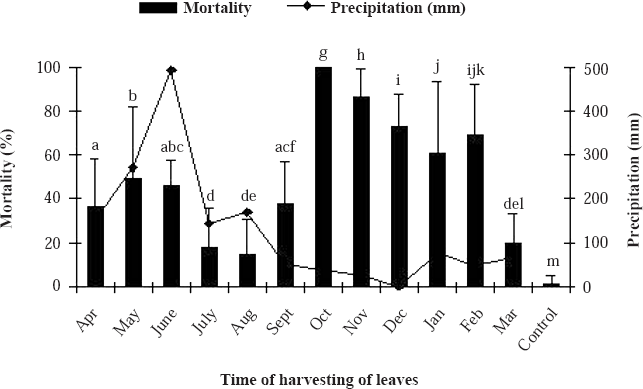
Observed mortalities of Plutella xylostella larvae exposed to kale leaves treated with ethanolic extracts of leaves of Annona muricata collected between the months of April 2002 and March 2003. The levels of precipitation recorded in the field during the months of collection of plant material are shown. Bars labeled with the different lower case letters are significantly different from each other (P ≤ 0.05) as determined by the c2 test.
The yields of ethanolic extracts obtained from leaves of A. muricata over the 12 month collection period are shown in Table 2. There appear to be no association between yields of extracts and larvicidal activity or level of precipitation.
Yields of extracts obtained from leaves of Annona muricata collected during different months of the year.
The influence of the time of collection of plant material on the profile and amount of secondary compounds present has been the subject of a number of studies. Veselá et al. (1999) reported that bark extracts of Taxus baccata L (Taxaceae) collected at various times during 1993 and 1994 exhibited significant variations in the concentrations of five taxanes. These authors concluded that diterpenes were accumulated in highest concentrations in October and in lowest amounts in January. Gu et al. (1999) reported that the evaluation of annonaceous acetogenins varied quantitatively in monthly samples of paw paw (Asimina triloba). They observed that the concentrations of the three major and most active annonaceous acetogenins, bullatacin, asimicin and trilobacin increased significantly in May and June. Other workers have also shown that the seasonal variation in bioactive products can give rise to alterations in the biological activity of plant material (Elsohly et al. 1997; Park et al. 1998; Dorn 2003).
The seasonal variation in the insecticidal activity of the leaves of A. muricata revealed in the present study probably reflects a significant variation in the accumulation of secondary compounds during the different seasons of the year. Further studies need to be carried out, however, in order to determine the role of climate change on the accumulation of these metabolites. In practical terms, the uniformly high larvicidal activities exhibited by the leaves during the dry season suggest that the most advantageous time of the year for the collection of plant material for its insecticidal properties is from October to February. Furthermore, the significant qualitative and quantitative variations in the biological activity exhibited by the leaf material imply important ramifications with respect to the strategy involved in using the plant for the control of the cabbage moth and for future studies concerning the isolation and determination of the active principles.
In common with A. muricata, a number of Annonaceous species contain toxic components that impart powerful insecticidal activity to the plant and indicate their potential use in the control of insect pests. Thus, Prates et al. (1999) reported that extracts of seeds of araticum (A. crassiflora), supplied at a concentration of 10mg.mL-1, were 100% fatal to larvae of the maize pest Spodoptera frugiperda (Smith & Abbot, 1797) (fall armyworm; "largarta-do-cartucho do milho"; Lepidoptera: Noctuidae) within 12 days of hatching. A. squamosa (Annonaceae) has also been shown to possess potentially valuable insecticidal properties (Gritsanapan 1997; Catarino y Ezequiel 1999). Through activity-monitored fractionation of seed extracts of A. squamosa, Londershausen et al. (1991) established that two of the active principles were the acetogenins annonin I and annonacin A.