






Abstract
A synopsis of dolichoderine ants of the genus Technomyrmex Mayr (Hymenoptera: Formicidae) in the New World is offered including notes, keys, pictures of all known species, and the description of T. gorgona
Introduction
Technomyrmex Mayr (Hymenoptera: Formicidae: Dolichoderinae) is a primarily Old World genus with asymmetrical distribution, with most of the species in Africa and southern Asia, and with a discrete faunae also present in Australia and Madagascar. One extant species described from Panama by Wheeler in 1934 is also known. Shattuck (1992a:160) says about this species: “The occurrence of an apparently native species of Technomyrmex in the New World tropics presents an interesting situation because the group is otherwise entirely Old World”. This situation changed with the confirmation of the presence of the genus in Miocene Dominican amber (Brandão et al. 1999; but see below), suggesting an old presence of the genus in the Neotropics with their withdrawal from these areas in modern times and leading to scattered samples in Panama and Costa Rica. This situation is similar in other groups such as Leptomyrmex (Baroni Urbani 1980) and some species Pheidole (Baroni Urbani 1995), with ants also known in Dominican amber but otherwise extinct from New World. Bolton (2007) revised the genus and synonymised T. fulvus sublucidum under T. fulvum, and provided a key to New World extant taxa, including two tramp species (T. difficilis and T. vitiensis in USA), and other two tramp species (not known in New World) potentially to be introduced (T. albipes and T. pallipes).
Ants sorted by one of us (RJG) from the collections of the Instituto Humboldt (IAvH) and Instituto de Ciencias Naturales (ICN) permitted us to confirm the presence of Technomyrmex as native and extant in the Neotropics. Being T. fulvus found in Colombia and a new species, the genus belongs to the humid low rain forest of south western Colombia.
Materials and Methods
Checklist of New World species of Technomyrmex
(For diagnosis, taxonomic history and other notes see Bolton (2007); the asterisk indicates extinct species).
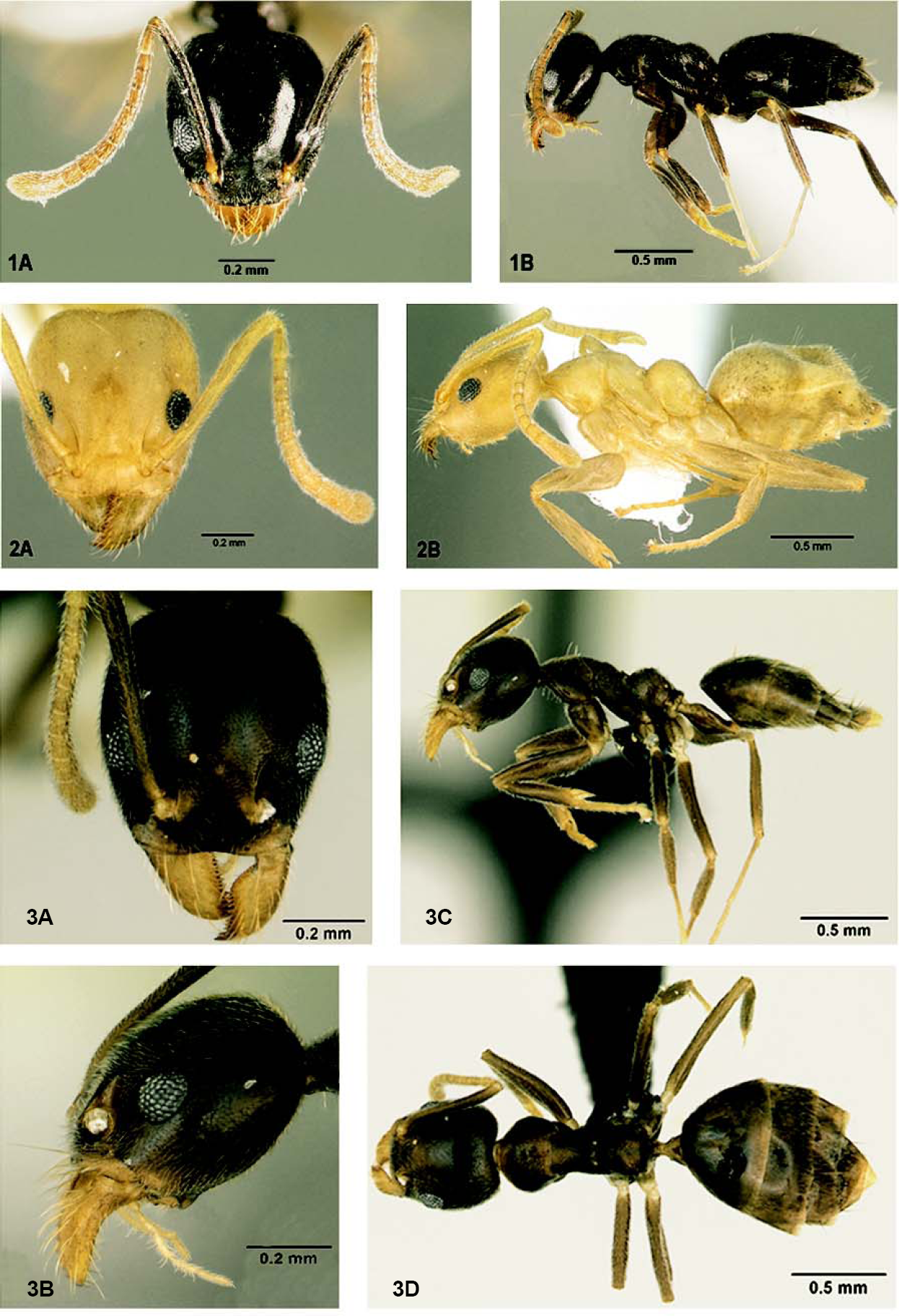
Technomyrmex difficilis Forel, 1892 (Fig. 1)
Technomyrmex mayri difficilis: Forel 1892:242 (w).
Technomyrmex difficilis: Bolton 2007:47.
This species is separated from others in the New World by morphological traits such as dorsum of head behind posterior margin of eye with a single pair of setae and tarsus of hind leg distinctly lighter than the tibia. It is a tramp species detected in at the zoo in Washington and outdoors in Florida and Puerto Rico (Bolton 2007 and personal communication).
Technomyrmex fulvus (W. M. Wheeler, 1934) (Fig. 2)
Tapinoma fulvum Wheeler, W. M. 1934:184 (w).
Tapinoma fulvum sublucidum Wheeler, W. M. 1934:185. Synonymy in Bolton, 2007.
Technomyrmex fulvum: Shattuck 1992a:161.
Technomyrmex fulvum sublucidum: Shattuck 1992a:161.
This was the only extant native species of Technomyrmex in the New World known previously from Panama (Shattuck 1992a; Bolton 1995) and Costa Rica (Bolton 2007). Its uniform yellow body color immediately distinguishes it from any other native or tramp species that are likely to be encountered in the Nearctic and Neotropical regions. The Chocó record is the first for Colombia and South America for the genus and species.
Technomyrmex gorgona sp. n. (Fig. 3)
Worker measurements. Holotype (Paratypes, N= 2): TL 3.17 (3.27 – 3.32), HL 0.69 (0.66 – 0.67), HW 0.68 (0.65 – 0.66), SL 0.72 (0.71), PW 0.46 (0.45 – 0.46), WL 0.95 (0.97 - 0.99), CI 99 (98 – 99), SI 104 (106 – 108), ΟΙ 32 (36), ΕΡΙ 56 (55 – 56), DTI 125 (124 – 127).
Head in full-face view with the posterior margin feebly concave in the middle. Outer margin of eye very close to the side of the head. Anterior clypeal margin with median concavity. Mesonotum in profile shallowly convex anteriorly and with a steeply sloping declivitous face that extends down to the tuberculiform metathoracic spiracle. Propodeal dorsum convex in profile; dorsum rounded evenly into declivity. Body smooth and shining, except for a fine reticulation in the posterior half of pronotum, dense and fine punctuation on the dorsum and sides (mesopleuron) of mesonotum and dorsum of propodeum. Head dorsum in profile entirely lacks setae behind the level of the posterior margin of the eye; dorsum of head with numerous very short spaced erect and suberect setae (less than 0.50 × the maximum diameter of the eye), numerous suberect (0.03 mm) setae between the torulus and the level of the midlength of the eye, anterior clypeus with four hairs, about 0.13 mm each long; pronotum with 2 pairs of long setae, arising from very well-marked pits; Gastral tergites 1 - 4 each with 2 - 4 very long erect setae. Short pubescence on scapes and dorsal (outer) surfaces of middle and hind tibiae usually almost appressed, but slightly elevated in some. Body dark brown. Head and body brown, scape apex, flagellomeres and mandibles lighter.
Material examined: Holotype worker: COLOMBIA. Cauca. Gorgona Island National Park. 02°58′N 78°11′W. 180 m. 01-mar-04-abr-2000. Sharkey, M. [IAvH]. Paratype workers (2 workers): Same data, deposited in ICN, CAS.
Etymology: The name gorgona refers to the Gorgona National Park, and is given as a noun in apposition.
Comments and diagnosis. This is the second extant species of Technomyrmex native to the New World is restricted to Gorgona National Park, Cauca, Colombia, a small continental Island in the Pacific Ocean. Its dark brown color, heavy fine punctuation on the mesonotum and dorsum of propodeum distinguishes it from T. fulvus, the first native species.
Technomyrmex vitiensis Mann, 1921 (Fig. 4)
Technomyrmex albipes vitiensis Mann, 1921:473 (w). Junior synonym of albipes: Wilson and Taylor 1967:82.
Technomyrmex vitiensis: Bolton 2007:104.
California, USA (Bolton 2007)
Tramp species potentially present in the New World
In the key to New World species of Technomyrmex presented below, Bolton (2007) added T. albipes and T. pallipes as two tramp species, inhabiting hothouses in the Palaearctic Region and potentially introduced to New World (as T. difficilis and T. vitiensis). We include pictures of both species.
Tramp species, in hothouses, Palaearctic, potentially to be imported to the New World.
Tramp species, in hothouses, Palaearctic, potentially to be imported to the New World.
Technomyrmex spp.:
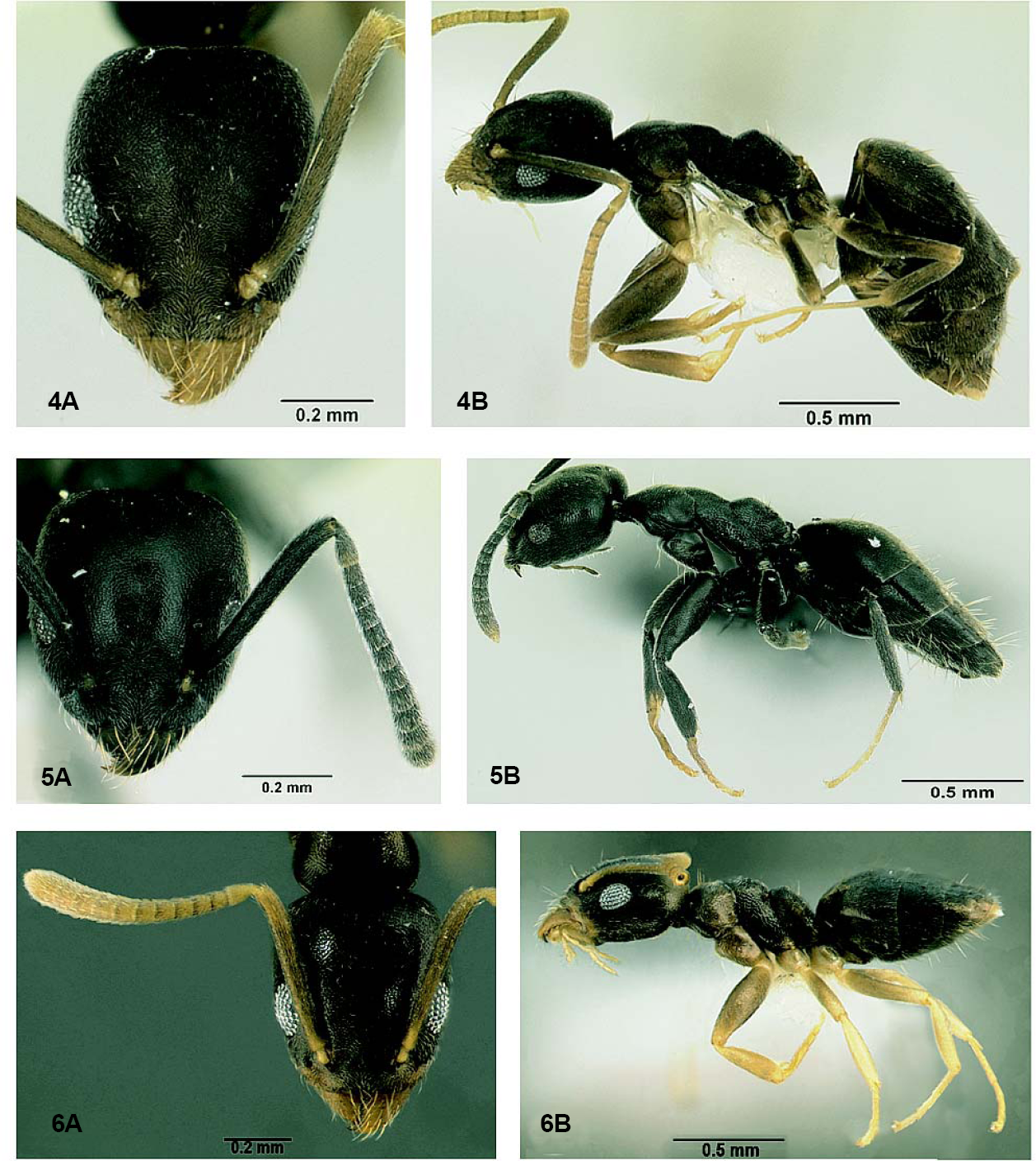
Technomyrmex spp.:
Fossil species ascribed to Technomyrmex
There are two dolichoderine species described from Dominican amber that are ascribed to Technomyrmex (Brandão et al. 1999). However, Bolton (2007:122) points out that both species “lack some critical diagnostic characters of the genus, the absence of which would argue for their exclusion”. Bolton also questioned the classification of T. hispaniolae in Iridomyrmex or Linepithema, leaving both taxa as incertae sedis in Technomyrmex.
* Technomyrmex caritatis Brandão & Baroni Urbani, 1999
Technomyrmex caritatis Brandão & Baroni Urbani 1999:416 (w) (Figs. 1, 4-6) in Brandão et al. 1999.
This extinct species is characterized by long scape, two pairs of setae on clypeus (none central), one pair of long setae on vertex, none on mesosoma. Described from Dominican amber.
* Technomyrmex hispaniolae (Wilson, 1985)
Iridomyrmex hispaniolae Wilson, 1985:33 (w) (Fig. 10).
Linepithema hispaniolae: Shattuck 1992b:16.
Technomyrmex hispaniolae: Brandão et al. 1999:414 (Figs. 2-3).
This extinct species is characterized by long scape, metanotum longitudinally striate, petiole very long and slender and the presence of one pair of long setae on vertex. This species has been described from Dominican amber fragments.
Key to the extant Technomyrmex workers from the New World (from Bolton 2007)
1 Dorsum behind the level of the posterior margin of the eye without setae (head in profile view) (Fig. 3B)……………… 2
Dorsum behind the level of the posterior margin of the eye with one or two pairs of setae (head in profile view) (Fig. 6B)……………… 5
2 Head, mesosoma, petiole, gaster, and leg segments entirely yellow to light brownish yellow (Figs. 2A, B); middle and hind coxae may be slightly lighter in shade than the mesosoma; Costa Rica, Panama, and Colombia…………….. T. fulvus
Head, mesosoma, petiole and gaster brown to black; colour may be more or less uniform or slightly different on separate tagmata, but never entirely yellow; middle and hind coxae the same colour as the mesosoma to distinctly lighter…………….. 3
3 Mesonotum, mesopleuron, and most of propodeal dorsum with dense and fine puncturation (Fig. 3C); propodeal spiracles protruding (Fig. 3D); SW Colombia …………….T. gorgona sp. n.
Mesosoma without dense fine puncturation; propodeal spiracles not protruding; tramp species, California (USA) and West Palaearctic …………….. 4
4 Scape relatively short and promesonotum relatively short and broad, SI 91 - 102, DTI 110 - 124; eye somewhat smaller, OI 24 - 27; with mesosoma in absolute profile, the mesonotal dorsal outline convex more or less evenly rounded (Fig. 5B); in same view the junction of the propodeal dorsum and declivity is blunt; tramp species, no New World records but very widespread and occurs in West Palaearctic hothouses ……..T. albipes
Scape relatively long and promesonotum relatively long and narrow, SI 104 - 115, DTI 128 - 141; eye somewhat larger, OΙ 29 - 32; with mesosoma in absolute profile the mesonotal dorsal outline with a more or less flat anterior section that passes through an obtuse angle to a distinctly more strongly sloped posterior declivity (Fig. 4B); in same view the junction of the propodeal dorsum and declivity sharply defined; tramp species, California (hothouses), USA ……..T. vitiensis
5 Hind leg tarsus distinctly lighter in colour than the tibia; dorsum of head behind level of posterior margin of eye with a single pair of setae, located about two-thirds the way between the level of the posterior margin of the eye and the posterior margin of the head (Fig. 1B); eyes located somewhat more posteriorly, EPI 72 - 86; tramp species; Florida (outdoors and in houses), Washington (zoo), Puerto Rico, Antigua, Nevis…………….. T. difficilis
Hind leg tarsus of the same colour as the tibia; dorsum of head behind level of posterior margin of eye with two pairs of very short, stubbly setae; first pair located about two-thirds the way between the level of the posterior margin of the eye and the posterior margin of the head; second pair at the posterior margin (Fig. 6B); eyes located somewhat more anteriorly, EPI 55 - 71; tramp species, no New World records, occurs in West Palaearctic hothouses …….. T. pallipes
Discussion
Initially seen as an biogeographic anomaly (Shattuck 1992a), the finding of two extinct species in Dominican amber (Brandão et al. 1999), and the new species described here, confirms the native status of Technomyrmex in the New World. T. fulvus was previously known only from Barro Colorado Island, Panama, until the recent discovery of scattered samples from tropical rain forests in Costa Rica (Bolton 2007) that proves their status as native (not imported) species to the Neotropics. The identification of Technomyrmex is not easy, because of the subtle traits that characterize this genus (as others in the subfamily, Shattuck 1992a), which opens the possibility that many other samples from collections may be awaiting discovery in other countries. This situation is similar to that of the genus Paedalgus (now junior synonym of Carebara), until recently known to be confined to Old World, but now reported from several native species from Costa Rica to Brazil. Dubovikoff and Longino (2004) also described a new species of the other Old World element, Bothriomyrmex, from the tropical rain forest in Costa Rica.
Technomyrmex and Bothriomyrmex could represent those groups probably widespread in the past and now limited to some scattered forested spots in the Neotropical forests, probably as retreating lineages. Leptomyrmex, also present in Miocene times were extinct in the New World, as some others ants taxa (Wilson 1988). Curators and ant collectors must be aware of the presence of interesting genera awaiting to be discovered and published; these must enrich the understanding of the evolution and the biogeography of the Neotropical ants.
Footnotes
Acknowledgements
To Mónica Ospina and Diego Perico (Instituto Humboldt), Carlos Sarmiento (ICN) for the loan of material, and Brian L. Fisher for the permission of the use of excellent colour pictures. Brian Fisher and April Nobile take the pictures of T. fulvus and T. gorgona sp. n. Thanks to Barry Bolton for advice and providing information from the revision of Technomyrmex and to help us with English writing. Julio Valle (University of Magdalena) edited pictures. This work was supported by Jóvenes Investigadores Program of Colciencias -University of Magdalena agreement # 122 to RJGF and partially supported by NSF Grant No. DEB No. 9972024 to M. Sharkey (University of Kentucky) and Brian Brown (LACM). Thanks also to Dr. Mike Sharkey for reading and improving the MS.